Tiger Research: An Industry That Quadrupled in a Year—What's the Next Trend in Crypto?


- Core Viewpoint: The digital asset custody market is evolving from passive safekeeping toward active trust services. Custody scale is merely the entry threshold; whether firms can layer on high-value-added services such as stablecoin issuance, investment advisory, and asset management will determine the industry landscape in the next phase.
- Key Elements:
- Under Europe's MiCA framework, compliant custody institutions grew from 50 to 230 within a year, a more than fourfold increase; RWA scale grew 85% to approximately $39.8 billion, and stablecoin market capitalization surpassed $300 billion.
- Pure custody charges proportional fees based on assets under custody, capping revenue potential; trust services grant trustees discretionary management and investment decision-making authority over assets, along with fiduciary obligations.
- Traditional finance history repeats itself: safe deposit companies expanded from physical safekeeping to estate and bond collateral trusts, while State Street extended from fund custody to index management and ETF trustee services.
- Anchorage and BitGo have obtained nationwide trust bank charters in the U.S. and are expanding into stablecoin issuance and clearing and settlement; Agora and Catena have received conditional preliminary approval from the OCC, positioning themselves in investment advisory and active asset management.
- Client demand has shifted from static token holding to asset activation—for example, using tokenized U.S. Treasuries as collateral to borrow stablecoins and deploy them into on-chain strategies—requiring custodians to possess clearing and settlement capabilities and dynamic collateral management.
- If traditional financial institutions delay in building crypto risk control frameworks, the professional knowledge gap will continue to widen; institutions that establish on-chain asset management track records early will gain asymmetric advantages.
Key Takeaways
- This article is from Tiger Research. The digital asset custody market has grown rapidly over the past year, with the number of compliant custodians under Europe's MiCA framework increasing more than fourfold, from 50 to 230.
- Custody businesses primarily charge fees proportional to the scale of assets held, a model that caps their revenue ceiling; trust services, which grant institutions the authority to directly manage and invest such assets, are becoming the core direction of the next phase of evolution.
- Looking back at the history of traditional finance, safe deposit companies initially expanded from simple safekeeping into estate management and bond collateral management, and State Street later leapt from fund asset custody to active investment management; this classic evolutionary trajectory is being fully replayed in the digital asset space.
- Anchorage and BitGo are expanding into stablecoin issuance and clearing and settlement, while Agora and Catena are going all-in on investment advisory and asset management; all four institutions have obtained or are applying for nationwide trust bank charters to broaden their business boundaries.
- In the future, the core competitiveness of custodians will no longer depend solely on the scale of assets under custody they control, but increasingly on the depth of value-added financial services they can provide to clients.
The Rapid Growth of the Crypto Custody Industry Over the Past Year
A year ago, Tiger Research noted in its report "The Custody Industry Growth You May Have Overlooked" that custody services are the core foundation of the entire digital asset industry. At the time, however, custody services focused on holding and securely managing assets had not attracted sufficient market attention.
Over the past year, the number of enterprises flooding into the crypto custody market has surged dramatically. In Europe, the number of compliant custodians licensed under MiCA (Markets in Crypto-Assets), the EU's comprehensive crypto regulatory framework, has more than quadrupled, soaring from an initial 50 to 230.
Meanwhile, major traditional financial institutions worldwide have also been deploying heavily: Standard Chartered made a major push through the acquisition of a specialized custodian, and Citigroup has publicly announced it will officially launch its dedicated custody business within the year.
This dramatic shift directly reflects the continued expansion of on-chain asset scale. According to RWA.xyz data, in this year alone, the scale of tokenized real-world assets (RWA) surged 85%, climbing to approximately $39.8 billion.
The total market capitalization of stablecoins grew by more than 50% within 2025 alone, crossing the $300 billion mark in one leap and remaining near that level ever since. Since both tokenized assets and stablecoins mandate that underlying assets be placed under compliant custody, custody demand has naturally risen accordingly.
However, institutions are by no means rushing in merely to grab a share of the basic custody business. Pure custody revenue comes primarily from proportional fees levied on assets under custody, which severely limits the business ceiling.
As a result, forward-looking institutions are using their existing custody client relationships as a springboard to accelerate their expansion into trust services to substantially boost profitability.
In the short term, institutions are focusing on custody to capture surging compliance demand; in the medium and long term, they are using it as a foundation from which to leap into higher-value-added business territories such as trust services.
Custody vs. Trust Services: From Asset Safekeeping to Asset Management

Figure: A comprehensive comparison of the core dimensions of custody and trust services
Custody and trust services are often conflated by outsiders. Although both involve holding client assets, the legal responsibilities and business substance assumed by the service provider differ vastly.
Custody is a basic service that involves securely holding assets on behalf of clients. Clients always retain legal ownership of the assets, and the custodian's role is strictly limited to safekeeping and transferring assets per instruction.
By contrast, in a trust structure, the settlor (client) transfers ownership of the assets to the trustee (trust company), which then independently manages, invests, and distributes the assets in accordance with the specific purpose for which the trust was established.
Any income generated by these assets accrues in full to the beneficiaries designated by the settlor. The trust company operates in a manner very similar to a trustee managing family wealth: responsible for investment growth and distributing returns to family members at agreed-upon milestones.
Because trust companies can make independent management and investment decisions regarding the underlying assets, they legally bear a fiduciary duty to place beneficiaries' interests first.
In short, although both involve holding client assets, custody focuses on passive safekeeping, while trust services focus on active asset management and investment operations.
The Replay of Historical Cycles: From Asset Safekeeping to Trust Services
To date, the vast majority of digital asset custody services still focus their core efforts on the secure storage of assets. In the industry's early stages, custody demand arose primarily from spot and futures trading, scenarios that did not require complex asset management structures.
However, as financial products based on real-world assets (RWA) become increasingly prevalent, simple secure storage alone can no longer meet the market's urgent demand for deeper trust functions such as yield generation and collateral liquidation.
This evolutionary process closely mirrors the trajectory of traditional financial history. During the American Civil War, the U.S. government began issuing government bonds on a large scale, driving a sharp increase in the number of ordinary individual investors holding securities.
To safely store these bonds, investors began renting safe deposit boxes, giving rise to the early boom of specialized safe deposit companies. However, as client asset scales and needs became increasingly diverse, simple physical safekeeping quickly hit its ceiling, propelling these companies to expand comprehensively into trust services.
The Evolution of Safe Deposit Companies: From Physical Safekeeping to Estate and Collateral Management

Figure: Traditional safe deposit companies expanding individual and corporate client service pathways through trust functions
The safe deposit companies of Boston and Rochester are classic examples of traditional finance successfully pivoting from safekeeping into the trust domain. As clients' wealth pain points extended beyond mere safekeeping, these companies naturally expanded their service scope.
For individual clients, the core pain point was asset inheritance. When a client passed away, securities held in safe deposit boxes often faced lengthy estate disputes or management vacuums.
To solve this problem, safe deposit companies established trust structures to act as trustee of the deceased's estate, distributing income through investment operations to the surviving spouse on a regular basis for life, and transferring the full principal to the next generation of children upon the spouse's passing.
For corporate clients, the core pain point was bond collateral management. When companies issued bonds for financing, they had to place corresponding collateral assets with a neutral third party and protect bondholders' legal rights in the event of default.
In 1883, the Boston Safe Deposit Company formally served as trustee for the bond collateral of the American Rapid Telegraph Company. This was an important milestone in the history of traditional finance when a safe deposit company expanded into corporate trust functions.
These historical cases demonstrate that safe deposit companies gradually forged themselves into modern trust banks by layering legal trust functions on top of their existing safekeeping business.
Since clients already trusted these institutions deeply and were willing to entrust them with asset safekeeping, they were naturally more inclined to authorize them to continue managing those assets. This also points to a breakthrough path for today's digital asset custodians: solving clients' unaddressed deeper financial needs.
The State Street Paradigm: From Fund Asset Custody to Active Asset Management

Figure: State Street's evolution from fund custody to index management and ETF trustee business
State Street serves as the industry benchmark for moving from pure fund asset custody to direct active investment management.
By combining asset custody and asset management into one, State Street was able to deliver comprehensive financial services to clients. Institutional clients who had originally entrusted it merely with safekeeping began confidently delegating assets to State Street for professional investment operations.
State Street's initial asset management business likewise grew out of the core capabilities it had accumulated through its day-to-day custody operations. Having long been responsible for fund valuation, accounting, and bookkeeping, State Street developed exceptionally precise hands-on experience in handling portfolios tracking market indices.
Leveraging this advantage, State Street established a dedicated index management division for institutional investors in 1978, formally kicking off its active asset management business.
Subsequently, State Street continued to broaden its product audience. In 1993, State Street partnered with the American Stock Exchange to launch SPY, the world's first exchange-traded fund tracking the S&P 500 index, and personally served as trustee.
State Street fully leveraged the deep technical barriers it had accumulated in trade clearing, interbank settlement, and fund valuation through its daily custody work to build an operational moat that traditional asset management giants found hard to match.
Today's digital asset custodians can likewise follow this paradigm: mining from the on-chain assets they hold and the client ecosystems they serve deeply to discover the next phase's most explosive asset management business loop.
How Digital Asset Custodians Can Cross Over into Trust Services
Current digital asset custodians are accelerating their departure from the simple private key safekeeping framework and advancing comprehensively into integrated trust businesses.
The most representative pioneers among them are Anchorage, BitGo, Agora, and Catena. The former two are actively moving into stablecoin issuance and clearing and settlement channels, while the latter two are focusing entirely on investment advisory and active asset management.
More critically, all four institutions have formally obtained or are actively applying for nationwide trust bank charters issued by the U.S. Office of the Comptroller of the Currency (OCC), using these as the core compliance lever to broaden their business scope.
Anchorage and BitGo: Layering Bank-Grade Financial Services on a Custody Foundation

Figure: The bank-grade value-added business matrix Anchorage and BitGo have expanded through national trust bank charters
Historically, safe deposit companies transformed from physical safekeeping into trust banks by leveraging trust charters. In today's digital asset space, Anchorage and BitGo are evolving along an almost identical trajectory.
Both institutions have obtained nationwide legal charters to provide both trust and custody services: Anchorage was the first to reorganize as a national trust bank as early as January 2021, and BitGo also achieved a substantive breakthrough in obtaining a nationwide trust bank charter in December 2025.
Leveraging their national trust bank compliance qualifications, their business matrices have expanded from initial Bitcoin and Ethereum products for institutional clients to comprehensively encompass real-world assets (RWA) and the stablecoin ecosystem.
Today, their competitors are no longer limited to other crypto-native custodians. With trust charters, they can compete directly with major traditional Wall Street banks in areas such as stablecoin issuance, block trade settlement, staking yield distribution, and on-chain collateral custody.
As Bitcoin spot ETFs, tokenized RWA assets, and stablecoin scale grow exponentially, institutional clients' demand for large-value secure settlement and on-chain staking yields is also rising geometrically.
The asset scale and compliance reputation these two institutions have accumulated are already sufficient to directly intercept potential client flows from traditional commercial banks in core digital asset areas. Their greatest moat lies in the hundreds of top-tier institutional clients they have deeply bound, as well as the native on-chain settlement and risk control experience they have accumulated over the years.
By the time traditional commercial banks fully clear internal compliance obstacles and formally enter the market at scale, Anchorage and BitGo may well have already firmly established an unshakeable industry leadership position within the nationwide trust bank framework.
Just as the safe deposit companies of yesteryear ultimately transformed into modern commercial banking giants, these two institutions are progressively growing into a new generation of global-scale banks for the digital age, using trust services as their springboard.
Agora and Catena: From Asset Holding to Active Asset Management
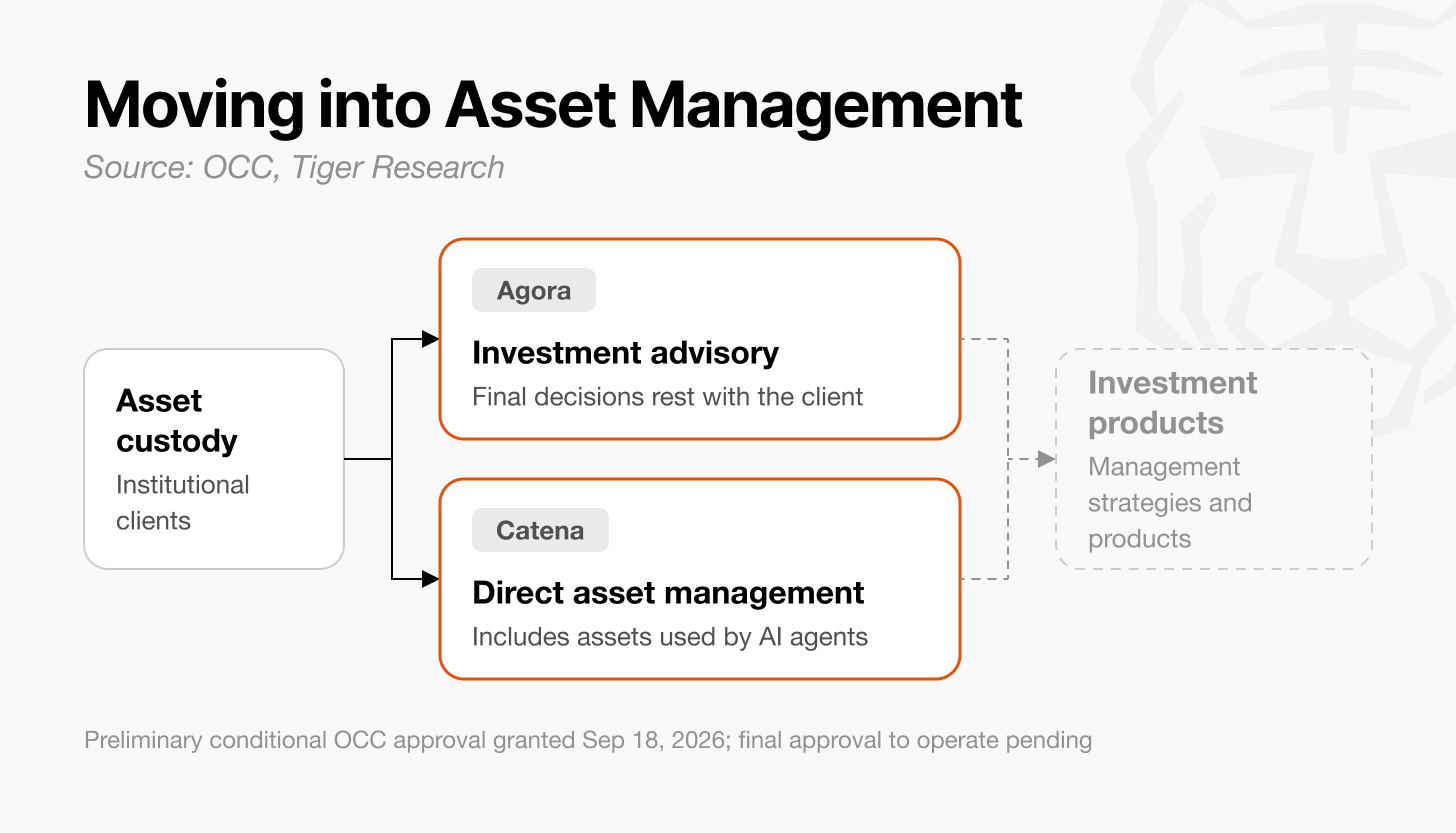
Figure: Agora and Catena expanding into investment advisory and direct asset management through trust structures
State Street once extended the capabilities it had accumulated in fund asset custody into asset management, ultimately building a global ETF powerhouse; Agora and Catena are now attempting to replicate this legendary path in the digital asset space.
On September 18, 2026, both Agora and Catena received conditional preliminary approval from the U.S. Office of the Comptroller of the Currency (OCC) to establish nationwide trust banks.
Currently, the investment advisory and active asset management businesses both institutions plan to conduct under their trust bank charters are in intensive preparatory stages, awaiting final full operating approval.
Once formally approved, Agora plans to comprehensively provide institutional clients with on-chain investment opportunity assessment and yield generation advisory, with final buy and sell decisions remaining in clients' hands.
Catena goes a step further, planning to conduct direct asset management business under the nationwide trust bank structure. Its asset management scope will cover not only traditional institutional capital but also, proactively, on-chain digital assets allocated and used by autonomous AI agents.
Their early positioning is of critical strategic significance. In the digital asset management field, deep understanding of the underlying on-chain ecosystem and hands-on refinement of quantitative risk control models often require years of accumulation.
In complex and intricate DeFi protocols, capturing excess returns through asset lending, liquidity market making, and multi-protocol composability operates on technical mechanisms entirely different from those of traditional financial markets.
If traditional financial institutions are slow to build comprehensive crypto risk management frameworks, this professional knowledge gap will only widen further over time.
If Agora and Catena can establish an indisputable on-chain asset management track record ahead of traditional financial institutions and subsequently launch low-threshold compliant products for ordinary investors, they have every opportunity to grow into a new on-chain force comparable to traditional Wall Street asset management giants.
Custody Has Become the Baseline: Preparing for the Next Round of Industry Evolution
Securely holding digital assets remains the fundamental basis on which custodians stand. However, in the future competitive landscape, simple private key secure safekeeping will become merely an entry threshold, and the real deciding factor will be institutions' ability to build value-added services atop the custody foundation.
As DeFi and RWA markets continue to converge, institutional clients' demands are no longer satisfied with simply leaving tokens idle in cold wallets; they want to deploy assets into investments, use them as financing collateral, or circulate them efficiently at any time.
Take tokenized U.S. Treasury funds as an example: investors today seek far more than basic interest. They want to use Treasury tokens as collateral to borrow stablecoins and deploy the borrowed stablecoins into other on-chain arbit