Binance Withstands $7B Net Outflow in 24 Hours: Withdrawal Wave Contained, Most Institutions Hold Steady


- Key Takeaways: After suffering the largest crypto theft in history, Binance restored withdrawals in phases within two days, covering losses with ample proprietary capital and reserve funds. Market reaction was far calmer than during the FTX incident, with institutions broadly acknowledging Binance's solvency and liquidity advantages.
- Key Facts:
- On October 30, Binance's hot wallet was hacked for $6.3 billion; starting at 15:00 on November 1, withdrawals resumed in phases. In the first 9 hours, $4.649 billion in withdrawals were processed, with a net outflow of approximately $3.64 billion—just 2.1% of total assets of $171 billion.
- In the 24 hours after withdrawals resumed, net outflow reached $7.034 billion, but the top 9 exchanges by reserves recorded a combined net inflow of approximately $750 million, indicating no large-scale migration of user assets.
- A new PoR snapshot was completed on October 31, with all major asset reserve ratios at or above 100%; approximately 95% of affected assets had already been replenished before the hack.
- Losses were covered by three sources: the company's own capital, the SAFU fund, and the futures insurance fund. SAFU allocated 7,499 BTC (approximately 50% of its assets), with a commitment to replenish it back to approximately $1 billion afterward. User losses are not borne by users.
- Yi He stated that annual revenue is sufficient to cover the theft losses; CZ and Musk had a public dispute over SPCX stock holdings, with CZ clarifying there was no intent to threaten a sell-off.
- Institutional reaction was measured: Dragonfly, Laevitas, Kronos Research, and others believe Binance has ample financial strength, market declines were moderate, some investors bought the dip, and no panic-driven bank run occurred.
Original | Odaily@OdailyChina)
Author | Golem (@web3_golem)

On October 30, Binance's hot wallet was hacked for $6.3 billion, the largest crypto theft in history, drawing worldwide attention. Just two days later, at 15:00 (UTC+8) on November 1, Binance had already begun restoring withdrawals in phases. As the world's largest crypto exchange, Binance has fully demonstrated its speed of response, corporate resilience, and strong concern for users when facing a crisis.
Yesterday, Binance completed the first phase of withdrawal restoration across 15 networks and assets, including major networks such as Bitcoin, the Ethereum mainnet, BSC, and Solana. According to official data, as of 23:30 (UTC+8) that day, within just 9 hours after resuming withdrawals, Binance processed a cumulative $4.649 billion in withdrawals and $1.01 billion in deposits, with a net outflow of approximately $3.64 billion on the first day, accounting for only 2.1% of its total assets under management of $171 billion (snapshot as of October 28).
Binance withstood the withdrawal surge triggered by this security incident. According to the latest DefiLlama data, in the 24 hours after resuming withdrawals, Binance saw a net outflow of $7.034 billion, while the top 9 crypto exchanges by reserves recorded a combined net inflow of approximately $750 million. There was no large-scale migration of Binance user assets to other exchanges. Binance stated that withdrawal volumes were in line with expectations and stabilized after the initial surge.
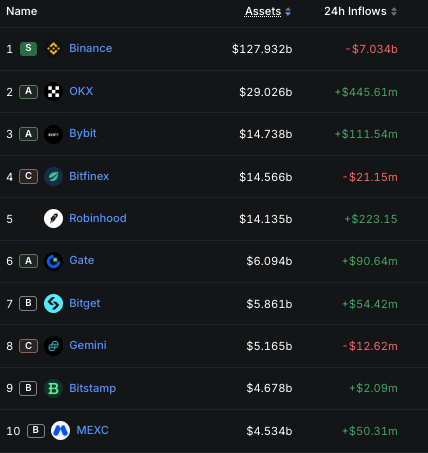
Inflows and outflows of the top 10 crypto exchanges by reserves (Screenshot: November 2, 2026, 15:30)
Annual Revenue Can Cover the Hack Losses; Musk Mocks Binance, Drawing CZ's Displeasure?
Meanwhile, Binance completed a new Proof of Reserves (PoR) snapshot at 8:00 (UTC+8) on October 31. According to the official website, major asset reserve ratios are currently at 100% or above, with the full report expected to be published on November 3.
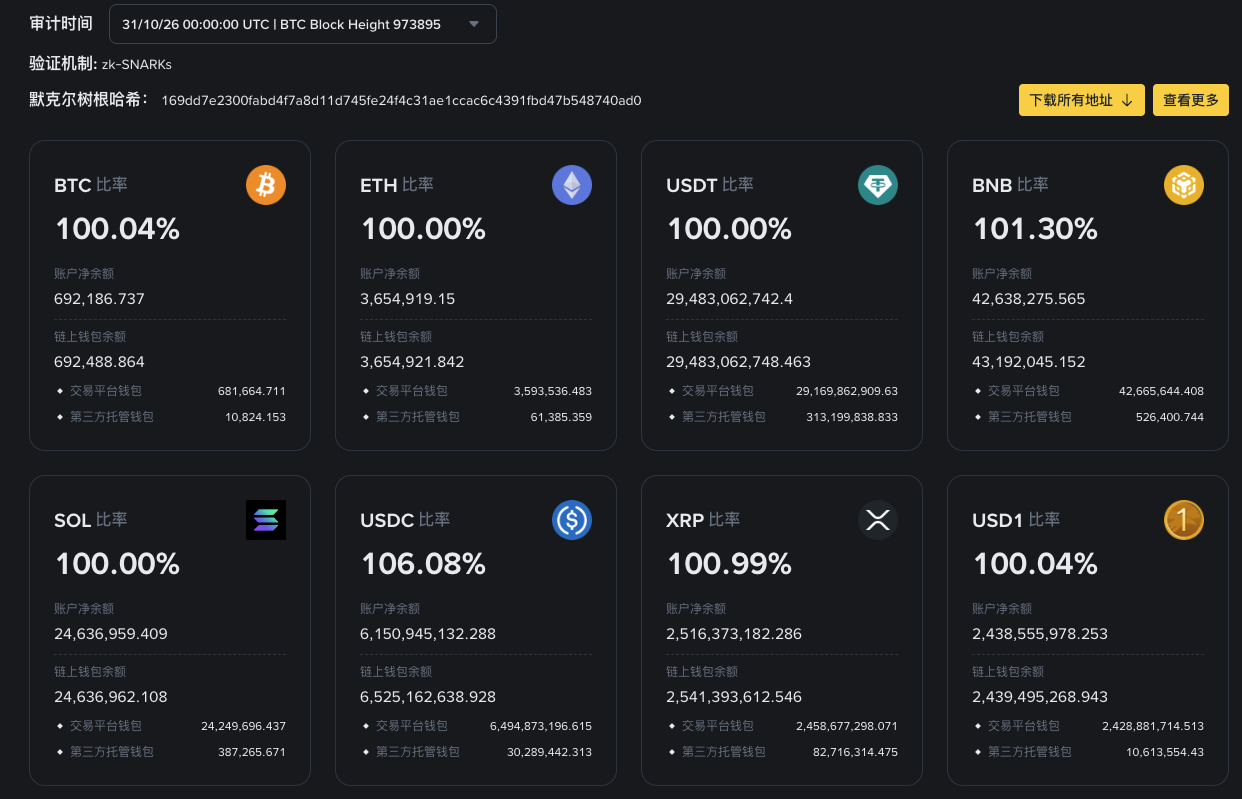
Before resuming withdrawals on November 1, Binance had already replenished approximately 95% of the affected assets, with the remaining 5% consisting of lower-liquidity tokens outside of mainstream coins. To make user withdrawals smoother, Binance has added newly generated wallet addresses to its Proof of Reserves (PoR) address list, and all withdrawal transactions will be processed through these new wallet addresses.
In response to community users who forwarded Whale Alert's report of large Bitcoin transfers from Binance to unknown wallets and claimed that "some whales have already started withdrawing," Binance co-CEO Yi He personally debunked the rumor on X, stating that these were all new Binance PoR addresses.
The stolen funds are mainly being covered by three parts: Binance's own corporate funds, a portion of the User Asset Safety Fund (SAFU), and the contract insurance fund.
SAFU is an emergency protection fund established by Binance, into which Binance allocates a certain percentage of trading fees. Before the hack, the SAFU fund was approximately $1 billion in size. To support smooth user withdrawals, Binance allocated 7,499 BTC from SAFU. Yi He stated that this represented 50% of the assets in the SAFU address, with the other half retained, and promised to restore SAFU to approximately $1 billion afterward. According to on-chain data, the SAFU address still holds 7,500 BTC, worth approximately $580 million.
Overall, the stolen funds are mainly covered by Binance's own corporate funds and insurance fund, with SAFU contributing as an auxiliary portion. User funds are fully covered by Binance, with losses not passed on to users.
CZ Threatened Musk by Threatening to Sell Billions in SPCX Stock?
Nevertheless, the community still has concerns about Binance's solvency, with anxiety even extending to whether Binance would sell its SpaceX shares. Although Yi He posted that Binance's annual revenue is sufficient to cover the hack losses and that there is no need to sell SpaceX shares yet, the community still believes that CZ previously wanted to use this to "threaten" Musk.
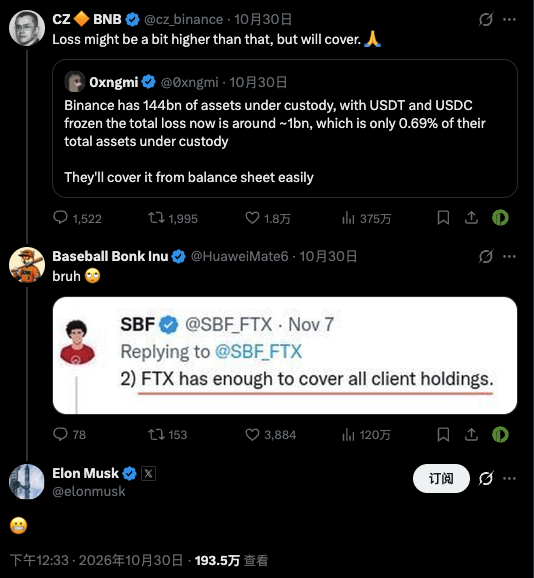
On October 30, CZ posted on X that Binance had sufficient funds to cover the losses caused by this security incident. Musk then replied with an awkward "😬" emoji to a post stating that "SBF also assured the platform had enough funds before FTX collapsed."
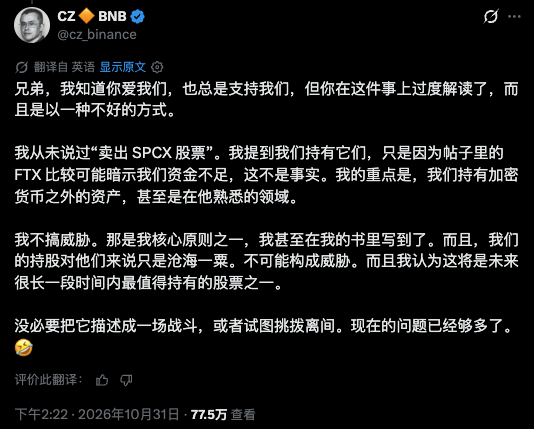
Hours later, CZ posted a reply to Musk stating: "I respect you very much, but now is not the time for jokes. Our SPCX stock (from our $500 million investment in your acquisition of Twitter) is now worth over a billion dollars. If you could show a little support, I would be very grateful."
Musk made no further comment, but the community began to over-interpret, believing that CZ was using his early SpaceX investor status or the threat of selling billions of dollars in SPCX to pressure Musk into retracting his mockery of Binance.
Faced with increasing secondary spread, CZ had to post again to explain and urge the community to stop over-interpreting, stating that he never said he would sell SPCX stock and had no intention of threatening Musk, and that the SPCX holdings are just a drop in the bucket for Musk.
After the Crisis: How Institutions Respond
After this security incident, discussions also emerged in the market about "whether to withdraw funds from Binance." However, most institutions are not panicking, believing that Binance has ample financial strength and that a panic-driven bank run will not occur.
Dragonfly Managing Partner Haseeb Qureshi believes that the market's reaction to Binance's security incident was far calmer than after the FTX incident, with some investors even buying the dip. Laevitas analyst Rick Maeda stated that BNB's price decline after the incident was relatively mild, and considering this was the largest exchange theft in history, it reflects the market's recognition of Binance's custody scale and its ability to backstop losses.
Kronos Research Chief Investment Officer Vincent Liu also stated he would not withdraw funds, saying "Binance is the most liquid platform; if you want to trade or hedge crypto, you have to do it on Binance. There may be some withdrawals, but I also think many people will return as liquidity recovers."
Quantitative trading firm SQS Trading has about a quarter of its trading capital on Binance and is planning to reduce that proportion by about one-third. Founder Eli Williams said the firm has not fully closed positions and will not reduce its use of Binance as a hedging venue. "It's hard to predict what the net impact will be right now, but we will closely monitor capital outflows and trading volume relative to other exchanges."
Some institutions have chosen to stay put. Justin d'Anethan, Head of Research at private market advisory firm Arctic Digital, believes that acting quickly is good if things look suspicious, but in the event of a catastrophic incident, it's best to stay put. "I have not and will not leave Binance," he added.