From Binance to PHP2Shell: In the AI Era, Web Security's Defense Lines Urgently Need Redefinition


- Core Viewpoint: Recent major security incidents at Bybit, Bitget, and Binance in succession show that attackers no longer directly crack private keys, but instead penetrate the entire "trust chain"—including employee endpoints, third-party products, and software supply chains—with AI significantly amplifying this structural risk.
- Key Elements:
- The Binance incident involved up to $6.3 billion in impact, with approximately $3 billion in assets jointly frozen; the attack path is suspected to have begun with the compromise of a DevOps engineer's laptop.
- Over the past year, security incidents at top exchanges have been密集: Bybit approximately $1.46 billion, Bitget approximately $387.5 million, with attack entry points being third-party wallet infrastructure, third-party security products, and internal operations environments, respectively.
- The PHP core engine exposed a high-severity vulnerability (CVSS 9.2) that had lain dormant for over a decade, threatening more than 22.6 million to 36.7 million public-facing instances globally, and the vulnerability was discovered with the aid of AI.
- Vitalik proposed that AI has industrialized zero-day vulnerability discovery, extremely compressed the patch time window, and intensified the structural asymmetry between offense and defense.
- Vitalik advocates restructuring software construction through formal verification (mathematically proving code security) and minimizing the trusted computing base (converging core authorization boundaries).
- d/acc (defensive accelerationism) emphasizes prioritizing the development of defense technologies across four dimensions—network, biological, physical, and information—and recommends allocating over 1% of GDP toward security hardening.
On the morning of October 30, the crypto market was hit—yet again—by a historic token theft incident, and this time it was Binance's turn.
According to a preliminary investigation, the attacker may have gained access to a service container by compromising the laptop of a DevOps engineer and then submitted unauthorized withdrawal transactions. Binance officially estimates the total impact of the incident at as much as $6.3 billion, and roughly $3 billion in related assets has now been jointly frozen.
Looking back, over the past year, security incidents at top-tier exchanges have become frequent enough to feel almost numbing:
Last year Bybit suffered the theft of approximately $1.46 billion in assets; in September this year, Bitget had about $387.5 million in assets transferred without authorization; and now even Binance has been drawn into a new crisis.
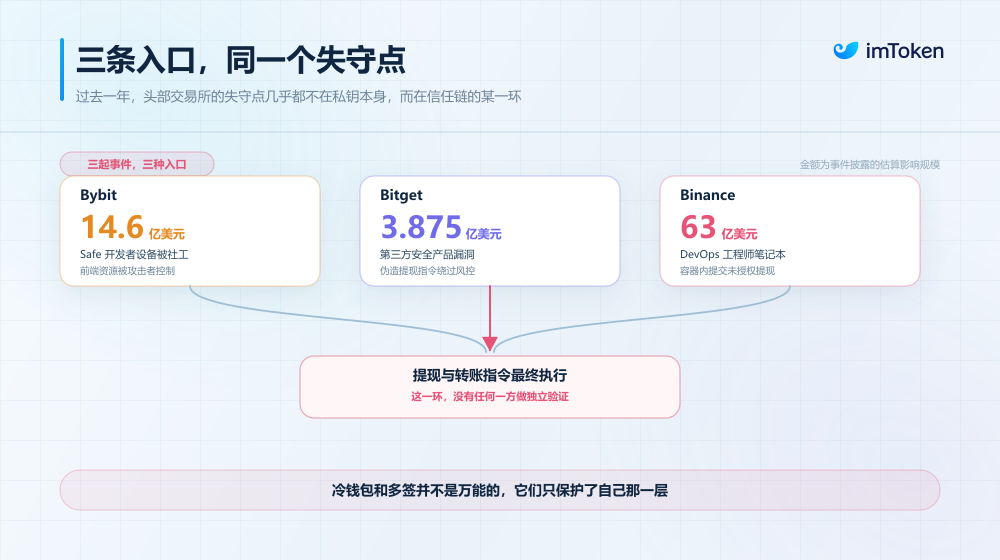
If we look at these recent security incidents together, an obvious trend emerges: attackers are increasingly less inclined to directly take on cryptography and private keys themselves, and are instead focusing on the entire "chain of trust"—from employee endpoints and third-party security products to the software supply chain, service containers, and even transaction authorization processes. If a crack appears in any one link, the entire line of defense can fall.
The rapid development of AI is further amplifying this risk.
On October 22, Ethereum co-founder Vitalik Buterin offered a new assessment: in the AI era, the endgame of cybersecurity may favor defenders, but the transition period leading to that endgame will be extremely difficult.
1. From Bybit to PHP2Shell: Attackers Are Piercing the Entire Chain of Trust
Let's review these incidents first.
Their attack paths were not the same, but they share one thing in common: the attackers did not simply rely on cracking private keys or breaking the underlying blockchain protocols. Instead, they found a link in the system that was trusted by default.
- In the Bybit incident, the attacker used social engineering to compromise the device of a Safe developer, obtained the relevant access credentials, and then took control of front-end resources in Safe's wallet infrastructure;
- In the Bitget incident, the attacker exploited a vulnerability in a third-party security product to obtain internal high-privilege credentials, then bypassed existing risk controls through forged withdrawal instructions;
- In the latest Binance incident, the attack path most likely began with the compromise of a DevOps engineer's laptop;
The three incidents involved third-party wallet infrastructure, a third-party security product, and the internal development and operations environment, respectively.
This also explains why traditional cold wallets and multisig mechanisms are not a cure-all. After all, what attackers are really exploiting are precisely those trust links that can influence the final execution of a transaction but have not been sufficiently independently verified.
And this kind of trust-chain crisis does not exist only at crypto exchanges.
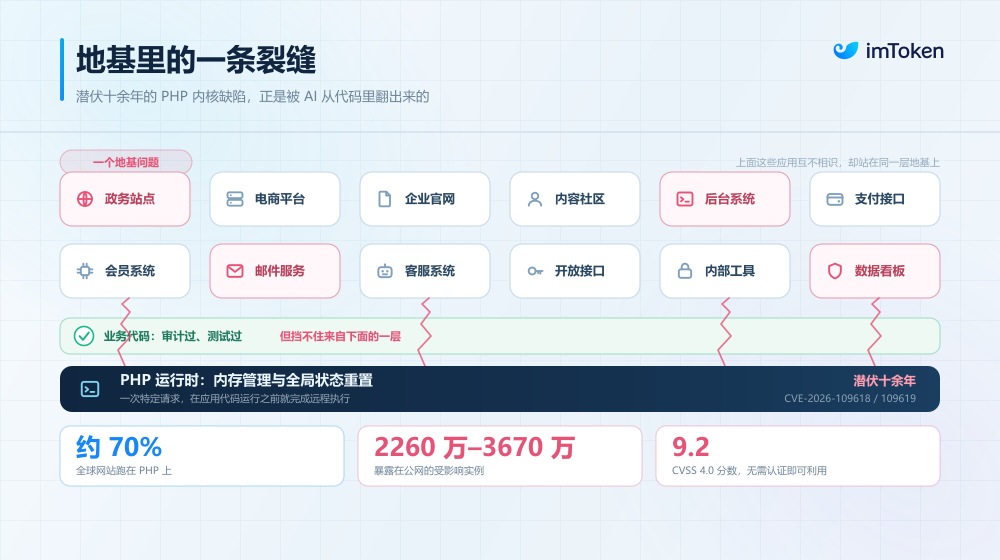
Just a week before Binance was attacked, Binance founder CZ specifically tweeted a reminder that everyone should be extra cautious when visiting any website in the coming days—at the time, two epic high-severity vulnerabilities in PHP's core engine, PHP2Shell (CVE-2026-109618 and CVE-2026-109619, with CVSS v4.0 scores as high as 9.2), were causing panic across the internet.
As the open-source server-side language supporting about 70% of websites worldwide, PHP underpins mainstream platforms such as WordPress, Magento, and Drupal.
These two memory management and global state reset vulnerabilities, which had lain dormant for more than a decade, allow attackers to achieve remote code execution (RCE) before a website's own application code runs, without authentication and with just a single specific web request, directly taking over the server and planting backdoors or stealing user credentials.
Scanning data from cybersecurity firms Palo Alto Networks and Censys shows that more than 22.6 million to 36.7 million internet-exposed instances worldwide are within the range of risk.
Even more striking, according to disclosures by security firms, these two low-level memory state vulnerabilities, which had slept for more than a decade and are extremely difficult for human auditors to detect, were discovered with the help of AI technology. In other words, AI has greatly lowered the threshold for turning hidden low-level logic flaws into usable attack payloads.
We have also discussed before the three qualitative shifts in cyberattack methods in the AI era (further reading: "When Hackers Use AI "More Efficiently," How Will the Web3 "Spear and Shield" Arms Race Escalate?"):
- The "industrialization" of zero-day (0-day) vulnerability discovery: In the past, finding deep memory vulnerabilities such as those in PHP's core engine or at the firmware level required top security experts to spend months on manual code auditing and fuzzing. Now AI can scan global open-source codebases around the clock at extremely low cost, turning decade-old dormant bugs into lethal weapons in bulk;
- Extreme compression of the "patch window" (N-day): Once vulnerability information leaks or patch code is submitted, malicious attackers using AI can reverse-engineer the patch within minutes, automatically generate variant exploits, and complete automated scanning and injection across the internet. Traditional operations teams' upgrade schedules measured in days or weeks are virtually meaningless in the face of AI attack scripts that respond at millisecond speed;
- The software supply chain and DevOps have become the number one breach point: Modern Web3 and financial systems are not built in a vacuum. Front-end interactions, back-end containers, third-party NPM/PyPI dependency packages, and engineers' local development environments form an extremely large and fragile open-source supply chain;
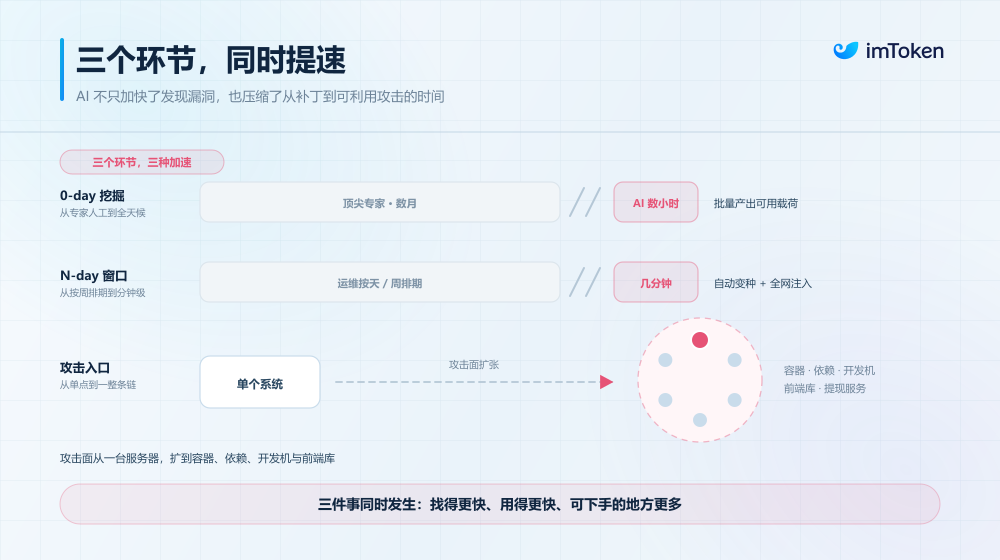
Just as Binance's DevOps container was penetrated this time and Bybit suffered front-end supply chain tampering, because on-chain attacks are the easiest to monetize directly, the crypto industry is among the first to experience a "pandemic-level global wave of AI hacking."
Of course, not all of the above attacks were directly launched or executed by AI, but AI is simultaneously amplifying the capabilities of both attackers and defenders, and under the existing software engineering system, this amplification effect has instead exacerbated the structural asymmetry that already existed between offense and defense.
2. Vitalik: The Endgame May Favor Defense, but the "Transition Period" Will Be Extremely Difficult
In response to the industry discussion triggered by AI's discovery of low-level vulnerabilities such as PHP2Shell, Vitalik Buterin offered a very sober assessment on October 22: the long-term endgame of cybersecurity may form a landscape favorable to defenders, but the transition period will be very difficult.
Why?
Because under the existing software engineering paradigm, there is a natural asymmetry between offense and defense. A large software system may contain millions of lines of legacy code, hundreds of external dependencies, and a large number of complex permissions and execution paths.
Defenders must ensure that all critical links are sufficiently secure, while attackers only need to find one gap that has not yet been discovered.
Vitalik specifically pointed out that relying solely on security researchers to find vulnerabilities in already released software before hackers do cannot truly establish a defensive advantage, because if both sides use increasingly powerful AI, then in essence it is still a contest of who can find vulnerabilities faster.
What really needs to change is the way software itself is built—for example, the two core directions he proposed: formal verification and minimizing the trusted computing base (TCB).
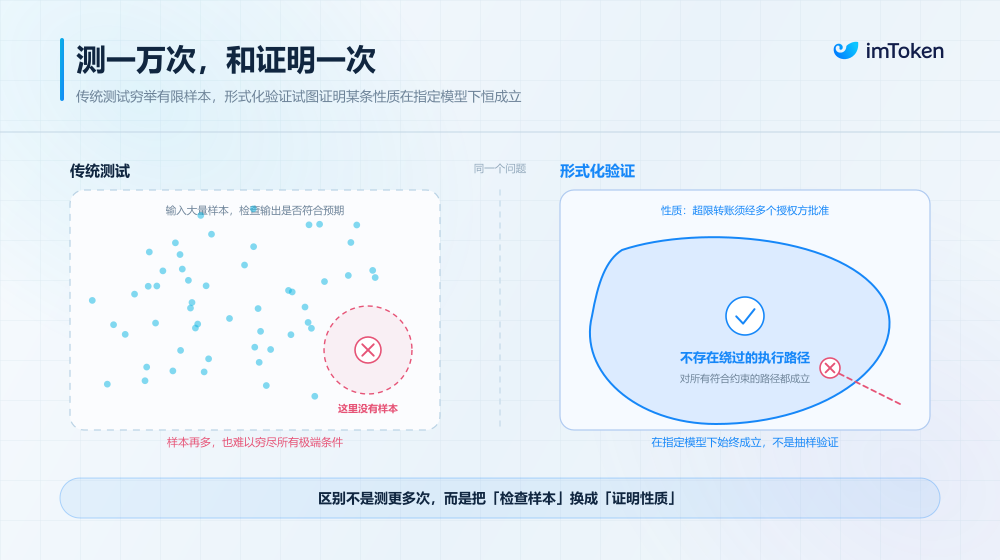
The first is formal verification, which aims to replace "empirical debugging" with mathematical proof.
Traditional software testing can only prove that "no bugs were found in the scenarios tested," but can never prove that "the code absolutely has no bugs." Formal verification, by contrast, uses rigorous mathematical logic to prove that a piece of program code strictly conforms to expected security specifications under all possible inputs and state transitions, with no defects such as memory overflow, state not reset (as in PHP2Shell), or logical reentrancy.
In the past, formal verification was extremely costly. The amount of code needed to write mathematical proofs was often several times that of the business code, and only aerospace or core cryptographic protocols could afford it.
But in the AI era, AI can not only find vulnerabilities but also serve as a super assistant for writing formal verification proofs. Therefore, Vitalik predicts that in the future "AI-assisted formal verification" will become the ultimate form of software development—whether for encrypted communication protocols such as Signal, TLS, ZK-EVM, or application-layer smart contracts, end-to-end mathematical security proofs can be automatically generated by AI before code release.
When a piece of code is mathematically proven to be "impenetrable," no matter how strong the attacker's AI computing power is, it cannot find a vulnerability that does not exist.
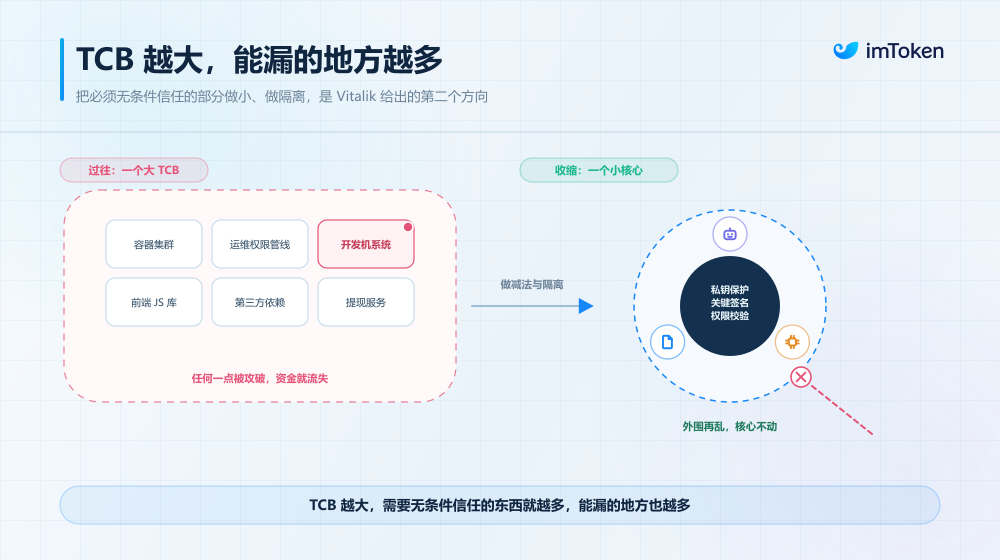
The second is streamlining the trusted computing base (TCB), which aims to compress the attack surface to the absolute minimum.
What is the trusted computing base (TCB)? Simply put, it is the sum of all software and hardware components that a system "must unconditionally trust not to fail" in order to ensure security.
Looking back at Binance's $6.3 billion security incident and Bybit's multisig hijacking incident: why were the underlying private key algorithms not broken, yet the assets were lost? Because their TCBs were too large—massive container clusters, complex operations permission pipelines, developers' laptop operating systems, and front-end rendering JavaScript libraries were all included in the chain of trust where "once breached, funds will be lost."
The core idea of TCB minimization is subtraction and isolation: converge the functions that truly involve private key protection, signature verification, and core authorization into a smaller, more clearly bounded security environment that can undergo rigorous auditing, while other complex functions are run as much as possible in peripheral environments with limited permissions.
Even if the browser, plugins, front-end services, or AI agents are attacked, they should not thereby directly gain the ability to mobilize user assets without restriction.
From this perspective, this is also where the value of non-custodial wallets like imToken lies. With a centralized exchange, user assets must pass through platform accounts, custodial wallets, and the internal withdrawal system; whereas with imToken, users safeguard their private keys themselves, directly manage on-chain assets, and initiate transactions, reducing the intermediate link of centralized custody.
A shorter chain of trust means fewer platform-level risk exposures, and there is no need to worry about an exchange suspending withdrawals or freezing platform account balances. Of course, users also need to bear responsibility for safeguarding their private keys and device security.
3. From Technological Acceleration to Defensive Accelerationism: Why Is d/acc Needed?
If formal verification and TCB minimization answer "how to be more secure technologically," then d/acc, which Vitalik has long advocated, attempts to answer a more macro question:
As AI and other frontier technologies are rapidly changing the world, how exactly should we prioritize technological development?
d/acc stands for Defensive Accelerationism, often referred to as "defensive accelerationism." Vitalik first systematically proposed this concept in 2023 and further elaborated on it in the 2025 piece "d/acc: one year later."
It does not oppose technological progress; it emphasizes a selective kind of acceleration: prioritize the development of technologies that can enhance society's defensive capabilities, disperse power, and reduce systemic risk.
Compared with the all-out acceleration emphasized by e/acc, d/acc focuses more on whether technology is enhancing offensive capabilities or improving defensive capabilities (further reading: "When Web3 Meets d/acc: In the Era of Technological Acceleration, What Can Crypto Do?").
Under the vision of d/acc, this defense system covers in-depth construction across four dimensions:
- Cyber defense: Reduce the success rate of cyberattacks and protect digital assets and data through cryptography, formal verification, software isolation, and vulnerability detection;
- Biological defense: Improve society's ability to respond to biosafety risks through pathogen detection, air monitoring, vaccine research and development, and public health technologies;
- Physical defense: Reduce the vulnerability of critical real-world infrastructure when attacked through distributed energy, resilient communication networks, and infrastructure resilience building;
- Information defense: Resist disinformation, deepfakes, and large-scale information manipulation through privacy protection, information source verification, and decentralized collaboration mechanisms;
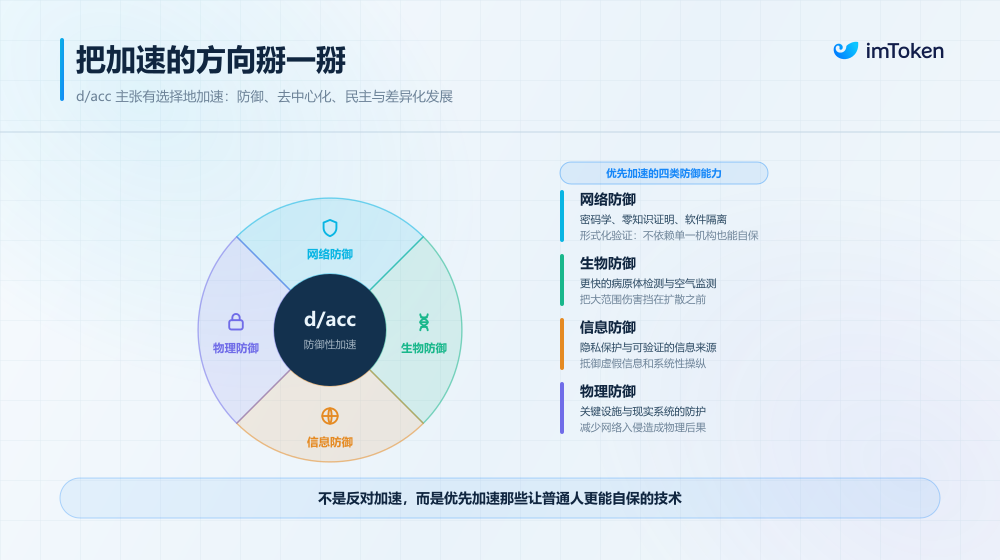
These areas may seem to span a wide range, but they all revolve around one goal: while technology continuously enhances the capabilities of individuals and organizations, it should also give them matching self-protection capabilities, and prevent more powerful technologies from being concentrated only in the hands of a few entities with resources and control.
It was also in the discussion of this PHP vulnerability wave that Vitalik reiterated a hardline position under his d/acc framework—in the face of the asymmetric impact brought by frontier AI, high-risk offensive AI should be treated prudently at the necessary stage and not allowed to advance in an unregulated way; at the same time, society as a whole should systematically invest more than 1% of GDP into cybersecurity, biosecurity, and the hardening of security in the physical world.
Why is such large-scale systematic investment needed?
Because the benefits brought by technological progress can often be quickly priced and commercialized by the market, but the value of security infrastructure is often underestimated.
Companies are willing to invest enormous sums in more powerful AI models, faster computing power, and more efficient software development tools, but may not be willing to provide support on the same scale for the long-term maintenance of underlying open-source software, formal verification, and security audits. If this resource misallocation is not actively corrected, the digital edifice built on a fragile open-source foundation will only become more dangerous.
Final Thoughts
From the global internet infrastructure risks exposed by PHP2Shell to the major security incidents that occurred successively at Bybit, Bitget, and Binance, the cybersecurity situation in 2026 is reminding everyone at a cost measured in real money:
The offense-defense contest in the AI era is no longer just about who can discover vulnerabilities faster; it is also about whether the entire software ecosystem can build a sufficiently reliable defense system.
Security can never be achieved once and for all, but that does not mean it is an unwinnable war of attrition.
Over the past few decades, cryptography has proven that certain defensive capabilities can establish very strong security guarantees through mathematical principles, rather than relying solely on defenders investing more manpower.
The combination of AI with technologies such as formal verification and minimized trusted computing bases also has the opportunity to further extend this concept to entire software systems.
For ordinary users, this security philosophy can likewise be applied to the choice of asset management methods.
Choosing a non-custodial wallet like imToken essentially means keeping control of assets in one's own hands and reducing dependence on centralized platform custody and internal operating systems. Of course, this also means users need to pay more attention to safeguarding mnemonic phrases, device security, and every transaction authorization. But at least whether assets can be controlled by oneself no longer depends entirely on whether a certain centralized platform is operating normally.
Perhaps this is the true meaning of what Vitalik meant when he said the endgame of cybersecurity may favor defenders: it is not about hoping that one day AI will no longer find any vulnerabilities, but about making steady daily progress so that the critical systems we rely on can continue to operate reliably even in the face of increasingly intelligent attackers, by relying on smaller trusted cores, stricter permission boundaries, and more verifiable security mechanisms.
Technological progress deserves acceleration, but the ability to protect technological achievements and individual assets also needs to accelerate.