Google's 10% Plunge: Is Its Core Business Collapsing, or Another "Microsoft-Style" Mispricing?


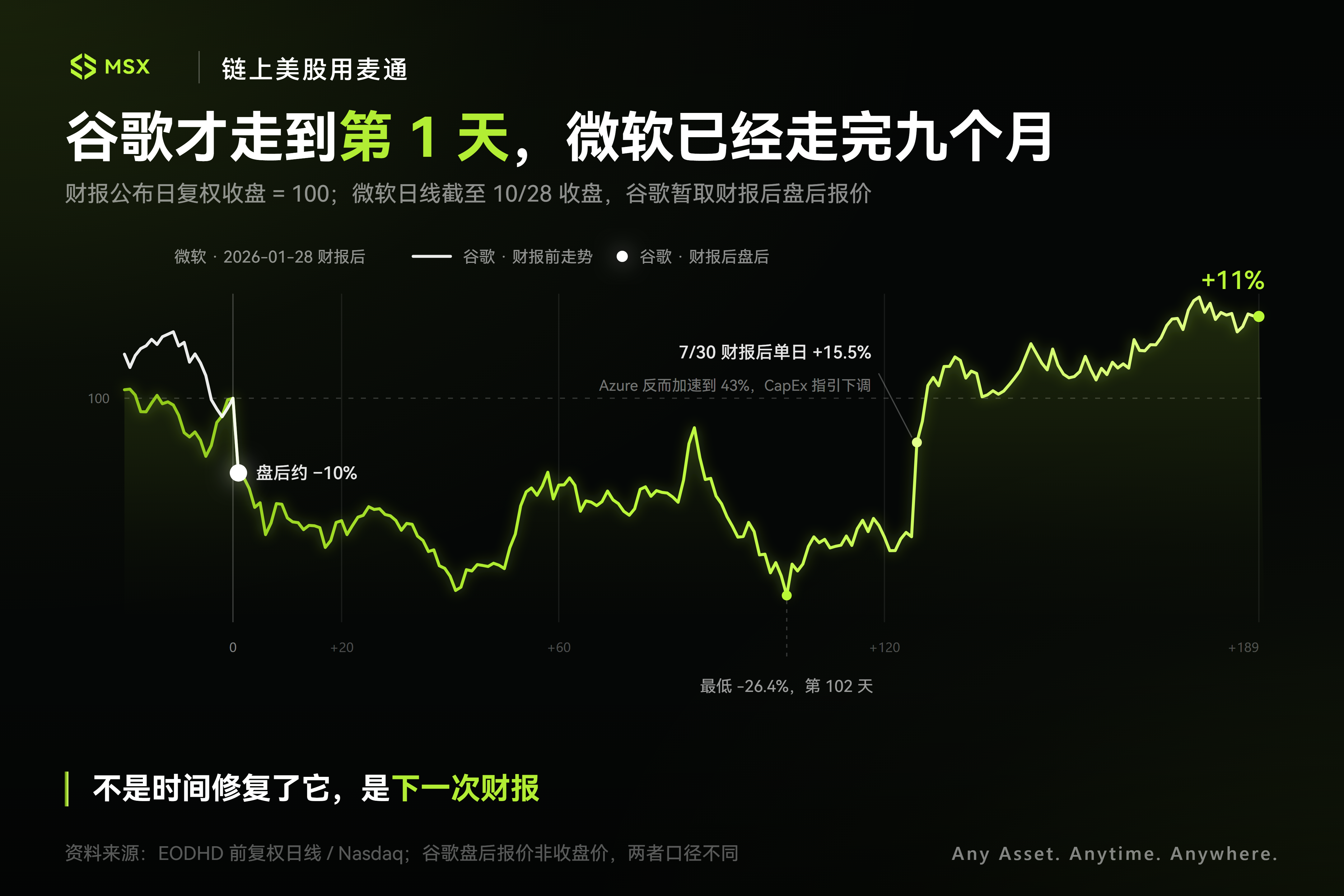
After hours following the overnight US stock market, Alphabet, Google's parent company, released its earnings report, and its stock price plunged more than 10% at one point, nearly wiping out most of its gains over the past six months.
Looking only at the few glaring numbers in the news alerts, it would seem Google's sky is truly about to fall—search and advertising businesses came in below expectations across the board, and free cash flow recorded an astonishing "negative $9.1 billion" (market expectations were around negative $3.5 billion). The pressure of massive AI capital expenditures seems about to gnaw right through the cash cow.
But if you read through the full transcript of the earnings call, and then compare it with the long-term logic dissected in the earlier article "Gemini 4.0 Is So Strong It's "Flooding the Screens"—Is Google's AI Counteroffensive Here?," you will likely find that this earnings report is far less pessimistic than the stock price suggests: Google's old businesses have indeed decelerated, but the progress of its new businesses is also more impressive than many people imagine.
This selloff is less a collapse of fundamentals than a typical "transitional-period mistaken killing."
This reminds me of those moments when Microsoft was undergoing its cloud and AI transformation, and the market repeatedly repriced the company around short-term performance, capital expenditures, and long-term returns.
Google has run headlong into exactly such a "bad time"—one that only recognizes current-period numbers and is unwilling to pay for the future.
1. Dissecting the "Blowup" Earnings Report: Is the Core Business Losing Speed?
Let's first lay out the few "landmines" that frightened the market the most.
On the surface, Google took this beating because the numbers of its traditional core business were not pretty enough:
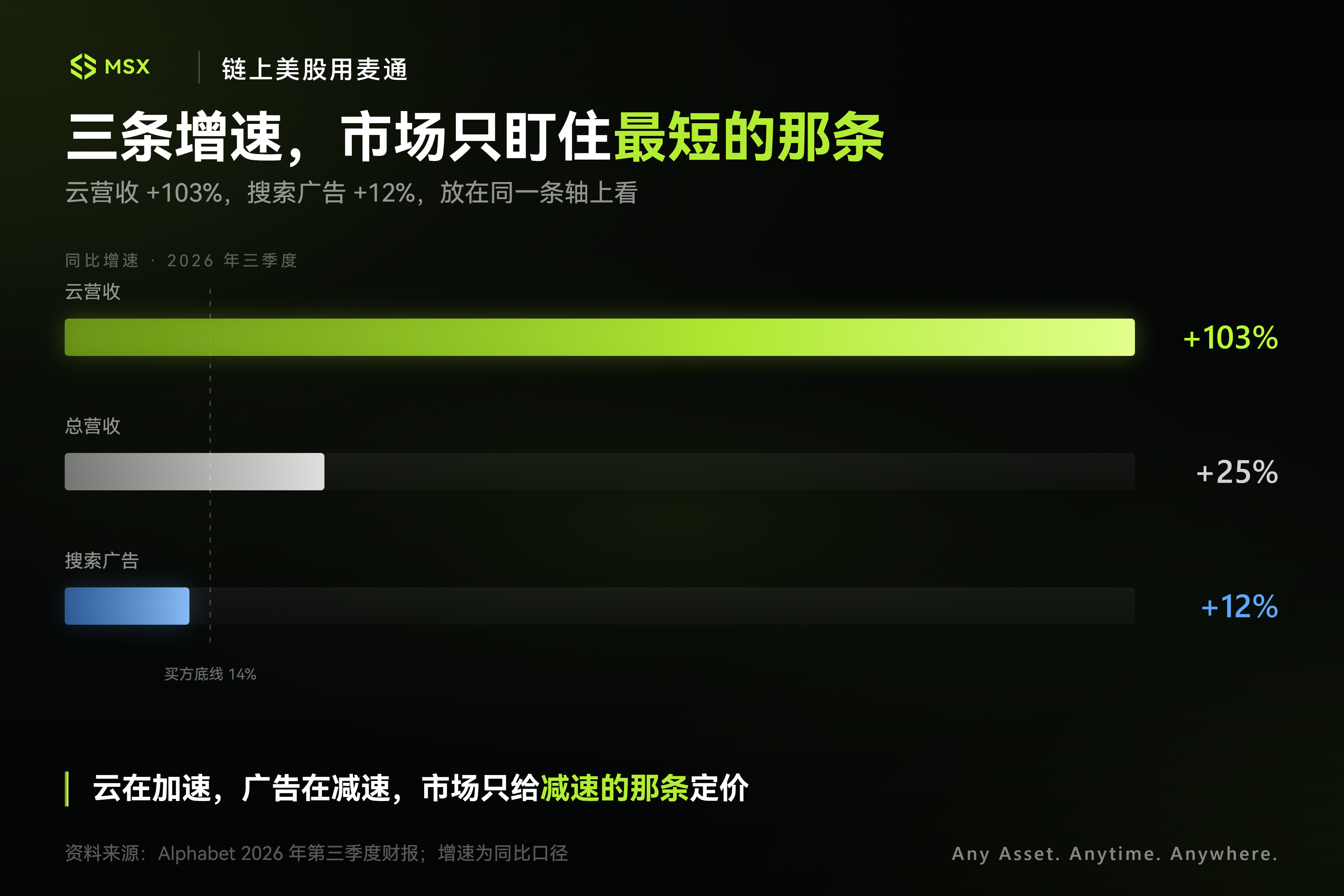
- Overall services are still growing, but slightly below expectations: Alphabet's third-quarter revenue reached $127.6 billion, up 25% year over year, slightly below market expectations; advertising revenue was about $82 billion, also missing expectations.
- The core advertising business came in below expectations across the board: Search and other advertising revenue rose 12% year over year to $63.3 billion, below the consensus estimate of $64.9 billion, and also failed to reach the buy-side floor of roughly 14% growth (for comparison, this figure was still 17% in the second quarter);
- Openly acknowledging "low monetization of AI search": Average AI query length has already reached three times that of traditional search, but monetization efficiency is relatively low, and more interactions have not yet brought in advertising revenue comparable to traditional search;
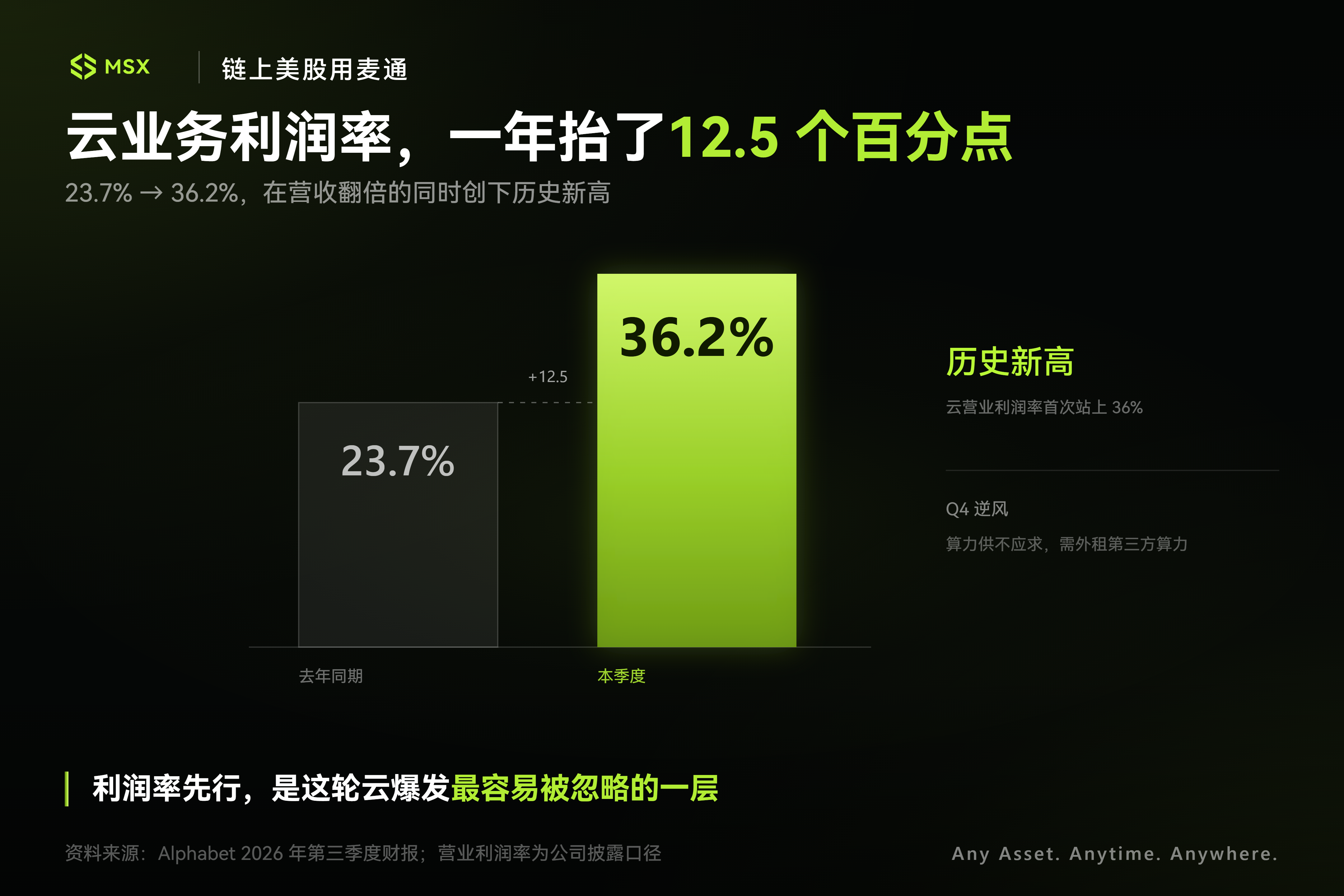
- Q4 and next year's guidance remain "unappealing": The cloud business, which just set a record-high profit margin of 36.2%, is expected to face margin pressure in Q4 due to increased use of third-party computing resources; on top of this year's capital expenditures of up to $195 billion to $205 billion, 2027 capital expenditures will "increase significantly" further;
This means Google is simultaneously under triple pressure: slowing growth in the cash-cow old business, lagging monetization of the new AI model, and infrastructure investment that must continue to ramp up.
These three things together, in today's US stock market, almost amount to a standard "valuation-killing combo." But the question is, is the market too fixated on current-period numbers?
After all, if you break down the search business, the so-called "AI is killing Google Search" remains a false premise. This quarter, Google's overall search query volume (including commercial queries) grew at the highest rate in the past five years. Under the AI mode, visual searches exceeded 50 billion per month, and the vast majority were "incremental searches."
More importantly, advertising experiments have already shown some positive signals. Google disclosed that in AI Mode, the click-through rates of sponsored product listings and organic product listings are now basically comparable.
So why did revenue growth actually fall?
There is a very key detail here. CEO Sundar Pichai repeatedly emphasized one sentence on the call: "Just like when we shifted to mobile a decade ago, we are focused on building the best search user experience first, and then monetizing it." In fact, as of the time of writing, Google had just announced that AI Mode ads would be introduced to international markets for the first time, and multi-turn conversational ads would launch in the US.
In other words, Google's strategy is to first get users accustomed to the new search behavior, and then gradually expand ad formats that have already proven effective. As user habits migrate from "typing a few keywords" to "long-chain AI multi-turn interactions," the traffic pool has indeed become larger—it's just that Google, in order to preserve entry-point stickiness, has deliberately chosen to let commercialization lag half a step behind.
From a valuation perspective, rather than treating AI search at this stage as a burden dragging down performance, it is better to view it as a "call option" in Google's hands that has not yet been fully cashed in.
The market currently focuses mainly on the potential impact of AI search on traditional advertising, but may be underestimating the future commercialization space of AI Mode. If ad load, conversion rates, and monetization per query gradually improve, Google will have every opportunity to unlock new revenue growth on top of its existing search ecosystem.
Of course, this option is not free.
AI search may divert some traditional queries that originally had higher monetization efficiency, and higher model inference costs may also erode profits. Only if new queries ultimately bring incremental revenue—rather than merely changing the way users search—will AI search have a chance to turn from a risk that must be defended into Google's next-stage call option.
Unfortunately, Wall Street today seems to have little patience.
The market does not really want to hear the story of "experience first, monetization later." Current capital is extremely utilitarian and wants to see this quarter's EPS and advertising revenue surge immediately. Especially against the backdrop of rising AI capital expenditures, every growth point that has not yet been realized may be seen as evidence of declining future returns.
On top of that, Sundar Pichai himself has always been a CEO with a classic engineer's mindset, emphasizing product experience, technological progress, infrastructure, and long-term returns, with almost no genetic inclination to "paint grand visions" or stir market sentiment with grand narratives.
So when faced with analysts' follow-up questions, he honestly laid out the Q4 base-effect pressure and computing bottlenecks. Combined with the fact that the deceleration pressure in the old business shows up in the financial statements before the commercialization results of the new business, the stock price naturally gave him a cold face on the spot.
2. The Overlooked New Engine: Cloud Doubles, TPU External Sales, and Gemini 4 Catching Up
If you shift your gaze away from the somewhat fatigued old businesses and look down along models, cloud services, and underlying computing power, you will find that Google's new businesses are not only not bad—they are even forming a comprehensive "all-fronts-blooming" AI commercial system.
This is also why I think this selloff has a strong flavor of "mistaken killing."
First, the surge of Google Cloud is no longer just a pretty percentage.
In the third quarter, Google Cloud revenue surged 103% year over year to $30.7 billion. For comparison, last quarter's growth rate was about 82%. Being able to violently accelerate further on a scale of tens of billions of dollars itself demonstrates the real strength of enterprise demand.
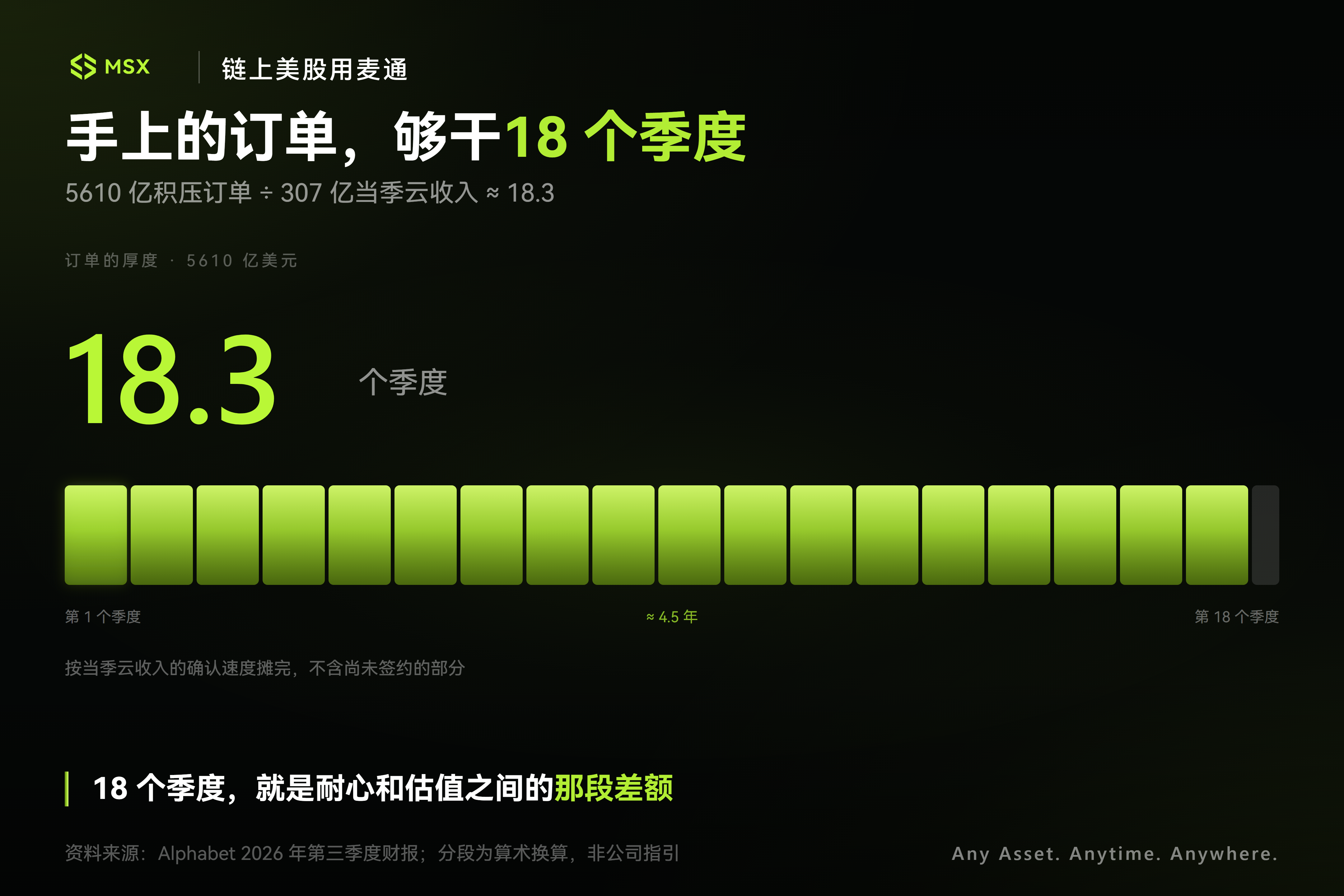
What is more noteworthy is profit. Google Cloud's operating profit this quarter reached $11.1 billion, more than tripling year over year, with operating margin jumping directly from 23.7% in the same period last year to 36.2%, a record high. At the same time, the cloud business's backlog of unfulfilled orders soared to $561 billion, of which more than 55% is expected to be recognized as revenue within the next 24 months.
This is also the core reason mentioned above why management warned that "because computing power is in short supply, increased rental of third-party computing power in Q4 will create a short-term headwind for cloud margins."
If you look more closely at enterprise adoption, Google disclosed that sales of "knowledge work seats" across all its AI services have exceeded 100 million, and nearly 90% of Fortune 100 companies are using Gemini Enterprise—for example, BNP Paribas deployed the system for more than 65,000 employees, and Tata Steel launched more than 300 specialized AI agents within nine months to optimize supply chains and customer service.
Admittedly, a few benchmark cases alone cannot directly calculate how much net profit Google has earned from enterprise AI, but they at least prove that AI is moving from early demos and partial pilots to truly taking over actual workflows inside enterprises.
And once enterprises begin using AI for programming, knowledge work, data analysis, and business process automation, what it brings is not just model invocation fees, but may also further drive demand for computing power, storage, databases, and security services, helping Google turn AI from a standalone model product into a full set of infrastructure and services that can be continuously sold to enterprises.
Second, behind the "negative $9.1 billion free cash flow" that frightened the market, there is actually a rapidly expanding TPU external sales business.
Many people, upon seeing free cash flow negative for two consecutive quarters and far worse than expected, react first with "AI is a bottomless money pit." But if you listen carefully to CFO Anat Ashkenazi and cloud business CEO Thomas Kurian break it down, you will find that behind this "shortfall" lies a big business.
In addition to $51.4 billion in routine infrastructure capital expenditures, among the cash outflows in the third quarter there was a $5.2 billion final payment of the 2018 EU fine. If you exclude this $5.2 billion cash payment for the EU fine, Google's cash flow performance this quarter was actually not as bad as the reported number suggests.
In the third quarter, Alphabet reported free cash flow of negative $9.065 billion, further deteriorating from negative $5.855 billion in the second quarter. But if you simply exclude this one-time cash fine payment, adjusted free cash flow was about negative $3.865 billion, actually an improvement of about $1.99 billion from the second quarter.
In addition, as we specifically analyzed in the previous article, Google's TPU is transforming from "an internal chip used to save money for itself" into "a platformized product for selling computing power externally," and this logic fully materialized into real orders in the third quarter:
- Chip performance iteration: The latest training chip TPU 8T improved performance by 2.7 times over the previous generation, and the inference chip 8I improved cost-effectiveness by 80%, giving it extremely strong pricing power in the current environment of scarce accelerated computing power;
- Software ecosystem breakout: Google partnered with Meta to launch TorchTPU, improving the training, inference, and deployment experience of PyTorch workloads on TPU and lowering developer migration costs;
- Distribution channel expansion: TPU systems are no longer locked only inside Google Cloud. They have begun to be deployed through partnerships with Oracle and Crux AI (a joint venture with Blackstone), and even directly into customers' on-premises data centers. Nearly a hundred heavyweight customers (including Apple, Anthropic, Citadel, Jump Trading, etc.) are currently using TPUs;
Here is the key point: why is it that the better TPUs sell, the worse current-quarter cash flow looks?
Because the financial recognition cycle for selling complete TPU systems externally (including hardware, storage, optical interconnect networks, and software stack) is completely different from traditional cloud leasing. Google disclosed on the call: "All TPU system inventory corresponds to signed contracts. We only purchase components to build inventory when we have contracts."
In other words, customers have already signed binding contracts, and Google must first spend real money to buy components and build inventory, which shows up as enormous cash outflows on the third-quarter cash flow statement; only when the systems are delivered at scale and billed in 2027 will this money turn into massive revenue and cash flow flowing back.
This is a cash flow cycle different from building one's own data centers—namely, inventory accumulation in the early stage suppresses operating cash flow, and only as systems are delivered and customers pay does the corresponding working capital occupation have a chance to gradually unwind.
Therefore, treating "the timing gap in stocking up backed by firm contracts" as "cash flow exhaustion caused by deteriorating fundamentals" is clearly misreading the books.
Finally, there is the impressive performance of the Gemini 4 series, which is filling in the most critical piece of Google's full-stack AI puzzle.
In the previous article, we analyzed that Gemini does not need to be "number one in the world"; as long as it can stay in the first tier, Google's massive distribution machine can start turning. And since the Gemini 4 series was unveiled, Google has not only held its ground but even charged directly to the front row on some key benchmarks.
In addition to Gemini 4 Argon released two weeks ago, the newly introduced Gemini 4 Carbon directly topped the globally authoritative Artificial Analysis Intelligence Index with a score of 59, comprehensively crushing Argon in full-stack web development, multimodal understanding, scientific reasoning, and cybersecurity (it is currently even undergoing testing by the US government).
Add to that the just-released world model Genie 4, which further expands real-time interactive environment simulation capabilities and provides a foundation for robot and agent training.
Reflected in actual invocation data, the token volume processed per minute by Google's first-party model API has approached 32 billion, up 40% quarter over quarter and more than four times the same period last year; the user base of the Gemini app has also officially crossed the 1 billion mark.
Of course, objectively speaking, model leaderboard rankings, user scale, and token throughput do not equal profit already in the bag. But they at least forcefully rebut the market's doubts—Google is continuing to accelerate across several core links: model capability, product penetration, and developer ecosystem. It is by no means being left behind by competitors and forced to merely take hits passively.
More importantly, the model itself is not an isolated business.
The stronger the model capability and the lower the inference cost, the more opportunity Google has to deeply embed AI into Search, Workspace, and the Gemini app, and the more it can further drive enterprise customers to use Google Cloud, invoke models, and deploy agents; conversely, cloud infrastructure and self-developed TPUs can also support model training, inference, and large-scale deployment.
This is the full-stack logic repeatedly emphasized before, allowing models, product entry points, cloud services, and underlying chips to form a mutually reinforcing commercial closed loop.
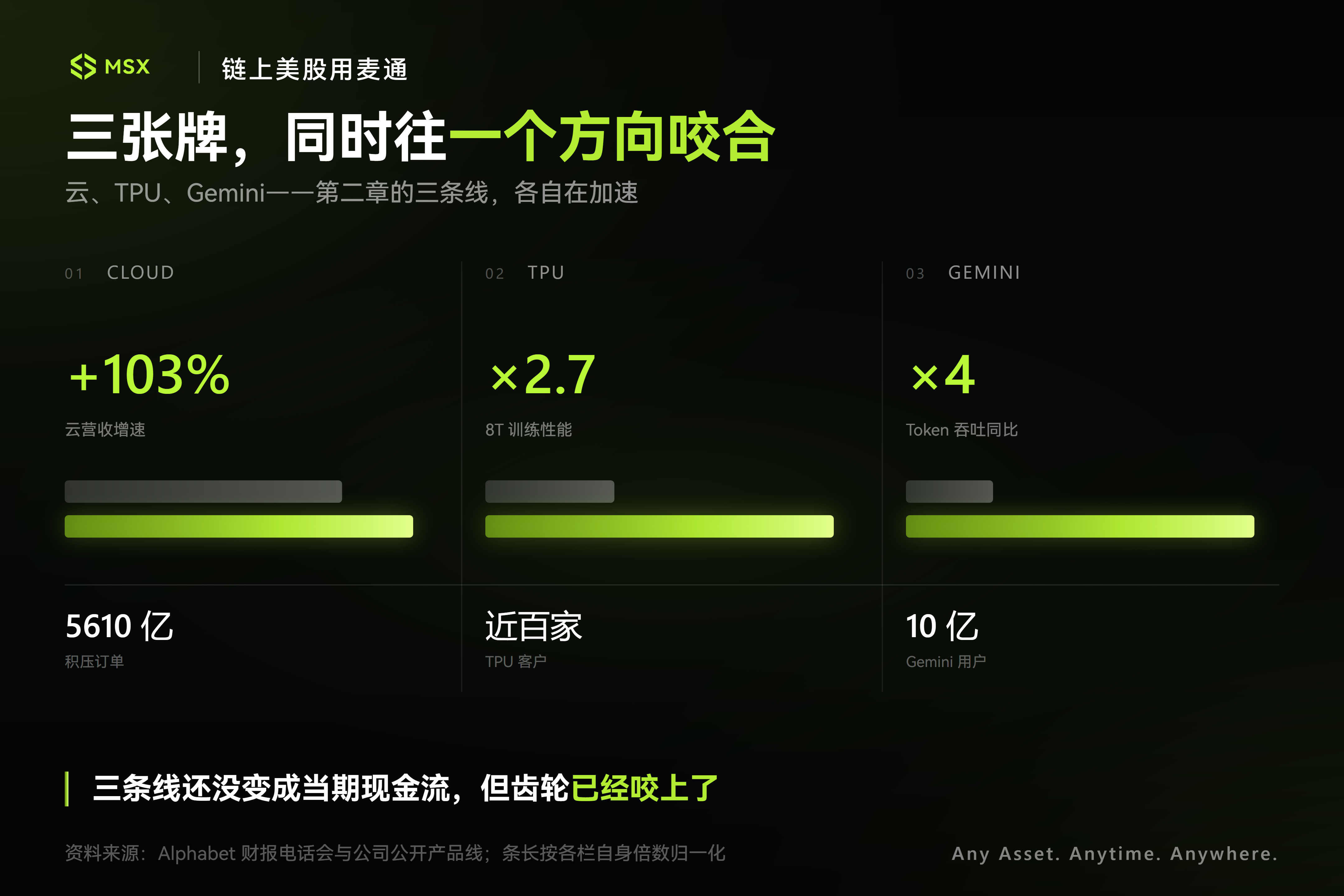
So, looking at these three cards together, the through-line is actually very clear: Google Cloud is already contributing doubled revenue growth and rich profits, TPU external sales are tearing open a new gap in the computing power market, and Gemini 4 is continuously strengthening the foundation of this system.
These three lines have not yet immediately translated into the free cash flow Wall Street most wants to see this quarter, but the gears are clearly all meshing and advancing in the same direction. Unfortunately, precisely because of the friction during the old business's gear-shift period and the cash flow "time gap," the stock was flattened by a market that only looks at current-period numbers.
If that is not a mistaken killing, what is?
3. Mistakenly Killed Like Microsoft? The "Perception Time Lag" of 2B Giants
On one side, there is the search advertising business growing 12% but missing expectations, Google Cloud surging 103%, and a cloud backlog as high as $561 billion; on the other side, there is a stock price that plunged 10% after hours, nearly erasing more than half a year of gains.
This strong sense of disconnect makes it hard not to think of Microsoft (MSFT) before.
During the critical stage of Microsoft's transformation toward Azure cloud and early Copilot, Wall Street also staged an almost identical script: as long as the quarter's traditional Windows OEM business or personal computing segment slightly dragged, or short-term capital expenditures surged and suppressed free cash flow, even if Azure's underlying bookings were soaring, the market would still sell first and ask questions later.
Today's Google is facing exactly this set of contradictions—not entirely identical, but highly similar in underlying logic.
Why can tech giants never escape this fate during transition periods—old businesses dragging down new ones, good earnings reports treated as bad ones and sold off? The core reason is that between 2B businesses and 2C businesses, there is a huge "market perception time lag."
In particular, enterprise cloud, AI infrastructure, and agent platforms often see demand reflected gradually through long-term contracts, computing power