HPE Plummets, Dell Beats Expectations: In the Second Half of AI Servers, Who Can Make Money?


- Core Viewpoint: Demand growth for AI servers is clear, but the market's pricing focus has shifted from order scale to profit margins. HPE plunged 16% on a pullback in its margin guidance, while Dell offset pressure through economies of scale and business structure. Profits across the industry chain are accelerating toward storage, GPUs, and power and cooling segments.
- Key Elements:
- HPE's fourth-quarter revenue reached $14.5 billion, up 50%, but its Cloud & AI operating margin is expected to fall from 18.4% to around 14%, mainly due to narrowing room for price increases and the depletion of low-cost inventory.
- Dell's AI server backlog reached $132.3 billion, with ISG operating margin rising to 17%, but overall GAAP gross margin was only 21%, a limited improvement that relies on operating leverage and the storage business for support.
- The lag in cost pass-through explains the margin inflection point: after low-cost inventory is consumed, restocking occurs at market prices, while complete-system selling prices are difficult to raise in tandem, putting pressure on gross margins; memory supply tightness is expected to persist through 2027-2028.
- Dell's inventory surged from $10.4 billion to $29.4 billion, with accounts payable expanding in tandem, warranting vigilance over order fulfillment and capital occupation risks.
- Gross margins diverge along the industry chain: Micron at 86.8%, Nvidia at 74.8%, and Vertiv with an operating margin of 25.2%, while complete-system manufacturers are caught between upstream and downstream pressure.
- Going forward, four key indicators warrant close attention: the slope of memory contract prices, the quality of server manufacturers' profit margins, the pace of backlog fulfillment, and capital expenditure from cloud giants.
On November 24, the US stock market delivered a fairly typical earnings-season lesson to the AI server industry.
On the evening of the previous trading day, HPE (Hewlett Packard Enterprise) reported better-than-expected quarterly results and sharply raised its revenue growth guidance for fiscal 2027. Yet the next day, its stock plunged 16.31%. On the same day, Dell (DELL) fell 11.83% before its earnings release, dragged down by weakness in the tech hardware sector, then disclosed similarly impressive results after the close, and its stock rebounded accordingly.
Looking only at revenue, orders, and guidance, both companies are positioned to benefit from the AI infrastructure buildout. But the market is clearly no longer satisfied with record-high orders—it has begun focusing more on how much profit these companies can actually retain.
This may be one of the most important shifts to watch in the AI hardware supply chain over the next few quarters.
1. Two Better-Than-Expected Earnings Reports, Why Did the Market React So Differently?
Judged purely on current-period numbers, neither company's report shows any obvious flaws.
HPE's fiscal Q4 2026 revenue reached $14.5 billion, up 50% year over year; Non-GAAP EPS was $1.43, up 131% year over year. Its Cloud & AI segment revenue was $11.3 billion, up 68.6% year over year, while server revenue was $8.8 billion, up 94.7% year over year.
More importantly, the company sharply raised its fiscal 2027 revenue growth guidance from the previous 13%–17% to 27%–35%, and expects full-year free cash flow of at least $5.5 billion.
Dell's fiscal Q3 2027 was similarly strong: quarterly revenue of $54.9 billion, up 103% year over year; Non-GAAP EPS of $9.45, up 265% year over year; AI server backlog of $132.3 billion; an increase in its fiscal 2027 AI server revenue guidance from $74 billion to $78 billion; and a new $25 billion share repurchase authorization.
Since both companies delivered solid results, the divergence in market pricing actually stems from expectations about future margins.
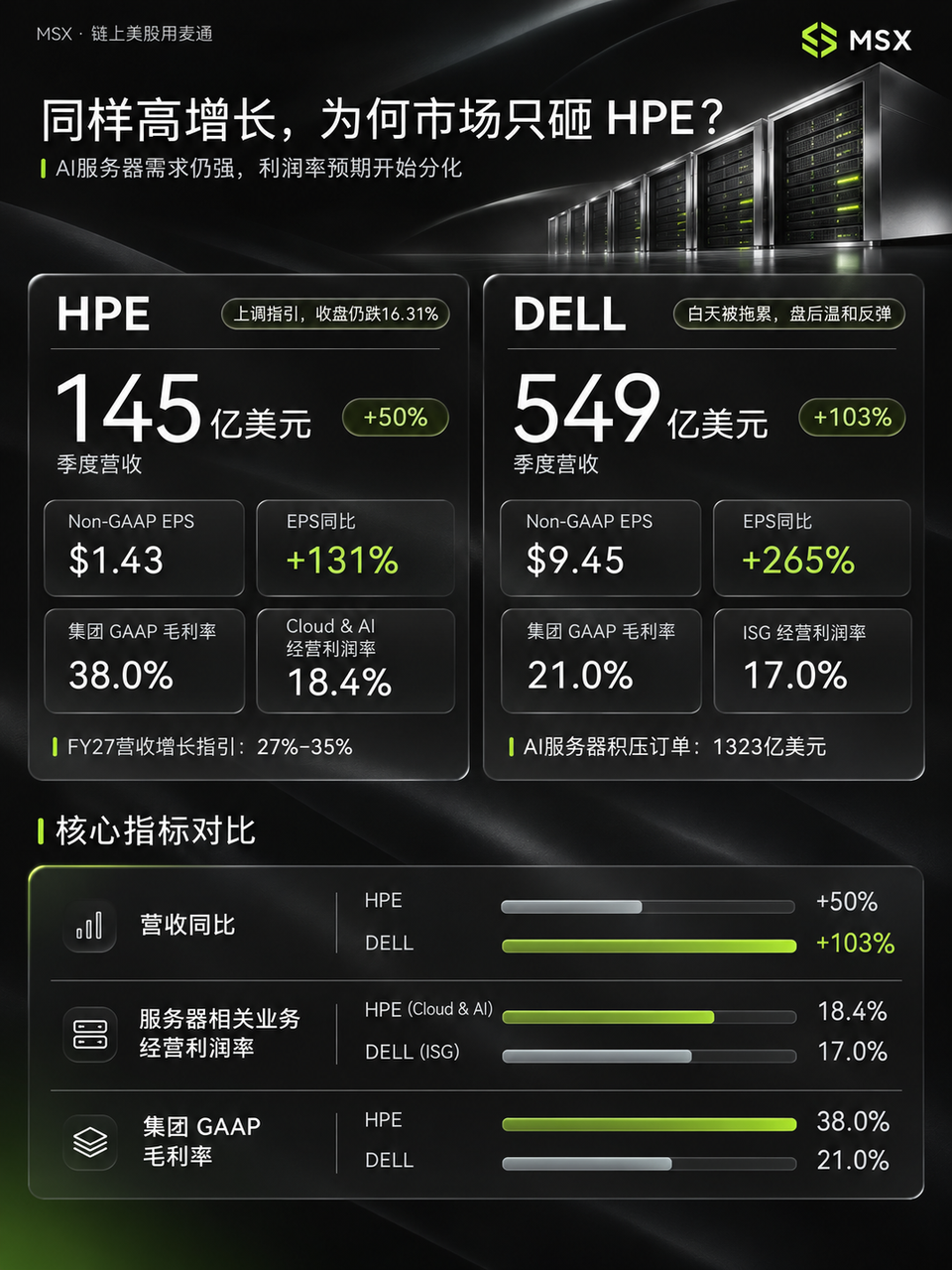
HPE's pressure first showed up in its margin guidance. Over the past year, the operating margin of its Cloud & AI business climbed from 9.3% in the year-ago period to 18.4% in the latest quarter. But that was partly driven by temporary benefits from component shortages, product price increases, and cost controls. Management expects the segment's operating margin to fall back to 16%–17% in fiscal Q1 2027 and further to around 14% for the full year.
Management offered two main explanations: on one hand, room for further product price increases will gradually narrow in fiscal 2027, while procurement cost pressure will not fade immediately; on the other hand, the share of lower-margin AI servers will continue to rise, naturally diluting overall margins.
Dell demonstrated another approach, mainly using scale effects and business mix to offset the margin pressure from AI servers.
Its Infrastructure Solutions Group (ISG) revenue reached $42 billion, up 198% year over year. Broken down, AI-optimized server revenue was $22 billion (up 291% year over year), traditional server and networking revenue was $15 billion (up 235% year over year), and storage revenue was $4.9 billion (up 24% year over year). ISG operating profit for the quarter reached $7.1 billion, up 308% year over year, with operating margin rising to 17%, up 460 basis points year over year.
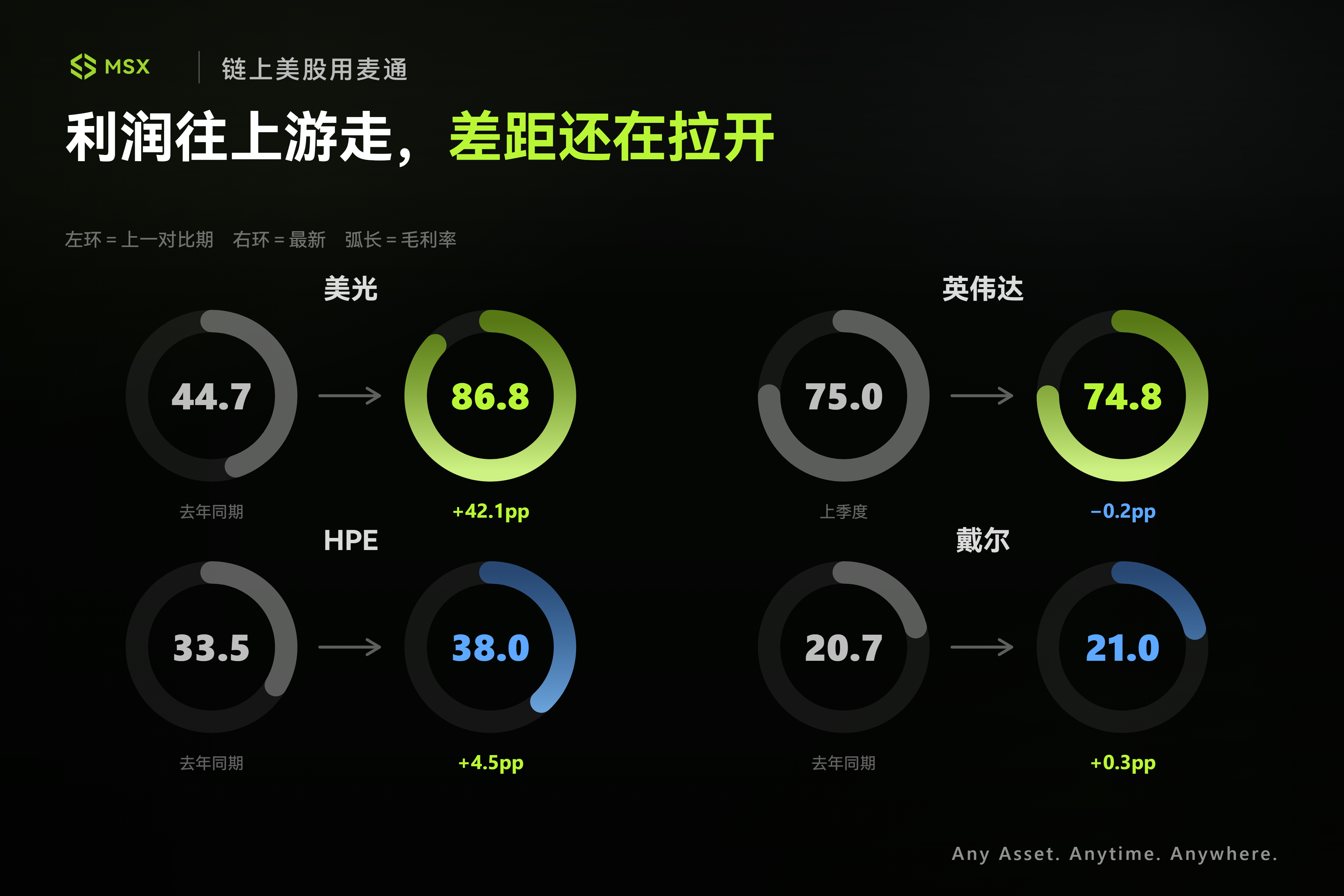
But looking one layer deeper reveals that Dell's overall GAAP gross margin was about 21%, only a very limited improvement from 20.7% a year earlier. The sharp jump in profitability was mainly due to operating leverage unleashed by doubling revenue—the group's Non-GAAP operating expenses as a percentage of revenue were compressed to 7%, down 4.8 percentage points year over year; meanwhile, traditional servers and its own storage business contributed substantial profit, helping offset some of the structural pressure from AI servers.
Even so, Dell is not entirely free of concerns. Management expects that as the temporary boost from its North American business mix normalizes, ISG operating margin will decline sequentially; memory supply tightness and rising procurement costs are expected to persist into 2027, though the pace of increase may be slower than in 2026.
It is fair to say both earnings reports point to the same industry reality: demand growth for AI servers is already clear enough. What will truly test manufacturers going forward is whether they can defend margins while continuing to expand.
2. The Margin Cycle and the Hidden Inventory Line: Who Is Capturing the Price-Increase Dividend?
Many people may not quite understand: if memory chips and key components have been rising in price, why did server makers' margins actually climb higher over the past few quarters?
A very important factor is involved here—the time lag in cost pass-through.
Suppose a server maker's original production cost is RMB 800,000 and its selling price is RMB 1 million, giving a gross margin of 20%. When memory and other key components become scarce, the server maker can raise the selling price to RMB 1.2 million. But because it had already purchased a batch of lower-priced components, short-term production cost remains RMB 800,000, and gross margin jumps to 33.3%.
But once that low-cost inventory is exhausted and the manufacturer has to restock at high market prices, pushing production cost to RMB 1 million, while the selling price stays at RMB 1.2 million due to customer acceptance constraints, gross margin falls back to 16.7%.
In other words, the selling price of complete systems remains high and revenue can continue to grow, but the profit actually retained per machine has already thinned. Real-world operations also involve long-term procurement contracts, customer price locks, inventory turnover, and internal cost controls, but this pass-through lag is enough to explain the inflection pressure HPE now faces.
Over the past year, supply tightness gave server makers strong pricing power. But as low-cost inventory is gradually consumed and procurement costs are repriced, the original margin advantage may gradually disappear. Moreover, in this round of AI infrastructure expansion, HBM demand keeps growing, and more DRAM wafer capacity is being allocated to HBM production, further squeezing supply of conventional server memory.
HPE management expects tight supply of memory, NAND, and other key components to last at least until the second half of 2028; Dell management also believes server memory supply tightness will persist into 2027. Although the pace of price increases may slow, overall costs still face upward pressure.
This means server makers still have a chance to sustain revenue through price increases in the short term, but whether they can continue passing costs downstream will be the key variable for margin changes.
Beyond margins, the hidden lines of inventory and cash flow on the balance sheet should not be ignored either.
Dell's operating cash flow in the latest quarter was about $4.46 billion (up 280% year over year), and free cash flow was about $3.47 billion. Its cash generation looks strong on paper, but over the same period inventory surged from $10.4 billion at the start of the fiscal year to $29.4 billion, while accounts payable also expanded from $33.6 billion to $57.8 billion. Once downstream data center construction is delayed, or power and cooling supporting facilities get stuck, inventory buildup and capital occupation could immediately turn into real risks.
Dell management specifically responded to this on the earnings call, saying that the $132.3 billion AI server backlog had all undergone strict review, covering customers' financial strength, end-user contracts, land, power supply, and trade compliance requirements, with a second review before production begins. But passing review does not equal zero fulfillment risk.
In particular, many emerging AI cloud service providers still rely heavily on external financing to build data centers. Once financing conditions tighten or infrastructure construction is delayed, delivery schedules for system manufacturers still face uncertainty.
3. Where Are Profits in the AI Supply Chain Concentrating?
From this perspective, when investing in the AI supply chain, a more effective entry point is to judge what resource is currently scarcest across the entire chain and who holds stronger pricing power.
Judging from the latest earnings reports, profitability levels across different parts of the supply chain have already diverged markedly. Take the latest-quarter GAAP gross margins of several representative companies as an example:
Breaking this gross-margin ladder down further, the three core segments of the supply chain present distinctly different profit logic.
1. Memory Chips: Cyclical Dividends Accelerating, but Watch for Peak Earnings
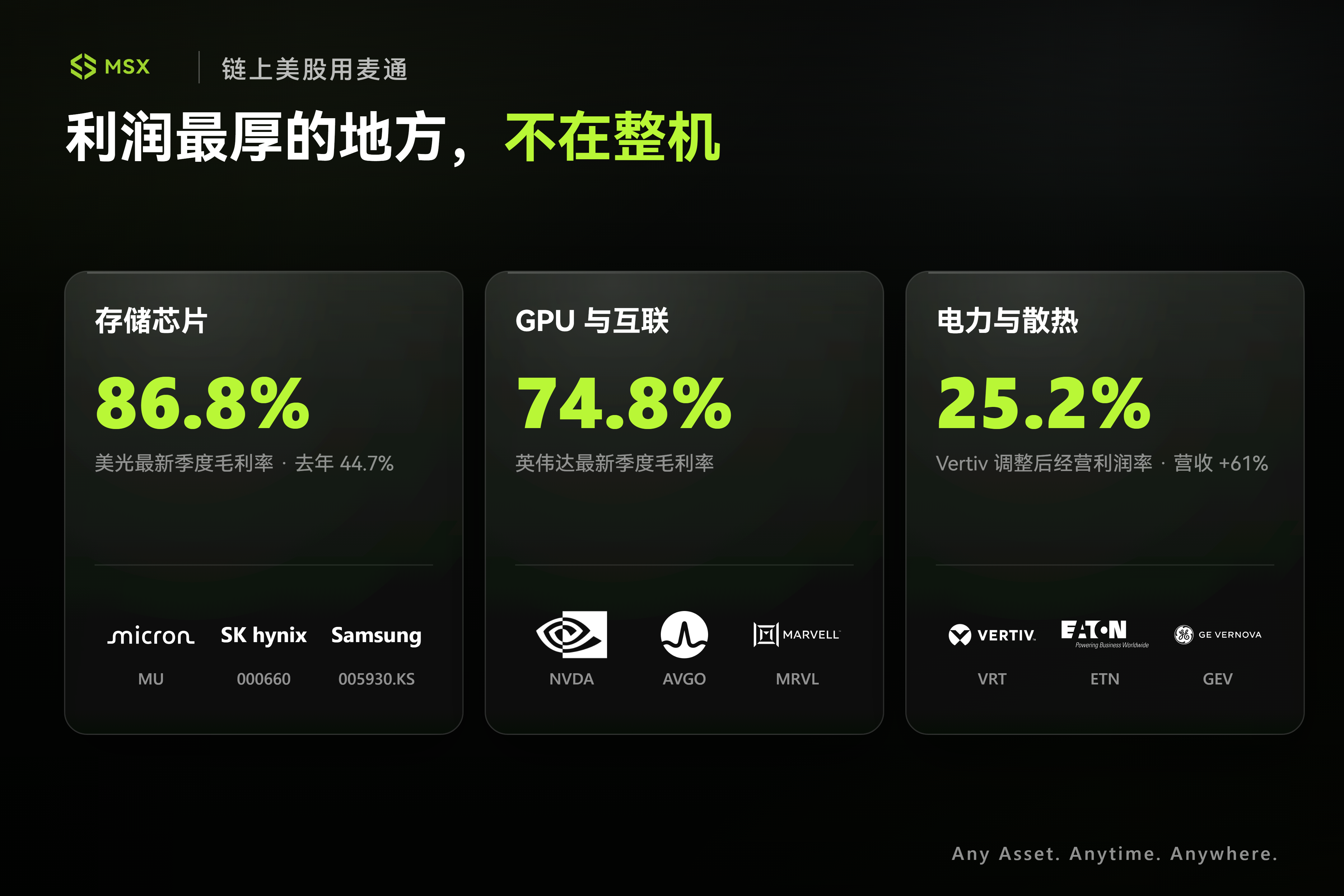
Micron's latest-quarter GAAP gross margin soared to 86.8% (only 44.7% a year earlier), directly confirming the super-cycle supply-demand dividend created by exploding HBM demand combined with squeezed conventional DRAM capacity. For Micron, SK Hynix, and Samsung, this is the segment with the most direct elasticity in the current AI infrastructure expansion.
But memory is ultimately a highly cyclical industry—when gross margin reaches historical highs, the market should be calculating how long such extraordinary profits can last. Even if forward P/E looks low, that does not necessarily mean it is cheap; once current earnings forecasts are built on assumptions of continued price increases, any future slowdown in price growth or release of new supply will quickly push valuations higher through downward earnings revisions.
Therefore, the biggest risk in the memory sector is precisely that the market has already priced in a considerable portion of future profits in advance.
2. GPU: Technical Barriers and Pricing Power Remain the Core Moat
Nvidia's latest-quarter GAAP gross margin was 74.8%, only slightly down from 75.0% in the previous quarter, still firmly at the top of the pyramid. Compared with server system manufacturers caught between upstream and downstream pressure, Nvidia has built extremely high customer switching costs through the CUDA ecosystem, chip performance, high-speed interconnect, and full-rack system solutions.
Although it also faces HBM price increases, rising advanced packaging costs, and competition from custom chips such as Google TPU, as long as AI training and inference demand continues to expand, GPUs remain the core segment with the thickest technical barriers and strongest bargaining power in the entire hardware chain.
3. Power and Cooling: Another Hard Constraint on AI Data Center Deployment
When Dell reviewed its hundred-billion-dollar order backlog, the reason it placed land, power, and cooling on equal footing with funding is that even if customers have the money to buy all the GPUs and servers, if the data center cannot secure enough power or solve cooling challenges, computing equipment can only sit idle.
As per-rack power keeps climbing, liquid cooling, transformers, power distribution equipment, and data center infrastructure are becoming rigid incremental demand. Take Vertiv (VRT) as an example: Q3 2026 revenue rose 61% year over year, and adjusted operating margin reached 25.2%, up 2.9 percentage points year over year, achieving a rare combination of simultaneous revenue and margin expansion.
Besides Vertiv, power infrastructure leaders such as Eaton (ETN) and GE Vernova (GEV) are also worth long-term tracking. However, this track generally faces common risks such as elevated valuations, capacity expansion investment, and delays in customer data center construction.
Combining the signals from HPE's and Dell's earnings reports, four key indicators deserve close attention over the next few quarters:
- Memory chip contract prices: Focus on the slope of contract prices for DRAM, HBM, and NAND, observe whether price increases are beginning to slow sustainably, and when new capacity will materially ease supply tightness;
- The quality of server makers' margins: Closely track the operating margin trajectory of Dell ISG and HPE Cloud & AI, as well as management's latest commentary on procurement costs, product price increases, and business mix;
- The pace of backlog conversion: If backlog keeps hitting new highs while inventory and accounts receivable expand in tandem and operating cash flow weakens, watch out for risks of prolonged order conversion cycles and deteriorating capital occupation;
- Hyperscaler capex and deployment progress: Whether Microsoft, Google, Amazon, and Meta maintain the intensity of AI capital spending will directly determine the demand ceiling for the supply chain;
Final Thoughts
Back to the original question: has the margin inflection point for AI servers arrived?
Judging from HPE's latest guidance, at least some server business margins have already shown signs of returning to normal from high levels; but Dell's performance also shows that, with greater scale effects, profit support from traditional servers and storage, and stronger supply chain control, leading manufacturers can still offset some of the gross-margin pressure from AI servers to a certain extent.
Therefore, these two earnings reports do not mean AI infrastructure demand has peaked, let alone that the entire AI hardware supply chain will slide into a profit downturn cycle.
The tide has not receded; it is just that the entire AI hardware chain no longer rises and falls in unison. The question is who can truly convert paper orders into profit and free cash flow.