Rebuilding L1: BNB Chain's New Killer Feature


- Core Viewpoint: BNB Chain has announced it is starting from scratch to develop a brand-new EVM L1 public chain, adopting a "multi-chain, one-token" strategy to respond to AI Agents, on-chain Perp DEX competition, and the wave of RWA financialization, with the goal of becoming an end-to-end on-chain system that serves as the global gateway to finance.
- Key Elements:
- The new L1 will not issue a new token; BNB will continue to serve network fee, staking, and governance functions, forming a complementary division of labor with BSC, opBNB, and Greenfield.
- The technical targets are 100,000 TPS, 200-millisecond block times, and approximately 20-millisecond sub-block pre-confirmations, using a mechanism that bypasses the global mempool and submits directly to block producers.
- Four major application scenarios: high-frequency trading and real-time payments, stability assurance for financial platforms, delegated authorization operations for AI Agents, and institution-grade privacy financial settlement.
- Core technical innovations include Multi-Lane multi-channel isolated execution, native account abstraction, revocable delegated authorization, and optional privacy pools.
- Driving factors: on-chain Perp DEXs such as Hyperliquid are catching up, and the tokenization of stocks and the on-chain migration of RWA assets are raising higher demands for privacy and real-time settlement.
- The mainnet launch is tentatively set for 2027; it is currently in the developer network stage, and the short-term goal is to complement rather than replace the BSC mainnet.
Original | Odaily@OdailyChina)
Author | Wenser (@wenser 2010 )
Now that public chain competition has reached a fever pitch, what is the surefire formula for maintaining an edge in the crypto mainstreaming process?
In 2026, Solana's answer is to boost performance through the Alpenglow consensus upgrade; Ethereum's L2 strategy has given rise to Robinhood Chain; Base is seeking incremental growth from AI Agent networks beyond the L2 route; stablecoin issuer Circle and payments giant Stripe have chosen to build their own public chains (Arc and Tempo) to seize the initiative. BNB Chain, however, has chosen a road less traveled — starting from scratch and developing a new EVM L1 public chain.
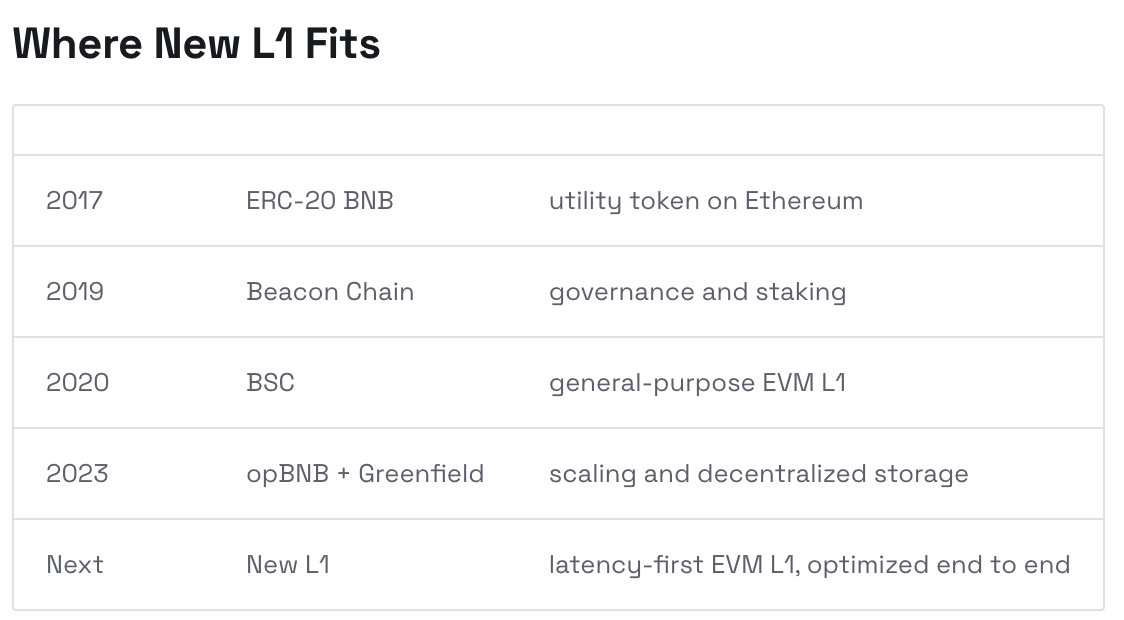
Since the BNB token launched in 2017, the BSC ecosystem has gone through stages including the Beacon Chain, BSC chain, and opBNB+Greenfield. Now, the new L1 carries high expectations and is poised to inherit past assets and technological accumulation to meet on-chain ecosystem demands such as AI and Perp DEX. Meanwhile, the wave of RWA assets and stock tokenization also determines that the BSC ecosystem's new L1 will be oriented toward the global financial gateway, building a new end-to-end on-chain system, opening up new battlefields and expanding the pie, using the "multiple chains, one coin" solution to raise the ceiling and expand the imagination for Binance, BNB Chain, Yzi Labs, and the projects in their orbit.
For BNB Chain, the Binance ecosystem, and hundreds of millions of users, what we need is not just a faster chain, but also a "new map" for meeting future challenges.
The Key Proposition of the New L1: Behind the Necessity of Latency Sensitivity, the Challenges of 4 Major Scenarios
After the new L1 strategy was proposed, CZ's response was just a simple sentence — "Multiple chains, one coin."
Four words, yet they clearly frame the core interests and development boundaries of the new L1 — no new token involved, maintaining BNB's exclusive status and its functions such as network fees, staking, and governance, while what needs to be done is multiple chains complementing each other with their own division of labor. The reason is that the current industry environment and crypto incremental growth have undergone drastic changes compared to the past. For a new L1 public chain, the first question it needs to answer is mainly: where is its value? What is it used for? Why do users need it?
The Necessary Choice of the New L1: Responding to Competition, Capturing Users, Marching Toward Global Financial Markets
It is obvious that for all public chains, CEXs, DEXs, and most crypto projects, the stage of comfortably staying within the crypto market's own circle is a thing of the past. At a time when stock tokenization and RWA assets are deeply coupling with traditional financial assets, the development of the crypto ecosystem is like sailing against the current — those who do not advance retreat. And what lies before BNB Chain is not just single-market competition at the public chain dimension.
Compounded by the development of the AI era, on-chain Perp DEX competition, and institutional financial reform demands, the current state of the new market environment is as follows:
First, the "new economic model" of the AI era with AI Agents as economic entities. This means AI Agents place more, higher, and faster demands on public chains' on-chain payments and the construction of the Agentic Economy, requiring not only high-performance standards but also comprehensive adaptation for AI Agent invocation, integration, payment, and execution.
Second, the contest for dominance over derivatives markets and pre-market pricing of traditional financial assets by on-chain Perp DEXs represented by Hyperliquid. Although Binance's contract trading volume, open interest value, and other data still maintain their lead, on-chain Perp DEXs are catching up head-to-head and fast. Beyond supporting ecosystem projects like Aster, BNB Chain also needs to safeguard Binance's derivatives business from the technical foundation level.
Finally, as the process of stock tokenization and on-chain transformation of RWA assets accelerates, traditional financial institutions and large-scale financial adoption have raised higher requirements for on-chain privacy and real-time settlement confirmation. Binance previously launched over 7,000 on-chain US stock tickers in one go, focusing on the asset onboarding side, and achieved a milestone of over $1 billion in TVL in about 3 months. However, from the perspective of institutional user adoption, functions such as routine applications, compliance disclosure, and private transactions still require a complete set of on-chain mechanisms. In this regard, BNB Chain Chief Business Officer Thomas Chen has repeatedly emphasized its importance and achieved results in media interviews, at BNB Seoul, Token2049, and other events, and has also elaborated in depth on future development goals.
In summary, BNB Chain's new L1 strategy is highly necessary, and its main application scenarios and technical advantages can also ensure that it meets the needs of multiple aspects from the underlying mechanism level.
The 4 Major Application Scenarios of the New L1: High-Frequency Trading, Real-Time Payments, AI Agents, Private Finance
Although the new L1 is currently still in the developer network stage, based on information such as the official documentation, its main technical advantages and application scenarios are already fairly clear.
Specifically, combined with the needs for AI Agents, high-frequency trading, and others mentioned above, the main technical advantages of BNB Chain's new L1 are:
- Transaction pre-confirmation: no global mempool; transactions are sent directly to the current and next block producers, shortening wait times and increasing the cost and difficulty of on-chain front-running.
- Multi-Lane configuration: reserves block capacity for eligible transaction types, isolating quote updates, liquidations, payments, and Meme trading during peak times; unused quota flows back to the general lane. In addition, this feature can in the future be deeply customized at the "blockchain network level" for different application scenarios and business needs, such as full-link compliance restrictions on compliant transactions from transaction types, on-chain steps, to transaction verification; or deeply customized transaction ordering scenarios for proprietary automated market makers (PropAMM), providing ordering solutions that meet specific trading needs.
- The protocol has native account abstraction capabilities: passkeys, batch operations, and fee sponsorship; the sender does not need to hold BNB, and the underlying network fee is still settled by the sponsor in BNB.
- Delegated authorization: allows owners to limit and revoke permissions, laying the groundwork for AI Agents to operate within user-defined scopes.
- Optional privacy pool: supports disclosure of asset information within a limited scope.
Based on the above technical advantages, the new L1 is expected to shine in the following scenarios:
First, high-frequency trading and real-time payments that demand higher performance. The new L1 is designed with a target of 100,000 TPS and a block interval of 200 milliseconds; sub-blocks are sent approximately every 20 milliseconds, and the revocable pre-confirmation mechanism can also meet transaction and payment speed requirements while ensuring the flexibility of transaction execution, thereby supporting businesses such as quote updates and real-time payments. Performance improvements will directly bring improvements in user experience, making on-chain transactions and payments more "seamless," approaching the operating experience of Web2 centralized systems.
Second, trading, payment, and financial platforms that demand higher stability. For such platforms, user scale and capital volume determine that the smooth operation of their related systems is crucial. The capacity reservation mechanism designed for this in the new L1 can effectively ensure the smooth progress of quote updates and payment operations, avoiding issues such as lag or even downtime in on-chain transactions, payments, and financial operations.
Third, Agent proxy operations that are more sensitive to operational permissions. The new L1's delegated authorization mechanism allows setting owner limits and revoking permissions, providing a native account control foundation for AI Agents' automated services, ensuring they operate within the scope authorized by users and avoiding issues such as excessive permissions, excessive fund mobilization, and black-box operation processes.
Fourth, financial platforms that demand higher privacy. The new L1 supports BNB and standard BEP-20 token assets and allows viewing permissions to be opened within a limited scope. While ensuring that some public calls, fees, and settlement results are visible, when it comes to confidentiality of user information and business asset information, the new L1's private asset settlement and limited-scope disclosure design greatly enhances the effectiveness of information security management and the security of asset invocation operations.
Of course, the development, construction, and application migration of the new L1 will not happen overnight, and the process will inevitably be accompanied by corresponding risks and problems. However, the superiority of its underlying design determines that its application openness and scenario coverage will be more comprehensive.
New Problems and Solutions for the New L1: Migration Costs, User Experience, Automated Execution, Privacy
The selectivity formula in communication studies states that the probability of information selection = guarantee of reward / degree of effort. In plain terms, the result of a user choosing a certain piece of information depends on the comparison between how well the media content satisfies their needs and the cost of investment.
Whether BNB Chain's new L1 can gain the support and use of more individual users, institutional users, and developers essentially still applies this principle — that is, only when benefit > cost will developers, users, and institutions choose to migrate to the new chain or run multiple chains in parallel. This is the problem facing the new L1 at different stages of development, growth, and subsequent long-term construction. At present, the corresponding solutions for the new L1 can be referenced from the following angles:
- For trading platforms, market makers, quant teams, and trading institutions, the new L1's user experience will be closer to the feedback speed of centralized matching, while its assets can still be self-custodied. BNB Chain CTO David Z previously told the media that what the new L1 wants to achieve is to make users' on-chain experience feel close to an exchange, while their assets remain on-chain, balancing user experience and asset self-custody needs.
- For payment platforms and payment users, the on-chain payment threshold of the new L1 is greatly lowered. Its native account will support passkeys and fee sponsorship, so users do not need to prepare BNB tokens in advance to authorize using trusted device verification methods; at the same time, applications or sponsors can pay Gas fees on behalf of users, with the underlying settlement still using BNB. The payment threshold for small daily payments and first-time consumer application experiences will be further lowered.
- For AI Agents that are gradually penetrating users' trading networks, the protocol layer has made limitable and revocable delegation a native feature. AI Agents can place orders, transfer funds, and execute trading strategies within the scope authorized by users without having to hand over all private keys, greatly improving account security and permission strength.
- For institutions that need to complete compliance disclosure and asset privacy management, the new L1's fund pool supports hiding information such as the sender, receiver, and transaction amount, while being able to open viewing permissions within a limited scope; some public calls, fees, and settlement results remain visible. As a result, from the perspective of regulatory friendliness and reducing compliance costs, it well balances the diverse needs of on-chain fund management.
The development and popularization of new things always take time. For the new L1, whose mainnet launch is currently tentatively set for 2027, as long as the functional groundwork is sufficient, user education and market growth will simply follow naturally.
Starting from Scratch Is Better Than Patching Things Up: The Differences Between the New L1 and Chains Such as opBNB and Greenfield
Regarding this new public chain, perhaps the biggest question many in the market have is: why does BNB Chain need to build a new L1? Does this mean that opBNB and Greenfield have failed?
According to the BNB Chain forum introduction, the new L1 is aimed at workloads that require deep architectural changes, which BSC cannot satisfy through modification; moreover, unlike opBNB and Greenfield, which are scaling add-on components built on the BSC chain, the new L1 is an independent infrastructure layer.
In other words, the new L1 is meant for a clear division of labor by starting from scratch, rather than patching things up on top of the original on-chain foundational ecosystem. Its short-term goal is not to replace the BSC mainnet, but to complement it, covering various application scenarios through flexible customized infrastructure capabilities, and in the future achieving 100% support and full-scale carrying capacity for trading-type scenarios.
Based on official information and community feedback, the division of labor among different chains in the future will be roughly as follows:
- The BSC mainnet will continue to exist as a broad-based application chain, carrying existing DeFi, token issuance, and most everyday contracts;
- opBNB will continue to serve as the scaling layer, mainly responsible for cost-sensitive, throughput-first operations with lower requirements for sub-second pre-confirmation;
- Greenfield will continue to be responsible for data and storage; compared with other chains, it is more like an "on-chain warehouse";
- New L1 will focus on solving the on-chain market for latency-sensitive, native abstract accounts, and private settlement, making efforts in on-chain trading, AI Agent applications, real-time payments, and large-scale institutional financial adoption.
The advantage of starting from scratch is that the new L1 can shed historical burdens and legacy issues, and on the basis of absorbing existing accumulated users and market growth, achieve a lightweight launch, open up new incremental growth, directly face a series of competitors such as Solana, Hyperliquid, Base, and Robinhood, and add another important pipeline connecting BNB Chain to the global financial system.
Conclusion: Performance Is Only One of the New L1's Features; Its Vision Is More Critical
In the 2026 crypto market, public chain competition is no longer as simple as pursuing performance and speed as it was years ago; instead, breakthroughs need to be achieved at the scenario, application, and ecosystem levels. Although BNB Chain's new L1 has set technical goals of 100,000+ TPS and sub-50ms, operating speed is only part of its features, and not even the most important part. Judging purely from the data level also cannot truly reflect its value and role for the BSC ecosystem and Binance exchange's main business.
For Binance and BNB Chain, the new L1 is not only the current development focus of derivatives trading and the public chain ecosystem, but also carries their hope of responding to changes in the future AI era, integrating with traditional financial markets, and even reshaping the global financial asset system. From this perspective, perhaps we can give BNB Chain's new L1 a bit more patience — after all, only when the foundation is solid can high-rise buildings be built on top of it. The so-called "slow is fast" also applies to the development path of the new L1.