From Safeguarding Private Keys to Constraining Agents: The New Boundaries of Crypto Security in the AI Era


- Core Viewpoint: As AI Agents participate in asset management and trade execution, the attack surface of the crypto industry is spilling over from private key and contract security to browser frontends, third-party supply chains, API credentials, and the Agent authorization layer. Security is no longer just a cost of defense—it has become critical infrastructure supporting automated financial activity.
- Key Elements:
- In the Optimizely frontend supply chain poisoning incident, attackers injected malicious scripts through a third-party CDN to tamper with crypto addresses copied by users—without needing to breach the wallet or the website's servers.
- Lighter suffered from API signing keys reusing a Nonce, which allowed private keys to be reverse-derived; approximately 10.39 million USDC flowed out, with only about 5 million recovered.
- The Hyperliquid Agent Wallet authorization risk shows that although an Agent cannot directly withdraw funds, it can execute abnormal transactions on behalf of the user and cause losses.
- Agent authorization has shifted from "single confirmation" to "continuous operational capability," with risk depending on the authorization's duration, scope of action, and trigger boundaries.
- Agent workflows span browsers, third-party tools, APIs, and wallet signatures—a failure in any one link cascades downstream.
- The new security baseline needs to cover four dimensions: independent Agent identity and least-privilege systems, readable and verifiable transaction intents, supply chain verification of the tool ecosystem, and continuous behavior monitoring and anomaly response.
Before 2026, the Crypto industry had developed a fairly clear division of labor around "security."
Contracts were left to audits and bounty programs, private keys to hardware isolation and offline backups. Although these two lines of defense did not mean assets were absolutely safe, for a long time the industry generally regarded them as the primary security boundaries.
Precisely for this reason, security in the Web3 world of the past always carried a kind of "cost attribute": it was an investment products had to bear for the sake of stability, and was sometimes even seen as necessary friction that added operational steps and sacrificed user experience.
But several recent Crypto security incidents are breaking this entrenched perception.
Attackers do not necessarily need to breach the core protocol, and users' seed phrases may never have left their original location, yet assets can still face real losses because browser scripts are tampered with, API credentials are stolen, or transaction permissions granted to an Agent are abused.
In a sense, as AI Agents begin to participate in asset management and trade execution, security is no longer just a protective cost that products must bear—it has become key infrastructure supporting automated financial activity.
1. Where Is the Crypto Industry's Attack Surface Migrating?
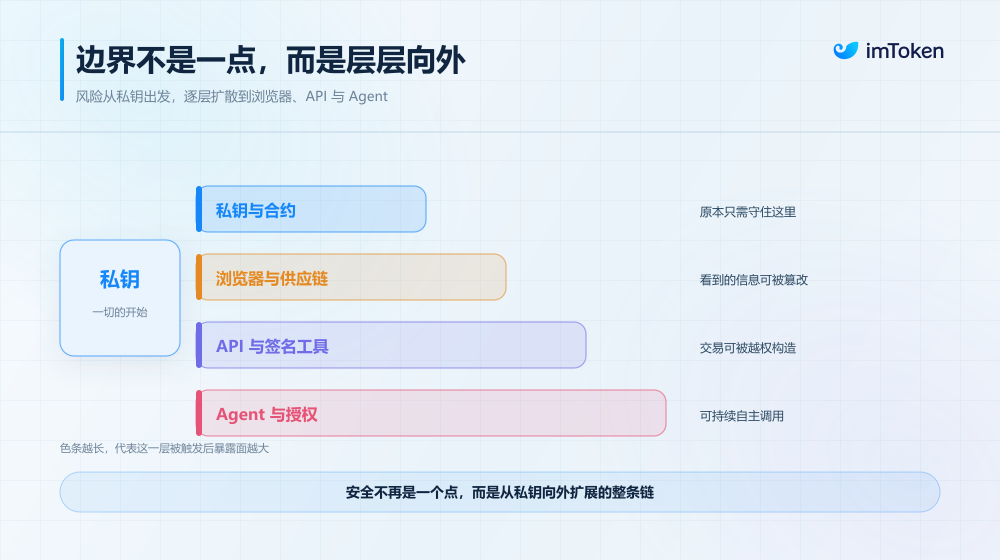
If recent incidents are viewed merely as isolated security news, it is easy to fall into a surface-level understanding of "switch to another platform, click fewer phishing links." But a careful comparison reveals that together they outline a fairly clear migration path for the attack surface:
Risk is spreading rapidly along the periphery of on-chain assets to the browser frontend, software supply chain, delegated credentials (API), and the AI Agent authorization layer (Further reading: "From Private Key Protection to Systemic Defense: How Can Crypto Rebuild Security and Trust in the AI Era?").
The first is the Optimizely frontend supply chain poisoning.
Attackers exploited a vulnerability in a third-party experience optimization platform to inject malicious scripts into hundreds of corporate websites worldwide via its official CDN, directly tampering with copied cryptocurrency addresses in users' browsers while also obtaining bank card information, cookies, and other data entered by users.
This means attackers do not need to breach users' wallets, nor necessarily hack the websites' own servers. As long as they control a third-party service in the user's chain of trust, they have an opportunity to change the transaction information users see before they click send.
The second is the Lighter API signing key leak.
On November 16, Lighter suffered a security incident involving trading account API keys. According to subsequent disclosures, affected accounts used custom signing programs and reused the random Nonce in cryptographic signatures, allowing attackers to derive the API private key from public signatures.
After obtaining the keys, attackers used the affected accounts' existing public fund pool permissions to transfer funds into the pool, then withdraw them through the share redemption path. Approximately 10.39 million USDC was observed flowing out on-chain. The platform subsequently suspended withdrawals and the creation of new fund pools, and recovered approximately 5 million USDC with the assistance of the Security Council.
Finally, there is the authorization risk of the Hyperliquid Agent Wallet.
On November 14, automated trading service HyprEarn disclosed that a small number of Hyperliquid user accounts that had previously authorized its Agent Wallet experienced unauthorized trading activity, and asked users to revoke the old Agent's authorization and re-establish the connection.
It is worth noting that although Hyperliquid's Agent Wallet cannot directly withdraw funds or transfer to external addresses, it can execute trades on behalf of users. This means that even if attackers cannot directly move assets away, they may still cause real losses to users through abnormal trades.
These risks were not created by AI Agents, but as Agents connect information acquisition, strategy decisions, tool calls, and trade execution into a single chain, previously scattered risks may be further amplified. This also signals that the Crypto industry's attack surface is comprehensively spilling over from traditional private key and contract security to the browser frontend, third-party supply chains, delegated credentials (API), and the identity and authorization layer of AI Agents (Further reading: "From Binance to PHP2Shell: In the AI Era, Web Security's Defenses Urgently Need Redefinition").
2. The "New Boundary" of Security in the AI Era
If the above incidents reflect the spillover of the traditional crypto attack surface, then the proliferation of AI Agents further changes the underlying nature of security problems.
In traditional wallet interactions, users usually need to actively select assets, confirm transactions, and sign. Even if phishing sites or malicious contracts exist in the process, users are at least still the primary decision-makers in the entire execution chain.
But Agents are different.
For users, "automatically buy the dip on Uniswap when ETH falls to the target price, and move the remaining funds into an Aave yield strategy" is just a simple instruction. But behind the Agent, it needs to read market data, call trading APIs, construct transactions, connect to wallets, sign contracts, and even continuously adjust positions afterward (Further reading: "When Hackers Use AI "More Efficiently," How Will Web3's "Spear and Shield" Arms Race Escalate?").
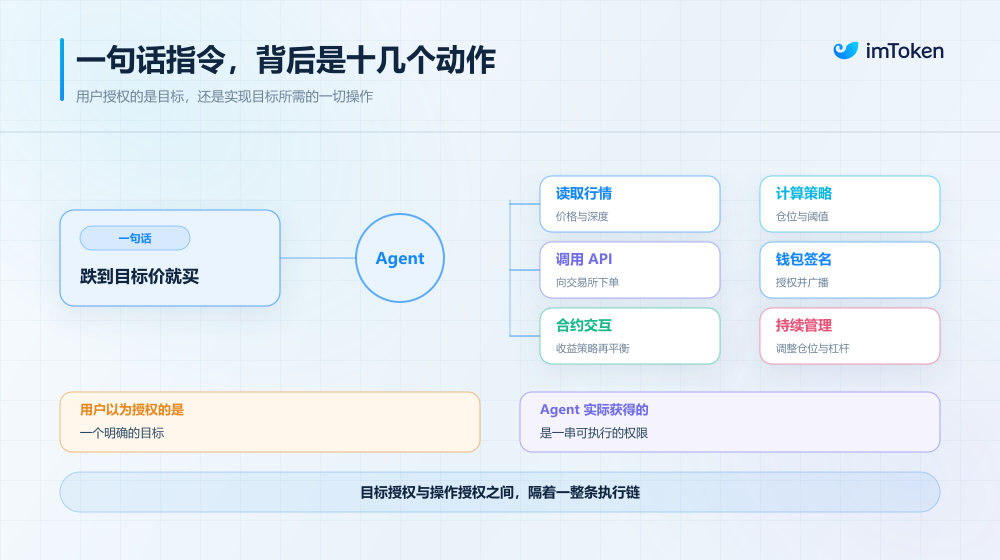
This shift in interaction paradigm brings two structural changes that were not prominent in the past.
First, authorization evolves from "single confirmation" to "continuous action capability."
In the past, signing a transaction meant approving a clearly bounded action. But once an Agent obtains authorization, it may continue operating for hours, days, or even longer, dynamically adjusting strategies based on external information and intermediate results.
Risk is no longer bound only to whether a single transaction is right or wrong, but depends on the authorization's duration, scope of action, and trigger boundaries. After all, why should an Agent responsible only for DCA into ETH have the authority to adjust leverage, make cross-protocol calls, or even transfer assets?
If users only deliver task objectives without clearly defining execution boundaries, then even if private keys are never leaked, the actual control of the account may be over-delegated without users realizing it.
Second, previously isolated vulnerabilities are chained into a continuous execution chain.
A typical Agent workflow often spans multiple layers—for example, scraping information via the browser, executing tasks through third-party Skills or MCP tools, connecting to trading platforms via APIs, and finally calling the wallet to complete signing.
The entire chain is interlocking, and any breach cascades downstream. For example, malicious instructions embedded in external web pages may tamper with an Agent's decision-making; contaminated third-party tools may swap transaction parameters during assembly; leaked API keys are enough to bypass the original interaction flow and directly move funds.
This is why security in the Agent era must never rely solely on the model's own alignment and guardrails. What truly determines whether an operation can be allowed must be a deterministic permission and policy foundation independent of model reasoning.
In other words, Agents can become increasingly autonomous, but autonomy must have hard boundaries. This is precisely the origin where Crypto security and AI Agent security truly intersect.
3. From Wallets to Agent Platforms: What Do New Security Standards Require?
When both the attack surface and risk subjects change, what wallets, exchanges, and Agent platforms need to establish is no longer just traditional private key protection and contract audit mechanisms.
Around risk propagation across the entire chain, capabilities in at least four dimensions are becoming new industry benchmarks.
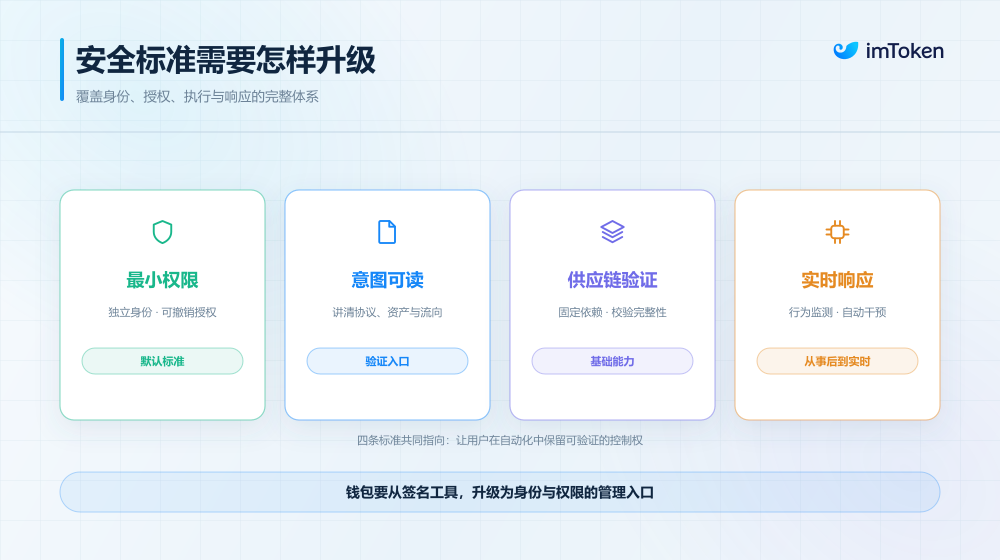
First, we must establish an independent Agent identity and least-privilege system.
Agents should not directly inherit all permissions of user accounts, but should operate as independent restricted entities. On closer inspection, a mature permission model needs to implement decomposable hard constraints across at least five dimensions:
- Operation scope: clearly distinguish read-only queries, spot trading, and specific contract calls, and reject broad general authorizations;
- Asset scope: limit which specific Tokens can be used, preventing risk from spreading to other assets in the main account;
- Amount scope: set per-transaction caps, cumulative spending limits, and maximum risk exposure;
- Time scope: bind authorizations to validity periods, automatically expiring when the task ends;
- Delegation scope: when an Agent calls sub-Agents or third-party tools, permissions may only narrow and must never spread downstream;
More critical than fine-grained allocation is the revocability of permissions. Once an Agent's behavior deviates from expectations, users must be able to cut off authorization independently and immediately, without waiting for a response from some centralized service provider. For wallets, this means their function is extending from a pure "signing entry point" to identity verification, permission allocation, and full-lifecycle authorization management.
Second, make transaction intent truly readable and verifiable.
In the Agent era, a real problem users face is that even if a transaction ultimately needs to be signed through a wallet, users may not understand what the Agent actually submitted.
A natural language instruction, after model reasoning, tool calls, and contract encoding, may ultimately become an on-chain transaction containing complex parameters. Therefore, a wallet cannot merely display raw transaction data or simply ask users to click confirm. Instead, it should restore the transaction as much as possible into specific actions users can understand.
For example, clearly display the protocols and contracts being called; explain the assets, amounts, and receiving addresses involved; flag high-risk operations such as unlimited allowance approvals and permission changes; for transactions involving leverage, collateral, and position changes, explain the possible impact; and even combine transaction simulation to show asset changes before and after execution.
One particularly critical bottom line is: transaction descriptions generated by the model itself must never be directly used as the final security basis.
The wallet must independently parse the actual underlying parameters awaiting signature locally, ensuring that "the intent the user sees" strictly matches "the facts that will be executed on-chain." For large-value assets, irreversible operations, or permission expansion, a clear manual confirmation mechanism must be retained.
Third, extend supply chain verification to the Agent's entire tool ecosystem.
The lessons of Optimizely and Lighter have already proven that defenses often break in third-party dependencies users cannot see. In the Agent era, this supply chain is multiplying in length:
In addition to traditional browser scripts and software SDKs, various Skills, MCP Servers, third-party APIs, external data sources, and automated execution tools are all directly connected to the execution chain.
Therefore, future security verification cannot stop at the model and wallet themselves; it must also cover the dependency graph of the entire tool ecosystem. For example, implement strict source verification for SDKs, plugins, and Skills, prioritizing trusted distribution channels; lock dependency versions and verify package integrity to block unreviewed silent updates; implement sandbox isolation for third-party tools, strictly limiting their access boundaries to local files, account credentials, and external networks.
In particular, tools involving wallet signing and asset operations must never gain unauthorized access to other resources simply because they are "normally called by an Agent."
Finally, establish continuous monitoring and abnormal response mechanisms for Agent behavior.
Traditional security systems usually focus on abnormal logins, abnormal transfers, and suspicious contract interactions. But for Agents, abnormal behavior may appear earlier in the trade execution process.
For example, an Agent originally responsible only for low-frequency spot trading suddenly begins frequently adjusting leverage and continuously opening positions, or calls contract interfaces it has never used before. These may all indicate that task execution has deviated from the user's original authorization scope.
Therefore, trading platforms and Agent service providers need to establish more fine-grained behavior monitoring mechanisms, including real-time thresholds around per-unit-time transaction frequency and amount caps, maximum positions and leverage exposure, abnormal API calls, and interactions with unfamiliar contracts. Once a policy red line is triggered, the system should automatically pause the task, downgrade permissions, or revoke the corresponding authorization.
Particular attention should be paid to the fact that once an on-chain transaction is completed, it usually cannot be simply undone. Therefore, truly effective risk control should occur as much as possible before trade execution, rather than waiting until after asset losses to remedy the situation.
For Agent platforms, it is also necessary to record the source, authorization basis, tool calls, transaction parameters, and execution results of each task, so that users can trace exactly which link went wrong.
Final Thoughts
Looking back at the history of the crypto industry, every upgrade in interaction paradigm ultimately forces a reconstruction of the security system.
From early private key management and cold wallets, to smart contract audits, multisig, and MPC, and now to account abstraction, permission management, and automated risk control, every product form upgrade brings new security boundaries.
AI Agents will be no exception.
When Agents begin to touch wallets, exchanges, payment networks, and on-chain protocols, security has already moved from information protection into the realm of real asset control and financial execution.
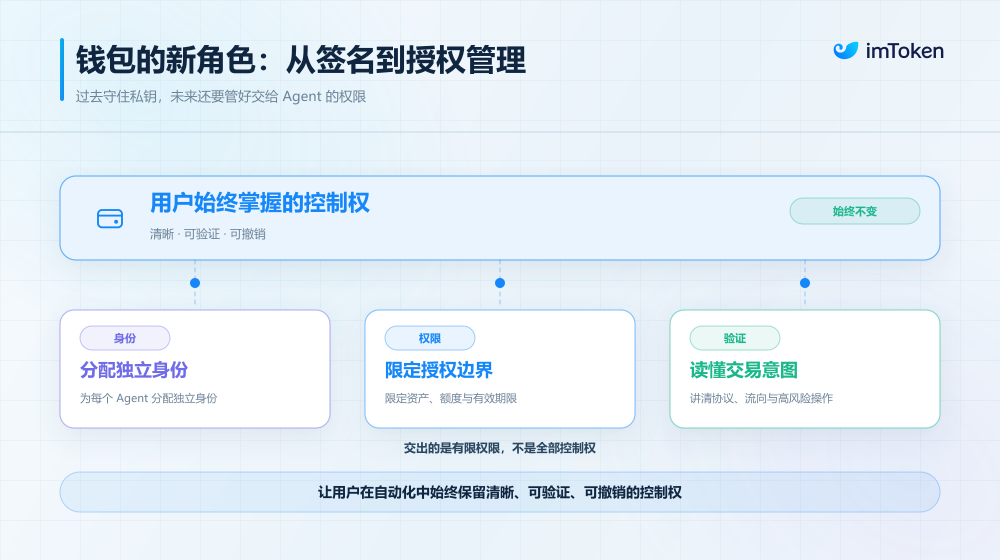
For wallets, the core challenge in the AI Agent era is not just how to support more complex automated operations, but how to ensure that while improving execution efficiency, users always retain clear, verifiable, and revocable control over their assets.
Automation can change how transactions are executed, but it should not change who ultimately controls the assets. This may be the bottom line that crypto security infrastructure must uphold in the AI Agent era.