Only Paper Wealth Is an Illusion? Ray Dalio Reveals the Underlying Logic Behind Bursting Asset Bubbles


- Core Viewpoint: Ray Dalio warns that a strict distinction must be made between "wealth" and "money." Paper assets cannot be spent directly, and bubbles often burst when holders are forced to liquidate; great technology does not equal a great investment, and the current AI frenzy is similar to the historical pattern of the electrification bubble in the 1920s.
- Key Elements:
- Wealth is a paper valuation and must be sold for cash before it can be spent; the market does not have enough money to absorb everyone liquidating at the same time, and tightening liquidity, debt repayment, or tax burdens will trigger a bubble burst.
- The power grid, automobiles, and radio technologies of the 1920s were no less disruptive than today's AI, but after credit leverage pushed valuations higher, they still underwent deleveraging and clearing, with 90% of companies ultimately going bankrupt.
- The five major forces driving history: the money, credit, and debt cycle; internal wealth gaps and political fragmentation; great-power geopolitical rivalry; natural disasters; and technological innovation. We are currently at the end of a long cycle that began in 1945.
- In Connecticut, 22% of high school students drop out or lose contact, and nearly 60% of U.S. adults read below a sixth-grade level. Inequality in educational opportunity is undermining the foundation of social trust.
- Dalio has algorithmized the investment principles of his lifetime, believing that meat-brain decision-making is outdated and that the future belongs to human-machine symbiosis; Bridgewater's "Dot Collector" uses objective data to achieve extreme transparency and an idea-meritocracy mechanism.
- The core trait of an outstanding leader is "knowing what you don't know," and being wary of the arrogance of elite-school test-taking types; life is divided into three major chapters: learning dependence, being depended upon, and free transmission.
Compiled & Edited by: TechFlow
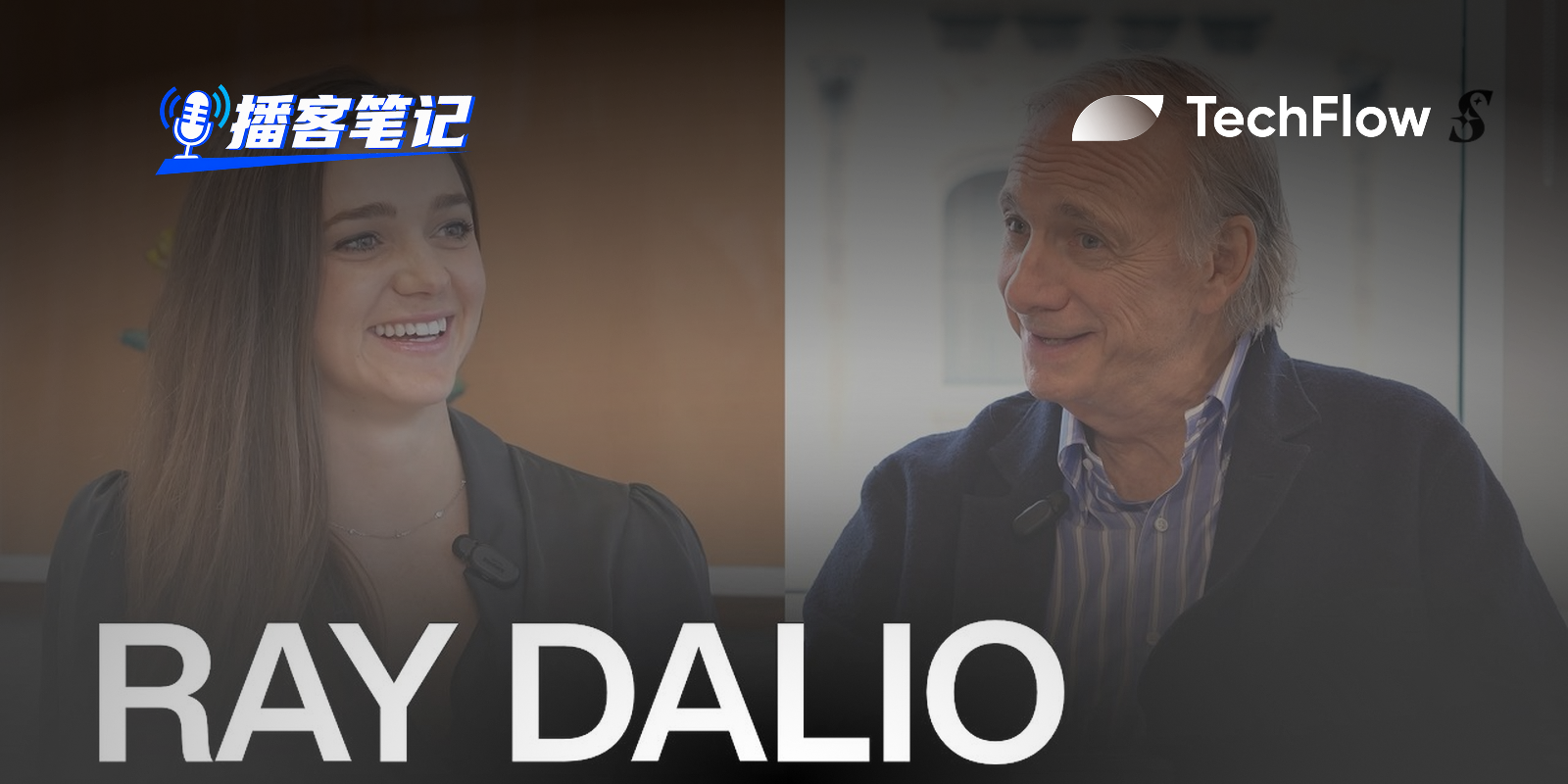
TechFlow Introduction: As the capital markets revel in trillion-dollar AI valuations and wealth-creation myths, Ray Dalio, founder of Bridgewater Associates, the world's largest hedge fund, offered a calm and cycle-penetrating macro warning in an exclusive interview with Sourcery: one must strictly distinguish between "wealth" and "money." Wealth is merely the paper value of assets, and asset bubbles tend to burst completely when wealth holders are forced to sell off assets to cash out for money. From electricity, automobiles, and radios in the 1920s to the internet in 2000, every birth of a great technology in history has triggered concentrated capital frenzy, but ultimately very few have directly translated into great investment returns.
In this 51-minute in-depth interview, Ray Dalio unreservedly laid out the five major macro forces driving historical evolution, America's deep wealth gap and public education crisis, and detailed the AI decision-making system he is building by algorithmizing a lifetime of investment principles and causal logic. He deeply deconstructed how Bridgewater's "Dot Collector" mechanism achieves radical truth and radical transparency, pointed out that the traditional way of the human brain weighing decisions in one's head is obsolete, and explained why exceptional leaders must possess the intellectual humility of "knowing what you don't know." Facing an unknown major historical cycle, he not only restructured macro investment logic but also shared his ultimate reflections on the three chapters of life, sparring with peers, and the meaning of life.
Guest: Ray Dalio (Founder of Bridgewater Associates, author of Principles)
Host: Molly O'Shea (Host of the Sourcery podcast)
Podcast Source: Sourcery with Molly O'Shea (https://www.youtube.com/watch?v=X5FuYnLtB6k)
Original Title: I Finally Interview Ray Dalio
Air Date: Beijing Time: 2026-11-23 22:00
Key Takeaways
The essential distinction between wealth and money: paper valuations are never liquid cash: Wealth cannot be consumed directly; it must be sold and converted into fiat money before it can be spent. It is easy to create paper wealth of $1 billion in valuation through a $50 million investment, but bubbles tend to burst completely when wealth holders face liquidity strain, debt repayment pressure, or rigid tax obligations and are forced to sell off assets to cash out. There is simply not enough money and credit in the market to absorb everyone cashing out at the same time.
Great technology is by no means a great investment; beware of history's relentless repetition: In the 1920s, electricity reached every household, and radios, automobiles, and airplanes became widespread—their technological disruptiveness far exceeded today's AI. But after frenzy triggered blind credit expansion that inflated valuations, when the market faced deleveraging, assets ultimately fell into fragile hands. A market that overbets on the concentration of a single new technology is extremely fragile, and ultimately 90% of companies will go bankrupt and be cleared out amid fierce competition.
The five major macro forces driving historical evolution are at the end of a long cycle: The money and credit/debt cycle, internal political order and wealth gap, external great-power geopolitical rivalry, natural disasters, and technological innovation—these five forces are intertwined. The current global order is at the end of a major cycle that began in 1945; high debt levels and social polarization are testing the resilience of institutions, and history is repeating classic patterns that humanity has experienced countless times.
The wealth gap is not just about wealth disparity but inequality of opportunity and education: Take Connecticut, which ranks among the top in per capita income—a staggering 22% of high school students statewide are on the verge of dropping out or losing contact. If the underclass loses fair access to education and pathways for upward mobility, the foundation of social trust will collapse, and populist antagonism will be inevitable.
The old model of human brain decision-making is obsolete; build a symbiotic system of extraordinary human wisdom and AI: At 77, Ray Dalio is writing a lifetime of investment principles and causal logic into algorithms. The world has become too complex; the "exam-taker" model of weighing things in one's head can no longer cope with a volatile environment. The future belongs to decision-makers who can algorithmize causal logic and achieve symbiotic evolution between machine and human intelligence.
Intellectual humility and confronting ignorance; arrogance and error are humanity's greatest tragedy: True excellence lies not in giving standard answers in traditional exam-oriented education, but in "knowing what you don't know." Bridgewater achieves radical truth and radical transparency through its "Dot Collector" system. Only by embracing thoughtful disagreement can one penetrate bias and reach objective truth.
Key Quotes
"You must distinguish between wealth and money. You cannot consume wealth directly; you must sell it for money before you can spend. Asset bubbles typically burst precisely at the moment when those who own wealth urgently need to sell it to convert it into cash."
"A fatal mistake people often make is mistaking a great new technology for a great investment. In the 1920s, electricity reached every household, and automobiles and airplanes emerged—the technological breakthroughs were more stunning than today's—but assets inflated by blind credit still ultimately suffered devastating liquidation."
"The traditional way of a person weighing pros and cons solely in their own head to make decisions is completely obsolete today. The future belongs to decision-makers who write causal logic into code and achieve symbiotic evolution of extraordinary human wisdom and artificial intelligence."
"Elite education rewards students who memorize and know the answers—that is the worst screening mechanism. Humanity's deepest tragedy is holding arrogant bias while being completely unaware that one is wrong."
"More important than finding a mentor is finding peers who can engage you in thoughtful disagreement. They have different perspectives and can spar with you without false pleasantries until you approach true reality."
"If a person spends their whole life fixated on making money but never thinks about genuine human connection, meaningful work, and meaningful relationships, that is truly incomprehensible."
"So-called spirituality is not religion but empathetic perspective-taking. Recognizing that you are just a small part of the whole and seeing the world through others' eyes is how you attain true lasting health and peace."
"All you really need is a bed, an apartment, and three meals a day. Beyond that, you have complete freedom. Go ahead and try boldly—what actual risk are you really taking?"
Full Conversation Transcript
Origins and Macro Framework: The 500-Year Cycle and the Five Forces Driving the World
Molly O'Shea: Ray Dalio, welcome to the Sourcery podcast! You have always been one of my top 100 dream guests I most wanted to interview. Our show focuses on venture capital, frontier technology, and macro investing. Before we started, we actually chatted and found we have a remarkable connection: we are not only both from Westport, Connecticut, but we also share the same birthday, August 8. Today we are recording at the Pro Se office, and we deliberately placed a shark model behind us as a tribute to your long-standing commitment to ocean exploration. As one of the world's top macro investors, you have been explaining the underlying mechanisms of how the world works. First, to lay the foundation for our entire conversation, could you systematically walk us through the five core forces driving human historical evolution?
Ray Dalio: I'm very happy to speak with you and all the listeners. Indeed, Bridgewater was born in Westport, and it's a wonderful thing to share the same birthday and the same hometown.
As a global macro investor, my job is to see all the variables that could affect markets and the economy, and I must put real money behind those bets. Looking back at my experience, in 1971 I was a clerk on the floor of the New York Stock Exchange. On a Sunday evening, President Nixon suddenly appeared on television and announced that the U.S. would stop converting dollars into gold. At the time, gold was the real fiat money, and this was essentially a debt default, although he didn't use the word default. When I walked into the NYSE trading floor on Monday morning, I expected it to be a huge catastrophe—the stock market would surely crash. But the opposite happened: the stock market rose instead of falling, ushering in a massive surge. I was completely baffled and simply couldn't understand the mechanism behind it.
That drove me to systematically study history. I found that in March 1933, President Roosevelt did exactly the same thing. I thus thoroughly understood the mechanical transmission mechanism of currency depreciation and liquidity injection. I deeply reviewed the Great Depression and the historical period from 1930 to 1945, and that research helped me accurately predict the 2008 global financial crisis decades later. Subsequently, I conducted a cross-cycle study of the past 500 years of human history and found that similar events keep recurring, driven primarily by five core forces.
These five forces have strict physical-mechanical logic behind them: first, the operating mechanism of money, credit, and debt markets; second, internal political order—how we get along with each other, especially the wealth gap and value divides, and how the existing system resolves or fails to resolve these differences; third, the international geopolitical order—in the past we relied on so-called multilateral mechanisms to resolve disputes, such as the United Nations, the WTO, and even the International Court of Justice, but that was actually a naive assumption. As the power of great nations rises and falls, these multilateral constraints have vanished, and we have entered a classic power-rivalry landscape; fourth, the forces of nature—the lives taken and the world reshaped by droughts, floods, plagues, and other natural disasters are far greater than humans imagine and absolutely cannot be ignored; fifth, science and technology—humanity's ability to enhance total factor productivity and change living conditions through learning and innovation, but the key is whether this technology is used for war and destruction or for improving human welfare.
These five forces intertwine and typically form a long-term mega-cycle spanning roughly one human lifetime. 1945 was the starting point of the current new world order. As emerging great powers rise to challenge established ones and global debt snowballs, turbulence follows. History always cycles from disorder to prosperity and rebuilt order, then from prosperity to severe polarization, major conflict, and back into disorder. These five forces interact to form the underlying framework for everything we discuss today.
America's Political Turning Point and Deep Fractures: The Rise of Moderates, the Historical Fate of Extremism, and the Debt Deadlock
Molly O'Shea: Speaking of the most timely topic right now, the U.S. election has just concluded, which is exactly the second force you mentioned. Could you deconstruct from the underlying mechanism what will actually happen next as the U.S. administration changes? In this game, what could be the most unexpected possible outcome?
Ray Dalio: I think we must first recognize a core reality: we have only changed the people handling the problems, but the problems themselves have not changed at all. These problems still objectively exist. We still face a heavy debt crisis, we still face a huge wealth gap and value divide between left and right, and we still face severe challenges such as climate change and geopolitical confrontation. What we have changed is only the specific decision-makers sitting at the table dealing with these challenges.
History repeatedly proves that for a democracy to function smoothly, there is often only one successful path. On the political spectrum, there is left and right—it is a continuum: far left, moderate left, moderate right, and far right. On this spectrum, there is not only confrontation between left and right, but after one side wins an election, fierce infighting also erupts between moderates and extremists within the winning party. We will soon see how they handle real dilemmas—for example, on the economic front, the debt ceiling issue will soon be on the table. Around December 11, related debates will fully erupt, and the game during the transition period will be extremely intense. For example, Elizabeth Warren will likely chair the Senate Banking Committee, and the philosophies of all sides are completely different, so conflicts will continue to escalate.
If there is a most unexpected and also most hopeful outcome, it would be that we truly see a moderate force rising that crosses party lines and can work together. When I look at the swing-state candidates who flipped in this election, the situation is very intriguing: although they are nominally called Democrats, they are nothing like radical leftists with socialist tendencies. Their governing style is almost indistinguishable from moderate Republicans, favoring a rational and pragmatic centrist路线. In fact, America currently has essentially four parties. The only effective way to resolve these conflicts is for moderate Democrats and moderate Republicans to join hands across party lines and jointly suppress the impulses of extremists. Because the vast majority of ordinary people are actually in the moderate middle.
And the biggest political deadlock behind this is: facing unsustainable trillion-dollar debt, no one in either party camp is willing to bear the political cost of raising taxes, and no one is willing to proactively cut public spending.
Molly O'Shea: Do extremists usually eventually revert to the mean? Is extremism merely a political tactic to win elections, or does it persist and solidify?
Ray Dalio: Typically, when divisions have exceeded the threshold of reconciliation—in other words, when factional interests override reverence for and adherence to the political system—the entire system falls into extreme danger. What follows is often some form of civil war or fierce confrontation, until one side completely overwhelms the other and imposes its will on the whole society. In a game composed of four major political factions, once one side achieves a superficial victory, a life-and-death struggle for dominance between moderates and extremists within the winning camp will inevitably erupt. This is exactly the historical stage we are in now.
The Invisible Ulcer Beneath Prosperity: 22% of Connecticut High School Students Lost Contact and the Social Crisis of Inequality of Opportunity
Molly O'Shea: I'd like to follow up on the first force. In our recent interviews, social class antagonism and the wealth gap have become extremely glaring. For example, California's earlier wealth tax proposal sparked massive debate, and socialist thinking is clearly rising across America. I previously interviewed David Friedberg, and you also discussed with him the K-shaped economic divergence and where it's heading. Where exactly is the core root of the wealth gap? How will such enormous debt ultimately end?
Ray Dalio: The core root of all this lies in the severe lack of broad social productivity. When you survey history, if a country wants to remain prosperous and enduring, it must do three or four fundamental things well: first, it must provide all citizens with quality basic education so that the vast majority of the population has productivity skills and maintains basic civility in interpersonal relations; second, whether people can efficiently collaborate to create productivity within the framework of laws and rules, because a nation's standard of living is entirely determined by productivity; third, whether it can stay away from the devastation of war, whether internal divisive civil war or external military conflict. Throughout human history, as long as these three things are done well, a prosperous and strong society can be achieved.
However, over the past few decades, this educational foundation has largely failed. Here's a shocking example: in the United States, nearly 60% of adults have reading comprehension below a sixth-grade level. I have a very intuitive sense of this because I have long lived in Connecticut, and my wife has been committed to helping disadvantaged groups. In Connecticut, which consistently ranks first or second in per capita income in the U.S., a staggering 22% of public high school students are on the verge of completely dropping out or failing academically due to absentee rates exceeding 25%! This means a considerable portion of our society can neither acquire productivity skills nor establish the civility of following rules.
Right-wing capitalists often emphasize: everyone must work hard to create value by their own ability, and self-interest is the greatest motivator. But history shows that when this single logic is taken to its extreme, it inevitably leads to an uncontrollable wealth gap. The Industrial Revolution gave birth to the Gilded Age, produced robber barons, which in turn spawned financial bubbles and the Panic of 190