South Korea's 10 trillion won market rescue: Why isn't it working?


- Key Takeaways: The South Korean government's 10.76 trillion won stock market stabilization fund failed to prevent the KOSPI from falling 3.32%, as the magnitude of external shocks exceeded what any single country's policy response could address, the fund's size has shrunk relative to the market's scale, the absence of the National Pension Service, and the lack of short-selling restrictions all combined to dilute the effectiveness of government intervention.
- Key Elements:
- The KOSPI closed down 3.32% on Monday, with Samsung Electronics falling over 3% and SK Hynix dropping more than 2.5%, as policy signals failed to lift confidence.
- The fund has never actually been deployed since 2008, and was announced as ready to be activated twice—in 2020 and 2022—without ever being implemented, leading to claims that it is a "paper commitment."
- In 2008, the KOSPI traded between 1,000 and 2,000 points; today it stands at 4,000 to 5,000 points. The market's size has expanded several times over, yet the fund's scale has not grown in tandem.
- In 2008, the National Pension Service bought a net 7.4 trillion won over two months to support the market; this time it has little room left to add positions, leaving the government without a key backstop.
- No new short-selling restrictions were included this time—only a three-month special monitoring program was launched—with the primary concern being the impact on the MSCI Developed Markets Index inclusion process.
- The Philadelphia Semiconductor Index plunged 10.7% on the 20th, as the global retreat from AI trades and a systemic correction in semiconductors constitute deep-seated external pressure.
Original author: Zhang Yaqi
Original source: Wallstreetcn
The South Korean government rolled out a stock market stabilization fund worth 10.76 trillion Korean won, yet it still failed to halt KOSPI's continued decline. The magnitude of external shocks, the inherent limitations of the tool itself, and the gap between policy signals and actual actions are together eroding the market effect of government intervention.
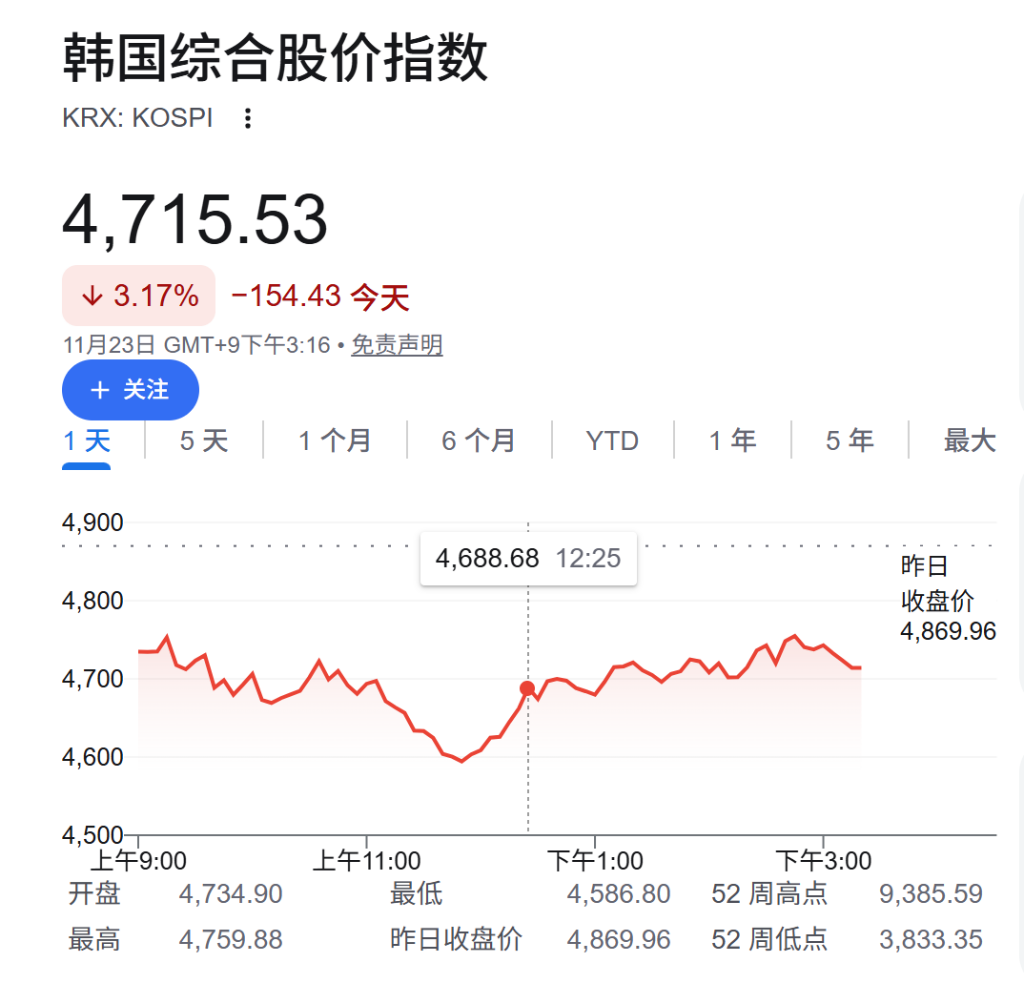
The KOSPI index closed down 3.32% on Monday, with Samsung Electronics falling over 3% and SK Hynix dropping more than 2.5%. This was the market reaction on the day after the South Korean government announced preparations to activate the stock market stabilization fund—a policy signal that was supposed to boost confidence failed to reverse the downturn.
Deputy Prime Minister and Minister of Economy and Finance Lee Hyoung-il chaired an emergency financial market meeting (F4 meeting) on the 22nd and announced the aforementioned measures. The meeting decided that the government will immediately begin preparations to activate the stock market stabilization fund (증안펀드) mechanism, ready to deploy it at any time depending on market conditions. At the same time, the daily cap on share buyback filings by listed companies will be relaxed for three months starting from the 24th, and a three-month special monitoring period for illegal short selling will also be launched.
The market's disappointment has traceable roots. Since the 2008 global financial crisis, the fund has never actually been deployed; it was announced as "prepared for activation" in both 2020 and 2022, but neither ultimately materialized. The current situation differs from those times: the committed scale of 10.76 trillion Korean won has significantly shrunk relative to current market capitalization, the National Pension Fund has limited room to maneuver, and the deeper selling pressure stems from the global retreat in AI trades and the systemic correction in the semiconductor sector—something no single country's policy can hedge against.
Policy Signal Fails to Halt the Decline; the Fund Is Effectively a "Paper Commitment"
South Korea's stock market stabilization fund is jointly funded by financial institutions and securities-related institutions. The 2022 commitment was 10.76 trillion Korean won, of which financial companies contributed approximately 10 trillion won and institutions such as the Korea Exchange contributed about 76 billion won. The fund was first established in 1990 as the "Securities Stabilization Fund" and was subsequently restructured or prepared for activation in 2003, 2008, 2020, and 2022.
However, 2008 was the last case in which the fund was actually deployed. At that time, approximately 515 billion Korean won was injected, while the National Pension Fund made net equity purchases of up to 7.4 trillion Korean won over the two months from September to October 2008, together shoring up the market. In 2020 and 2022, the government similarly announced preparation procedures but never actually intervened—the announcement alone was enough to steer retail investors into net buying and stabilize the index.
This time, the same signal failed to replicate the same effect. According to Chosun Biz, market observers note that the magnitude of the current external shock has exceeded what a single country's injection of trillions of won can address, and the government therefore cannot easily press the deployment button.
Triple Constraints: Pension Fund Capacity, Market Size, and Loss Attribution
The government's action this time is constrained by multiple structural factors.
First, the absence of the National Pension Fund. The National Pension Fund, which played a key supporting role in 2008, is now deemed to have little room for further net buying—the fund has already made substantial net equity purchases during the current administration's term, leaving limited capacity for additional position building. This deprives South Korean authorities of the most important "firefighting" reserve force they had in 2008.
Second, the fund's scale has relatively contracted. In 2008, the KOSPI index traded in the 1,000–2,000 range, whereas it now sits around 4,000–5,000. The market has expanded several times over, but the committed scale of the stabilization fund has not grown in tandem, greatly diminishing its actual intervention capacity. Kim Jin-wook, Chief Korea Economist at Citibank, said that 10 trillion Korean won is already too small for the current market size, and the fund can only indirectly suppress selling pressure at the sentiment level, making it difficult to form a substantive floor.
Finally, there is the risk of loss attribution. A 2023 report by the Korea Institute of Finance noted that if the fund actually buys stocks, some retail investors will lose the opportunity to buy at lower prices. Expanding the contribution ratio of private financial institutions also carries the risk of disputes over unclear liability attribution should losses occur in the future.
Absence of Short-Selling Restrictions Draws Mounting Criticism from Retail Investors
Another notable gap in this package of measures is the absence of new short-selling restrictions. This omission is triggering strong dissatisfaction among South Korean retail investors.
Taiwan previously implemented new rules starting from the 23rd, prohibiting short-selling below the previous trading day's closing price and raising the short-selling margin requirement from 130% to 150%. By contrast, South Korea only announced a three-month special monitoring of illegal short selling by the Financial Supervisory Service and the exchange, without introducing substantive restrictive measures.
According to Seoul Economic Daily, South Korea's reluctance to follow suit is mainly out of concern for its MSCI developed market index inclusion process. South Korea again failed to make the MSCI developed market candidate list in June this year, with regulatory burdens—including short-selling monitoring mechanisms—cited as one of the reasons. Kim Tae-hong, CEO of Growth Hill Asset Management, said that abruptly implementing a comprehensive short-selling ban would deprive foreign investors of hedging tools and could trigger their exit from the South Korean market.
South Korea is not without historical precedent for short-selling restrictions: phased short-selling bans were implemented in October 2008, during the August 2011 European debt crisis, and in March 2020 when COVID-19 broke out. Some market participants expect that if uncertainty persists, authorities may gradually tighten relevant regulations.
Limited Measures Cannot Hedge Against Systemic Correction in Global Tech Sector
The government also announced the relaxation of the daily share buyback cap for listed companies for three months starting from the 24th—a move identical to the six-month similar measure implemented by the Financial Services Commission during the 2020 pandemic. However, since buybacks depend on each company's own judgment, their actual effect during sharp market declines is limited.
The deeper pressure comes from external sources. The Philadelphia Semiconductor Index plunged 10.7% on the 20th, the Dow fell about 2% that day, the S&P 500 dropped nearly 4%, and the Nasdaq fell over 5%, dealing a severe blow to the global AI trade narrative. South Korea, as an economy with highly concentrated semiconductor exports, faces cross-border spillover risks. Lee Hyoung-il warned that volatility in the semiconductor sector could spread to the broader macroeconomic level.
Near-term variables the market is currently watching include: Dell's earnings report to be released on the 24th, and whether it can confirm the conversion of AI server demand into profitability; and the US October PCE data to be released on the 25th—if higher than expected, it will exacerbate market concerns about further monetary tightening and deal a new round of selling pressure to chip stocks.
An unnamed financial investment industry executive, quoted by Seoul Economic Daily, said that intervention measures can only be effective when the government takes substantive, concentrated action and the market has objectively bottomed out. For now, none of these three conditions are met.