Why did $4.3 billion of Claude's extra $5.4 billion in revenue get eaten up by compute costs?


- Key Takeaways: Anthropic was valued at nearly $1.8 trillion on its first day of trading, but every $1 of compute spending corresponds to only $1.72 of revenue—and that ratio keeps declining. The core disagreement is how much of the value created by AI growth can actually be left for model-company shareholders.
- Key Elements:
- Q3 revenue grew by about $5.4 billion quarter-over-quarter, while compute and infrastructure expenses rose by about $4.3 billion over the same period—meaning each additional $1 of revenue came with roughly 80 cents of new compute costs.
- The stock opened 34.3% higher at $111.50 on its first day, then closed down at $97.17; about $15 billion traded in the first minute, and half an hour later it had fallen about 13% from its opening price—the weakest first half-hour for a major IPO since 2008.
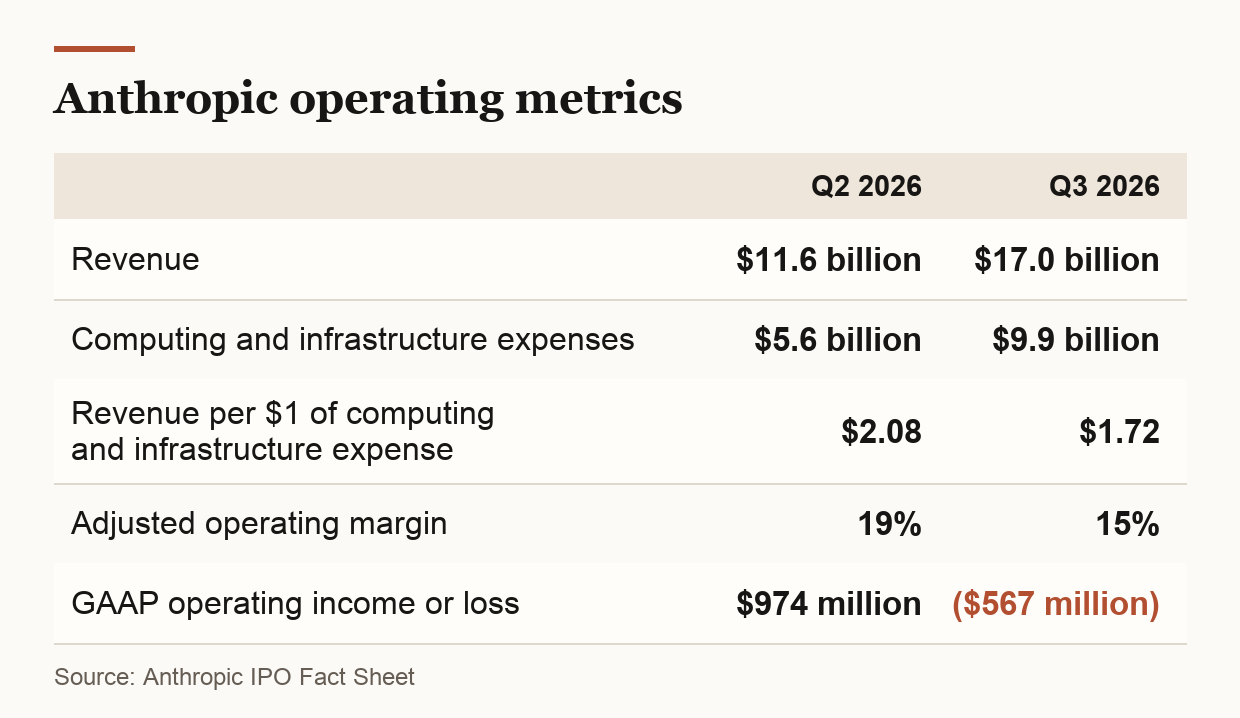
- Revenue per $1 of compute spending fell from $2.08 in Q2 to $1.72 in Q3; adjusted operating margin dropped from 19% to 15%, and under US GAAP it swung to an operating loss of $567 million.
- $5 billion of Q3 compute came from short-term purchases at significantly higher prices, weighing on margins; in the same period last year that ratio was only $0.68, and it is expected to improve once long-term contracts replace temporary capacity.
- Disclosed compute commitments total about $900 billion, of which roughly $70.7 billion matures within 12 months, requiring a steady stream of paying customers to absorb the locked-in capacity.
- Institutions affiliated with Google, Microsoft, Nvidia, AMD, Broadcom, Micron, and TSMC collectively subscribed to $26 billion of private shares at the offering price, creating a double-counting risk between industrial capital and compute orders.
- Economist Anna Wong worries this is the "last wave of fuel" for the AI rally: Claude's unit prices are falling and usage is surging, but its market share has not risen in tandem—gains may flow first to users and compute suppliers.
Author: SoSoValue Research

On November 19, Anthropic listed on Nasdaq. Investors who got in at the $83 offering price made 17.1% by the close; those who bought at the $111.50 opening price lost 12.9% by the close. Both bought the same fast-growing company—the disagreement is over how much that growth is worth.
The prospectus contains a set of figures that explain this divergence better than the first-day gain. In the third quarter of this year, Anthropic's revenue increased by about $5.4 billion quarter over quarter, while compute and infrastructure costs rose by about $4.3 billion over the same period. Based on the book increase across the two quarters, every additional $1 of revenue was accompanied by roughly 80 cents of new compute costs. This ratio can swing widely with the pace of compute procurement and delivery, but it points to the question behind the nearly $1.8 trillion valuation: the more widely Claude is adopted and the more enterprises spend on AI, how much of that profit can be left for Anthropic's shareholders?
$15 Billion in First-Minute Trading, Two Kinds of First-Day Returns
Anthropic opened 34.3% above its offering price, reaching an intraday high of $115.10, a gain of 38.7%. Based on the fully diluted valuation at the opening price, the company's value briefly surpassed $2 trillion, ranking sixth globally in media rankings at the time. The closing price settled back to $97.17, bringing the fully diluted valuation down to about $1.77 trillion, below SpaceX's level at its first-day close.
According to Yahoo Finance, Anthropic traded about $15 billion in its first minute, and half an hour later the stock was down about 13% from its opening price. Among the 21 large U.S. IPOs it compared, this was the weakest first-half-hour performance since 2008. For the company, with shares priced at $83 and a public offering size of about $81.3 billion, it has already set a global IPO record. For buyers who entered only after the open, the first trade cost $28.50 more per share than what allottees paid. The massive first-minute volume recorded the turnover at that premium, and the buying interest willing to sustain that price was quickly put to the test.
The market environment that day also raised the valuation bar. The Nasdaq closed down about 2.3%, the Philadelphia Semiconductor Index fell 2.4%, and rate futures had largely priced in expectations of a 25-basis-point Fed rate hike in December. For companies that must lock in years of compute capacity before gradually recouping their investment, a higher discount rate lowers the present value of future profits. Bloomberg Economics economist Anna Wong worries that this IPO could be the "last wave of fuel" for this round of the AI rally. Her reasoning is more worth discussing than the first-day stock price: by her observation, after the end of September, Claude's actual unit price fell and usage surged, yet market share did not rise in tandem. If more calls come from price cuts, both users and compute suppliers have the opportunity to capture returns ahead of the model's shareholders.
A $5 Billion Short-Term Compute Purchase Changed Quarterly Profitability
Commercial demand for Claude is already considerable. Anthropic's third-quarter revenue reached $17 billion, compared with about $1.4 billion a year earlier. But from the second quarter to the third quarter, revenue rose from $11.6 billion to $17 billion, while compute and infrastructure costs rose from $5.6 billion to $9.9 billion. The company's revenue per $1 spent on compute and infrastructure fell from $2.08 to $1.72. Over the same period, the adjusted operating margin fell from 19% to 15%; under U.S. GAAP, the company swung from operating income of $974 million to an operating loss of $567 million, the latter also including stock-based compensation and non-cash donation expenses.
The turning point came in compute delivery. In the third quarter, $5 billion of compute came from short-term purchases at prices significantly higher than comparable long-term agreement rates. When demand suddenly rises, buying high-priced compute in time can accommodate customer business, at the cost of pressuring quarterly margins. Signing long-term contracts in advance can lower unit costs, but leaves another risk with Anthropic: once capacity is delivered, the company must still honor its purchase commitments even if customers switch to cheaper models or slow their deployment.
This is also the most substantial basis for the bulls. In the same period last year, every $1 of compute and infrastructure costs corresponded to only $0.68 of revenue; by the third quarter of this year, that had reached $1.72. As long-term procurement replaces expensive temporary capacity, as long as paid usage is enough to fill the new capacity, revenue and margins have a chance to grow together. Conversely, if competition forces Anthropic to keep cutting prices, the savings from procurement could be passed on more to customers. Post-IPO financial reports will, for the first time, let investors compare quarter by quarter which of these two forces prevails.
The Same Compute Contract Has Two Values on Two Companies' Books
As of the end of September, Anthropic disclosed compute commitments of about $900 billion, of which about $70.7 billion will come due within the following 12 months. For the companies providing capacity, long-term contracts increase the visibility of future orders; for Anthropic, the contracts lock in supply and also require it to keep finding customers willing to pay. Both sides may profit from Claude's growth, but on the day the order is signed, the supplier already has another piece of business, while Anthropic still has to sell that capacity.
The interests of both sides are also linked through equity. Investment arms of Google, Microsoft, Nvidia, AMD, Broadcom, Micron, and TSMC agreed to subscribe to a total of $26 billion in concurrent private placement shares at the offering price. Industrial partners' willingness to contribute strengthens Anthropic's ability to fulfill its procurement plans; for companies that both supply and hold shares, new orders bring revenue opportunities, and the model company's valuation fluctuations also affect investment returns. Treating both the private placement subscriptions and the compute orders as evidence of end-demand growth makes it easy to count the role of the same industrial capital twice.
Software companies are in a more delicate position. For a tool that charges per seat, if some functions can be performed directly by Claude, customers have reason to push for lower prices or reduce seats at renewal. Another software vendor that controls customer data, approval authority, and delivery processes may use the same model to lower service costs and keep the savings on its own income statement. What determines the outcome is who controls the customer relationship and who the contract allows to charge for the efficiency brought by automation.
Products tracking this divergence have also emerged in the market. According to SoSoValue, SoDEX has launched $ANT spot and perpetual contracts. SSI simultaneously introduced two observation indices tracking the business opportunities and competitive pressures brought by Claude's adoption. ANTBEL tracks suppliers and partners expected to benefit, while ANTHAT tracks companies facing competitive pressure from frontier AI models. The relative performance of the two groups of companies provides an angle for observation, and subsequent financial reports can test the expectations reflected in stock prices: how many profitable orders the former group has added, and how many customers and pricing power the latter group has retained at renewal.
For Anthropic, the benchmark left by its first trading day is not only the $97.17 closing price, but also $1.72 of revenue per $1 of compute costs. In the coming quarters, if short-term purchases decline, this ratio rebounds, and operating margins improve at the same time, the nearly $1.8 trillion valuation will have an additional operating support. If Claude usage continues to hit new highs while these metrics keep weakening, then AI's commercial value is still expanding—only more of the gains are landing in the hands of suppliers and customers.