With the Democrats poised to take power, which sectors will benefit first?


- Core View: As the new Democratic-controlled Congress is about to take office, healthcare, consumer, and clean energy sectors are expected to be beneficiaries of favorable policies. However, amid high market volatility, investors should carefully time their entries and watch for liquidity risks.
- Key Points:
- The healthcare sector has deep ties to the Democrats' "Obamacare," with hospital stocks such as UHS and HCA rising 5.05% and 2.91%, respectively, between November 3 and 18.
- The consumer sector has drawn attention due to voters' dissatisfaction with rising prices, with Clorox and Tyson Foods gaining 15.55% and 12.80%, respectively, over the same period.
- The clean energy sector stands to benefit from a possible easing of U.S.-Iran tensions, but internal divergence is severe, with solar-related stocks broadly posting sharp declines.
- Historical experience shows that U.S. stocks have risen after each of the past five midterm elections through the new Congress taking office, but the risk that "this year is different" remains.
- Anthropic's upcoming IPO could trigger a short-term liquidity crunch, and combined with Fed rate-cut expectations, investing may become even more challenging before January next year.
Original | Odaily@OdailyChina)
Author | Wenser (@wenser 2010 )

There are roughly 40 days left before the new Democratic Congress takes office. Although many individual stocks are still declining, the market is also filtering out a new round of rising targets amid volatility and recovery. Previously, in the article "After the Democrats Take Both Chambers, Who Will Succeed Nvidia as the Next 'Victim'?", we discussed potential targets affected by "Democratic negatives." Today, we will start with potential targets affected by "Democratic positives" and attempt to identify sectors and individual stocks that may rise going forward.
Of course, historical experience tells us that even though the U.S. stock market has been in an uptrend after each of the past five midterm elections leading up to the seating of a new Congress, the curse of "whether this year is different" will still hover over every high-risk, high-volatility capital market. No one can predict the future; we can only make limited judgments based on available information. The following is for discussion and sharing only, does not constitute investment advice, and please DYOR (do your own research) in all things.
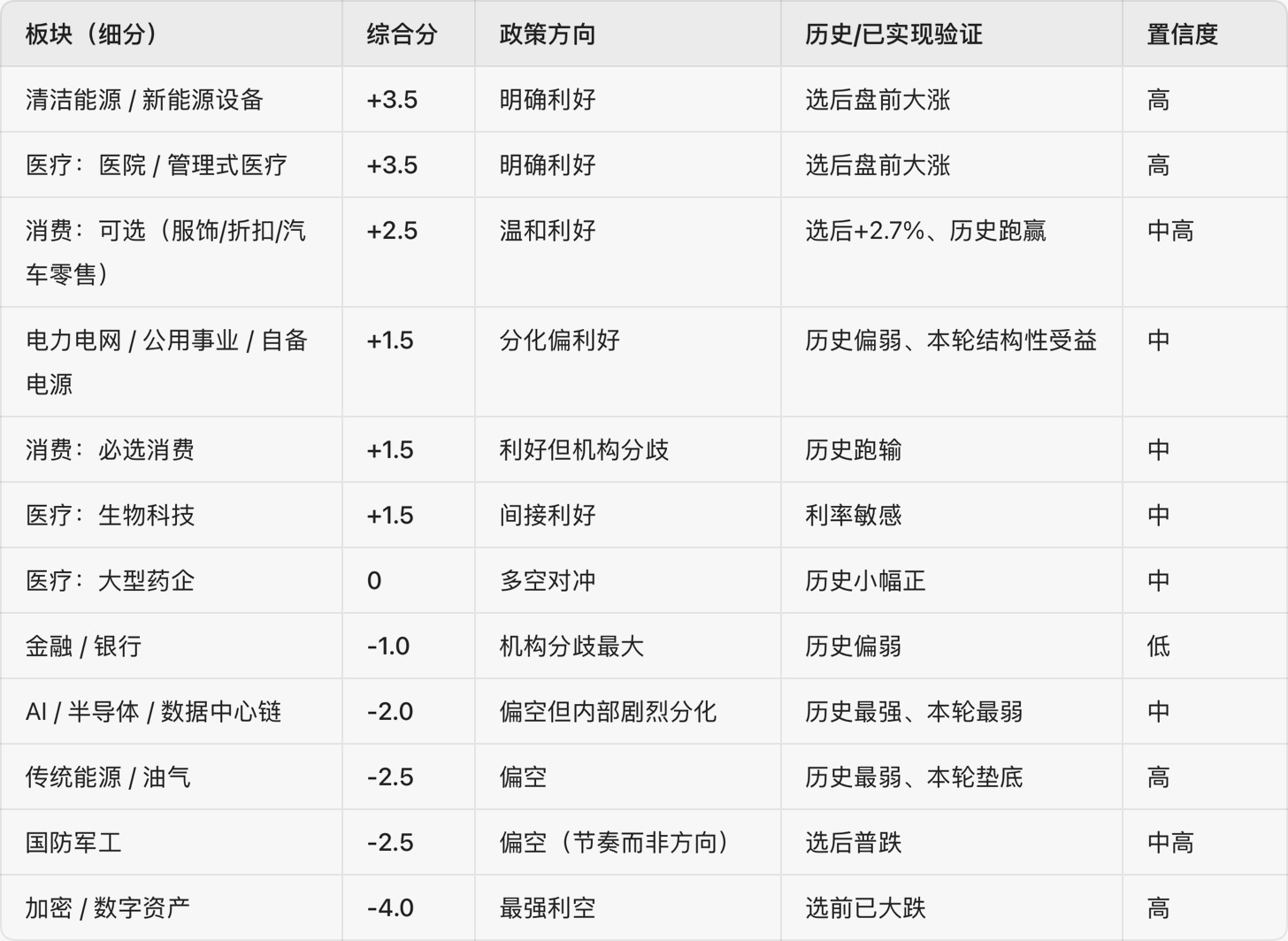
Sectors Concentrated in "Democratic-Style Positives": Healthcare, Consumer, Clean Energy
In the previous article, we briefly mentioned that after the Democratic Party formally becomes the majority party in Congress, the potentially favored sectors are mainly concentrated in healthcare, consumer, and some defense and security stocks. Representative stocks are as follows:
- Consumer stocks: Walmart (WMT), Costco (COST), Procter & Gamble (PG), Coca-Cola (KO);
- Healthcare stocks: Merck (MRK), Eli Lilly (LLY), Johnson & Johnson (JNJ), UnitedHealth (UNH);
- Defense and security stocks: Palantir (PLTR), among others.
Looking at recent data after the midterm elections, the clean energy sector is expected to become a beneficiary after the Democrats formally take office. Of course, individual stocks such as Tesla (TSLA), which are labeled as part of the "Trump faction," are still unlikely to benefit directly. Specifically, the general logic is as follows:
Healthcare: The Democratic Party's "Conventional Political Weapon"
As one of the Democratic Party's focal points, the healthcare sector has long been closely tied to the Democrats through "Obamacare," and this was also one of the important areas where many Democrats sought to consolidate their voter base and push back against Republican governance during this midterm election.
Therefore, the healthcare sector is expected to be among the first to post gains after the Democrats become the majority party in Congress. In addition to the healthcare giants mentioned above, hospital-related stocks are also worth long-term attention (the following data show percentage changes from November 3 to November 18):
- Universal Health Services (UHS): +5.05%
- HCA Healthcare (HCA): +2.91%
- Tenet (THC): +1.74%
- Molina (MOH): -0.62%
- Centene (CNC): -0.04%
- Elevance (ELV): -3.12%
Consumer: The Democratic Party's "Tool for Maintaining Stability"
One important reason the Democrats were able to win both chambers of Congress by a wide margin over the Republicans in this midterm election was the rising consumer prices after Trump took office and launched strikes against Iran. The American public urgently needs and hopes that the new Congress can exercise some control over consumption, prices, and the cost of daily necessities in order to reduce the cost of living. In light of this, in addition to the related targets mentioned above, other representative consumer stocks are also expected to rise (the following data show percentage changes from November 3 to November 18):
- Clorox (CLX): +15.55%
- Tyson Foods (TSN): +12.80%
- Domino's Pizza (DPZ): +9.42%
- MGM Resorts (MGM): +8.77%
- Airbnb (ABNB): +7.94%
- Amazon (AMZN): +6.80%
- McDonald's (MCD): +4.18%
- Starbucks (SBUX): +4.14%
Clean Energy: A Beneficiary Sector After U.S.-Iran Tensions Ease
The U.S.-Iran conflict will be another major issue that the Democratic Congress will need to address soon after taking office. Although Trump as president still holds powers such as foreign affairs, military authority, and pardons, once the Democrats block him on fiscal matters, personnel appointments, and legislation, Trump will undoubtedly find himself isolated and unable to hold things together, and the U.S.-Iran conflict may also quickly come to an end or reach a phased ceasefire. In light of this, falling prices for oil and other energy sources will, on the one hand, drive a rebound in the share prices of many airlines; on the other hand, it may also反过来 promote a rebound and rise in the share prices of clean energy-related companies. Representative targets are as follows (the following data show percentage changes from November 3 to November 18):
- NeoVolta (NEOV): +6.49%
- Clean Energy Fuels (CLNE): +5.13%
- Ameresco (AMRC): +5.12%
- Energy Vault (NRGV): +4.98%
- Wolfspeed (WOLF): +1.61%
- SOLV Energy (MWH): +1.45%
- ReNew Energy Global (RNW): +1.02%
- Brookfield Renewable Partners (BEP): +0.79%
- Elevra Lithium (ELVR): +0.45%
It is worth noting that divergence within the clean energy sector is also quite severe. In addition to the stocks above that have risen, solar-related names including Invesco Solar ETF (TAN), Nextpower (NXT), First Solar (FSLR), Canadian Solar (CSIQ), Sunrun (RUN), Plug Power (PLUG), and Enphase Energy (ENPH) have all fallen sharply. Subsequent stock selection within the sector requires particular caution.
Finally, Anthropic is about to complete its IPO and open for trading. In the short term, the U.S. stock market may face a wave of liquidity tightening. Combined with the impact of expectations for Federal Reserve rate cuts, during the period through January next year, the difficulty of capital market investing faced by retail investors and institutions may further escalate. The only thing we can do is protect our principal and time our entry.