Who can officially succeed Jensen Huang?


- Core Viewpoint: Jensen Huang suddenly resigned as NVIDIA CEO due to scandals and compliance investigations. Prediction markets show that internal veteran Buck (30%) and interim CEO Kress (17%) together have a combined win probability of nearly half, leaving the board facing a trade-off between internal stability and an external breakthrough. The new leader must answer whether NVIDIA can operate without the founder's personal heroism.
- Key Elements:
- Jensen Huang resigned as President, CEO, and director with immediate effect; CFO Kress serves as interim CEO and has launched a global search for a successor.
- Polymarket odds: "Father of CUDA" Buck leads at 30%, followed by Kress at 17%, with external candidates Arm CEO Haas and Apple hardware executive Srouji each at 12%.
- The advantage of an internal promotion lies in seamless integration with the CUDA ecosystem and customer roadmaps and in protecting the flat engineer culture; the shortcoming is a lack of experience running a multinational giant as top executive and of handling geopolitical challenges.
- An external hire can bring mature governance and crisis PR capabilities, but faces risks of cultural rejection, loss of core talent, and a six-month to one-year strategic gap.
- Poaching from peers is constrained by three barriers: trade secret litigation and a 1-2 year garden leave, global antitrust review, and the high buyout cost of hundreds of millions of dollars in unvested equity.
- NVIDIA holds more than 80% of the data center AI accelerator market, is at a critical juncture of ramping Blackwell production and developing Rubin, and carries $164.5 billion in data center financial commitments.
Original | Odaily (@OdailyChina)
Author | Azuma (@azuma_eth)

Jensen Huang, the soul figure and co-founder who led Nvidia for 33 years, has abruptly departed in a way that neither Silicon Valley nor Wall Street anticipated.
Amid the fallout from multiple recent extramarital affair scandals and a potential national security compliance investigation, Nvidia officially announced on Thursday local time (November 12) that Jensen Huang has resigned from his roles as President, Chief Executive Officer, and member of the Board of Directors, effective immediately. To steady the ship, Nvidia's board swiftly appointed Colette Kress, the company's Chief Financial Officer of 13 years, as Interim CEO (while retaining her CFO role; given Kress lacks an engineering technical background, the outside world widely views her as a transitional option only), and engaged a top external executive search firm to comprehensively launch the process of selecting a permanent successor.
Who will ultimately inherit that leather jacket symbolizing global AI computing supremacy? This is undoubtedly one of the topics the market cares about most right now.
US President Trump publicly called out on social media this morning, endorsing former Apple CEO and current Executive Chairman Tim Cook to take the helm; meanwhile, financial media outlets such as Bloomberg are actively compiling candidates spanning internal executives, chip industry peers, and cloud giants; and on the prediction market Polymarket, the number of potential successors to Jensen Huang has already grown to 24.
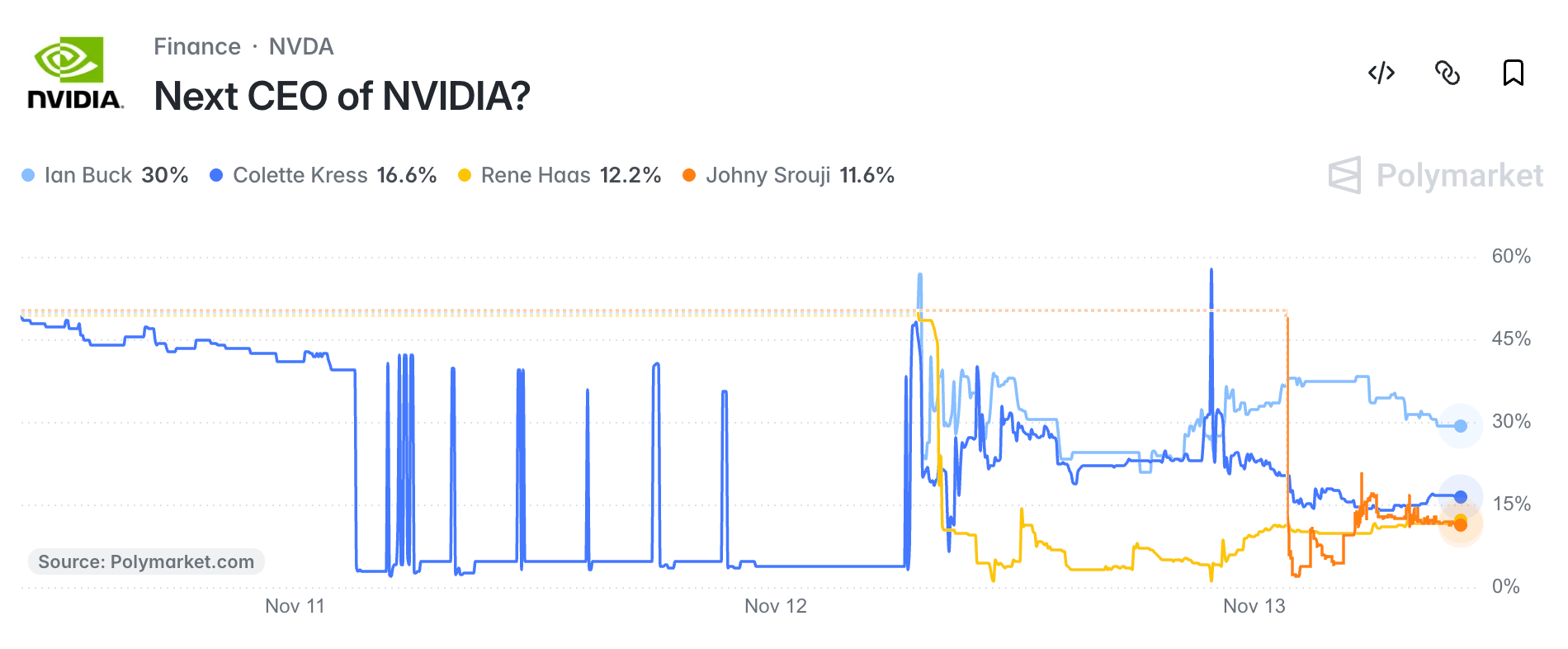
This article will use prediction market probabilities as a baseline to profile the ten most likely candidates to succeed Jensen Huang, and analyze the potential pros and cons of choosing an internal promotion versus an external hire.
Full Rundown of the Top Ten Potential Candidates
Based on industry roundups from various media outlets and the latest odds data on prediction markets, Nvidia's headhunting scope has been divided into three camps: internal core veterans, external semiconductor heavyweights, and "legendary wildcards" endorsed by the political and business establishment.
Internal Promotion Track: The Preferred Choice for Stabilizing the Base
Because Jensen Huang long practiced a flat management structure and did not appoint a group deputy, Nvidia internally developed a multi-vertical structure with software, finance, networking, sales, and frontier research operating in parallel. The heads of these different verticals are all viewed as hot candidates at present.
- Ian Buck — Vice President of Hyperscale and High-Performance Computing at Nvidia

Polymarket win probability (as of 10:20 Beijing time on November 13; same below): 30%, currently the top favorite.
Core strengths: Widely recognized in the industry as the "Father of CUDA." He has served at Nvidia for over 20 years and personally led the software revolution that transformed GPUs from graphics cards into general-purpose parallel computing platforms, and was the core driver behind Nvidia's data center business growing from zero to hundreds of billions of dollars.
Succession rationale: Nvidia's true moat is not just chips, but the deeply coupled CUDA software-hardware ecosystem. Buck has intimate knowledge of the company's technology roadmap (from Blackwell to the subsequent Rubin architecture), and his succession would maximally reassure the internal R&D army and core cloud vendor customers.
- Colette Kress — Interim CEO and Chief Financial Officer of Nvidia

Polymarket win probability: 17%, currently ranked second
Core strengths: Recruited in 2013 by Jensen Huang personally, who sketched AI blueprints on a whiteboard to bring her on board; she previously accumulated nearly 25 years of finance and operations experience at Microsoft (where she served as CFO of the Server and Tools division), Cisco, and Texas Instruments. During her tenure, she accompanied Nvidia through more than 50x annual revenue growth and is the "financial megaphone" for Nvidia that Wall Street knows best and trusts most.
Succession rationale: During a sensitive period when the founder's personal scandal has triggered a corporate governance crisis and the company faces up to $164.5 billion in data center financial commitments and the US-China chip export control standoff, Kress carries extremely high capital market credibility and is the safest card for achieving a smooth transition.
- Michael Kagan — Chief Technology Officer (CTO) of Nvidia

Polymarket win probability: 4%
Core strengths: A top Israeli computer architect who spent 16 years at Intel early in his career (where he led the Pentium MMX architecture), and co-founded high-speed networking giant Mellanox in 1999, serving as CTO for over 20 years. After Nvidia acquired Mellanox for $7 billion in 2020, Kagan became Nvidia's CTO, overseeing Nvidia's largest R&D base outside the US (the Israel R&D center).
Succession rationale: The bottleneck for massive AI clusters has long shifted from "single-card compute" to "high-speed interconnect" (InfiniBand and NVLink). Kagan is the chief architect who defined the modern data center as "a giant computer" (AI factory), and his succession would align closely with Nvidia's technical mainline of transforming into a full-stack systems company.
- Jay Puri — Former Executive Vice President of Worldwide Field Operations at Nvidia, now Senior Advisor

Polymarket win probability: 3%
Core strengths: Nvidia's internal "evergreen number two" and head of monetization. He holds a master's in electrical engineering from Caltech and an MBA from Harvard Business School. After 22 years at Sun Microsystems, he joined Nvidia in 2005 and led global sales, key account relationships, and regional markets for 21 years.
Succession rationale: He is one of the rare veterans on Nvidia's executive team who combines a deep engineering background with global business development acumen, dealing directly with sovereign AI buyers and hyperscale cloud vendors worldwide, and is familiar with the business maneuvering behind every multi-billion-dollar deal. However, Puri has recently stepped back from active management and transitioned to a senior advisory role this fall, which reduces the likelihood of his direct appointment as CEO.
- Bill Dally — Chief Scientist and Senior Vice President of Research at Nvidia

Polymarket win probability: 2%
Core strengths: A titan in the global computer architecture field and former chairman of Stanford's Computer Science Department. Since joining Nvidia in 2009, he personally built NVIDIA Research and led nearly all the foundational technology breakthroughs that underpin today's AI supremacy, including Tensor Cores, NVLink high-speed interconnect, and low-precision inference.
Succession rationale: As the company's "technical brain" and a member of the President's Council of Advisors on Science and Technology (PCAST), Dally enjoys immense prestige in academia, government, and engineering circles, and is the spiritual totem for maintaining Nvidia's foundational technology generation gap over the next decade.
External Hire Options: Top Technical Luminaries from the Semiconductor World
If the board decides to seek outside help, the prediction market has concentrated its bets heavily on three chip giant executives who understand hardware, understand architecture, and can grip TSMC's capacity lifeline.
- Rene Haas — CEO of Arm

Polymarket win probability: 12%, tied for first among external candidates
Core strengths: Combines public company CEO experience with "former Nvidia executive" pedigree. He served as Vice President and General Manager of Nvidia's computing products business from 2006 to 2013, a seven-year tenure; after taking the helm at Arm, he successfully led the company through its IPO and its transformation toward data center and AI computing foundations.
Succession rationale: He understands Nvidia's unique internal culture while also commanding ecosystem resources in global mobile and server CPU architecture (Nvidia's Grace CPU is based on Arm architecture), making him a rare "inside-outside" candidate.
- Johny Srouji — Chief Hardware Technology Officer (Senior Vice President) at Apple

Polymarket win probability: 12%, tied for first among external candidates
Core strengths: The architect of Apple's custom silicon empire (Apple Silicon, encompassing the A-series and M-series chips), with unmatched iron-fisted execution in advanced process architecture design, software-hardware integration, and control of TSMC's core capacity.
Succession rationale: Nvidia is in an extreme R&D cadence of "one iteration per year" and is heavily dependent on TSMC's advanced packaging and wafer capacity. Srouji's engineering prestige and supply chain control align closely with Nvidia's hardware foundation needs.
- Lisa Su — Chair and CEO of AMD

Polymarket win probability: 4%
Core strengths: PhD in electrical engineering from MIT and the semiconductor industry's recognized "iron lady of business." After taking over a near-death AMD, she dealt a heavy blow to Intel in the data center market with Zen-architecture CPUs and launched the MI series AI accelerators, becoming the only rival currently capable of directly challenging Nvidia in the AI computing market.
Succession rationale: In terms of pure technical depth, supply chain rallying power, and business boldness, Lisa Su is arguably the only chip leader globally who can stand on equal footing with Jensen Huang (the two also share a distant cousin relationship). But as the commander of the archrival, this option reflects more the market's speculative wishful thinking, with enormous practical obstacles.
"Legendary Wildcards" Backed by the Political and Business Establishment: Former Big Tech Chiefs
Jensen Huang's resignation this time involves not only personal morality but also congressional and FBI scrutiny of potential national security risks. As a result, two godfather-level Silicon Valley figures with top-tier political and business finesse have also entered the top ten in odds.
- Tim Cook — Former CEO and current Executive Chairman of Apple

Polymarket win probability: 5%
Core strengths: Trump's anointment — After Jensen Huang's resignation, US President Trump publicly named him on social media on Thursday: "Since the extremely outstanding Nvidia CEO Jensen Huang has resigned, there is only one person who can take his place, and that is Apple's Tim Cook. One legend replacing another legend."
Succession rationale: At Apple, Cook proved how, after a legendary founder (Steve Jobs) departed, he could leverage极致 global supply chain control, steady financial discipline, and political-business lobbying finesse among great powers to propel a tech company to the pinnacle of multi-trillion-dollar market value.
- Eric Schmidt — Former CEO and Executive Chairman of Google

Polymarket win probability: 2%
Core strengths: Silicon Valley's most famous "Adult Supervision." In 2001, he parachuted into Google as CEO for a decade, mentoring two young founders in building Google from a startup into a global internet hegemon; after stepping down, he remained long active in Washington defense and AI policy circles (having served as chairman of the National Security Commission on Artificial Intelligence) and invested deeply in the AI sector.
Succession rationale: Some Wall Street research institutions point out that Nvidia's biggest pain point right now is that the 60 direct reports Jensen Huang left behind lack the prestige to handle political storms from Wall Street and Washington. Schmidt understands hyperscale AI strategy and possesses deep Pentagon and White House connections, making him an excellent transitional commander to help Nvidia quell the national security investigation storm.
Internal Promotion vs. External Hire: The Board's Weighing of Pros and Cons
Nvidia is not a company that follows a conventional professional manager system. Over the past 33 years, Jensen Huang built an extremely distinctive organizational structure — highly flat management, engineering agility governed by "speed of light" principles, and deep software-hardware integration. This has turned the direction of the headhunt into a complex game.
If "internal promotion" is chosen (such as Buck, Kress, or Kagan), the biggest advantages lie in "stability" and "speed."
On one hand, there is seamless continuity in technology roadmap and customer expectations. Nvidia is currently at a critical juncture of ramping Blackwell architecture production and intensively developing the Rubin architecture, and internal core veterans need not spend months re-understanding the complex CUDA software stack and NVLink network architecture. At the same time, hyperscale cloud vendors such as Microsoft, Google, and Meta have long dealt directly with Buck, Puri, and Kress on product roadmaps and multi-billion-dollar orders; having an insider take over would minimize large customers' wait-and-see sentiment and transition friction costs.
On the other hand, there is the protection of Nvidia's unique engineer culture. External executives are often accustomed to the hierarchical and bureaucratic management processes of traditional tech giants; once forcibly implanted, they could easily damage Nvidia's proud flat, agile decision-making; internal veterans, by contrast, are naturally adapted to this high-intensity, engineering-driven operating mode and can maximally steady the R&D army's morale.
But the shortcomings of internal promotion are equally obvious. First, there is a lack of the comprehensive command experience of a public company "number one," whether it is the technology-and-business-oriented Buck and Kagan or the finance-oriented Kress, none has previously independently helmed a multinational tech empire approaching $4 trillion in scale, and all lack direct experience in handling complex geopolitical maneuvering, congressional national security reviews, and global antitrust regulation; second, there is the difficult issue of internal factional power balance, in the past Jensen Huang could single-handedly oversee 60 executives by virtue of his absolute authority as co-founder, but now if one person is promoted from among originally peer-level senior vice presidents, the slightest misstep could break the delicate internal power balance.
Moreover, in the face of encirclement by cloud vendors' custom chips (ASICs), internal custodians tend to fall into path dependency and lack the boldness to leap outside the original framework and disrupt the business model.
Conversely, if "external hire" is chosen (including peer technical luminaries or other big tech chiefs), what the board values is "breakthrough" and "reshaping."
The core advantage first lies in mature giant-corporation governance finesse and crisis PR capability. External leaders like Haas, Cook, and Schmidt have long proven in capital markets their ruling power to independently steer ultra-large enterprises. This Nvidia leadership change stems from the founder's personal scandal and a potential national security compliance crisis; bringing in an external CEO with a formidable track record and outstanding prestige would not only quickly reassure shell-shocked Wall Street institutional investors but also send a strong signal to the outside world that "corporate governance has thoroughly turned the page and no longer relies on a single founder's aura."
At the same time, cross-industry DNA is also expected to shore up Nvidia's weaknesses — if an Apple-affiliated executive (Srouji or Cook) is brought in, chip foundational design and TSMC supply chain control could be pushed to the extreme; if a political-business godfather (Schmidt) or a cloud giant executive is brought in, Washington relations could be swiftly repaired or the transformation into a full-stack cloud service provider accelerated.
However, an external hire is also a