Jensen Huang Exposed in Another Affair with a Subordinate, Probability of Leaving Nvidia by Month-End Nears 90%


- Core Viewpoint: Jensen Huang faces board discussions about his future at Nvidia following two consecutive revelations of extramarital affairs, with market bets on his departure probability soaring to 88%-93%. However, the company lacks a clear succession plan, and the founder's personal influence is difficult to replace.
- Key Elements:
- The New York Times reported that Jensen Huang had an extramarital affair with Kimberly Powell, Nvidia's Vice President of Healthcare, and the two were photographed in intimate interaction during the GTC conference. Neither party has responded.
- Nvidia's board is considering convening a meeting to discuss Jensen Huang's future, and plans to appoint an interim leader and select candidates for a new CEO.
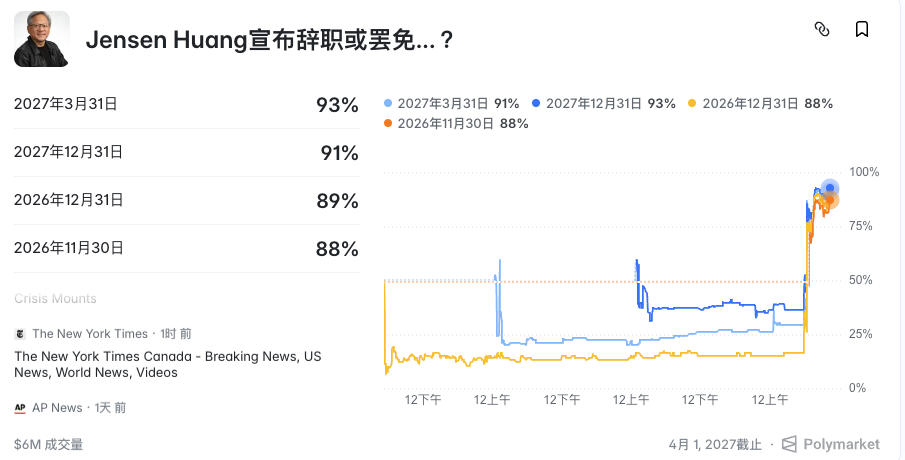
- Polymarket data shows the probability of Jensen Huang leaving before November 2026 has risen to 88%, and reaches 93% before March 2027.
- The news triggered sharp stock price fluctuations, with Nvidia falling more than 10% at one point in after-hours trading, erasing over $300 billion in market value and dragging down AI stocks including Intel and Dell in tandem.
- Nvidia adopts a flat management structure, with approximately 36 executives directly reporting to Jensen Huang. The company has no clear succession plan, and the founder's personal influence and role as the face of the company are difficult to replace.
Original |Odaily@OdailyChina)
Author|Golem(@web3_golem)
No sooner has one storm subsided than another rises. The scandal over Jensen Huang's affair with Alice Huang, an executive at Singapore data center company Megaspeed, has yet to be fully resolved, and the media has already unearthed a second extramarital relationship. According to The New York Times, Huang also had an affair with Kimberly Powell, an internal executive who is likewise married.
More seriously, because of his continued entanglement in multiple extramarital affairs, Nvidia's earlier statement that the matter would not affect Huang's continued tenure as CEO has now been rendered void. According to The Wall Street Journal, Nvidia's board of directors is considering convening a meeting on Wednesday local time to discuss Huang's future, and is weighing appointing an interim head first while working with external firms to select candidates for a new CEO.
Although the board's decision has not yet been finalized, market bets on Huang's departure or removal have soared. According to Polymarket data, the probability of Huang leaving before November 30, 2026, has risen to 88%, and the probability of his departure before March 31, 2027, has climbed to 93%.
Musk is still backing Huang. On November 12, Musk responded on social media to zerohedge's post "Elon, please hire Jensen," saying: "That would be an honor."

The combination of dual negative news quickly triggered violent swings in Nvidia's stock price. On Wednesday, Nvidia shares closed up 2.87%, but in after-hours trading they fell by more than 10% at one point, wiping out over $300 billion in market value and dragging down other AI stocks as well, with Intel, Dell Technologies and others declining in tandem.
The market may not have fully digested the chain reaction set off by Huang's private life. Huang and Nvidia have not publicly confirmed or denied the second affair, and Nvidia has long lacked a clear succession plan. If Huang is indeed forced to step down, an interim successor newly installed would be unable to carry the banner, potentially dealing an even bigger blow to Nvidia's business and stock price.
A Married Female Executive, 15 Years Younger Than Huang
The woman The New York Times latest reported as having an affair with Huang is Kimberly Powell, Nvidia's Vice President of Healthcare. The report said the two were photographed "interacting intimately" at a hotel in San Jose during Nvidia's GTC developer conference in March this year; the video has not surfaced online (bystanders recorded it on their phones, and Huang's security personnel intervened and attempted to have them sign non-disclosure agreements). Huang, Nvidia and Kimberly Powell herself have all not responded to the matter.
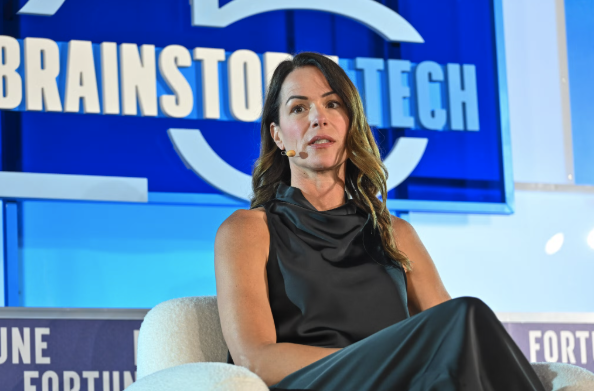
Kimberly Powell
Kimberly Powell is 48 this year, 15 years younger than Huang, and is one of roughly 60 direct reports to Huang. Powell joined Nvidia in 2008 and has been with the company for more than 18 years. She is the key figure who grew Nvidia's healthcare business from an early niche project into a major operation. She initially focused on advancing GPU applications in medical imaging, was promoted to Vice President of Healthcare in 2017, and is responsible for the global healthcare business, covering applications of accelerated computing, AI and visualization platforms in medical imaging and other fields.
As for her personal background, according to media reports, Kimberly Powell is married and has two children. Companies generally prohibit employees or supervisors and subordinates from developing improper relationships, and Nvidia is no exception. Nvidia's code of conduct states that employees should "avoid any situation that could create a conflict," including "personal relationships."
If it is confirmed that Huang, as Nvidia's CEO, took the lead in violating the company's code of conduct, it would have a serious negative impact on the company's image and the establishment of future leadership. Given the board's broader considerations, Huang may have no choice but to leave this time.
Huang Has No Replacement
But if Huang really does leave, Nvidia's board will probably face an even more headache-inducing question: who takes over?
Internally, Nvidia is not short of executives. CFO Colette Kress, Executive Vice President of Worldwide Field Operations Jay Puri, and Executive Vice President of Operations Debora Shoquist are all veterans who have spent years deeply engaged in their respective fields. But the problem is that whether these people can take over Nvidia and whether they can succeed Huang are two different things.
Nvidia has always adopted a rather unusual management approach. According to reports, the number of executives directly reporting to Huang once reached 55, and later remained at about 36. This leaves the company with very few management layers and highly efficient decision-making, but conversely, this structure also makes Huang the center of the entire management system. Business heads can each hold their own, but no one can coordinate all the businesses together—except Huang.
Unlike leaders of other major companies, Huang seems to have never seriously prepared a clear succession plan. He previously discussed succession in an interview and expressed that he did not agree with the traditional model of grooming successors. In Huang's view, the company's knowledge and experience should be dispersed throughout the entire team rather than concentrated in a single designated successor.
Huang is irreplaceable to Nvidia. Over the past three decades, Huang has tied himself almost inseparably to Nvidia; he is not only the company's founder but also its most important spokesperson. That iconic black leather jacket has become his fixed attire at global tech conferences, industry summits and government events. Whether launching a new generation of GPUs, explaining Nvidia's technology roadmap, or negotiating cooperation with governments and tech giants around the world, the person standing at the forefront for Nvidia has always been Huang.
Therefore, it is easy for the board to replace him. A successor may be able to take over daily operations, but it will probably not be so easy to inherit Huang's industry influence and market appeal in a short period of time.
For a company worth trillions of dollars and highly dependent on its founder's personal influence, replacing the CEO could mean that Nvidia's future strategic direction needs to be reassessed. Even if the company's business will not grind to a halt immediately because of Huang's departure, is an Nvidia without Huang still the same Nvidia as before?