Democrats Take Control of Congress: Seven Things the Crypto Industry Must Face


- Key Takeaways: After the U.S. midterm elections, Democrats have taken control of both chambers, and the crypto industry's nearly $200 million in spending failed to prevent critics from being elected. Key legislation such as the CLARITY Act now faces far greater obstacles to advancement, and the industry's regulatory outlook has turned unfavorable.
- Key Elements:
- The crypto industry spent $195.8 million lobbying Congress in 2024, of which $40 million failed to prevent Sherrod Brown's election; cumulative spending targeting Brown has reached approximately $95 million.
- Although the CLARITY Act passed the House with a bipartisan vote of 294 to 134, it failed a Senate procedural vote 49 to 50, falling short of the 60-vote threshold, and the industry widely believes passage within the year is unlikely.
- Senator Warren is expected to become Chair of the Senate Banking Committee, and Representative Waters is expected to lead the Financial Services Committee. Both are sharp critics of the crypto industry and will hold the power over bill hearings and subpoenas.
- Trump earned approximately $1.2 billion from the crypto sector in 2025, including $635 million from $TRUMP meme coin royalties and nearly $550 million from World Liberty Financial; Democrats plan to launch an investigation into this.
- Binance suffered a hack resulting in losses of approximately $6.3 billion, which Waters used to call for stronger consumer protection and cybersecurity standards, while also questioning CZ's investment of over $2 billion in World Liberty and the SEC's withdrawal of its lawsuit.
- The SEC proposed crypto rules on August 18, and the CFTC sent a draft to the White House for review on September 17, but binding federal rules may take more than a year to take effect.
Original article from beincrypto.com, author Lockridge Okoth
Compiled by | SuDiXia @Odaily
The crypto industry spent $195.8 million in 2024 to buy a friendlier U.S. Congress. On Tuesday, the ballots handed both chambers to the Democrats—and the man the industry spent $40 million trying and failing to stop is coming back.
The implications go far beyond wallets. Bitcoin holders, crypto stock investors, and every exchange across the country are all waiting for the same thing: a federal law that spells out who regulates crypto. Starting in January, that law will need to be advanced by a party that has spent this year grilling the industry—and the president's own crypto earnings.
Why Is the Crypto Industry's Wish List Now Harder to Pass?
1. Every Crypto Bill Now Needs Democrats
According to PBS, Democrats captured Senate seats that Republicans had held in Texas, Kansas, Iowa, and Ohio. CBS News projects that Democrats will control both chambers. The new Congress takes office in January.
For the crypto industry, this is an arithmetic flip. Previously, Republicans set the agenda, and the industry needed to bring along a handful of Democrats to reach 60 votes in the Senate. Starting in January, Democrats will decide which bills make it to a vote.
Ohio was the race the crypto industry felt most deeply. Sherrod Brown, former chairman of the Senate Banking Committee and a longtime critic of the crypto industry, won back a seat. He led Republican Senator Jon Husted 48.6% to 46.5%, with 87% of ballots counted at the time.
Two years ago, the crypto industry spent $40 million on ads attacking him, and he lost. This year, the same groups said they would spend even more to stop his comeback. He won anyway.
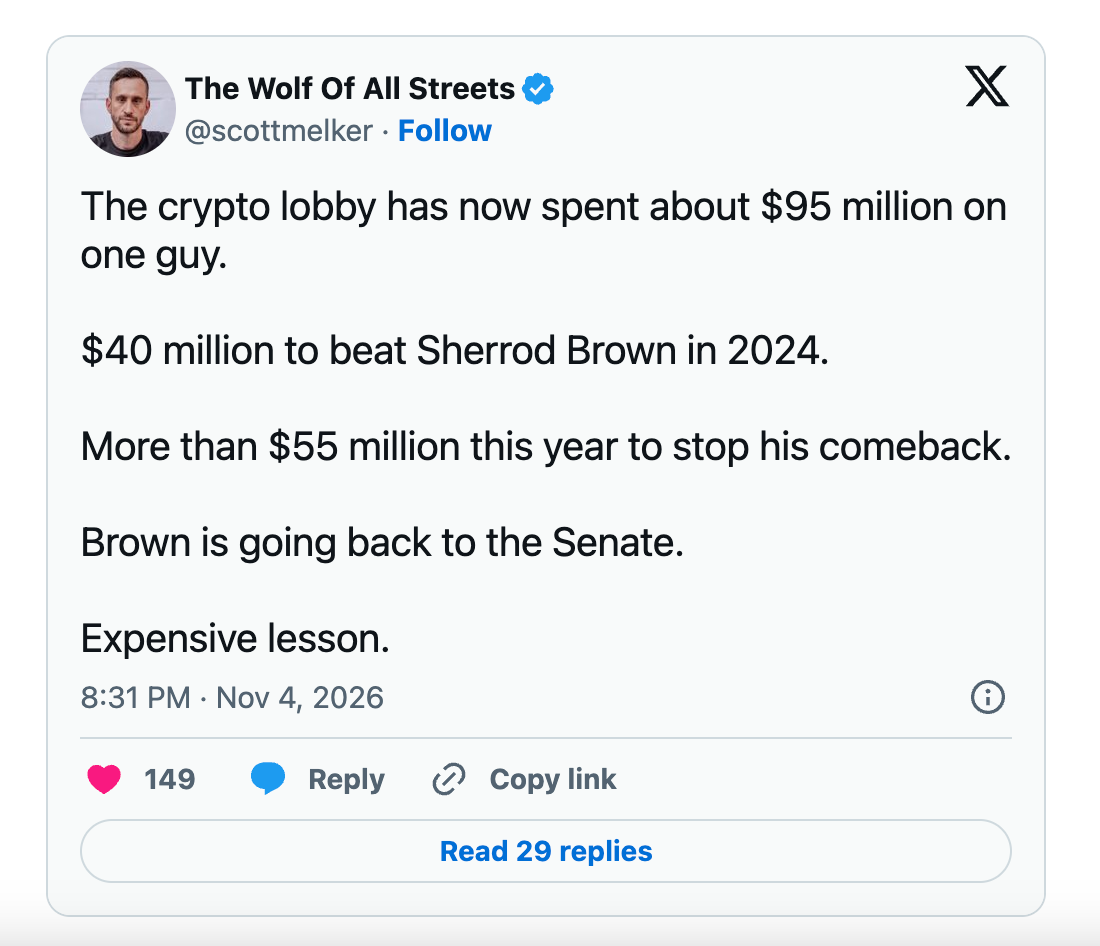
The crypto lobby has now spent roughly $95 million on a single man. $40 million in 2024 to defeat Sherrod Brown. Over $55 million this year to stop his comeback. Brown is heading back to the Senate. An expensive lesson. — The Wolf Of All Streets (@scottmelker) November 4, 2026
2. The CLARITY Act Was Already on Life Support
The CLARITY Act is the crypto industry's most important piece of legislation. It would determine which regulator oversees crypto tokens and trading platforms—the U.S. Securities and Exchange Commission (SEC) or the U.S. Commodity Futures Trading Commission (CFTC).
The House passed it in July 2025 by a vote of 294 to 134, with lawmakers from both parties voting in favor. Then it hit the Senate.
According to Orrick law firm, a procedural vote on September 15 ended 49 to 50, failing to reach the required 60 votes. And at that time, Republicans controlled both chambers.
Two fights stalled it. The first was ethics. Lawmakers argued over restrictions on "federal officials holding and profiting from crypto assets while writing the rules."
The second was money. Crypto companies wanted to pay yield on dollar-pegged stablecoins, while banks worried those yields would pull deposits out of their accounts.
The bill is not dead. Senator Thom Tillis voted no deliberately so that he could file a motion to put the bill back on the agenda. However, Orrick notes that the industry widely believes passage this year is unlikely.
3. Without a Law, the Rules Stay Temporary
Today, crypto businesses in the U.S. largely operate under rules written by the agencies themselves. A change of administration could rewrite those rules, and Trump's term ends in January 2029.
Orrick points out that without federal law, other rulebooks will continue to govern most crypto activity. Only stablecoins have their own law—the GENIUS Act, passed in 2025.
Before the ballots were counted, crypto traders were already worrying about a Democratic sweep. Mary Cull of Cryptex Finance told American Banker that Democratic control of the Senate would make the bill harder to pass. She also discussed the industry's situation under Trump.
"Under this administration, I think crypto is the darling." American Banker quoted Cull as saying.
Starting in January, Who Holds Crypto's Fate?
4. The Crypto Industry's Two Sharpest Critics Will Get Chairmanships
American Banker reports that Senator Elizabeth Warren is likely to become chairwoman of the Senate Banking Committee. That committee is responsible for considering Senate crypto bills.
Warren was already the committee's ranking Democrat. This year she co-signed letters urging the Trump administration to respond on Binance and demanding hearings on the Trump family's crypto earnings.
In the House, Representative Maxine Waters is expected to become chairwoman of the Financial Services Committee. Representative Sean Casten could challenge her, but American Banker reports that by seniority she should prevail.
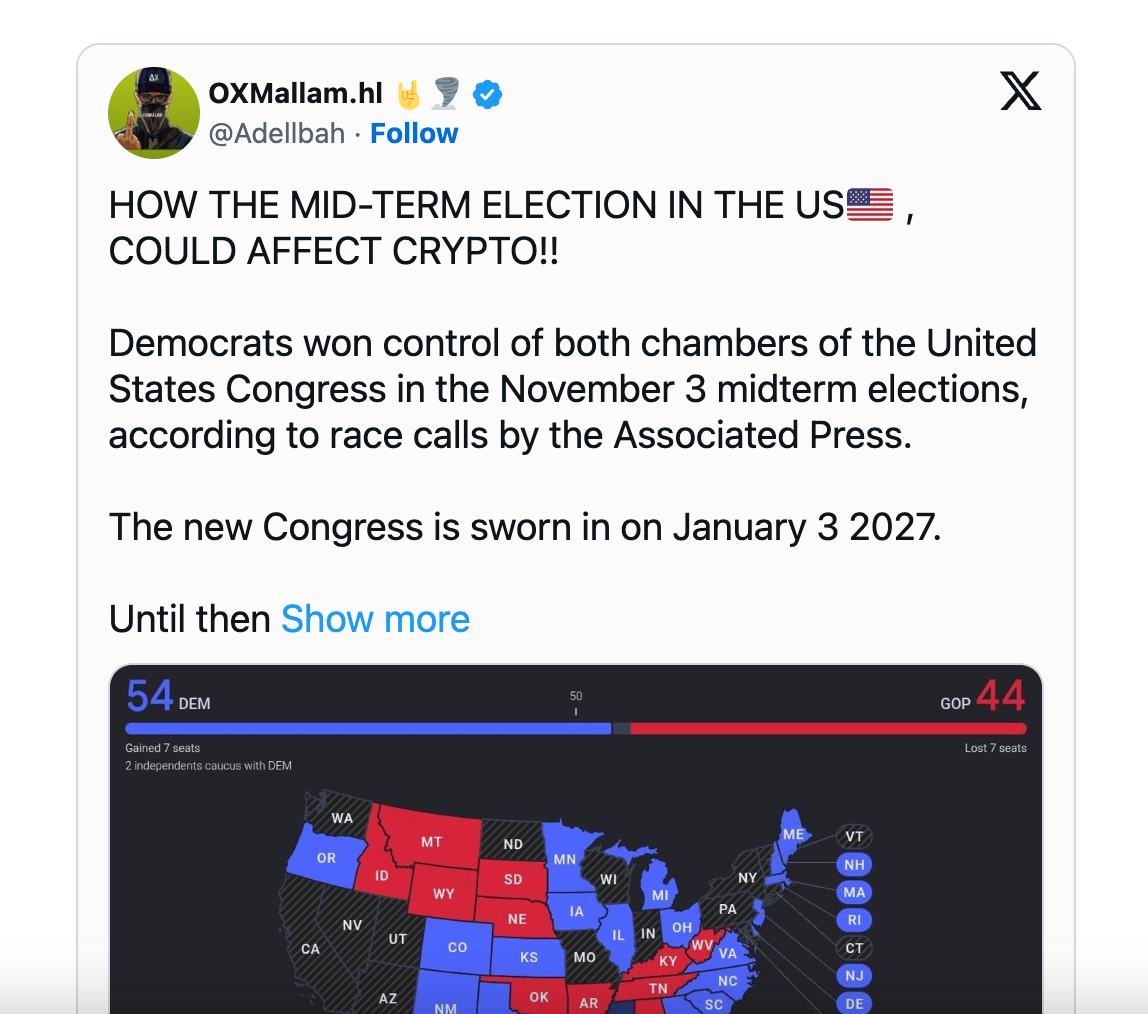
How the U.S. midterms will affect crypto According to state-by-state vote counts from the Associated Press, Democrats won control of both chambers of Congress in the November 3 midterm elections. The new Congress will be sworn in on January 3, 2027. Until then, chairs hold real power: they decide which bills get hearings, can summon executives to testify, and can issue subpoenas—legal orders requiring the production of documents. — OXMallam.hl (@Adellbah) November 4, 2026
5. Trump's Crypto Empire Becomes a Target
The sums involved are large. According to financial disclosure documents reported by AFP, Trump earned about $1.2 billion from crypto in 2025.
About $635 million of that came from royalty shares on the $TRUMP meme coin—a coin launched hours before his inauguration. Nearly $550 million came from the family crypto company World Liberty Financial.
Buyers of World Liberty's WLFI token fared worse. According to AFP, after the token began trading in September 2025, it fell from 46 cents to 6 cents.
In July, five Senate Democrats, including Warren, put the family's crypto earnings at $1.4 billion in an open letter. They demanded hearings and cited reports that the UAE bought a 49% stake in World Liberty.
Bart Naylor of the consumer group Public Citizen expects Democrats to go after these businesses, possibly using subpoenas. Public Citizen argues that these dealings raise questions under the "emoluments clause"—which bars the president from accepting payments from foreign governments.
Congress has already investigated World Liberty Financial. The White House denies these criticisms. According to AFP, the White House says the president and his family have never been involved in conflicts of interest.
"Democratic control also brings subpoena power, scrutiny of Trump-linked crypto businesses, and influence over future nominees for regulatory positions," one X user noted.
6. After the Binance Hack, Exchanges Will Face Sharper Questioning
In an October 30 statement, Waters cited reports that Binance was hacked last week, losing about $6.3 billion. Those reports linked the attack to North Korean state-backed hackers.
She said millions of customers were unable to withdraw at the time, while Binance was raising billions of dollars for compensation.
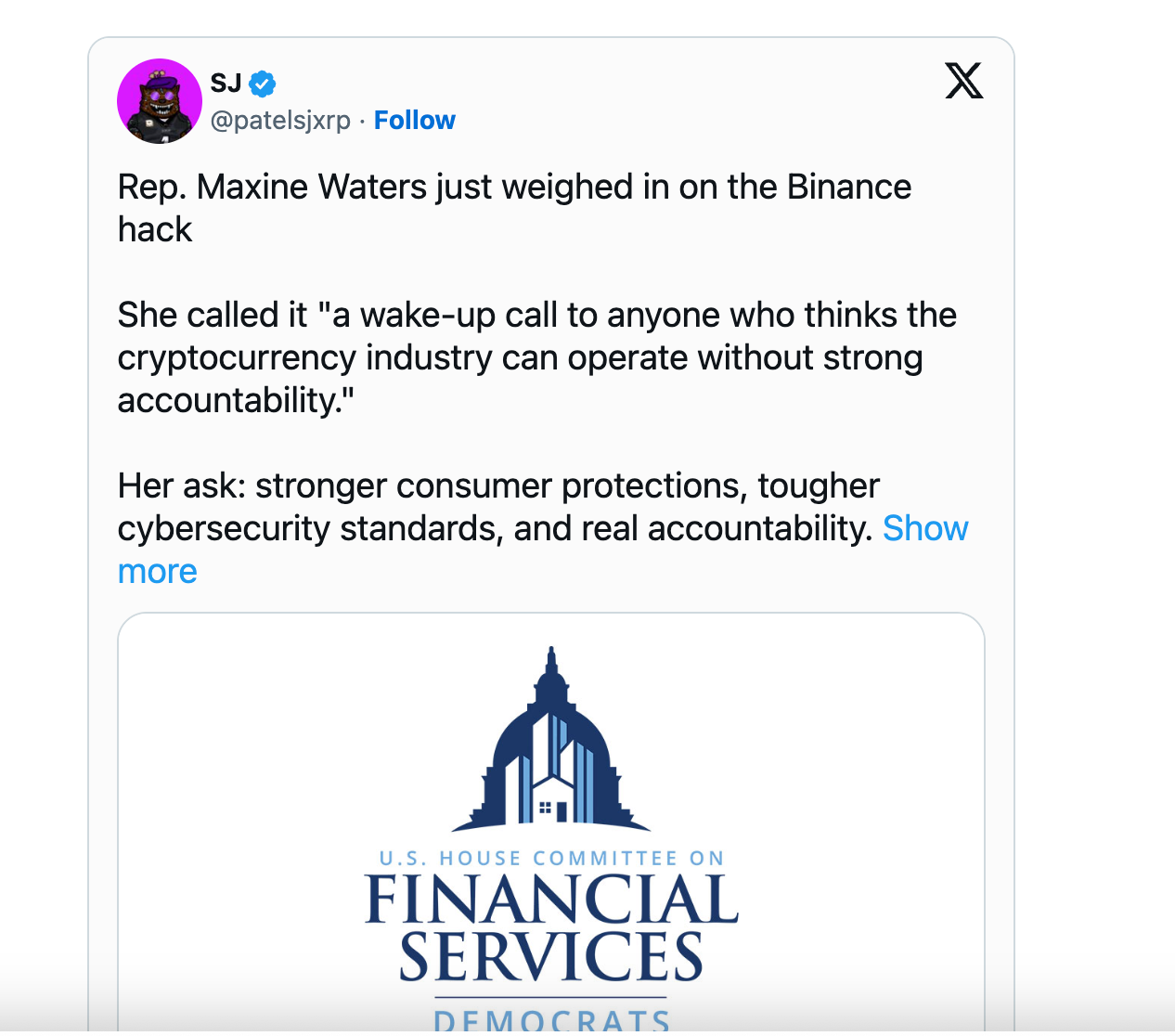
Rep. Maxine Waters just weighed in on the Binance hack She called it "a wake-up call for anyone who thinks the crypto industry can operate without strong accountability mechanisms." Her demands: stronger consumer protections, stricter cybersecurity standards, and real accountability — SJ (@patelsjxrp) October 31, 2026
Waters then turned to politics. She noted that Binance founder Changpeng Zhao (CZ) invested more than $2 billion in World Liberty Financial before being pardoned by Trump. She also said the SEC dropped its fraud case against Binance and Zhao.
Senate Democrats raised similar concerns in February. Their open letter said Binance pushed users to buy World Liberty's dollar stablecoin USD1.
Waters called for stricter consumer protections, financial crime controls, and cybersecurity standards across the industry.
"Americans have a right to know their money is safe," she said.
Is This Really Bad News for Bitcoin?
7. History and the Direction of Regulators Point the Other Way
Not every Democrat opposes crypto. The CLARITY Act passed the House with bipartisan support, meaning dozens of Democrats voted in favor.
The industry hedged on both sides. In 2024, Fairshake spent about $14 million supporting Democratic candidates, according to FactCheck.
Regulators are still moving forward. The SEC proposed crypto rules on August 18. Orrick notes that the CFTC also sent its own draft to the White House for review on September 17. However, binding rules may still take more than a year to take effect.
The market's reaction to the midterms was also muted beforehand. Since 1982, the S&P 500 has risen after every midterm election, and Bitcoin has also closed higher one year after each of the last several midterms. On the night results rolled in, Bitcoin and U.S. stock index futures swung back and forth with the news.
Crypto's money machine has not slowed either. According to FactCheck, Fairshake had raised nearly $137 million for this year's elections by June 30. It still could not stop Brown.
The next test comes before January. If the CLARITY Act does not advance in the final weeks of this Congress, the crypto industry's most important bill will have to start over in the hands of Warren and Waters.