US Stock Selloff Storm: Quant + Leveraged ETFs Dump $70 Billion in One Day, with Another $50 Billion in Selling Still to Come


- Key Takeaways: The tech-driven US stock selloff is triggering a chain deleveraging of systematic strategy funds, with CTAs and leveraged ETFs selling over $70 billion in a single day, while volatility-target funds still have about $50 billion left to sell, keeping short-term market pressure unresolved.
- Key Elements:
- The S&P 500 plunged 4.4% in a single day and the Nasdaq 100 tumbled 6.4%, the worst performance since "Tariff Day."
- CTA momentum signals were breached en masse, with positioning in the S&P 500, Nasdaq 100, and Russell 2000 all turning net short, and roughly $11 billion in net S&P futures selling within the first 90 minutes of trading.
- Leveraged ETFs sold over $60 billion in exposure on the day, about 90% concentrated in tech products, marking the second major deleveraging within a week.
- Volatility-target funds need to cut roughly $50 billion in exposure over the coming days, with target leverage falling from the 67th percentile to the 30th percentile, creating a "sell more as prices fall" negative feedback loop.
- Leveraged ETFs' implied short gamma exposure has already dropped from about $7.5 billion per 1% move to about $6.5 billion, suggesting the scale of subsequent passive selling may narrow.
Original author: Zhao Ying
Original source: Wallstreetcn
The sharp selloff in US stocks, triggered by tech stocks, is setting off a chain reaction of deleveraging among systematic strategy funds. The scale and speed of the selling are so large that the pressure on the market is unlikely to dissipate in the short term.
According to a report released on November 5 by JPMorgan's equity derivatives strategy team, as reported by the Trading Desk, US stocks that day suffered their worst single-day performance since "Tariff Day," with the S&P 500 plunging 4.4% and the Nasdaq 100 tumbling 6.4%. Quantitative strategy funds played a key accelerating role in this decline—CTA trend-following strategies and leveraged ETFs collectively sold more than $70 billion in equity exposure that day.
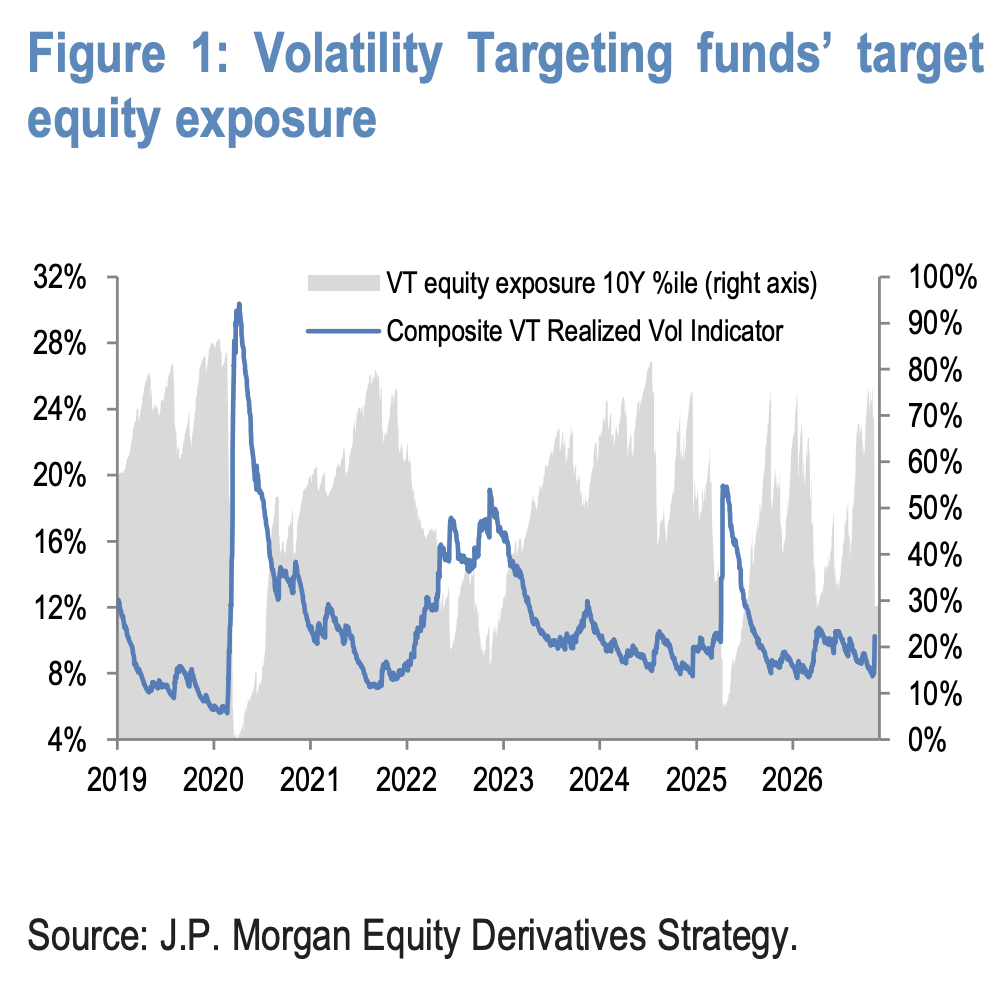
More concerning is that the selling pressure has not yet cleared. JPMorgan's model estimates that volatility targeting funds still have roughly $50 billion in equity exposure left to sell over the coming days, in order to compress their target leverage ratio from around the 67th percentile down to the 30th percentile. This means that if the market continues to decline, mechanical position reduction will constitute sustained downward pressure.
CTA Flips to Net Short, Selling $11 Billion in First 90 Minutes
The direct trigger for this decline was the mass breach of momentum signals in CTA trend-following strategies. JPMorgan's report noted that during the morning trading session, the drop broke multiple key momentum signals across major US stock indices, triggering CTA programmatic selling and further accelerating the market downturn.
Specifically, within approximately 1.5 hours after the cash market open, net selling in S&P 500 futures had already reached about $11 billion. From a momentum signal perspective, CTA positioning in the S&P 500, Nasdaq 100, and Russell 2000 has all flipped to net short.
JPMorgan's CTA momentum signal tracking table shows that with the S&P 500 currently at around 7,383 points, the 1-month momentum signal is negative and the CTA signal has turned to "short"; the same is true for the Nasdaq 100. Although 12-month momentum remains positive across major US stock indices, and the S&P 500 price is hovering near its 200-day moving average—meaning further deleveraging depends on whether the market continues to break lower—the report also noted that because most signals have turned bearish, flow risk is currently skewed to the upside.
Leveraged ETFs Deleverage Sharply for the Second Time in a Week, Tech Accounts for 90%
Leveraged ETFs were another major force in this selloff. JPMorgan estimates that leveraged ETFs sold more than $60 billion in equity exposure before the close that day, with about 90% concentrated in tech products, including semiconductors (Semis), Nasdaq 100 (NDX), and tech sector ETF (XLK), among others.
This was already the second significant deleveraging by leveraged ETFs within a week, reflecting the market characteristic of tech stocks continuing to dominate the decline recently. However, the report also noted that dip-buying inflows from investors during past major selloffs may have partially offset ETF rebalancing selling pressure.
After this round of deleveraging, the implied short gamma exposure of leveraged ETFs has fallen from about $7.5 billion per 1% move to about $6.5 billion, meaning the scale of passive selling triggered by subsequent rebalancing will narrow somewhat.
$50 Billion Overhang: Volatility Targeting Funds Become the Next Focus
The largest potential source of selling pressure currently facing the market is volatility targeting funds. JPMorgan's model shows that as market volatility surges, these funds need to cut roughly $50 billion in equity exposure over the coming days to compress their target leverage ratio from around the 67th percentile to the 30th percentile.
The operating logic of volatility targeting strategies is: when market volatility rises, mechanically reduce risk asset exposure to keep portfolio volatility stable. This mechanism often creates a negative feedback effect of "selling more as prices fall" during periods of violent market swings.
JPMorgan had already warned in a Monday report that macro systematic strategies face two-way flow risk, with significant deleveraging potential in a scenario of sharp declines and surging volatility. The market action that day confirmed this judgment, and the adjustment process could last several days. For investors, until this $50 billion in passive selling is fully released, the market's pressured condition is unlikely to fundamentally change in the short term.