After reclaiming the top spot by market cap, Apple faces a stress test at the $5 trillion threshold


- Core View: Apple has returned to a $5 trillion market cap on the strength of $136.1 billion in free cash flow and restrained capital expenditure, but rising memory chip prices are squeezing gross margins and services growth has fallen below 10%, meaning the "safe haven" narrative is facing its first real stress test.
- Key Elements:
- Free cash flow reached $136.056 billion in fiscal 2026, up nearly 38% year over year; capital expenditure was cut 29% to $9.041 billion, in stark contrast to AI giants such as Microsoft.
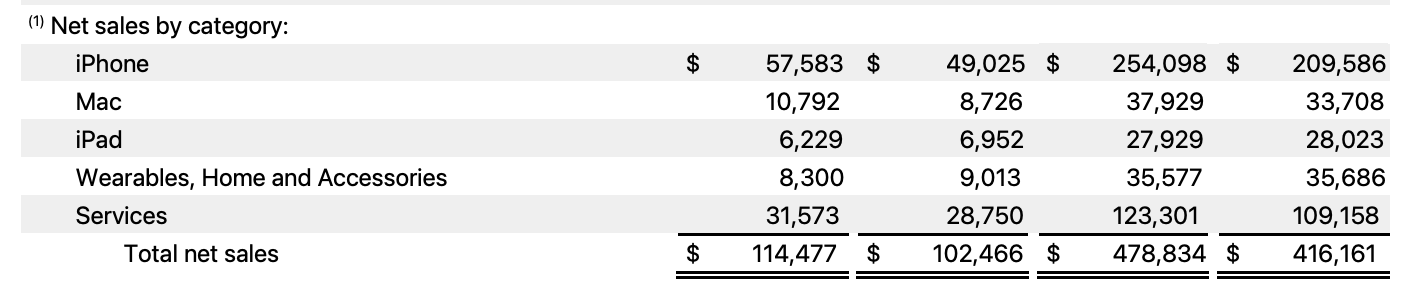
- Fourth-quarter revenue was $114.477 billion, up 11.72% year over year; iPhone revenue was $57.583 billion, up 17.46%; Mac revenue rose 23.68%, beating expectations.
- Inventory book value surged 154.30% to $14.541 billion, and the CFO warned that gross margin guidance for the December quarter will fall to 45%-46%, a contraction of 2-3 percentage points.
- Services revenue was $31.573 billion, up only 9.82% year over year, falling below 10% for the first time in three years, with guidance for next quarter slowing further to 8%-9%.
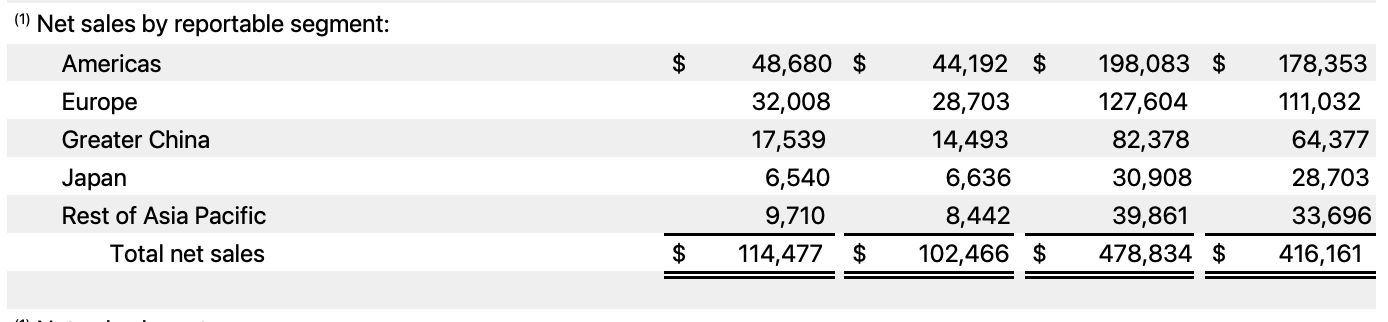
- Greater China revenue was $17.539 billion, up 21.02% year over year, but down 6.8% quarter over quarter, nearly 6.5% below Wall Street expectations.
- R&D expenses soared 32.30% to $11.730 billion; the new Siri AI experience has drawn criticism, and its rollout costs are in turn weighing on margin guidance.
- The forward P/E ratio of 36x sits at the 99th percentile of history, roughly twice that of the S&P 500, greatly narrowing the margin for error.
Original | Odaily (@OdailyChina)
Author | Azuma (@azuma_eth)
At a time when Silicon Valley tech giants are collectively suffering from "AI capex anxiety," Apple has reclaimed the throne as the world's most valuable company with an almost classical poise.
Unlike Microsoft, Google, Amazon, and other tech giants that have been steadily ramping up spending on data centers and computing infrastructure, Apple has maintained relatively restrained capital expenditure. Riding on its robust cash flow, Apple has become a "safe haven" for Wall Street capital amid the recent volatility over whether the AI boom has peaked, overtaking a sold-off Nvidia in market capitalization and briefly surpassing $5 trillion.
Measured from the late-June low, Apple's stock has gained 25% over the past four months, adding roughly $1 trillion in market value. Yet standing at the $5 trillion summit, the view is accompanied by a chill — a forward P/E ratio of 36x (at the 99th percentile of its own history and roughly twice that of the S&P 500) means the market has already priced Apple's certainty premium to the extreme, leaving little room for error.
After U.S. market close on November 3 Beijing time, John Ternus, who succeeded Tim Cook as Apple CEO just this September, delivered his first earnings report at the helm (Q4 and full-year fiscal 2026 results). Although both revenue and net profit beat Wall Street expectations, Apple's stock briefly ticked up 0.4% after hours before quickly diving, at one point falling more than 4%. As of 9:30 Beijing time on November 3, the stock was at $328.81, down 2.81% after hours.
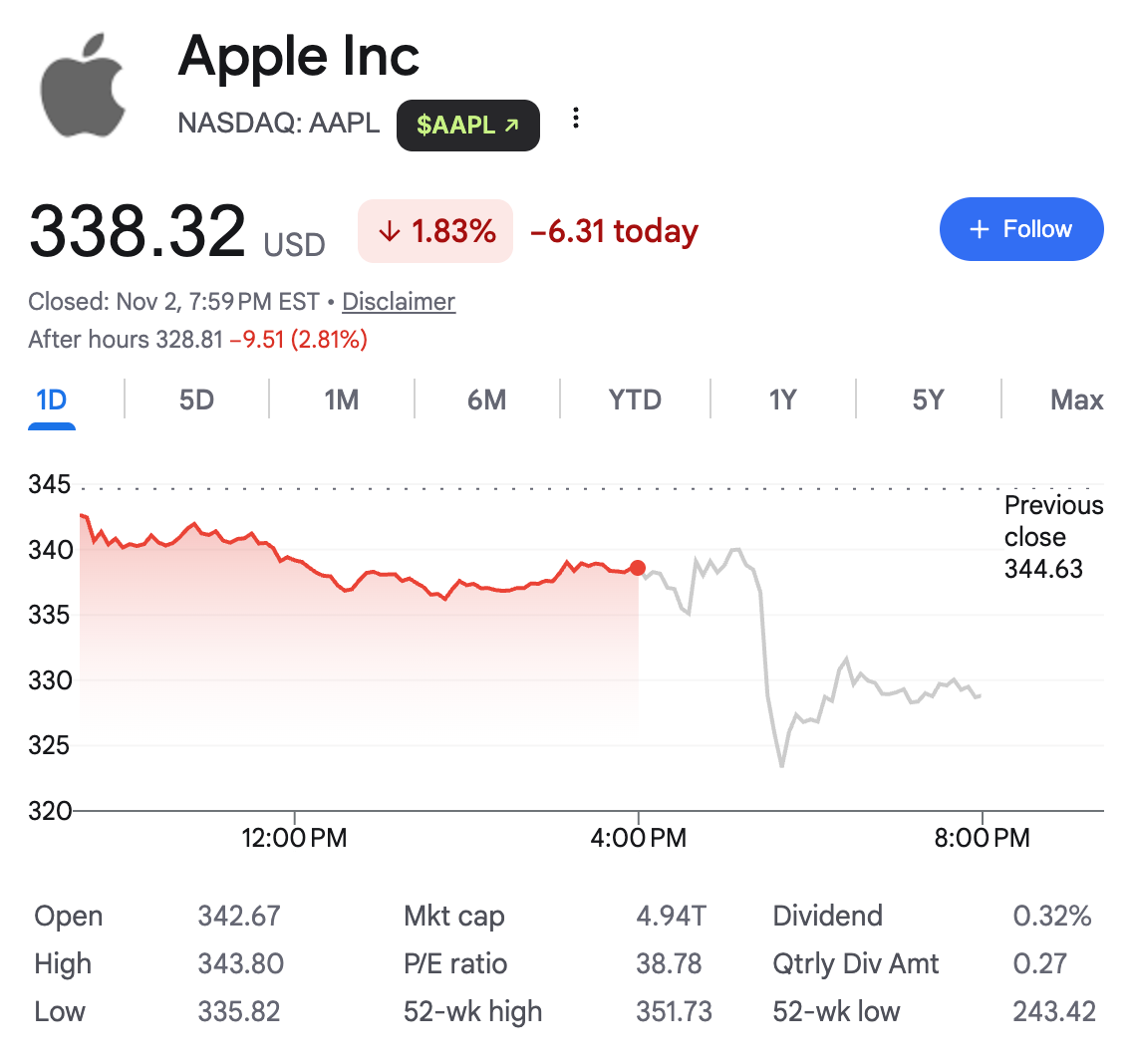
The after-hours divergence in consensus essentially lays bare the deeper game beneath the "safe haven" narrative — as paper prosperity meets a memory chip price hike cycle and a structural slowdown in the services ecosystem, the crown atop Apple's head is facing its first real stress test.
$136.1 Billion in Free Cash Flow: The Foundation Supporting a $5 Trillion Market Cap
Looking purely at core financial metrics, Apple's fiscal 2026 has actually drawn to a rather handsome close.
The earnings report shows that in the fourth fiscal quarter ended September 26, 2026, Apple posted total revenue of $114.477 billion, up 11.72% year-over-year, beating the market expectation of $113.47 billion and exceeding the upper end of the company's prior guidance of 9% to 11% growth; quarterly net profit came in at $30.711 billion, up 11.81% year-over-year; diluted earnings per share (EPS) reached $2.1, up 13.51% year-over-year and above the market expectation of $2.
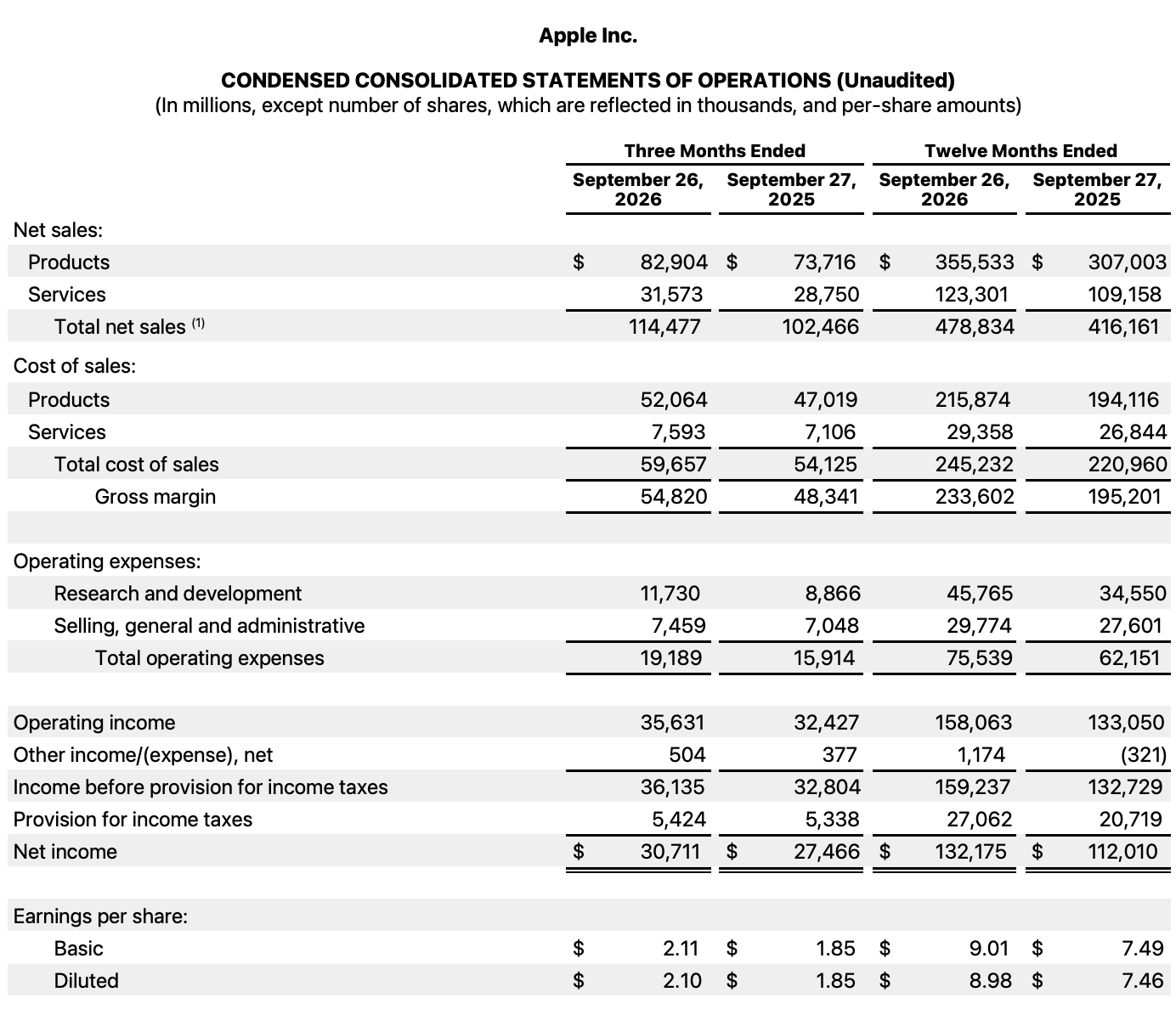
Across the full fiscal 2026, Apple's total annual revenue hit a record $478.834 billion, up 15.06% year-over-year, marking its best annual sales growth since 2021; full-year net profit reached $132.175 billion, up 18.00% year-over-year.
At a time when tech stocks are jittery, the core trump card that has enabled Apple to beat Nvidia and return to the top of market capitalization is written in its cash flow statement. In fiscal 2026, cash flow from operating activities reached $145.097 billion, surging 30.15% year-over-year. What has drawn even more attention on Wall Street is that while Google, Meta, and Amazon splurge to compete for AI computing supremacy and even fall into free cash flow deficits, Apple's full-year capital expenditure (CapEx, i.e., cash spent on fixed assets) not only did not expand but actually shrank nearly 29% from $12.715 billion in fiscal 2025 to $9.041 billion.
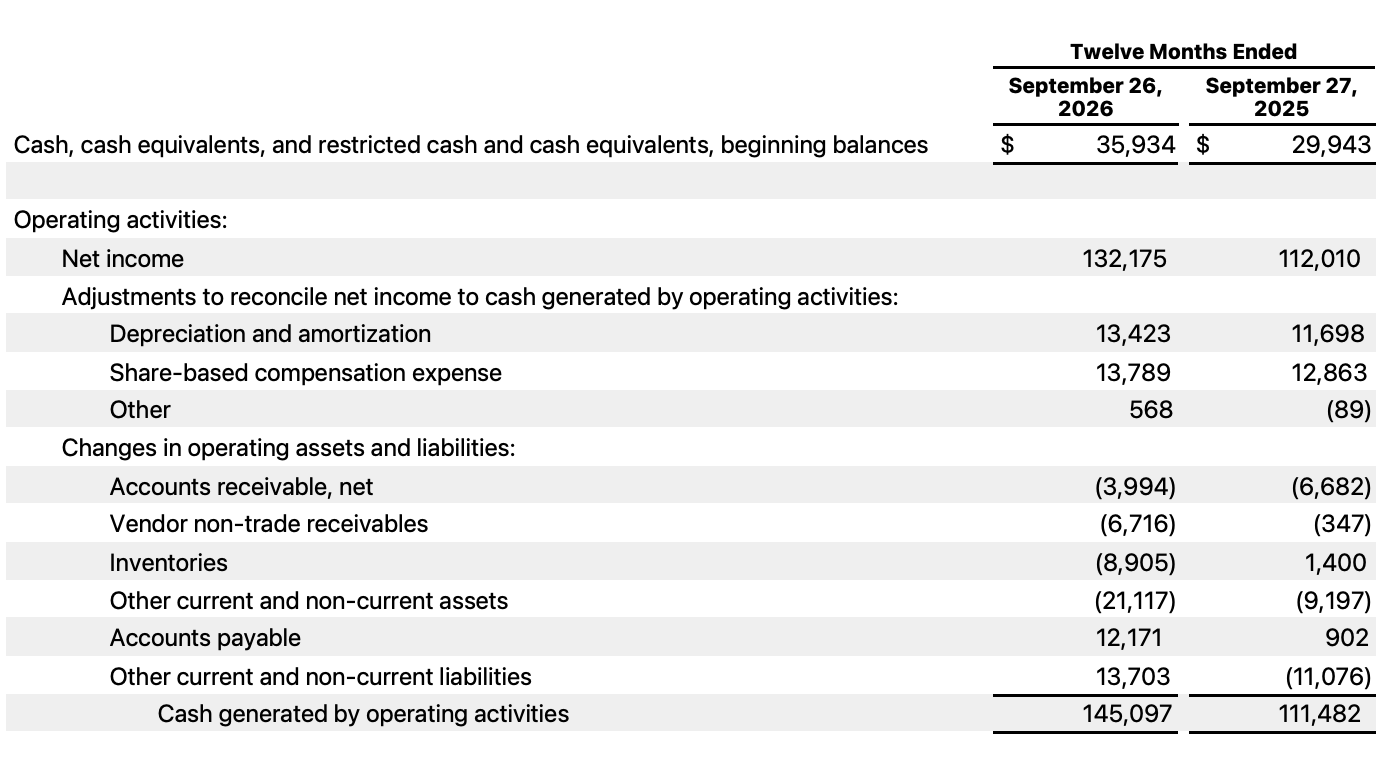
The "high revenue conversion + asset-light capex" model enabled Apple to rake in $136.056 billion in free cash flow in fiscal 2026, surging nearly 38% year-over-year, and supported the company in completing $86.390 billion in share buybacks and $15.721 billion in dividend payouts for the year — in a cycle where the return on AI commercialization remains uncertain, this massive money-printing machine has become the scarcest certain asset in institutional investors' eyes.
iPhone Still Carries the Load, but Hardware Divergence Intensifies
Stripping away the shell of better-than-expected total revenue, Apple's hardware fundamentals this quarter present a distinct picture of "dual-core drive, two wings stalling."
The growth banner this quarter was carried by iPhone and Mac. In the fourth fiscal quarter, the iPhone business contributed $57.583 billion in revenue, up 17.46% year-over-year, setting a record high for a September quarter and beating the market expectation of $56.49 billion; the Mac business was the biggest surprise of the quarter, with revenue surging 23.68% year-over-year to $10.792 billion, far exceeding Wall Street's expectation of $9.7 billion.
It should be noted that the iPhone 18 Pro series this quarter did not officially go on sale until September 18, only about nine days before the quarter ended. As such, this earnings report has not yet fully reflected the complete sales performance of the new-generation iPhone. As for the much-watched iPhone Duo, although Apple announced the product in September, its official launch date was October 23, after the quarter's cutoff, so the iPhone Duo did not contribute to this quarter's revenue; its true market performance will only be reflected in the next fiscal quarter.
Based on the current situation, the iPhone Duo has received an enthusiastic market response since launch, but there have also been reports of some early users encountering screen cracking and display issues. Ternus candidly admitted on the earnings call that the model is currently in a "supply-constrained state," and while he stressed that only a "very small percentage" of devices have been returned or exchanged due to defects, production ramp-up and yield rates remain a stern test for the holiday season.
On other products, iPad revenue declined 10.40% year-over-year to $6.229 billion this quarter; the Wearables, Home and Accessories business, which includes Apple Watch and AirPods, also shrank 7.91% to $8.300 billion, both below market expectations.
By region, Greater China revenue came in at $17.539 billion in the fourth fiscal quarter. Although it still maintained strong growth of 21.02% year-over-year, it declined 6.8% quarter-over-quarter from $18.82 billion and came in nearly 6.5% below Wall Street's expectation of $18.75 billion. Under the magnifying glass of a 36x P/E, any shortfall in a core overseas market is enough to become a reason for capital to take profits.
The Real Trigger for the After-Hours Drop: Memory Cycle Blowback and the Loosening of the "Apple Tax"
If the blemishes in Greater China and some hardware segments were merely ripples, then two warnings from management on the earnings call were the direct trigger for the selloff.
The first warning is the blowback of memory chip price hikes on gross margin. On the surface, Apple's fourth-quarter gross margin reached 47.89% (gross profit of $54.820 billion), slightly above 47.18% in the year-ago period, but this figure includes a contribution of about 1 percentage point from tariff refunds. Excluding this factor, the actual operating performance is not as impressive as the headline numbers suggest.
A sterner test lies ahead. CFO Kevan Parekh candidly stated on the call that Apple's previously stockpiled low-priced component inventory is rapidly being depleted, forcing it to procure memory chips at higher prices. Looking at Apple's balance sheet, this cost pressure is already showing — as of the end of the fourth fiscal quarter, Apple's inventories were carried at $14.541 billion, a staggering 154.30% surge from $5.718 billion in the year-ago period. Beyond stocking up for the dense lineup of holiday-season new products, the intake of high-priced memory chips directly inflated the carrying value of ending inventory, and this batch of high-cost inventory will be formally converted into cost of sales in the coming December quarter, directly squeezing profit margins.
Against the backdrop of AI computing centers devouring global DRAM and NAND capacity and driving memory chip prices ever higher, even Apple — with the strongest supply chain bargaining power — cannot insulate itself. Parekh warned that dragged down by high memory costs and the cost of rolling out Siri AI, Apple's gross margin guidance for the upcoming December holiday quarter (Q1 fiscal 2027) will plummet to 45% to 46%. That figure represents a sharp contraction of 2 to 3 percentage points from this quarter and is well below Wall Street expectations.
The second hammer blow is the stalling of the high-margin "services engine." As the ballast of Apple's valuation system, the services business posted a gross margin of 75.95% this quarter, more than double the hardware business's gross margin (37.20%). Although fourth-quarter services revenue hit a record high of $31.573 billion, its 9.82% year-over-year growth rate was not only slightly below expectations but also fell below the 10% threshold, marking its lowest growth rate in more than three years. Management even expects services growth to slow further to 8%-9% next quarter, significantly below the market expectation of 10.7%.
The deceleration in services is not a short-term fluctuation but strikes at the very foundation of the business model. On one hand, global antitrust regulation is steadily eroding the App Store's ability to charge high commissions; on the other hand, super apps in the AI era are actively bypassing Apple's "toll booth" — after falling out with Apple over a trade secrets dispute, OpenAI (ChatGPT), which originally contributed considerable in-app purchase revenue, has begun directing subscribers to pay on the web. When AI gateways are no longer willing to pay the "toll," the moat of Apple's services ecosystem is bound to be eroded.
The Real Test of the Ternus Era
In the fourth fiscal quarter, Apple's R&D expenses quietly surged 32.30% to $11.730 billion, demonstrating the company's determination to catch up in new foldable form factors, touchscreen Macs, smart home hubs, and Siri AI. However, the all-new Siri AI officially launched this quarter still appears to be struggling in the eyes of outsiders — while competitors' AI agents can already smoothly execute multi-step complex tasks, Siri's experience remains widely criticized, and its rollout costs have instead dragged down the holiday-quarter margin guidance first.
Over the past four months, Apple has earned a "safe haven" premium amid Silicon Valley's turmoil by virtue of its restraint in "not joining the AI arms race" and its abundant free cash flow, and has duly returned to the top of global market capitalization. But this earnings report also clearly reminds the market that a hardware giant ultimately cannot escape the cost squeeze of the upstream semiconductor memory cycle, and the closed ecosystem's tax-collection model is also coming under assault from the AI wave.
For new chief Ternus, a $5 trillion market cap is not a victory banquet but a stern exam — if he cannot digest the lofty valuation with truly dominant hardware innovation and a better AI experience, then relying solely on shrewd supply chain orchestration and financial buybacks, this "safe haven" can only withstand a limited amount of rough seas.