The Trillion-Dollar Journey’s Critical Bet: Why Is Marvell Swallowing Lumentum?


- Core Viewpoint: Marvell plans to acquire optical component leader Lumentum for nearly $100 billion, aiming to build a vertical closed loop of “electrical chips + optical components” and control scarce indium phosphide wafer capacity. However, the high premium, equity dilution, and transition to an asset-heavy model have raised market concerns about the buyer.
- Key Elements:
- The deal size may reach $90 billion to $100 billion. Lumentum has a market capitalization of about $83 billion and its stock price has risen more than 360% over the past year, while Marvell’s market capitalization is about $221 billion.
- Lumentum’s optical component capacity has been sold out through early 2029, about 70% of customer demand cannot be met in 2027, and the supply gap is expected to be about 30% in 2028.
- Marvell previously gained PAM4 DSP chips through its acquisition of Inphi. This acquisition can fill in EML, CW laser, and indium phosphide wafer production lines.
- After the rumor, Marvell fell more than 10% at one point in after-hours trading, while Lumentum rose more than 17%, reflecting market concerns about equity dilution and pressure on gross margins.
- After being acquired, Lumentum will transform from a “neutral supplier” into an asset exclusive to a competitor. Coherent, as the only remaining independent optical component leader, may benefit from order transfers.
Original | Odaily (@OdailyChina)
Author | Azuma (@azuma_eth)
After U.S. markets closed on October 28 (Eastern Time), the global semiconductor and optical communications market received a major piece of news.
Citing people familiar with the matter, Bloomberg and The Information reported that chip design giant Marvell Technology (NASDAQ: MRVL) is in advanced talks to acquire Lumentum Holdings (NASDAQ: LITE), the leading player in data center optical components.
Sources said that if all goes smoothly, a formal agreement could be announced as early as next week (early November). However, before the final signing, the deal terms and timeline could still be delayed or even fall apart. As of now, media reports have not disclosed the specific per-share offer price or the payment structure (the exact mix of cash and stock is unknown), but given Lumentum's massive size, the market widely expects the deal to involve an extremely high proportion of stock consideration.
Before news of this acquisition emerged, Lumentum's stock had already surged over 360% in the past year, driven by the explosive demand for optical interconnects in AI data centers, with a market capitalization of approximately $83 billion; the buyer Marvell has a market cap of about $221 billion. If a standard M&A control premium is factored in, the total size of this potential deal—characterized by foreign media as an "AI mega-merger"—could very likely approach the $90 billion to $100 billion mark.
Once completed, this would not only be the largest M&A deal in the history of optical communications, but also the most expensive gamble in the global semiconductor industry this year.
Marvell's Motive: Positioning for "Optics Replacing Copper" and Locking Up Scarce Capacity
The underlying driver for Marvell's willingness to spare no expense in targeting Lumentum at this moment is that AI compute infrastructure is hitting a physical wall.
As AI compute clusters evolve from tens of thousands of GPUs to hundreds of thousands and even millions, traditional copper cable connections within servers and between racks are approaching their limits in terms of signal attenuation, thermal power consumption, and physical transmission distance. "Optics replacing copper" is no longer just a long-term vision, but a rigid survival rule for data center networks evolving toward 1.6T, 3.2T, and even CPO (co-packaged optics).
For Marvell, swallowing Lumentum serves two major strategic objectives.
First, closing the full-stack vertical loop of "electrical chips + optical components." As early as 2021, Marvell acquired Inphi for $10 billion, securing absolute dominance in PAM4 DSP (digital signal processor), the core electrical chip for optical modules. However, as the industry enters the deep waters of ultra-high-speed optical interconnects, DSP electrical chips alone can no longer meet the stringent requirements of optoelectronic co-packaging (such as silicon photonics and CPO).
The proposed acquisition target, Lumentum, possesses world-leading EML (electro-absorption modulated laser) and CW (continuous wave) high-power laser technologies, and Marvell itself is a major customer of Lumentum's laser components. Bringing Lumentum into the fold means Marvell can achieve tightly coupled internal R&D spanning from underlying compute connectivity and DSP electrical chips to upstream laser light sources, while capturing the rich margins that would otherwise flow to upstream suppliers.
Second, controlling the industry's most critical "indium phosphide" (InP) wafer production lines and seizing supply chain allocation power.
The biggest bottleneck in global optical communications today is not on the demand side, but rather the extreme depletion of upstream indium phosphide laser wafer capacity. Lumentum CEO Michael Hurlston said in an interview with Bloomberg in early October this year that Lumentum's optical component capacity is effectively sold out with lead times extending to early 2029, and some customers have even begun locking in orders for 2030; in 2027, up to 70% of customer demand for some of its core products cannot be met, and the supply gap in 2028 is also around 30%.
This extreme shortage could directly threaten Marvell's core growth logic. In high-speed optical modules, electrical chips and optical chips are strictly paired—every set of lasers that is out of stock upstream means Marvell sells one less set of high-margin DSP or silicon photonics solutions. More critically, as the industry evolves toward CPO, the bundled delivery of external high-power light sources with compute chips has become an irreversible trend. Since building a new indium phosphide wafer fab typically requires a 3-to-5-year ramp-up period, Marvell's move to acquire Lumentum, which owns core global InP production lines, is essentially bringing the industry's most scarce "optical ammunition depot" for the next three years under its wing and grasping supply chain capacity scheduling power in its own hands.
Fire and Ice: Why Is Lumentum Soaring While Marvell Plunges?
After the acquisition rumors surfaced, during after-hours trading, Marvell and Lumentum's stock movements were diametrically opposite—Marvell dropped more than 10% at one point after hours, temporarily quoted around $230 in overnight trading with after-hours losses still exceeding 8%; Lumentum surged more than 17% at one point, temporarily quoted around $993 in overnight trading with after-hours gains of 8.65%.

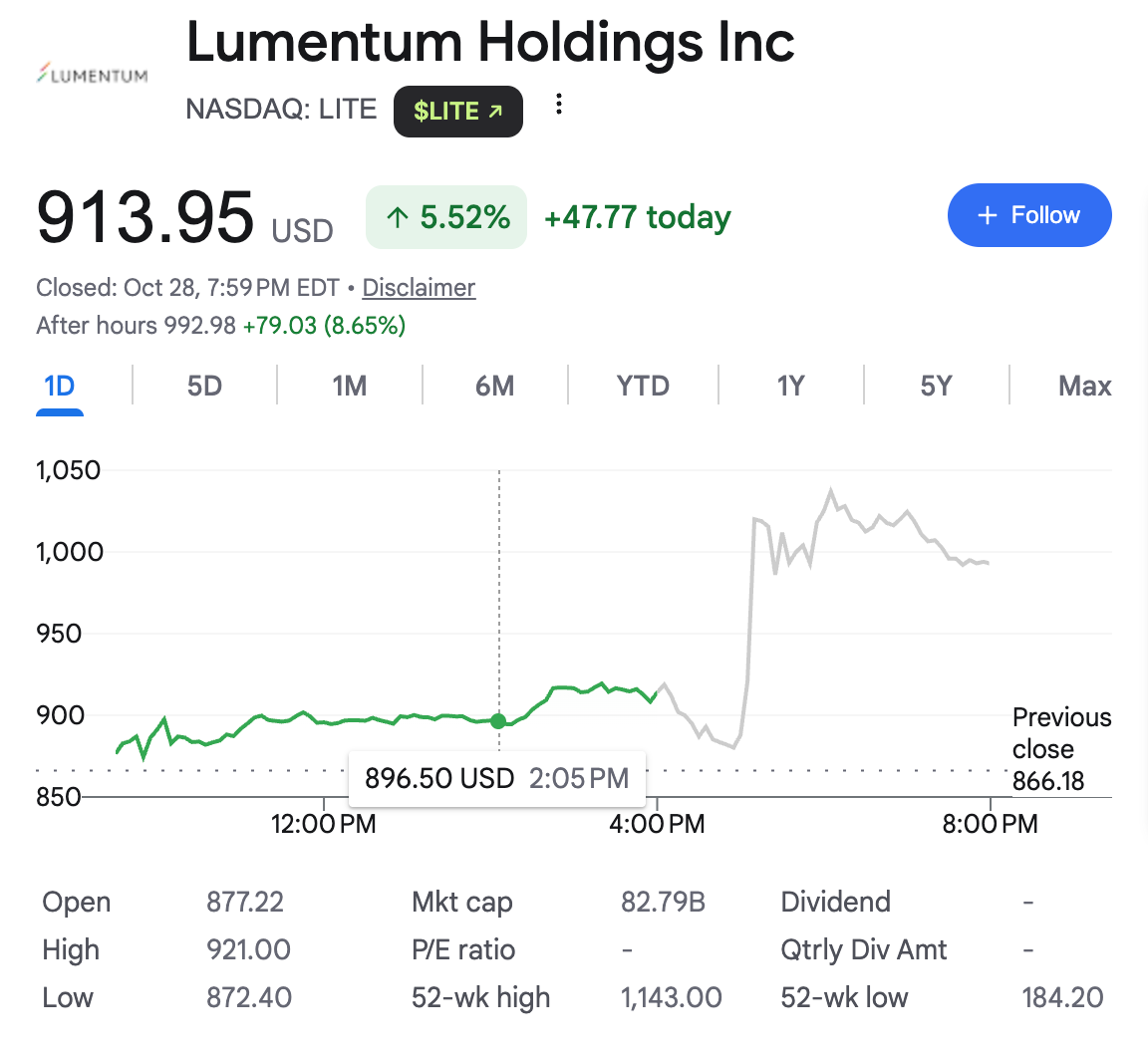
For the acquiree Lumentum, on top of an already extremely tight capacity cycle, the expectation of a massive "control premium" naturally led to funds rushing in and driving the stock price higher; but the reason the same deal triggered a selloff in the buyer Marvell is that Wall Street still has certain concerns about the "financial math" behind this multibillion-dollar deal.
The first is the staggering acquisition cost and equity dilution pressure. Lumentum is by no means a cheap asset at the bottom of a cycle—catalyzed by the AI optical interconnect narrative, its stock has multiplied over the past year, and some Wall Street institutions have recently given an aggressive price target of $1,200. Acquiring a giant with a market cap exceeding one-third of its own near an all-time high, while also paying a substantial control premium, means that Marvell, whose cash flow is not exactly abundant, will inevitably need to issue a massive number of new shares or take on enormous debt. For a considerable period after the deal closes, Marvell's existing shareholders will face severe earnings-per-share (EPS) dilution pain.
A deeper divergence lies in the fact that this deal will fundamentally rewrite Marvell's business model DNA. For a long time, Marvell has been a typical Fabless (fabless) chip design company, outsourcing all wafer manufacturing to TSMC, thereby enjoying an asset-light, high-margin valuation model; while Lumentum is a full-fledged IDM (integrated device manufacturer) giant with multiple self-built indium phosphide wafer fabs and packaging and testing facilities worldwide. Stepping from "asset-light design" into "asset-heavy manufacturing," Lumentum's massive fixed asset depreciation and production line expansion capital expenditure (CapEx) could very likely drag down Marvell's previously attractive overall gross margin.
On one side is a long-term optoelectronic closed-loop blueprint yet to be realized; on the other is imminent equity dilution and gross margin pressure—making it easy to understand why Wall Street institutions chose to "sell first and ask questions later" after hours.
Coherent Sitting Pretty?
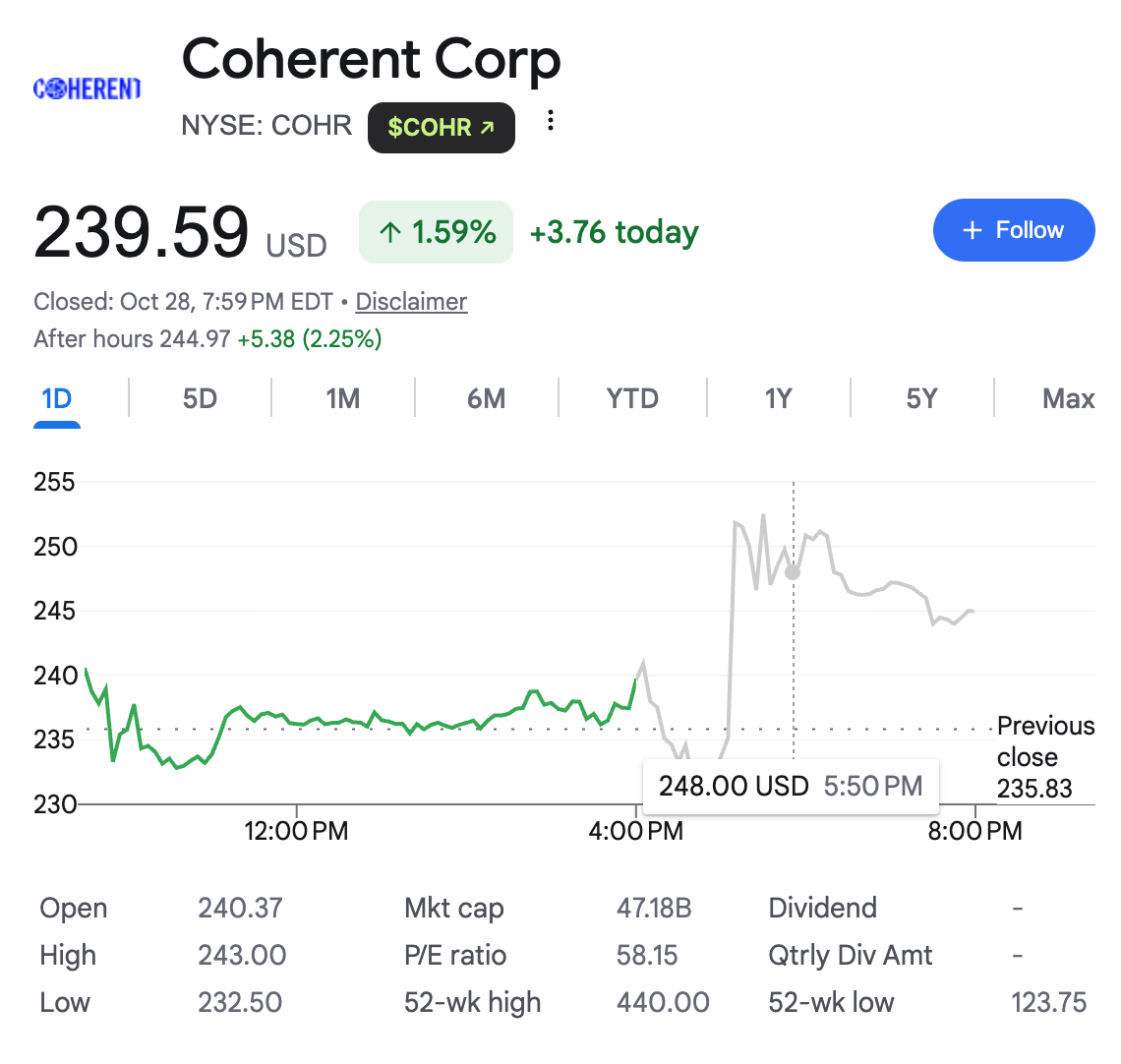
While the two protagonists at the table sent shockwaves through the industry, shares of another global photonics and optical communications device giant, Coherent (NASDAQ: COHR), also rose noticeably after hours, briefly breaking through $250 in overnight trading.
The market's bullish logic for Coherent may be related to "supply chain neutrality." Before this acquisition, Lumentum was an industry-neutral public underlying supplier whose customers included not only major cloud providers and optical module manufacturers, but also chip giants such as Broadcom, NVIDIA, and AMD. Once Lumentum is wholly absorbed by Marvell, it would transform from a "public arms dealer" into "exclusive assets controlled by a direct competitor."
For Broadcom and major cloud providers, handing the lifeline (lasers) of their core network equipment to Marvell—a competitor in custom chips and switches—is absolutely unacceptable from a supply chain security standpoint. To follow the "Second Source" principle and avoid the risk of being held hostage, those giant customers who were previously queuing outside Lumentum's door waiting for 2027-2028 capacity will very likely accelerate the shift of massive incremental orders, capacity expansion prepayments, and multi-year long-term agreements to Coherent, the only other independent optical device leader remaining in the market.
In other words, if the Marvell-Lumentum deal ultimately goes through, Coherent's "independent third-party" status and existing mature capacity could directly benefit from a higher scarcity valuation premium.
Marvell's Path to a Trillion Dollars
In June this year, NVIDIA founder Jensen Huang shared a fireside chat stage with Marvell CEO Matt Murphy. When discussing the evolution of AI infrastructure, the two jointly offered a highly forward-looking industry judgment: the first wave of AI bottlenecks was compute, which created the first $5 trillion market cap company, NVIDIA; the second wave of bottlenecks is memory, which spawned three trillion-dollar memory giants; and the next ultimate bottleneck will be "Connectivity."
On that stage, Jensen Huang pointed at Marvell and shouted to the audience: "Ladies and gentlemen, this is the next trillion-dollar company!"

For helmsman Matt Murphy, to truly leap from the current $220 billion market cap to the "trillion-dollar club" predicted by Jensen, relying solely on selling DSP chips or doing custom ASIC foundry work for cloud providers has a clearly visible ceiling.
Only by bringing Lumentum into the fold and forging the industry's most scarce light source capacity for the next three years together with its own silicon photonics, DSP, switch, and custom XPU technologies into an indivisible closed loop can Marvell truly transform from a "core supporting player selling shovels" into an "infrastructure rule-maker" in the AI optical interconnect era.
Early next week, the cards of this nearly $100 billion deal may be officially revealed—and the second half of the global AI compute supply chain reshuffle has only just begun.