US Stocks Daily | 10-Year Treasury Yield Breaks 5.04%, December Rate Hike Expectations Intensify, GOOGL Plunges Nearly 10% After Hours (October 29)


- Key Takeaways: The Fed held rates steady but saw its first hawkish dissent with two votes favoring a hike. Combined with AI capital expenditure consuming cash flow, the market is repricing tech and crypto assets from "scale of investment" to "return on investment," and the DAT sector's asset authenticity risk has been publicly exposed for the first time.
- Key Elements:
- The FOMC maintained rates at 3.75%-4.00% in a 10-2 vote, with Cook and Hammack advocating for a 25 basis point hike—the first explicit hawkish dissent of this cycle—as the 10-year Treasury yield rose to 5.05%.
- Alphabet's Q3 capital expenditure reached $51.355 billion with free cash flow at -$9.065 billion, sending shares down 9.97% after hours; Microsoft's Azure grew 48% year-over-year with capital expenditure discipline intact, rising 2.88% after hours, forming a control group.
- ServiceNow fell 18.07% and Fortinet dropped 25.71% after hours, as concerns over AI displacing software and security budgets spread from individual stocks to a sector-wide valuation reset.
- Strategy disclosed holdings of 848,517 BTC at a total cost of $64.02 billion; Datavault AI admitted it could not withdraw Bitcoin linked to a $150 million stock transaction from a custody wallet and restated multiple periods of financial statements, becoming a high-risk DAT case.
- Brent crude settled at $115.32, as the U.S. asked Gulf states to prepare for resuming strikes on Iran after the midterm elections, making oil prices the primary exogenous variable for inflation and the Fed's hawkish stance.
- The 20-year yield at 5.41% exceeded the 30-year at 5.37%, with the long-end inversion reflecting "high inflation + high deficit supply" pricing rather than pure growth expectations.
1. Top Stories
- The Fed held rates steady, but two votes favored a hike. On October 28, the FOMC voted 10-2 to keep the federal funds rate target range at 3.75%-4.00%, with Cook and Hammack dissenting in favor of a 25 basis point hike; the statement said the economy is "expanding at a strong pace" and that "inflation remains elevated." Interpretation: This is the first clear hawkish dissent of the current cycle, directly capping rate-cut expectations, with the 10-year Treasury yield rising to 5.05% that day.
- Alphabet pays for AI with cash flow, shares slump after hours. Third-quarter revenue was $127.577 billion (+25% YoY), Google Cloud $30.709 billion (+103% YoY), but capital expenditures were $51.355 billion, free cash flow was -$9.065 billion, and diluted EPS was $2.12 (Nasdaq calendar consensus $2.94); the company maintained its 2026 capex guidance and said 2027 would "significantly increase" (Source: SEC 8-K Exhibit 99.1; CNBC). Shares fell 9.97% after hours. Interpretation: For the first time, the gap between AI spending and free cash flow appears as a "negative value" on a mega-cap company's financial statements.
- Microsoft offers the opposite sample: cloud growth and capex discipline coexist. First-quarter revenue was $92.279 billion, diluted EPS $4.92 (Nasdaq calendar consensus $4.71), Azure +48% YoY, capex $39.367 billion (Source: SEC 8-K Exhibit 99.1). Shares rose 2.88% after hours. Interpretation: With similarly massive AI spending, the market is beginning to price on "input-output ratio" rather than "scale of investment."
- Software and cybersecurity stocks plunged collectively after hours. ServiceNow fell 18.07% after hours (Q4 cRPO growth guidance cut to 18.5%, below Q3's 20.5%), while Fortinet fell 25.71% after hours (Q3 revenue $2.08 billion, raised full-year guidance, but the market read it as slowing growth). Interpretation: Concerns that AI will substitute traditional software and security budgets are spreading from individual companies to the sector.
- Crude oil oscillates at highs, geopolitical premium persists. Brent December contracts settled at $115.32 on October 28; the front-month continuous contract traded at $114.19 (-0.98%) before 23:12 ET on October 28. CNBC reported that the U.S. has asked Gulf states to prepare for "resuming strikes on Iran after the midterm elections." Interpretation: Oil prices are the main exogenous variable for current inflation and the Fed's hawkish stance.
- Two opposing narratives in crypto-linked U.S. stocks. Strategy disclosed 848,517 BTC at a total cost of $64.02 billion; Datavault AI admitted it cannot withdraw bitcoin linked to a $150 million stock transaction from a custodial wallet and announced restatement of multiple periods' financials (Source: SEC 8-K). Interpretation: The DAT sector's "asset authenticity" and "financing sustainability" are beginning to be priced separately.
2. U.S. Stock Market and Macro
2.1 The Three Major Indices and Volatility (U.S. Eastern Time, October 28, 2026 Close)

Drivers:
First, the Fed kept rates unchanged with hawkish language but no hike, removing uncertainty;
Second, semiconductors rallied (SOX +1.76%, AMD +3.25%, AVGO +2.77%);
Third, position adjustments ahead of earnings. It should be noted that index gains diverged from market breadth—Fortune reported that most S&P 500 constituents fell that day, with gains concentrated in heavyweight tech and chip stocks.
2.2 Sectors and Styles (October 28 Close)

The style was a classic "duration compression + defensive sector outflow": in a rising-rate environment, utilities and real estate led declines, while chips and small caps outperformed relatively.
2.3 The Fed: Holding Steady, but Internal Rifts Widen
- Decision: The federal funds rate target range remains 3.75%-4.00%, with a 10-2 vote.
- Direction of dissent: Cook and Hammack favored a 25 basis point hike, not a cut—the first time this cycle that dissent has clearly pointed toward tightening.
- Statement language: The economy is "expanding at a strong pace," productivity growth is strong, capital investment is "solid"; "inflation remains elevated," requiring "the accumulation of more information" to determine the appropriate policy stance.
- Meeting mechanism: Fed Chair Warsh announced at a press conference an adjustment to future FOMC meeting arrangements, reducing the number of rate-decision meetings starting in fall 2027. Some media reported 6 rate-decision meetings in 2028; this detail appears only in secondary reports and has not been verified against original Fed text, marked as unconfirmed.
- Market reaction: Short-end yields fell while long-end rose (Bloomberg said short-end yields declined after Warsh's remarks).
2.4 Rates, the Dollar, and Commodities
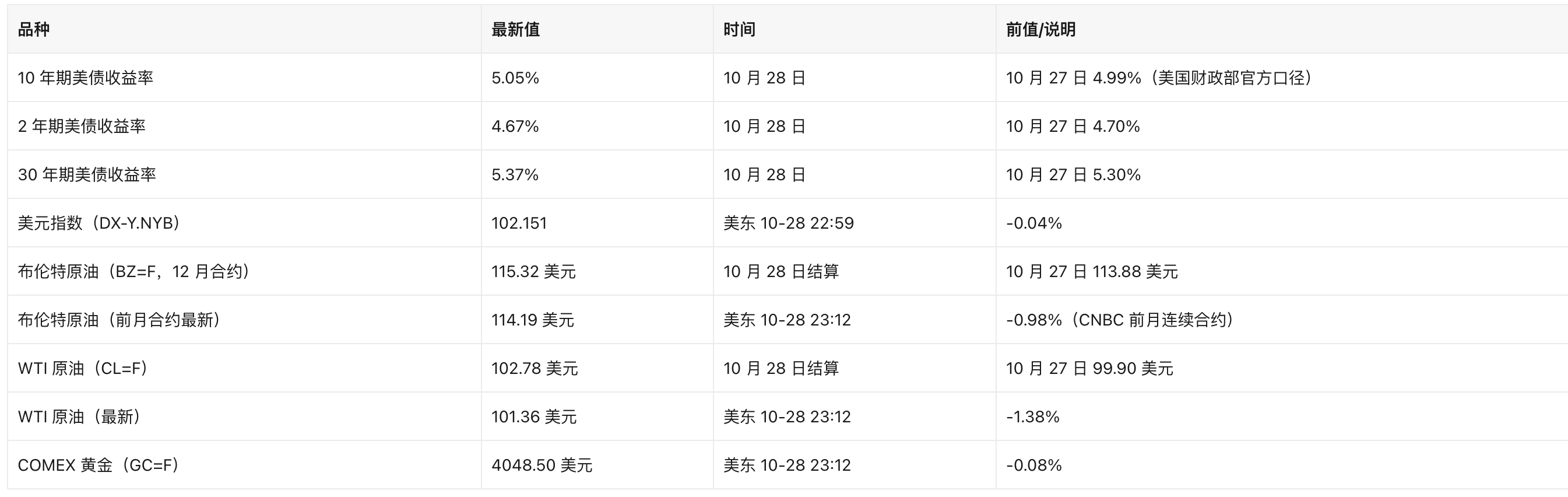
The yield curve shape is noteworthy: the 20-year at 5.41% is above the 30-year at 5.37%, with an inversion at the long end, reflecting the market pricing a combination of "high inflation + high deficit supply" rather than pure growth expectations.
2.5 Macro Data (Released)
- September durable goods orders (released October 27): +1.8% MoM, expected +1.7%, prior +0.1%; core durable goods orders +0.5%, expected +0.6%; nondefense capital goods orders excluding aircraft +0.5%, expected +0.7%. Reuters attributed equipment spending to the "AI investment boom."
- October Conference Board Consumer Confidence Index (released October 27): 91.7, expected 81.2, prior 84.2.
- September new home sales (released October 27): 676,000, expected 651,000.
- MBA mortgage applications (October 28): +3.4% MoM, 30-year fixed rate 7.37%, prior 7.41%.
- EIA weekly inventories (October 28): crude -1.892 million barrels (expected +100,000 barrels), gasoline +3.870 million barrels, distillates -1.462 million barrels. The combination of crude drawdown and large gasoline build explains oil's intraday spike on October 28 followed by a pullback in overnight electronic trading.
- Atlanta Fed GDPNow (October 28): Q3 GDP growth tracking estimate 3.3%, prior 3.4%.
3. Hot Stocks and Sectors
3.1 Alphabet (GOOGL): Capex Swallows Free Cash Flow
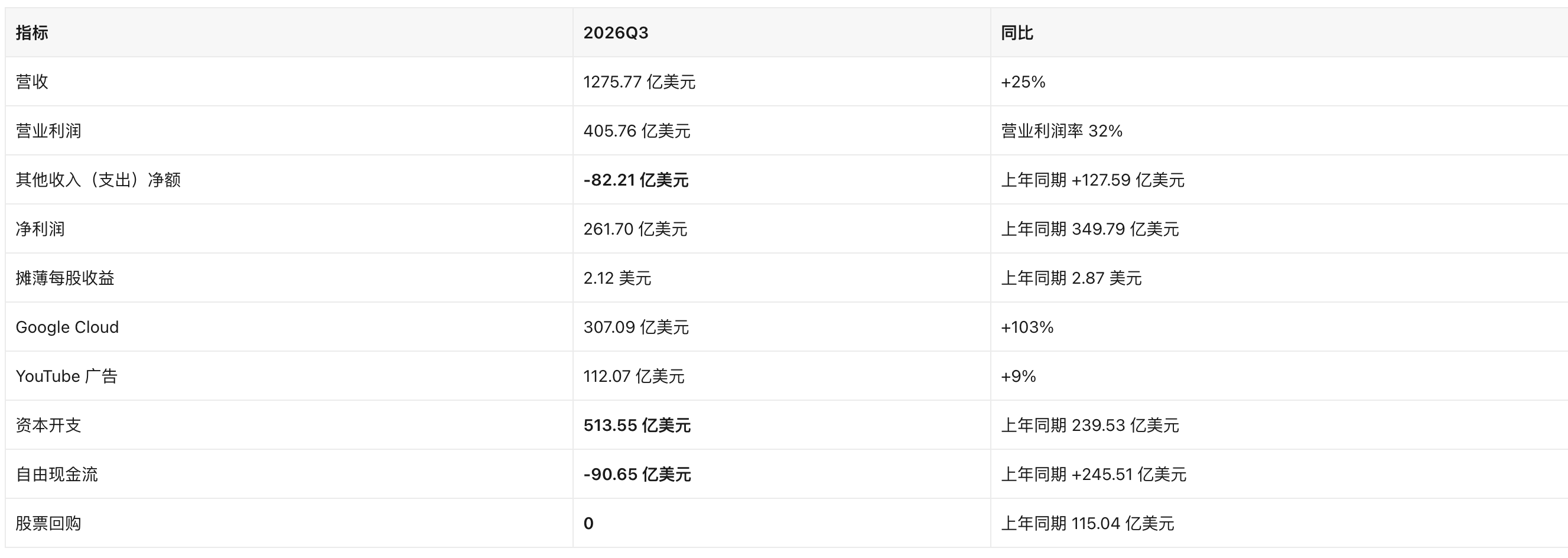
After-hours price: $292.50, down 9.97% (19:59 ET, October 28, volume 25.26 million shares).
Transmission logic: Revenue and cloud business are fine; the problem is threefold—capex doubled YoY, free cash flow turned negative, and buybacks went to zero. The market previously priced "AI capex" as a growth option; now it is beginning to re-discount on a "cash flow discount" basis. Operating margin remains at 32%, indicating the operating business has not been eroded and all pressure comes from the investment side; however, "other income (expense), net" swung from +$12.759 billion to -$8.221 billion, the main source of the EPS miss, which includes investment gains and losses and is highly volatile and poorly predictable.
3.2 Microsoft (MSFT): A Counter-Proof of the Same Proposition
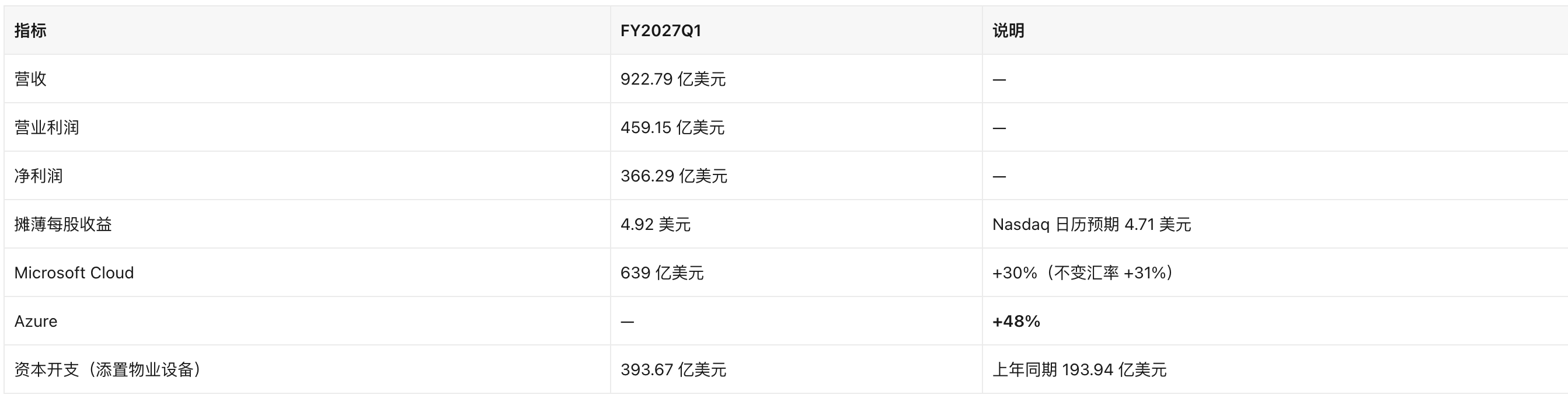
After-hours price: $546.30, up 2.88% (19:59 ET, October 28, volume 8.04 million shares).
Transmission logic: Azure's 48% growth exceeded the market's threshold for "AI monetization," and although capex doubled YoY it landed within an acceptable range; Reuters summarized it as "cloud growth and cash flow offer relief from AI spending concerns." Forming a control group with Alphabet, capital is beginning to reallocate within the AI sector based on "input-output ratio" rather than exiting entirely.
3.3 ServiceNow (NOW) and Fortinet (FTNT): Valuation Reset in Software and Security

After-hours price time: 19:59 ET, October 28; volume 7.22 million and 3.08 million shares.
Transmission logic: Both companies' current results are not bad—ServiceNow said it "exceeded the high end of guidance," and Fortinet raised full-year guidance. The decline comes from forward-looking indicators: ServiceNow's Q4 cRPO growth guidance of 18.5% marks a step down from Q3's 20.5%; Fortinet's Q4 revenue guidance of $2.155-2.245 billion was described by Stock Titan as "the smallest raise of the year." At a 10-year yield discount rate of 5.05%, SaaS companies are extremely sensitive to the "second derivative of growth." Benzinga reported that the cybersecurity sector weakened broadly after hours, indicating this is a sector-wide revaluation rather than an individual stock event.
3.4 Semiconductors: Capital Flows from Software to Hardware
- AMD $578.44 (+3.25%), AVGO $351.81 (+2.77%), KLAC $158.77 (+3.33%, after-hours $165.04, up 3.95%, Benzinga said "double beat + strong guidance").
- NVDA $215.38 (-1.18%), bucking the sector rally, showing capital is also rotating within AI hardware.
- Logic: The software side fears "AI substituting budgets," while the hardware side benefits from "AI buildout budgets"—the same macro variable gives opposite signs across the two industry chains.
3.5 Other Names Worth Noting
- Apple (AAPL) $343.83 (-0.94%), Tesla (TSLA) $404.22 (-0.80%), Meta (META) $612.49 (-1.24%), Amazon (AMZN) $254.60 (+0.59%, Q3 results released after today's close).
- eBay (EBAY) $118.02, after-hours $123.88 (+4.97%).
4. Crypto-Linked U.S. Stocks
4.1 Strategy (MSTR)
Key Data (Source: Original 8-K filed by Strategy on October 26, 2026)
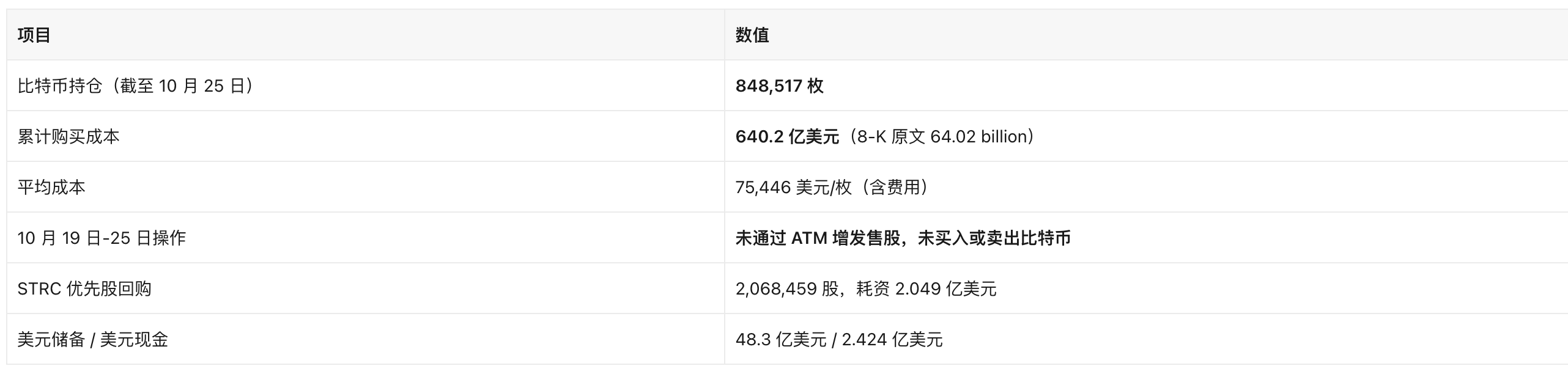
Key inferences (methodology noted): At bitcoin's latest price of $79,775, holdings are worth $67.69 billion; using CNBC's market cap figure of $61.732 billion, market cap/holdings value = 0.91x (this methodology excludes preferred stock and debt; not strict mNAV). Unrealized gain on holdings relative to cost is +5.74%.
Other Actions
- On October 28, a special shareholders' meeting approved amendments to daily dividends for four preferred stocks (STRF, STRC, STRK, STRD); STRC effective November 1, 2026, and STRF/STRK/STRD effective January 1, 2027 (Source: original 8-K). This is essentially converting preferred stock into a "high-frequency distribution tool" to stabilize its financing cost relative to common stock.
- Third-quarter results will be released after the close on October 29 ET (Source: Nasdaq earnings calendar). Market focus has shifted from "how much crypto did they buy" to "the funding source for dividends and buybacks."
Price: $145.16 (October 28 close, +2.66%); after-hours $144.15 (-0.70%).
4.2 Strive (ASST)

Source: Original 8-K filed by Strive on October 26, 2026
Interpretation: Strive is the only DAT this period that is "expanding its balance sheet while adding leverage"—using preferred stock financing to simultaneously increase bitcoin holdings and hold peer STRC, forming a "BTC + preferred stock" dual-layer structure. The Block said its holdings have approached the second-largest corporate bitcoin treasury. At the latest price, 43,000 coins correspond to a market value of $3.43 billion. Risk point: This period's average purchase price of $82,732 is above the current price of $79,775, leaving new positions underwater.
Price: $27.53 (+1.46%).
4.3 New Entrants and Transformations: Datavault AI (DVLT)—The Most Important Negative Case This Period
Facts (Source: Datavault AI 8-K filed October 26, 2026, Item 4.02)
- On September 25, 2025, the company entered into a securities purchase agreement with Scilex: Scilex purchased 15 million common shares and pre-funded warrants for $150 million, paid in bitcoin at $112,915.52 per coin, equivalent to 1,328.43 BTC (the 8-K states approximately), recorded via off-exchange transfer into the company's digital wallet held at Biconomy.
- From September 26, 2025 to January 30, 2026, the company sold 491.431 bitcoin back to Scilex via off-exchange transfer for $40.5 million in cash (the 8-K states approximately $40.5 million).
- In June 2026, the company applied to withdraw coins from the Biconomy wallet to an external account; as of the 8-K filing date, the withdrawal had still not been completed.
- The company determined that this batch of bitcoin does not meet the conditions for recognition as the company's digital assets and should be treated as "subscription receivables arising from the issuance of common stock," and announced that it no longer relies on its Q3 2025 report, 2025 annual report, Q1 2026 report, and interim report, all of which require restatement.
- The restatement is expected to reduce total assets by $8.1 million (2025-09-30), $92.2 million (2025-12-31), $57.1 million (2026-03-31), and $49.0 million (2026-06-30), respectively.
Market reaction: October 27 close $0.07 (October 26 close $0.13); October 28 close $0.09 (last traded price $0.088).
Why this is a landmark event: This is the first public disclosure in the current DAT boom of "holding coins on the books but unable to withdraw them," and it directly triggered restatements of multiple periods' financials. It pushes the DAT valuation framework from "holdings × coin price" to "verifiability of holdings × custody counterpart