After major players entered, is Ethereum staking really becoming more "centralized"?


- Core Viewpoint: Institutional capital is accelerating its influx into Ethereum staking, and EIP-7251 has raised the balance cap for individual validators, but staking concentration cannot be judged solely by token holdings; the real risk depends on the actual distribution of control over validator operations, signing keys, and infrastructure.
- Key Elements:
- In the first half of 2026, the scale of Ethereum staking grew from approximately 36.3 million ETH to 43.1 million ETH, an increase of about 19%; the share of institutional staking rose from 25.9% to 35.3%.
- Lido's share fell from 23.9% to 21.2%, while Bitmine, Coinbase, and Binance reached approximately 11.5%, 10.9%, and 7.9% respectively, with Bitmine growing by about 10 percentage points in half a year.
- Staking control must be distinguished across three layers: asset ownership, validator operational control, and infrastructure and governance decision-making power; the concentration of these three is not consistent.
- EIP-7251 raised the effective balance cap for a single validator from 32 ETH to 2048 ETH, reducing key management and operational costs and supporting native compounding at the protocol layer.
- If a coordinated group controls more than one-third of the active staking weight, under certain conditions it can prevent the network from achieving finality.
- The conversion of 0x02 validators is irreversible, and partial withdrawals must be actively initiated; large holders need to exercise caution in their operations.
If an institution holds millions of ETH and decides to put the vast majority of it into staking, will Ethereum become more centralized as a result?
This question sounds easy enough to answer.
After all, under PoS (Proof of Stake), if more and more ETH is held by a small number of large institutions, it seems to imply that the network's say is concentrating in the hands of a few.
But the reality may not be so simple.
Over the past year, as more and more institutional capital has entered the Ethereum staking market, and as EIP-7251 raised the effective balance cap for a single validator from 32 ETH to 2048 ETH, the entire staking ecosystem has been undergoing two changes that look similar but are in fact entirely different:
On the one hand, large amounts of capital are indeed becoming more concentrated; on the other hand, more ETH is being consolidated into a smaller number of validators.
So will these two things actually exacerbate Ethereum's centralization risk?
1. Large ETH Holdings Are Accelerating Into Staking—Is the Centralization Trend Intensifying?
Let's look at a few sets of data first.
According to Lido's H1 2026 report, as of the end of June, the Ethereum staking market had grown from about 36.3 million ETH at the start of the year to 43.1 million ETH, an increase of about 19% over the half year. This figure includes staking funds that have entered the queue but have not yet been activated, while excluding ETH in the exit queue.
But what is more noteworthy is the change in the source of funds.
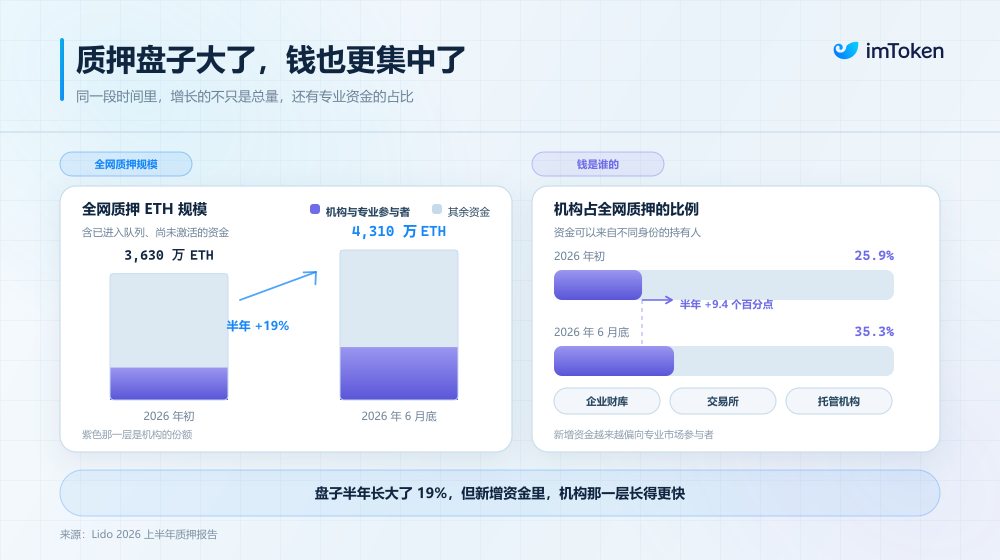
Over the same period, institutional staking's share of the overall market rose from 25.9% to 35.3%, an increase of nearly 10 percentage points.
In other words, a growing portion of the newly staked ETH is coming from professional market participants such as corporate treasuries, exchanges, and custodians.
And in terms of market share, this shift is also quite evident.
As of the end of June 2026, Lido remained the largest staking protocol, accounting for about 21.2% of network-wide staking, but its share had actually declined from 23.9% at the start of the year.
Meanwhile, Bitmine, Coinbase, and Binance held shares of approximately 11.5%, 10.9%, and 7.9% respectively in the same period, with Bitmine's growth particularly notable—its market share increased by about 10 percentage points in just half a year.
This actually reflects an interesting phenomenon.
In past years, when the community discussed Ethereum staking centralization, attention tended to focus on liquid staking protocols such as Lido, worrying that more and more users would participate in staking through the same protocol, ultimately forming some kind of concentration of consensus power.
But now, a new change has emerged.
As institutional-grade ETH holders begin to participate in native staking at scale, the capital structure of the staking market is changing, and liquid staking protocols are no longer the primary destination for new capital.
However, problems follow.
If a large institution holds more than 10% of the network's staked ETH, does that mean it can directly control more than 10% of the network's validators?
And if hundreds of thousands of validators are consolidated into fewer high-balance validators, does that mean Ethereum is actively moving toward centralization?
To answer these questions, we first need to unpack a few easily confused concepts.
2. Does an Institution Holding Millions of ETH Mean It Controls the Validation Power of Millions of ETH?
The most common mistake in understanding Ethereum staking centralization is to directly equate "who owns the funds" with "who actually operates the validators" (Further reading: "When 34% of ETH Is Staking: In the Era of Native Compounding, How Should You Choose Staking?").
In fact, this involves three different levels of control.
- First is asset control: who actually owns the staked ETH, and who has the right to decide to exit staking, withdraw assets, or change service providers.
- Second is validator operation: who runs the nodes, manages the validator signing keys, and is responsible for block proposing, consensus attestations, and other actual work.
- Finally, there is infrastructure and decision-making power: do large numbers of validators rely on the same clients, cloud service providers, or MEV relays? To what extent can a platform's governance mechanism or management team coordinate the behavior of these validators?
The concentration at these three levels is not always consistent.

For example.
An institution may hold 1 million ETH and use all of it for native staking, but actually allocate that ETH across more than a dozen independent node service providers.
From the perspective of asset ownership, the 1 million ETH is indeed concentrated in the hands of a single institution; but from the perspective of actual validator operation, the relevant signing keys may be managed by different service providers, deployed in different regions, and using different client software.
Conversely, another scenario is also worth watching.
Suppose tens of thousands of users each hold 32 ETH and all use the same node operator to perform validation tasks.
Then even if asset ownership is highly dispersed, the underlying validator signing, operations, and infrastructure may be highly concentrated.
So what truly deserves vigilance is actually who ultimately executes consensus for these ETH, and whether different participants share common points of failure or decision-making dependencies.
Of course, this does not mean that large institutional holdings carry no centralization risk at all.
If an institution not only holds a large amount of ETH but also actually controls the signing keys of all relevant validators, then its influence over network consensus naturally cannot be ignored.
And even when using external node operators, asset holders may still indirectly influence validator behavior through service agreements, capital allocation, exits, and redelegation.
In addition, Ethereum consensus itself allocates weight according to effective staked balance. When a participant actually coordinates or controls enough staking weight, it may influence network finality.
For example, if a coordinated group controls more than one-third of active staking weight, under certain conditions it would be able to prevent the network from reaching finality.
Therefore, whether large staking threatens decentralization cannot be judged solely by how much ETH a certain institution holds, nor can the risk be assumed to have disappeared simply because multiple service providers are used.
This is also why discussing Ethereum staking concentration requires more nuance than simply comparing market shares.
3. From 32 ETH to 2048 ETH: What Changes for Large Staking?
It is worth highlighting that alongside the large-scale entry of institutional capital, Ethereum's Pectra upgrade has also substantially changed how large staking operates.
In particular, EIP-7251 raised the maximum effective balance of a single validator from 32 ETH to 2048 ETH, while retaining the 32 ETH minimum activation threshold (Further reading: "When 8 Million ETH Begin to "Move House": In the Post-Pectra Era, Is Staking Facing a Structural Upheaval?").

Why make such an adjustment?
In the past, if we held 1024 ETH and wanted to put it all into native staking, we typically needed to split it into 32 portions and create 32 independent validators. Each validator had its own independent signing identity, needed to participate separately in consensus attestations, and incurred corresponding costs for key management, message propagation, and state maintenance.
After EIP-7251 took effect, the same 1024 ETH can, subject to protocol rules, be carried by a single 0x02 validator, so management costs and the additional burden on the consensus layer can be significantly improved.
In addition, another more direct change lies in "native compounding."
Traditional 0x01 validators have their effective balance cap fixed at 32 ETH. Excess rewards do not continue to increase their effective staking weight. If you want to put those earnings back into native staking, you need to arrange the funds separately.
For large staking pools, this is not entirely unsolvable, because they can pool the rewards generated by a large number of validators, reassemble 32 ETH, and create new validators.
But for long-term holders with only one or a few validators, this approach is often not convenient enough. After all, staking rewards do not generate 32 ETH all at once, but accumulate gradually over a long period of time.
EIP-7251, by contrast, allows consensus-layer rewards to remain in the validator's own balance and, according to protocol rules, gradually increases the staking weight used in reward calculations in effective-balance adjustment increments of 1 ETH, until reaching the 2048 ETH cap.
In other words, the process that originally required users to actively withdraw rewards, accumulate them, and reinvest them can now be completed automatically within the Ethereum protocol.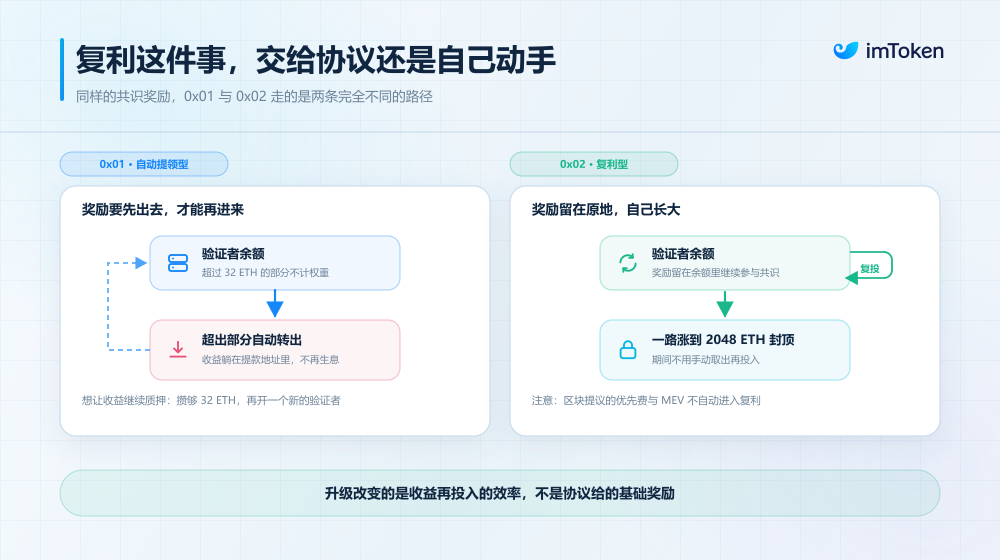
For large institutions, this undoubtedly greatly reduces the number of validators and lowers key management and operational costs; for ordinary long-term holders, there is no longer a need to repeatedly accumulate new 32 ETH in order to reinvest small amounts of rewards.
This is also Ethereum paving the way at the protocol layer for the scaling, institutionalization, and professionalization of ETH staking, giving greater flexibility to staking scale, compounding methods, and capital management.
Of course, greater convenience comes with new management requirements.
0x02 validators do not, as in the traditional model, automatically transfer out rewards above 32 ETH on a regular basis. If users need to use rewards for spending, trading, or other asset management purposes, they must initiate partial withdrawals according to protocol rules.
In addition, converting a traditional 0x01 validator to the 0x02 type is irreversible. For large holders who manage validators themselves, consolidation operations also require extra caution; once the target validator or authorization information is entered incorrectly, it may cause serious losses.

Final Thoughts
Looking back at the changes in large-scale ETH staking, we can actually identify two trends advancing simultaneously.
One occurs at the market level: as institutional capital continues to enter, ETH staking is gradually becoming an important part of long-term asset management.
The other occurs at the protocol level: through upgrades such as EIP-7251, Ethereum is reducing the mechanical validator splitting of the past, allowing large amounts of capital to participate in network consensus in a more efficient way.
But it should also be clear that efficiency gains themselves do not equal increased decentralization.
A smaller number of validators does not directly prove that the network is more centralized; conversely, even if there are many validators, if the underlying signing rights and operational rights are highly concentrated, it does not mean the network is sufficiently decentralized.
Ultimately, the degree of decentralization still depends on the real distribution of control, and on whether the entire network can avoid excessive dependence on a small number of operators, clients, and infrastructure.
For users, this also reminds us that when comparing ETH staking options today, the focus should no longer be only on APR.
For example, in practice, imToken's non-custodial ETH staking offers two modes: compounding validators and auto-withdrawal validators. Users can choose different capital management approaches depending on whether they want to accumulate ETH over the long term or receive disposable staking rewards on a regular basis.
At the same time, the non-custodial model leaves withdrawal control with users, while professional service providers handle validator signing and operational maintenance, thereby preserving control over staked assets without the need to maintain nodes oneself.
From this perspective, the next stage of Ethereum staking is about enabling ETH holders of different sizes to participate in a clearer, more controllable, and more efficient way.
This may be the truly noteworthy long-term change in the era of large-scale staking.