Joining Hands with Kraken's Parent Company: How Far Is Hyperliquid from Entering the U.S. Market?


- Core Viewpoint: Hyperliquid has partnered with Payward, the parent company of Kraken, and plans to bring on-chain perpetual contracts into the U.S. market through licensed institutions. The HYPE price has returned above $80, but the plan still requires CFTC regulatory approval, and an official launch is yet to come.
- Key Elements:
- Payward intends to become the first CFTC-regulated deployer in the HIP-3 market, and the supporting features are currently in the testnet phase.
- The division of responsibilities is clear: Hyperliquid provides the public chain and on-chain order book, Bitnomial handles market creation and clearing and settlement, and NinjaTrader takes on client accounts.
- U.S. customers must complete account opening with NinjaTrader and enter the dual admission list before they can trade the relevant contracts.
- The HIP-3* testing feature allows deployers to maintain an on-chain admission list, mapping customer review results to on-chain access permissions.
- The CFTC issued an advance notice of proposed rulemaking on October 5, with the comment period closing on December 14, and no new effective rules have yet been formed.
- The two parties have not announced a confirmed launch date or a complete contract list, and business growth will depend on product selection, liquidity, and trading costs.
Original | Odaily (@OdailyChina)
Author | Asher (@Asher_0210)
As Hyperliquid makes new progress in entering the US market, HYPE has climbed back above $80.
Yesterday, Hyperliquid co-founder Jeff said he was pleased to partner with Kraken parent company Payward to advance on-chain derivatives based on Hyperliquid infrastructure and bring a new generation of perpetual futures markets to the United States.
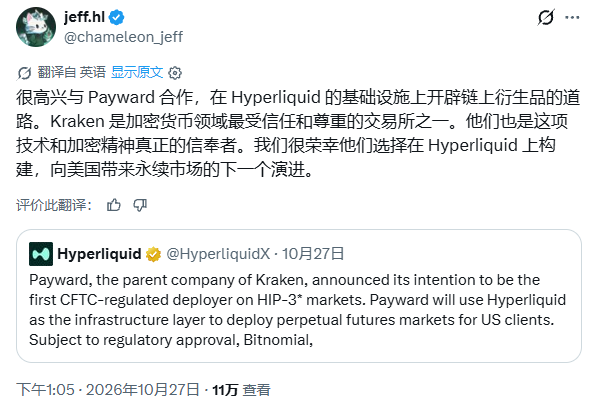
According to the disclosed plan, Payward intends to become the first deployer of an HIP-3* market regulated by the US Commodity Futures Trading Commission (CFTC). The plan still requires regulatory approval, and the supporting features are currently in the testnet stage.
This partnership provides Hyperliquid with a path to serve US customers through licensed institutions. As the division of responsibilities gradually becomes clear, market attention has shifted to more specific questions — how will US customers participate in trading, and how far is this arrangement from an official launch?
Payward Handles Accounts and Clearing, Hyperliquid Provides On-Chain Trading
As early as September 16, Payward announced plans to use Hyperliquid to provide on-chain perpetual contracts to US customers. Under the proposed arrangement, Hyperliquid provides the public chain and on-chain order book; Bitnomial's exchange and clearing entities are responsible for creating and managing markets and for contract clearing and settlement; and NinjaTrader Clearing handles customer accounts. The corresponding regulatory obligations are borne by the aforementioned licensed entities.
US customers must complete NinjaTrader's account opening process and be placed on both NinjaTrader's and Bitnomial's access lists before they can trade the relevant contracts. In other words, users open futures accounts through a licensed brokerage, trading uses Hyperliquid's on-chain infrastructure, and market operations and clearing are handled by the corresponding Payward subsidiaries.
Notably, Payward already offers its own perpetual contract products to US customers, and this plan is intended to further incorporate Hyperliquid into its product lineup on top of its existing business. For Payward, this is expected to expand customers' trading options; for Hyperliquid, the partner's account and service systems may help it reach more users who participate in derivatives trading through regulated channels.
Whether the partnership can generate business growth depends on whether these links can connect smoothly. On-chain matching is only part of the trading process; customer onboarding, fund management, clearing, and risk control also affect the product experience. The participation of licensed institutions clarifies who bears these responsibilities and gives Hyperliquid's US business a more concrete operating plan.
How Does HIP-3 Connect Customer Verification with On-Chain Trading?
After US customers complete account opening verification, the on-chain market also needs to recognize their trading eligibility. HIP-3*, which Hyperliquid is testing, allows market deployers or their designated sub-deployers to maintain on-chain access lists that determine which accounts can participate in trading. Payward can use this to map customer verification results to on-chain access permissions, ensuring that access requirements are enforced at the trading stage.
HIP-3* is an optional feature added on top of HIP-3; deployers can decide whether to enable it, and existing markets remain unchanged. The initial version is already available on testnet, specifications may still be adjusted based on feedback, and official support will require a subsequent network upgrade. This design allows the same infrastructure to host markets with different access conditions, and each operator can manage its own deployment according to the service region, customer type, and applicable requirements.
However, access lists address account access control; customer verification, contract rules, clearing arrangements, and other regulatory obligations still need to be implemented by the operator. Hyperliquid has also made clear that deployers, as independent operators, retain control over their own markets and bear responsibility for them. Therefore, this partnership concerns new markets for eligible US customers; which products are ultimately opened will depend on the scope of approval, and it should not be understood as the entire platform opening fully to the United States.
Regulatory Approval Remains the Key to Implementation
As the partnership advances, the CFTC is also exploring new rules for crypto markets. On October 5, the agency issued an advance notice of proposed rulemaking, intending to use its existing statutory authority to develop tailored rules for retail commodity trading of relevant crypto assets and to study a dedicated registration category for crypto asset markets. The comment period ends on December 14, and no new effective regime has yet been formed. The CFTC is seeking a viable path to regulate crypto markets within the existing legal framework, but Payward's partnership plan still requires specific approval.
As of this disclosure, the two parties have not announced a confirmed launch date or a complete contract list, and the specific trading conditions applicable to US customers remain to be further clarified. Whether business growth can be generated will also depend on product selection, liquidity, trading costs, and account experience. A licensed business framework provides the foundation for entering the US market; whether it can attract users to trade consistently will require data verification after the products launch.
This partnership incorporates Hyperliquid's on-chain trading infrastructure into a licensed institution's US business plan, and if it is successfully implemented, it will also provide a reference for other institutions. HYPE has already risen first, but Hyperliquid's entry into the US market still needs to clear the two hurdles of approval and launch.