From "Prisoner's Dilemma" to "Reflexivity": The Market Game That Will Govern AI Trading


- Key Takeaways: The AI infrastructure arms race is shifting from "operating cash flow-driven" to "external financing-driven." Hyperscaler capex will surpass free cash flow, and market sentiment is becoming an endogenous variable affecting investment scale, with reflexivity risk rising significantly.
- Key Elements:
- Five cloud providers—Microsoft, Alphabet, Amazon, Meta, and Oracle—are projected to have total capex exceeding free cash flow by 2027, with every $1 of operating cash flow corresponding to approximately $1.57 of new capex.
- The five giants' combined capex rose from approximately $227 billion in 2024 to $391 billion in 2025, with 2026 guidance potentially exceeding $635 billion; 2026 committed spending is approximately 3.8 times their combined free cash flow.
- Oracle's capex as a percentage of operating cash flow surged from 47% in fiscal 2022 to 174% in fiscal 2026, free cash flow turned negative, and the stock fell 36% year-to-date, with plans to raise $45 billion to $50 billion.
- Historical parallels: nine out of ten railway companies went bankrupt during the 19th-century railway boom, the aviation industry accumulated only about $86 billion in net profit over 80 years, and the telecom bubble wiped out approximately $2 trillion in market value—all demonstrating that transformative technologies are corrosive to investor profit margins.
- Based on current guidance, AI compute revenue would need to reach approximately $2.9 trillion by 2030 to cover capital costs—more than three times the current cloud computing market size—requiring about 68% annual growth for five consecutive years.
- The Jevons Paradox may fail at the AI infrastructure level: for every 10% drop in task cost, usage increases only about 3%, and AI revenue growth of 25%-30% is far below capex growth of 60%-70%.
Original author: Long Yue
Original source: Wallstreetcn
Last week, two risk signals in AI infrastructure surfaced simultaneously: CoreWeave suffered a double blow to its stocks and bonds, with financing costs surging; Meta's massive AI capital expenditures and negative free cash flow once again triggered market concerns over the input-output ratio. The former exposed the financing fragility of highly leveraged infrastructure companies, while the latter prompted investors to re-examine the ever-increasing capital expenditures of tech giants.
This is not just pressure facing two companies; it points to the same question: As AI buildout becomes increasingly dependent on external financing, how long can this arms race last?
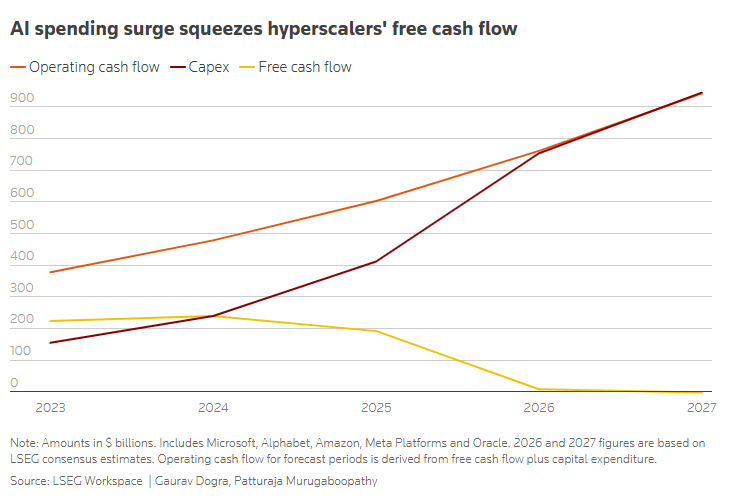
Cloud computing giants are mired in a classic prisoner's dilemma—everyone knows the cost of collective overinvestment, yet none dares to hit the brakes unilaterally. According to Reuters' analysis of LSEG consensus forecast data, the five hyperscale cloud providers—Microsoft, Alphabet, Amazon, Meta, and Oracle—are expected to have total capital expenditures exceeding their free cash flow by 2027, with every additional $1 of operating cash flow corresponding to roughly $1.57 of additional capital expenditures. This scissors gap is pushing tech platforms once known for being "asset-light" toward a new business model highly dependent on capital markets.
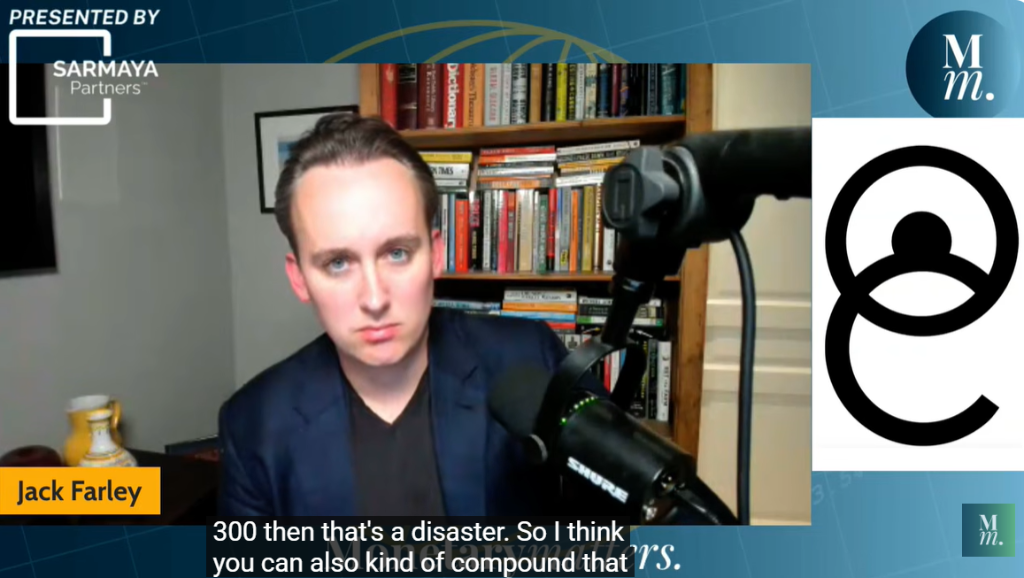
Investor Citrini directly pointed out the core risk of this shift in an interview on the Monetary Matters podcast: "In the first three years of this AI trade, sentiment-driven drawdowns had a floor—because most of the spending came from hyperscalers' operating cash flow. But now, more and more infrastructure is being financed on rather staggering expectations." When the funding source shifts from internal cash flow to equity issuance and debt financing, market sentiment itself gains the ability to directly influence the scale of real investment.
If market sentiment turns sharply, those incremental funds will dry up—because this is no longer a company spending its own money; it's determined by the market.
This is precisely the "Reflexivity" risk (referring to the circular, two-way interaction and influence between cause and effect): confidence supports financing, financing supports investment; once confidence weakens, funding contraction in turn hits investment and growth expectations, forming a negative feedback loop.
AI is reshaping tech giants, and also reshaping their own business models. The logic driving this AI infrastructure arms race may have quietly shifted from "investment drives growth" to "confidence determines investment."
No One Dares to Stop: The Game Structure of the Prisoner's Dilemma
Cornell Capital Group's research report "The AI Prisoner's Dilemma" describes the internal logic of this arms race quite clearly: Any giant that bets big on AI while competitors do not can gain market dominance; if it does not invest while rivals do, it faces the risk of being eliminated. Therefore, regardless of what competitors choose, aggressive investment is every company's "rational strategy."
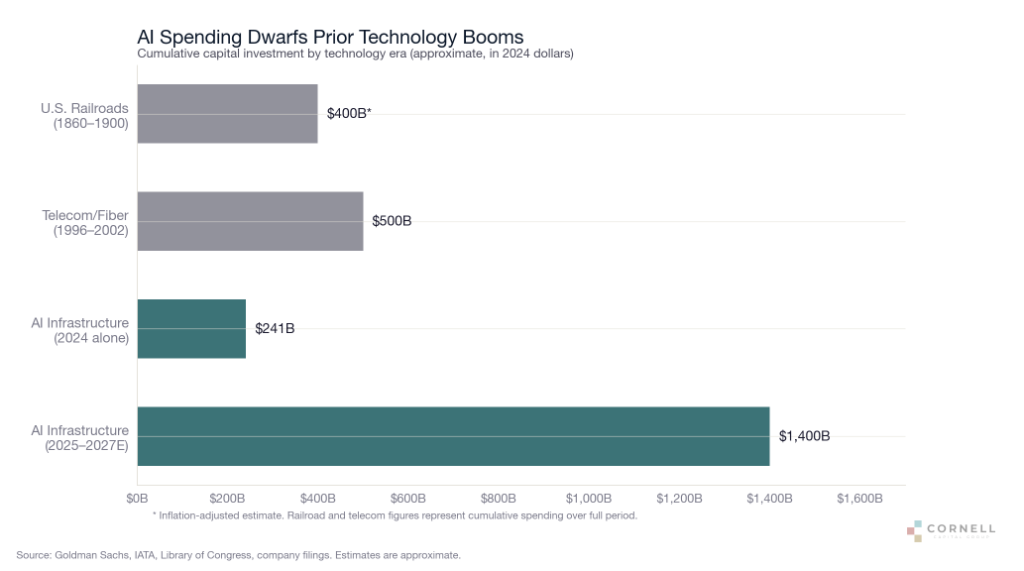
Numbers confirm the intensity of this logic. In 2024, the five companies—Amazon, Alphabet, Microsoft, Meta, and Apple—had combined capital expenditures of approximately $227 billion; in 2025, this figure jumped to $391 billion; management guidance for 2026 suggests the total could exceed $635 billion. Goldman Sachs predicts that between 2025 and 2027, cumulative capital expenditures of hyperscale cloud providers will reach $1.15 trillion to $1.4 trillion—more than double the $477 billion from 2022 to 2024.
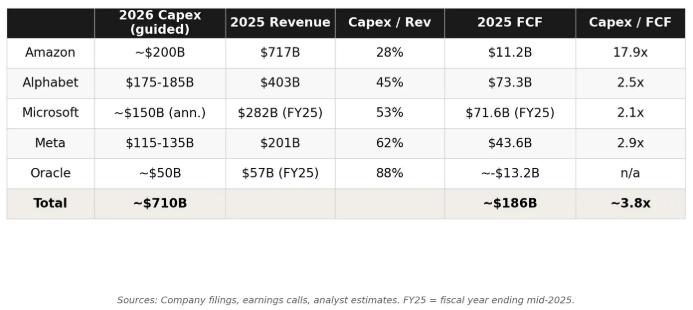
Specifically for each company, 2026 guidance is even more aggressive: Amazon targets $200 billion in spending, Alphabet guides $175 billion to $185 billion—with CEO Sundar Pichai even saying "that number may not be enough"—and Meta guides up to $135 billion.
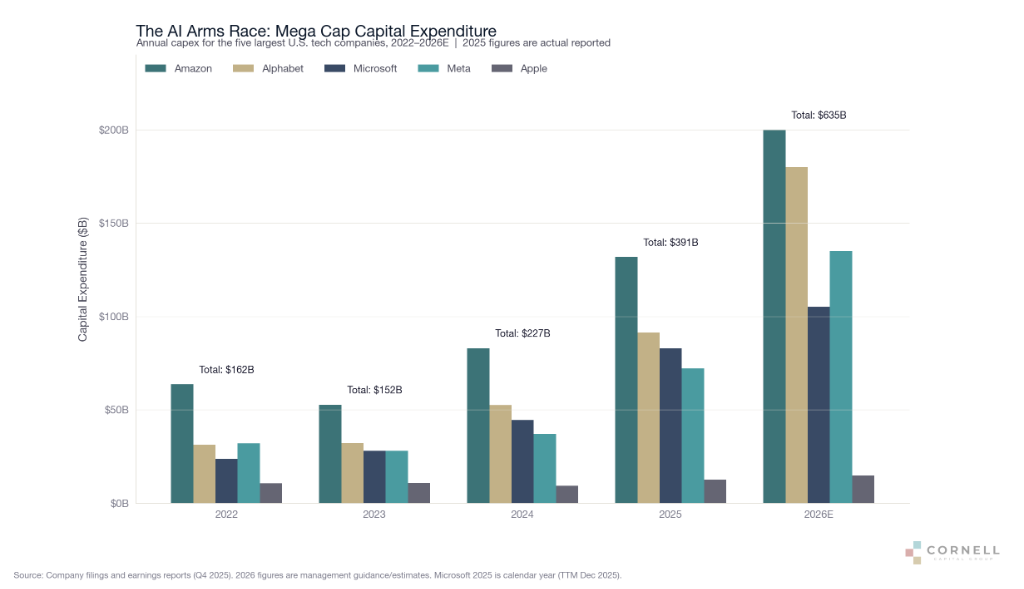
Analyst Amin Mrini noted in his report "The $700 Billion Prisoner's Dilemma" that the five companies' combined committed 2026 capital expenditures are approximately 3.8 times their combined free cash flow—"the most cash-generative businesses in history are on a trajectory of spending nearly $4 for every $1 of free cash flow they generate, filling the gap with record debt issuance."
The structural root of this dilemma lies in the incompressibility of infrastructure. Data centers, power agreements, and specialized chips all require years of advance procurement and construction cycles. By the time demand is clearly visible on the revenue side, the response window has long closed. Mrini wrote: "It is precisely this lag that turns expectations into obligations."
Mirrors of History: The Fate of Railways, Aviation, and Fiber Optics
Cornell Capital's report cites three historical episodes that provide a sobering reference framework for this AI arms race.
During the 19th-century American railway boom, total railway stocks and bonds reached $10.6 billion (about $400 billion in today's terms), far exceeding the $1.2 billion in government debt at the time. Railways did transform America, but in the "Long Depression" after the Panic of 1873, nine out of ten railway companies failed; during the Panic of 1893, a quarter of railway mileage entered bankruptcy receivership. The beneficiaries were manufacturers, agricultural producers, and merchants—not railway shareholders.
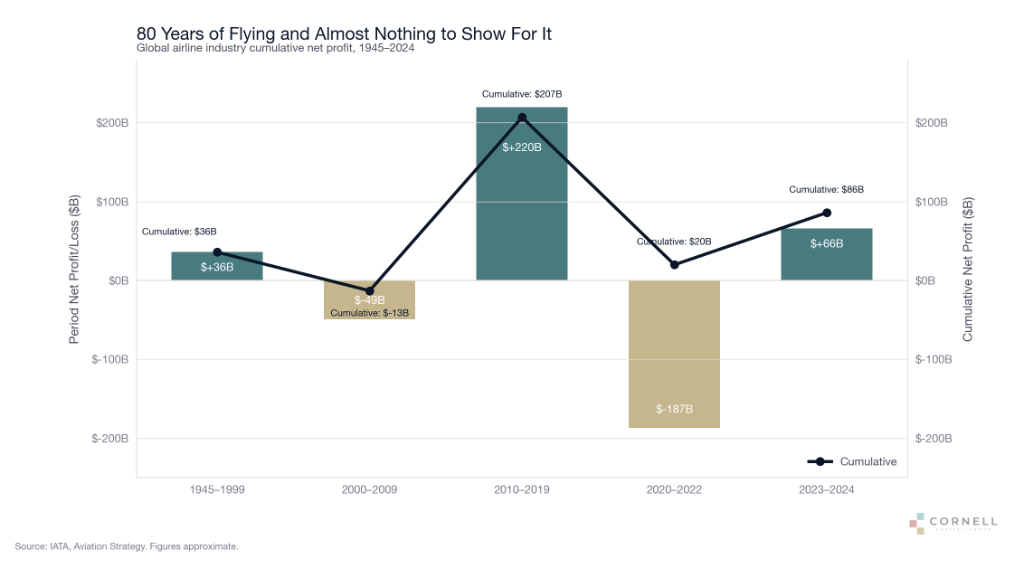
The commercial aviation story is even more straightforward. Over the past 80 years, the global aviation industry has accumulated approximately $86 billion in net profits, while the three years of the COVID pandemic alone wiped out nearly $190 billion. Warren Buffett once summarized this structural predicament: "If a far-sighted capitalist had been present at Kitty Hawk, he would have done his successors a huge favor by shooting Orville Wright down." Buffett himself ultimately sold out of four U.S. airlines in 2020 at a loss of approximately $5 billion.
The telecommunications bubble of the late 1990s is the most direct analogy. At the time, over $500 billion poured into fiber optic cables and wireless networks, mostly financed by debt. By 2002, more than 23 major telecom companies had filed for bankruptcy, approximately $2 trillion in market value evaporated, and less than 5% of laid fiber was actually lit and in use. Yet it was precisely the cheap bandwidth left behind by those bankrupt investors that incubated Netflix, YouTube, and the entire cloud computing industry.
Cornell Capital's conclusion is incisive: "The paradox of transformative technology is this: the more companies spend and the more fiercely they compete, the faster the technology commoditizes. Commoditization is a blessing for consumers but a corrosive to investor margins."
The Cash Flow Scissors Gap: A Stress Test at the Data Level
Reuters' analysis of LSEG data provides empirical support for the above logic.
Oracle is currently the most conspicuous case of stress. Its capital expenditures as a percentage of operating cash flow soared from 47% in fiscal 2022 to 174% in fiscal 2026 (ending May this year)—capital expenditures of $55.7 billion versus operating cash flow of just $32 billion, with free cash flow already negative. The company's stock has fallen 36% this year, and it plans to raise $45 billion to $50 billion through debt and equity financing for cloud infrastructure expansion.
Microsoft recorded $35.8 billion in operating cash flow in its most recent fiscal quarter, while capital expenditures (including finance leases) reached $37.5 billion over the same period. Amazon's operating cash flow grew 30% year-over-year to $148.5 billion over the past 12 months, but free cash flow has dropped to $1.2 billion.
Shay Boloor, Chief Market Strategist at Futurum Equities, said: "Investors underestimate the extent to which AI is fundamentally changing the business models of large tech companies. These companies have historically been viewed as asset-light platforms because revenue growth could far outpace capital requirements, but AI is pushing them toward a hybrid model where the economics of software, advertising, and cloud computing increasingly depend on massive physical infrastructure spending."
Mrini's calculations are even more severe: extrapolating capital expenditures at the current guidance pace through 2027, and using a 15% pre-tax return on investment as a benchmark, AI computing revenue would need to reach approximately $2.9 trillion by 2030 to cover the cost of deployed capital—more than three times the current size of the entire cloud computing market. From the current base of approximately $211 billion, this implies sustaining roughly 68% annual growth for five consecutive years—"unprecedented in any infrastructure market."
Reflexivity: When the Financing Structure Changes the Nature of Risk
Citrini's description of this shift in the interview is one of the most precise frameworks for understanding the current risks of the AI trade.
He divides the change in AI investment financing structure into two phases. In the first phase, hyperscale cloud providers funded spending with their own operating cash flow, meaning that regardless of market sentiment fluctuations, as long as these companies kept investing, the fundamentals of beneficiary companies like semiconductors had a "floor." "Whether it was tariffs, the yen carry trade, or whatever we were worried about in September 2023 that I can't even remember, fundamentals kept improving."
In the second phase—the present—the situation is fundamentally different. Citrini put it bluntly: "Now, virtually every incremental dollar of AI spending comes from equity financing—whether venture capital or public markets—and debt financing. This means AI can become more useful, usage can continue to expand, but you may be paying too high a price for the compute that supplies it; or sentiment can have a more pronounced impact—because unlike before, there's no fundamental floor. If market sentiment turns, those incremental funds will dry up, because this is no longer just one company spending money—it's determined by the market."
The core of this mechanism is: the change in funding sources has turned market sentiment from an exogenous variable into an endogenous variable that can directly influence the scale of investment. Citrini calls this dynamic "reflexivity"—confidence supports financing, financing supports investment, investment supports revenue expectations, and revenue expectations in turn support confidence. And once any link in this chain cracks, the entire positive feedback loop can reverse.
He offered a specific trigger scenario: "I think the turning point of this cycle will arrive with a whimper rather than a bang. It won't be a company default triggering a crash, but rather: we revise the combined ARR forecast for the labs down from $400 billion to $360 billion, and because that growth has already been fully priced in, this incremental change spreads outward and drags down the entire system."
The Jevons Paradox Fails: The Critical Gap in Demand Elasticity
One core optimistic assumption underpinning AI infrastructure investment is the "Jevons Paradox"—falling compute costs will stimulate a demand explosion, thereby absorbing all new capacity. Mrini acknowledges this logic in his report but points out its limitations in the AI context: enterprise integration is slow, regulatory constraints are real, and efficiency gains occur mainly at the model layer—demand response may flow to application developers and model providers rather than the infrastructure layer that sells compute. "The Jevons Paradox can hold at the level of AI as a technology while failing at the level of AI infrastructure as a business model."
Citrini cited economic index data published by Anthropic: for every 10% reduction in task cost, usage increases by only about 3%. "Maybe when the model isn't working well, you actually need more tokens because you have to keep revising." "This is not the Jevons Paradox at all." He also noted that current AI revenue growth is about 25% to 30% annually, while capital expenditure growth is close to 60% to 70%, and the gap between the two widens with each guidance cycle.
He set clear conditions for "when to turn bullish on semiconductors again": "If we see paid usage continue to grow, the second derivative reaccelerate, and financing can genuinely be supported by customer cash flow—that requires adoption to truly improve, especially adoption of the most frontier models."
The Market Is Already Differentiating: Who Sells Compute vs. Who Makes Money from AI
Despite similarly high AI capital expenditures, the market's reaction to different companies has already diverged.
Mrini observed that Meta has gained market recognition because its AI investment is already reflected in improvements in ad targeting and ad effectiveness measurement, driving revenue growth and margin expansion. Compute here is embedded in a business with pricing power, where efficiency gains can directly reduce service costs.
By contrast, Google and Microsoft are still in a phase where investment is clearer and application-layer returns have not yet fully shown up in the income statement. Both companies are embedding AI into search, office software, Android, enterprise collaboration, and agentic tools, and both are competing for the orchestration and coordination entry point for agentic workflows. But what the market sees in the short term is still, first and foremost, the data center bill.
Amazon and Oracle are positioned closer to infrastructure providers. Although Amazon has initiatives like Alexa+ and its in-house Trainium chips, most of its investment still goes toward AWS compute sold by the hour; Oracle is more dependent on cloud infrastructure and faces more pronounced financing pressure.
The difference lies in whether AI investment can be converted into product revenue with pricing power, or whether it mainly relies on selling standardized computing resources.
This is also the most critical dividing line for the next phase of the AI trade: capital expenditure alone is no longer sufficient to constitute a positive catalyst; the market needs to see a clearer transmission to revenue, margins, and cash flow.
Reuters quoted Freddy Lavric, a senior trader at Winthrop Capital Management, as saying: "Over the next two to three years, companies need to prove that AI is driving incremental revenue, expanding margins, and improving cash flow. If these financial benefits do not materialize, the market will begin to question whether this investment cycle has gone too far."
The Real Test of the AI Trade: Whether Capital Can Survive Until Returns Materialize
The technological progress brought by AI has not disappeared, nor has demand evaporated into thin air. The fact that hyperscale cloud providers continue to expand infrastructure investment precisely shows that they believe AI will be core to long-term competitiveness.
The problem is that when all participants believe they cannot afford to be absent, they may collectively create excess supply; when all participants increase financing intensity, market sentiment may shift from bystander to a variable that determines the scale of investment.
The prisoner's dilemma explains why giants keep raising the stakes: everyone fears falling behind.
Reflexivity explains why the market has become fragile: when internal cash flow cannot cover new investment, stock prices, bonds, financing willingness, and capital expenditures begin to influence one another. In optimistic times, this mechanism can amplify expansion; once revenue materializes slower than expected, it will equally amplify contraction.
Whether AI infrastructure ultimately becomes a high-return asset or an expensive commoditization treadmill depends on a simple yet extremely difficult question: can demand growth outpace the decline in compute prices, and can that answer be proven before the equipment being deployed today finishes depreciating?