Can Grok Bot Really Make Money Automatically? First Understand the Loss Traps of Three Types of Bots


- Core Viewpoint: Meme coin trading bots generally have overlooked failure modes. Investors should prioritize assessing the maximum loss a bot can incur when it makes judgment errors, rather than focusing solely on profit performance. Risk control rules can only limit losses and cannot guarantee profits.
- Key Elements:
- If a gambler-type bot adjusts its position based on the result of the previous trade, it may lose about 12% of the account when encountering a Rug, while a fixed-proportion position strategy basically preserves the principal.
- A market maker-type bot must ensure that expected fee income is at least twice the cost of a single token issuance, and must not hold or sell self-issued tokens; otherwise, it constitutes a Rug and brings legal and reputational risks.
- Tracking-type bots have copy-trading delays. A 40-second delay can lead to chasing a price 60% higher; when the tracked wallet profits 100%, the copy trader profits only 25%, or even loses 12.5%.
- Common mistakes include comparing only returns, drawing conclusions from a single run, running the system at its limits, and treating risk control merely as a settings option rather than a hard rule embedded in the order placement process.
- Risk control should prioritize issues that endanger the entire account: first correct position rules, then set a cap on chasing higher prices, and finally calculate coverage of token issuance costs.
Original Title:Grok Bot Engineer: Every Memecoin Bot Has a Failure Mode. Find It Before the Market Does
Compiled by Odaily (@OdailyChina); Translator: Asher (@Asher_ 0210)

Every post on X introducing Grok Bot seems to tell the same kind of money-making story: 0.25 ETH turns into 1.35 ETH in a day, $1,000 becomes tens of thousands overnight, or you start with zero capital and earn fees continuously. But what few people mention is when these bots fail, and how much damage that failure causes.
The same three trading signals, with only different position-sizing rules, can produce opposite results: one account remains roughly flat after hitting a rug, while another loses about 12% and gives back all the profits from its previous two trades. What determines the outcome is not just whether the bot can catch opportunities, but how much capital it loses when it gets it wrong.
When analyzing a trading bot, you should also first figure out when it will fail and how costly that failure will be. It's like designing a bridge: you can't only consider the light traffic on an ordinary day; you must also consider the extreme loads that could cause it to collapse. So I re-examined my entire Grok Bot trading system using failure mode analysis. No extra tools or spending required—each bot just needs one analysis sheet laying out what it profits from, what causes it to fail, and how much capital is affected when it does.
Below, let's start with the three common types of bots and break down their weak points one by one, along with the risk-control rules each must follow.
Designing Trading Bots from an Engineering Perspective
In aerospace and manufacturing, there is a seemingly dull but highly effective practice called "failure mode analysis." You list all the ways a system can fail, then score each on three dimensions: how severe the consequences are, how likely it is to happen, and how quickly the problem can be detected. Then you prioritize the failure modes with the highest risk scores. On top of that, engineers introduce two concepts:
- Safety factor: Don't run a system constantly at its rated limit. If a beam can bear 10 tons, only load it with 5 tons in actual use;
- Blast radius: When one component fails, how many other parts get dragged down with it.
Applied to memecoin trading, this framework requires every bot to answer three questions: What is its edge? What causes that edge to fail? When it fails, does the loss affect only a single position, or does it take down the entire account?
Three Types of Bots and How Each Fails
Currently, most people trading memecoins with Grok Bot use architectures that fall into the following three categories. These three make money in completely different ways, and they fail in completely different ways.
Type 1: The Gambler Bot
The gambler bot scans newly issued tokens, checks contracts, then judges price direction and trades. Its edge lies in identifying which tokens will rise, but its fatal weakness is the tendency to keep increasing position size after profits, so a subsequent string of wrong calls can cause large losses.
In many gambler bot configurations, the most dangerous instruction is: "Determine the size of the next trade based on the result of the previous trade." This is essentially a Martingale-style position-sizing strategy in disguise. Take an account with $1,000 in initial capital as an example—two position-sizing rules produce the following results:
- Both strategies profit 50% on the first trade: allocating 5% of account capital, or $50, brings the account to $1,025; allocating a fixed 2%, or $20, brings the account to $1,010;
- Both strategies profit 50% again on the second trade: the former raises the position to 10%, allocating about $103, bringing the account to about $1,076; the latter still allocates 2%, or about $20, bringing the account to about $1,020.
- The token rugs on the third trade, and both strategies lose 90%: the former further raises the position to 20%, allocating about $215, dropping the account to about $883; the latter still allocates 2%, or about $20, leaving about $1,002 and essentially preserving the principal.
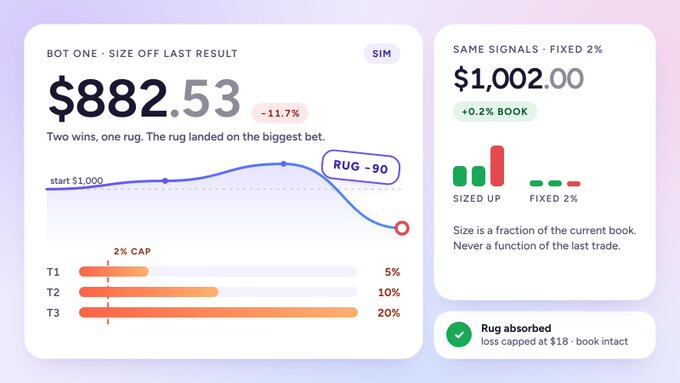
With the same three trading signals, one group of accounts remains roughly flat after hitting a rug, while the other loses about 12% and gives back all the profits from the first two trades. Therefore, the rule that must be followed is: the position size of each trade must be determined as a fixed percentage of the account's current total capital, and must never be adjusted based on the result of the previous trade. Contract checks—including mint authority, liquidity pool status, and the holdings of the top ten token addresses—must serve as preconditions for rejecting an order, not merely as scoring factors for reducing position size.
Type 2: The Dealer Bot
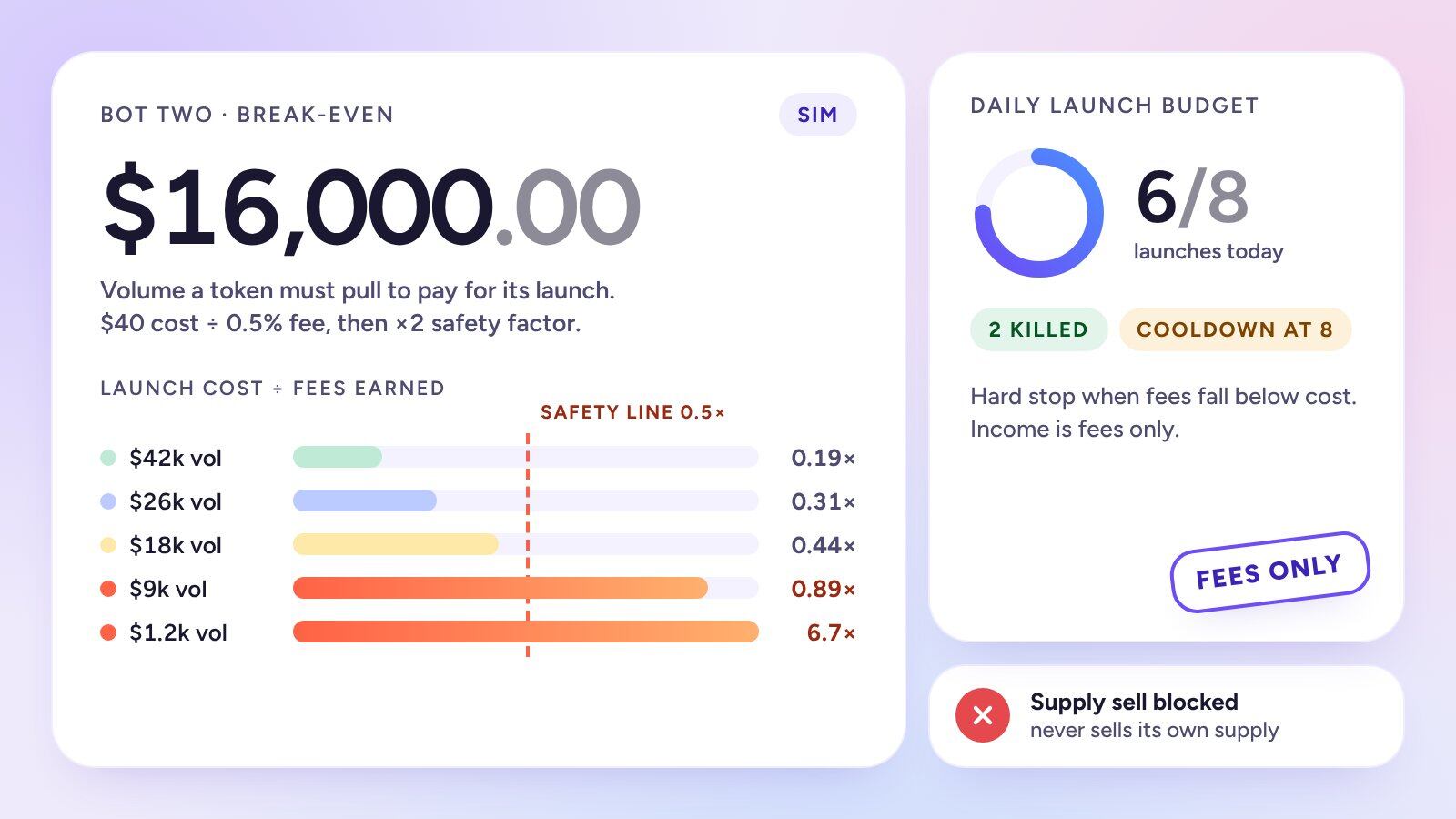
The dealer bot issues tokens, collects fees from every trade, and eliminates tokens that nobody trades. Its edge is that it earns income as long as there is trading volume, without needing to judge price direction, but its fatal weakness is that once trading volume dries up, the cost of issuing tokens can exceed fee income. In addition, it carries another risk—one that never appears in profit screenshots.
Dealer bots are often marketed as "rarely lose money." But that claim only holds when you count only fee income and ignore costs. Every token issuance has costs, including deployment fees, initial liquidity funding, gas fees, and the capital consumed by tokens that receive not a single trade after issuance. Before the bot starts running, calculate the break-even condition clearly: fee rate × expected trading volume per token must exceed the cost of a single token issuance, with a 2x safety factor. In other words, expected fee income should be at least twice the cost of a single token issuance.
The second failure mode is even more important. The fee model earns from fees generated by user trading. But once the bot starts holding tokens it issued itself and dumping them on buyers, it is no longer just a "dealer" collecting fees—it is executing a rug, and you are the operator behind it. Reputational risk, platform risk, and legal risk all converge here, and no profit screenshot will ever show these problems.
Therefore, the rule that must be followed is: the dealer bot must not hold or sell tokens it issued itself; income may come only from fees. At the same time, a daily token-issuance budget must be set, and issuance must be forcibly halted once fee income falls below cost.
Type 3: The Copy-Trading Bot
The copy-trading bot tracks profitable wallets, ranks them, and copies their trades. Its edge lies in borrowing trading advantages that others have already validated, but its fatal weakness is copy-trading latency—even if you copy the right wallet, you may buy at the wrong price.
This type of bot looks the safest, yet it harbors the sharpest risk. For memecoins, a 40-second delay is no small matter—it can directly determine whether a trade ends in profit or loss. Suppose the tracked wallet buys at $0.0010, and you complete your copy trade 40 seconds later at a fill price of $0.0016—that's chasing a 60% price increase.
Furthermore, when the price rises to 2x the tracked wallet's entry price, or $0.0020, and both parties sell at the same time, the other party profits 100% while you profit only 25%; when the price rises to 1.4x the tracked wallet's entry price, or $0.0014, and both parties sell at the same time, the other party profits 40% while you lose 12.5%.
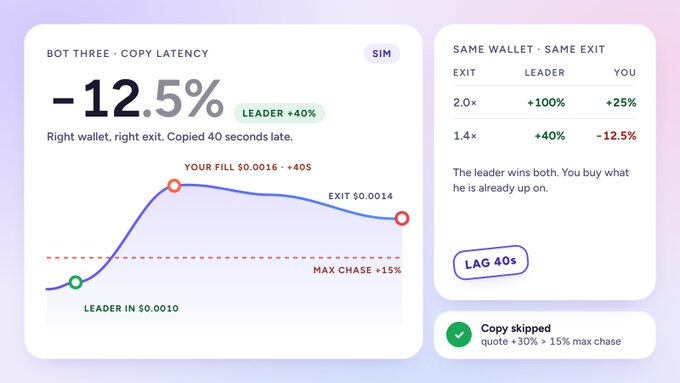
Same wallet, same token, same exit timing—the tracked wallet makes money both times, while you profit once and lose once, because by the time you buy in, the other party already has a substantial unrealized gain. Worse still, the wallet you're tracking may be using the buy pressure from you and other copy traders to sell. In that case, you're not following smart money—you're providing it with the liquidity it needs to exit, becoming its exit buyer.
Therefore, the rule that must be followed is: set a cap on chasing price. If the expected fill price is more than 15% above the tracked wallet's entry price, skip the trade. Follow not only buys but also sells; limit the capital allocated to any single wallet, and lower that wallet's tracking priority after three consecutive copy-trading losses.
The Four Most Common Mistakes When Using Trading Bots
First, comparing only returns, not failure modes. Making 10x in a day only tells you about the best-case scenario. It doesn't tell you what would wipe out all the money in the wallet.
Second, trusting a single run. Running for 24 hours straight is still just one sample. Engineers don't deem a component reliable just because it passed one test.
Third, running the system at its limit. If a stop-loss mechanism only works when checked once per second, don't assume that checking once per second is sufficient. You need to leave a safety margin.
Fourth, treating risk control as a settings option. A slider in a UI only expresses a preference. A limit only becomes a real rule when it is embedded in the order flow and tested to ensure it errors out when it fails.
Risk Control Can Limit Losses, But Cannot Guarantee Profits
Risk-control rules cannot make a bot automatically profitable, nor can they make its judgments correct. Project rug pulls, honeypot contracts that can only buy but not sell, and liquidity that can vanish within a single block will not stop appearing just because circuit breakers are well designed. These rules can only limit losses; they cannot eliminate risk.
In practice, prioritize issues that could endanger the entire account. For most traders, first fix the gambler bot's position-sizing rules, then set the copy-trading bot's cap on chasing price, and finally verify whether the dealer bot's income can cover costs.
If the strategy itself depends on dumping tokens it issued, front-running copy traders, or circumventing platform rules to profit, then no amount of risk-control refinement can fix a problem that lies in the strategy itself.
Rather than focusing only on how much a bot can earn, you should first be clear about how much loss you can withstand when things go wrong.