



PRL surged 3x — Can Pearl become the "AI version of Bitcoin"?


- Core Thesis: Pearl (PRL) is gradually transitioning from an early speculative project to an L1 protocol with real AI commercial applications by merging AI computing with GPU mining, but its token currently still cannot capture the value of its AI business.
- Key Points:
- PRL has surged over 300% in the past month, with a circulating market cap exceeding $470 million and an FDV of approximately $2.9 billion, becoming a community focal point during Token2049.
- Pearl has joined NVIDIA's Inception accelerator program, and its AI inference platform has launched 7 OpenAI-compatible models, with some priced lower than mainstream platforms like Fireworks AI.
- It has introduced a new ultra-efficient floating-point PoUW solution, addressing the previous technical limitation of only supporting integer matrix multiplication, and has built a zk-SNARKs-based AI privacy trust layer.
- Network hashrate has grown from 19 EH/s to 50 EH/s, equivalent to over 170,000 4090 GPUs participating in mining, with approximately 1.086 million PRL issued daily, worth about $1.52 million.
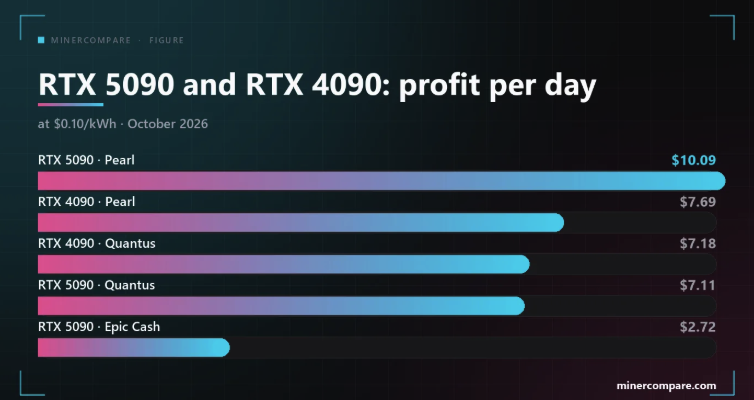
- Miner calculations show a daily net income of approximately $7.69 per 4090, with most miners preferring to hold rather than sell, though renting GPUs for mining remains unprofitable.
- The project's positioning has gradually evolved from "saving Bitcoin mining energy" to an AI inference platform, where mining-generated tokens are becoming a byproduct of AI computing.
Original | Odaily (@OdailyChina)
Author | Golem (@web 3_golem)
Over the past month, GPU mining coin Pearl (PRL) surged over 300% (from $0.33 to $1.4), igniting crypto communities overseas.
Well-known overseas KOL Ansem called Pearl "the Bitcoin of AI" in an interview, crypto-native fund No Limit Holdings announced a long-term heavy position in Pearl, and Dragonfly General Partner Tom Schmidt praised Pearl's approach in an interview.
At the recent Token2049 conference, Pearl also became one of the hot topics. According to Luma, Pearl's community side event during Token2049 had 164 registrants. When DWF Ventures officially reviewed Token2049, it stated that "Pearl was the focus of the entire network, with both funds and retail investors discussing it endlessly."
What is Pearl's origin? In short, Pearl is an L1 protocol that merges AI computing with GPU mining. Users' GPUs perform blockchain proof-of-work while simultaneously handling AI training and inference workloads, producing the PRL token — essentially Proof of Useful Work (PoUW).
In May of this year, Pearl, affected by rumors of a16z investment, sparked a mining frenzy in Chinese communities. Odaily at the time provided a detailed introduction to Pearl's core mechanisms, ecosystem projects, and mining tutorials, and based on an objective assessment of the project's early fundamentals, concluded that Pearl had been overly FOMO'd by the market, with its technical strength and capital operations still unproven, urging investors to be cautious. (Recommended reading: "a16z's $1.5 Million Shopping Spree for PoW Gem? Pearl Sets the Mining World Ablaze Again (with Mining Tutorial)")
Subsequently, PRL fell from a high of $1.7 to a low of $0.23. However, Pearl did not enter a death spiral. About 4 months later, PRL's price has now returned to levels seen in May of this year.
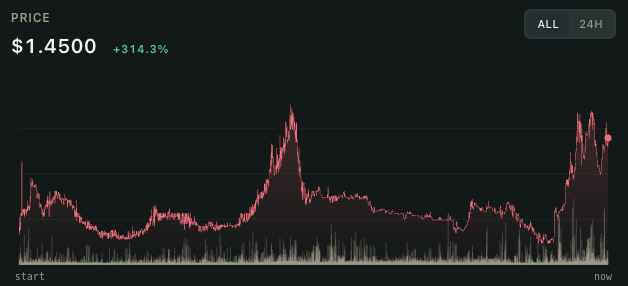
PRL price trend, source: pearl-otc
Various signs indicate that Pearl does not appear to be a flash-in-the-pan speculative project. So, what actual development and commercial implementation has Pearl achieved over the past few months? What changes have occurred in its ecosystem? Odaily will analyze these in this article for investors' reference.
Joining NVIDIA's AI Startup Ecosystem, Launching AI Inference Platform
In recent months, the most credibility-enhancing thing Pearl has done is joining NVIDIA's AI startup ecosystem.
On July 15, Pearl officially announced its admission to NVIDIA Inception. NVIDIA Inception is a free global startup accelerator program launched by NVIDIA, specifically supporting startups in AI, deep learning, data science, and accelerated computing. As of 2026, Inception has over 40,000 member companies.
Although the barrier to entry for NVIDIA Inception is not as competitive as Y Combinator, and joining NVIDIA Inception does not mean obtaining NVIDIA investment or an official partnership, it at least proves that Pearl, as an AI startup founded only 5 months ago, has gained NVIDIA's recognition. Pearl also candidly stated that joining NVIDIA Inception is partly because it's free, and partly because other member companies running GPU clusters could potentially become Pearl's customers in the future.
Meanwhile, compared to May when it only launched a Gemma-4-31B-it-Pearl endpoint in partnership with Together AI (which recently completed an $800 million Series C funding), Pearl's AI inference platform has been gradually opening up.
Currently, Pearl's Serverless Inference offers 7 available models, all compatible with OpenAI (streaming, tools, JSON mode, etc.). Pearl's pricing compared to mainstream platforms is at a "competitive, with some models being cheaper" level, with particularly notable advantages on Flash-tier models.
For example, Pearl prices GLM-5.3-Flash at just $0.07 per million input tokens, while Fireworks AI charges $0.15 per million input tokens — twice Pearl's pricing.
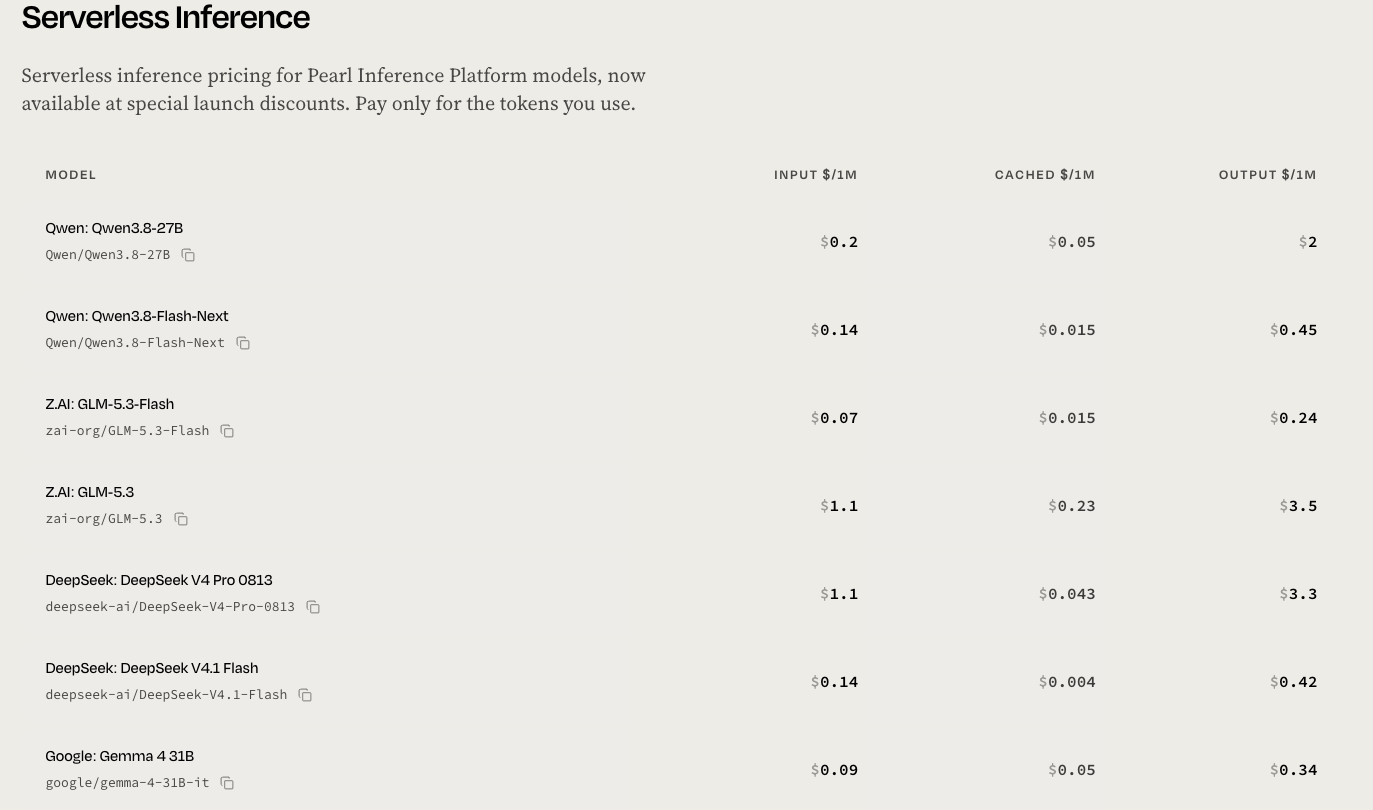
Pearl's Serverless Inference pricing
In July, Pearl also announced the upcoming launch of its Accelerated Inference Platform, which is currently in the waitlist registration phase.
Beyond commercial expansion and implementation, Pearl has also been continuously iterating its protocol. Previously, one criticism of Pearl was its reliance on integer-based matrix multiplication (Odaily note: an AI large model training algorithm), while modern AI workloads essentially depend on floating-point computation. In mid-September, Pearl officially announced a new and ultra-efficient floating-point PoUW solution, which will soon be deployed in production environments.
Additionally, Pearl is building an AI privacy trust layer. Currently in the AI inference space, user privacy protection is increasingly widely discussed and valued. Since Pearl L1 uses zero-knowledge proofs (zk-SNARKs), it is naturally conducive to protecting user privacy. When Pearl miners perform large-scale matrix multiplication operations, these matrices may contain private model data or user information. zk-SNARK compresses these complex computations into a small cryptographic proof that neither reveals any information about the underlying matrices nor prevents the network from verifying whether a miner has found a valid block.
Applying zero-knowledge proofs to AI privacy protection may also become one of Pearl's core narratives.
In summary, on the surface, PRL's rise over the past month was due to overseas community propagation, but fundamentally it stems from the project team genuinely "continuing to build."
PRL Mining Status Quo: 4090 Daily Net Income of 50 RMB?
According to Pearl's block explorer data, approximately 16.3% of PRL has been mined so far (out of a total supply of 2.1 billion). At the current price of $1.4, PRL's circulating market cap has exceeded $470 million, with an FDV of approximately $2.9 billion.
Compared to May, Pearl's total network hash rate has grown from 19 EH/s to 50 EH/s, roughly 2.5 times, equivalent to over 170,000 RTX 4090s participating in mining. Pearl's average block time is 180 seconds, still within the network's original setting (194 seconds), but the block reward has decreased to 2,262.52 PRL per block. Based on this, PRL's daily issuance is approximately 1.086 million tokens, worth about $1.52 million at $1.4.
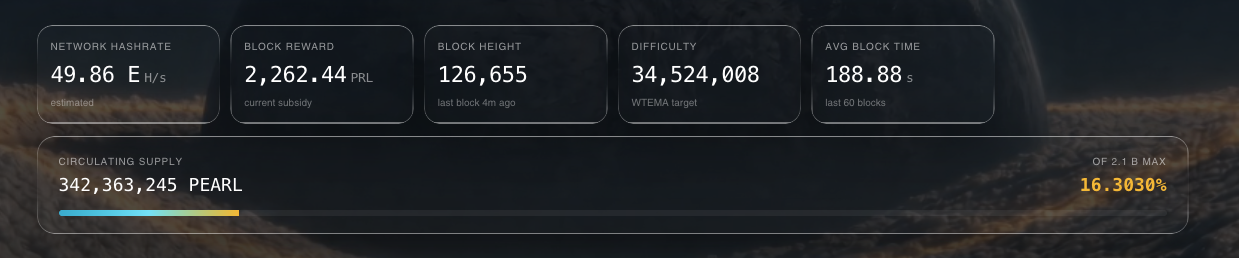
Pearl network data
Obviously, there is not enough capital buying pressure in the market to absorb such an issuance rate, but in the current early stage, miners seem more inclined to hoard PRL rather than sell.
After the token price rise, PRL mining enthusiasm has continued to increase. Miners can use their own GPUs for mining or choose to join mining pools. Pearl previously supported users in renting cloud GPUs on the platform for mining, but new package quotas have not yet been opened.
Previously in May, Odaily introduced Pearl ecosystem mining pools in an article, but the fact is that after several months, most of these mining pools have shut down, with only pearlhash still operating relatively stably. Therefore, if users want to participate in PRL mining long-term, the optimal choice remains solo mining.
However, on October 11, Pearl community miner @YuChen posted that even with PRL having risen to $1.4, renting GPUs for mining is still not profitable. He also listed the costs and returns of mining PRL with different GPUs (assuming electricity costs of 1 RMB per kWh).
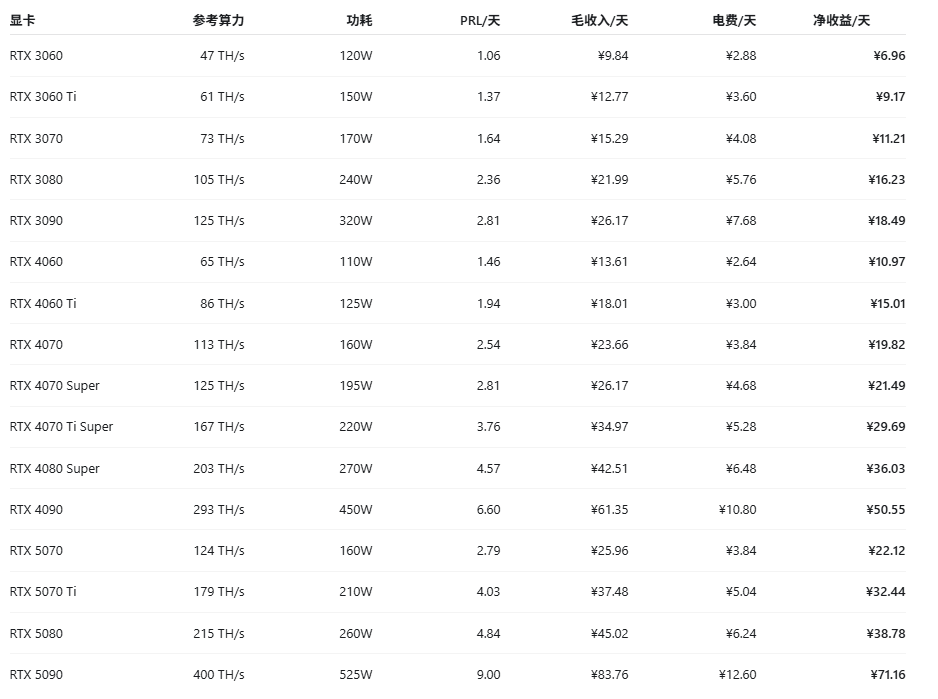
Pearl mining revenue and cost calculation, source: @YuChen
On October 11, miner compare also published the latest Pearl mining revenue statistics. Assuming electricity costs of $0.1/kWh, a 5090 mining PRL yields approximately $10 net income per day, while a 4090 yields approximately $7.69 net income per day — roughly consistent with Pearl community miner YuChen's estimates. miner compare also launched a Pearl mining revenue calculator for solo miners to calculate themselves.
In addition to mining, users can also purchase PRL directly on the OTC platform pearl-otc or on the exchange SafeTrade. Aster listed Pearl perpetual contract trading on October 10, providing an option for users who only want price exposure to Pearl. However, it should be noted that the Pearl contract price on Aster carries a premium of approximately $0.2 compared to spot.
One Computation, Two Outputs
Looking back at Pearl, the original intention of this project was to save the energy wasted by Bitcoin mining — "rather than wasting resources on meaningless hash computations, why not provide the same computing power to AI and have a chance to earn block rewards."
From this philosophy, Pearl is a native crypto project. There exist some large miners who perform matrix multiplication primarily to compete for blocks, without actually connecting to real paying inference customers. A significant amount of computing power on the network does not produce sellable AI output.
However, after months of development, Pearl is transforming into an AI project. The team has invested substantial effort into operating its AI inference platform and commercial implementation. On the official website, one cannot even find the Pearl network entry point or mining guide — mining tokens seems to be gradually becoming a byproduct of AI computation.
Pearl's core is "one computation, two outputs," but currently the PRL token cannot capture any of Pearl's AI commercial value. This may be the closed loop Pearl needs to complete in the future.