



梁文鋒沒有生活,楊植麟沒有退路


- 核心觀點:文章對比了中國AI領域兩位關鍵創始人——來自廣東的梁文鋒(DeepSeek)和楊植麟(月之暗面/Kimi)——截然不同的創業軌跡與性格底色,揭示了技術理想主義、商業模式與資本壓力如何共同塑造了中國AI競爭的格局。
- 關鍵要素:
- 梁文鋒(DeepSeek)從量化交易起家,透過自建算力和金融為AI研究供血,走出一條「先現金流、後研究」的反商業邏輯路徑,其開源與低成本策略以R1模型震動全球市場。
- 楊植麟(月之暗面/Kimi)憑藉頂尖學術背景和快速融資,以長文本產品Kimi搶佔用戶心智,但面臨高昂的投放成本和來自老股東的仲裁糾紛,一度陷入「懸浮」困境。
- DeepSeek的R1模型顛覆了行業對資本開支的想像,證明開源和演算法效率在中國的可行性,間接為月之暗面提供了轉向開源、停止買量的「翻身」依據。
- 梁文鋒面臨核心人才因身價飆升而流失的內部挑戰,而楊植麟則在外部資本壓力和內部路線糾偏後,透過K2等模型實現市場地位和估值的強力反彈。
- 兩者在2026年殊途同歸:楊植麟開始關注成本和節奏像梁文鋒,梁文鋒則因留人問題而需走出實驗室接觸資本,兩人都必須承受技術不確定性、資本耐心與創始人神話被審判的三重代價。
Original Author: Jia Liu
In the week following the release of Kimi K3, the US tech circle was collectively lamenting why an outstanding young talent like Yang Zhilin didn't stay in America back then.
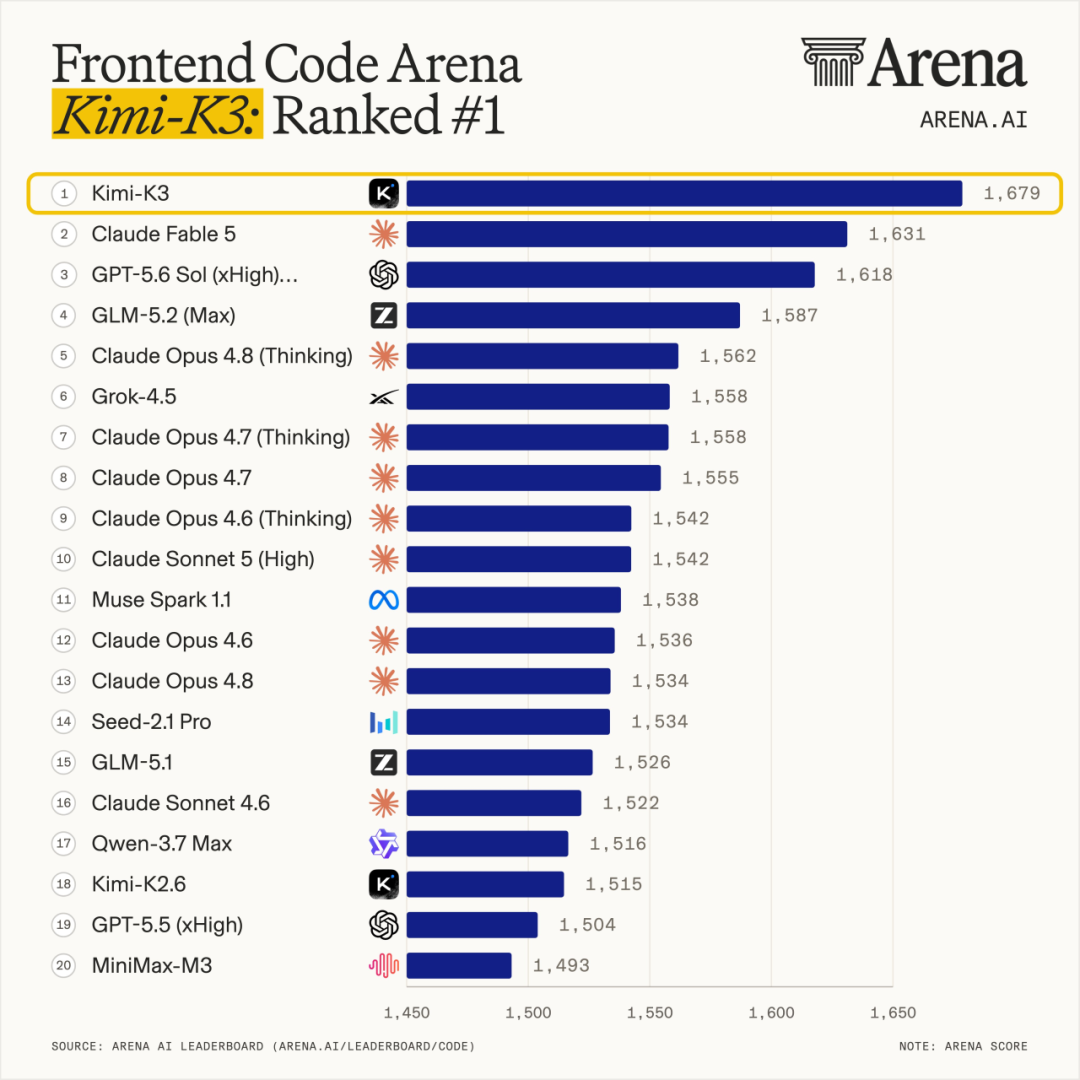
Kimi K3 surpasses all models in front-end capabilities
This topic garnered over five million views on X. David Sacks, the former White House AI lead under Trump and a close confidant, said he had already switched from Claude to Kimi for a lot of his work, stating, "It's just way more fun because it gets straight to work instead of lecturing you." Meanwhile, veteran Silicon Valley venture capitalist Vinod Khosla blamed immigration policies, saying the US is scaring off top talent with its own hands.
As speculation swirled, Yang Zhilin's doctoral advisor, Salakhutdinov, publicly 'showed off' his prized student on social media while also clarifying why Yang didn't stay in the US: "If he didn't even have the courage to try starting a business, Yang Zhilin said he would regret it for the rest of his life."
On the other side of the Pacific, another Cantonese name is also widely known in China's AI circle: Liang Wenfeng.
Seven years Yang's senior, Liang was born in Wuchuan, Zhanjiang. A programmer who spent fifteen years in quantitative trading, he rarely gives interviews and has no social media accounts. Colleagues describe his personality simply as "no hobbies besides programming." After his DeepSeek R1 was released in January 2025, Nvidia lost nearly $600 billion in market value in a single day. Silicon Valley called it the "Sputnik moment." While the whole world was looking for him, he retreated to his hometown to play soccer for a few days.
Two Cantonese men, one born in Wuchuan, the other in Shantou, separated by the Leizhou Peninsula. Their companies tread the same path with nearly mirror-image trajectories, yet each fork in the road stems from their fundamental personalities.
A Radio and a Band
Liang Wenfeng was born in 1985 in Mili Ling Village, Tanba Town, to parents who were both primary school teachers. With few toys at home, his most important childhood possession was a Feiyue brand radio, which he took apart and reassembled countless times.
This quiet child showed his differences early on. His middle school homeroom teacher recalled he wasn't a bookworm, nor did he seem to study harder than others, but he had self-taught all of high school math by junior high and started flipping through university textbooks, "as if he didn't need much time to excel in every subject."
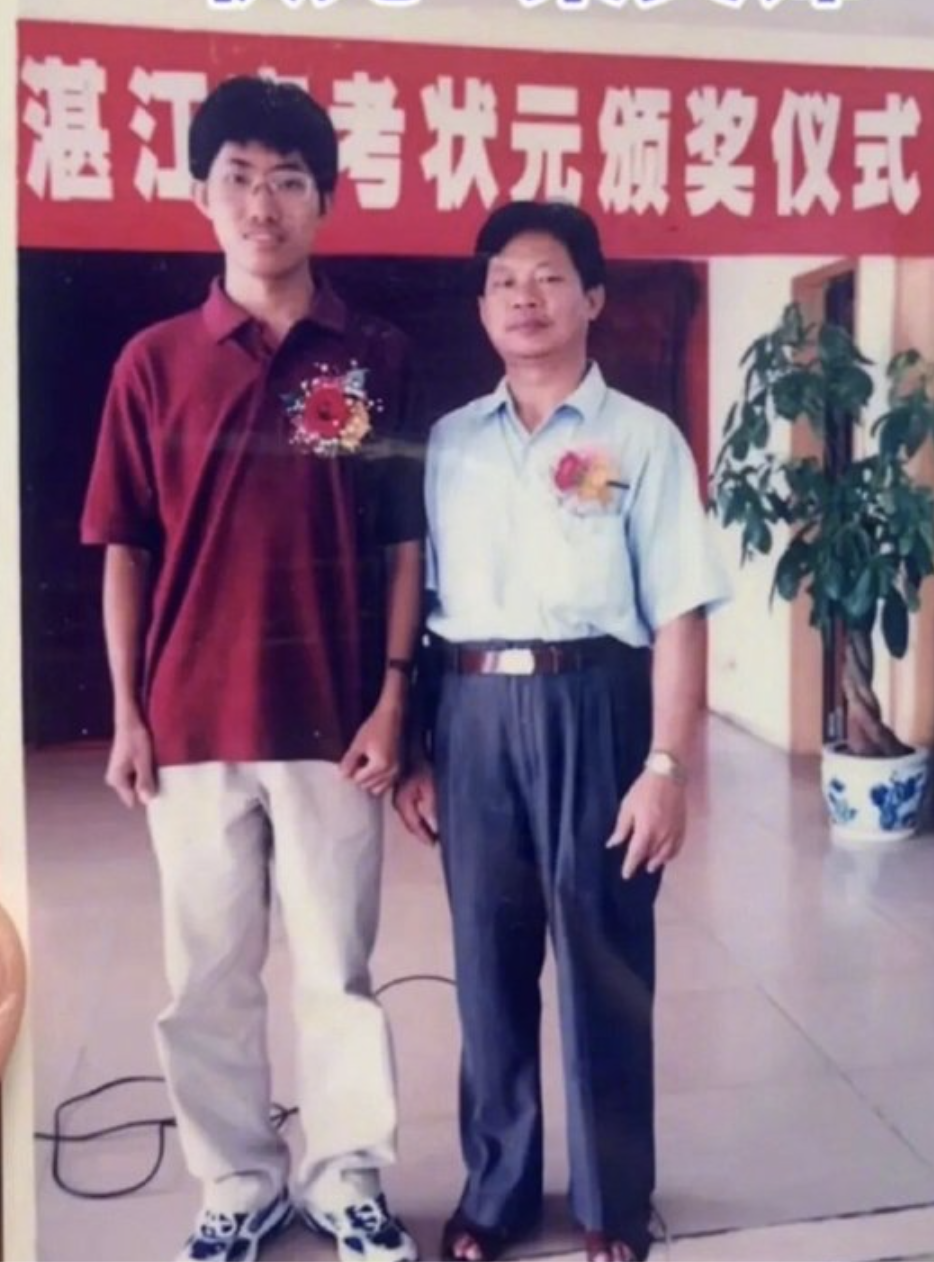
In the 2002 college entrance exam, he scored 806, the top score in Zhanjiang City. The award photo can still be found online: wearing a maroon short-sleeved shirt with a large red flower pinned on his chest, his expression stiff, clearly pushed onto the stage by his teacher. That autumn, he enrolled in Zhejiang University's Electronic Information Engineering program. But for the next twenty years, no other occasion on this man's life seemed worth photographing.
Seven years later in Shantou, another Cantonese boy grew up. Yang Zhilin was born in 1992. He ranked first in his class throughout his four years in Tsinghua's Computer Science department and published over twenty papers. These weren't the rarest feats at Tsinghua, but what was unusual was that alongside these achievements, he formed a rock band named Splay, after a data structure, serving as the drummer.
He later explained, "I felt like I had a lot to express back then, including pressures from reality and the absurdity of the broader environment." They wrote a song about a pipe dream of getting rich overnight through a successful startup, "half out of empathy, half as a reminder to myself not to become too utilitarian."
Many years later, this band would return to the story in an unexpected way: bandmate Zhou Xinyu became a co-founder of Moonshot AI.
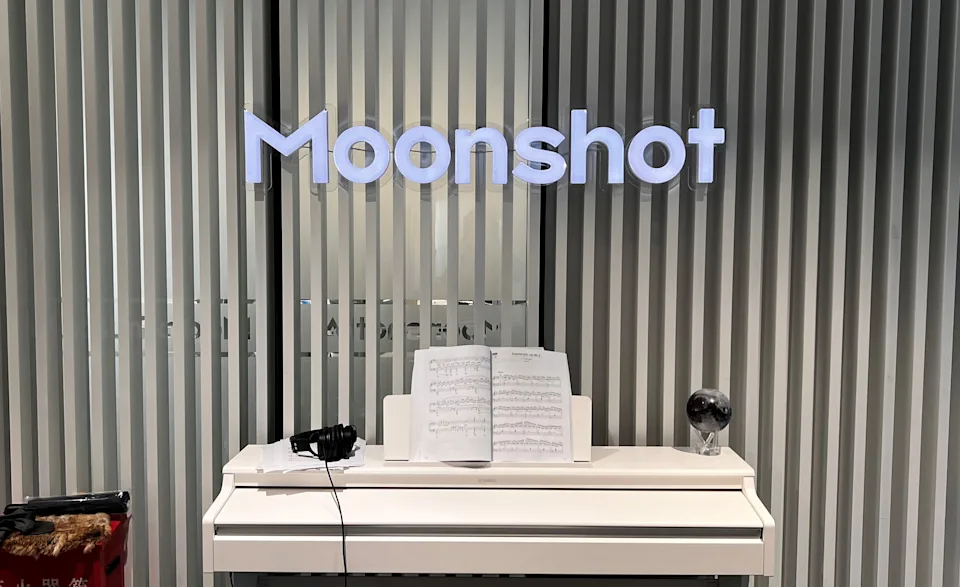
And at the entrance of Moonshot AI's office sits a white Yamaha electric piano, on which rests Pink Floyd's 1973 album, "The Dark Side of the Moon." The company's name comes from this album.
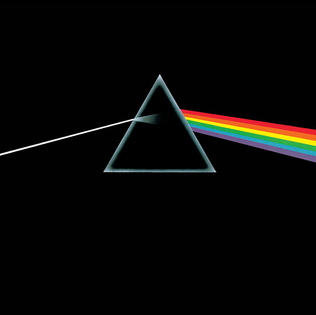
The Dark Side of the Moon album
One took apart radios where no one needed to see; the other played drums because he had something that *had* to be expressed. Nearly every choice these two made over the next twenty years stemmed from this.
A Chengdu Rental and the CMU Hallway
After graduating from Zhejiang University, Liang Wenfeng didn't go to a big tech firm for a technical credential. He went to Chengdu, hiding out in a cheap rental, trying various algorithms to equip traditional industries with AI - all of which failed. The founding teams of China's top quantitative hedge funds mostly had prestigious overseas backgrounds, but Liang figured it out on his own in that rental.
In 2015, he founded High-Flyer with his Zhejiang University classmate. A series of moves followed that almost no one understood at the time: in 2019, he spent nearly 200 million RMB to build an in-house cluster with 1100 GPUs; in 2021, he added another 1 billion RMB to stockpile about 10,000 A100s.
Quantitative trading didn't need that many GPUs. Liang himself admitted that trading only required a few cards. Someone who dealt with him early on recalled that watching him stockpile GPUs for training models felt like a tech-obsessed weirdo burning money.
But what he was doing was the opposite of what everyone understood. He wasn't using AI to cut costs and boost efficiency in finance; he was using finance to fuel AI research. Most Chinese AI companies follow the sequence of getting funding first, then finding a product, then generating cash flow. He completely reversed this order: build a cash flow machine first, then use it to buy the freedom to do research.
Yang Zhilin took a different path, one paved with flowers and landmines.
After Tsinghua, he went to CMU (Carnegie Mellon University) for his PhD, during which he also did research at Google's and Meta's AI labs. In 2017, he bet his entire focus on language models, later calling it "the only important problem." During his PhD, he published two papers: one taught AI to remember longer contexts, the other beat Google's best model in 20 tests. Their combined citations total nearly 20,000.
Years later, Kimi became famous for handling long text inputs. Many thought it was a temporary differentiator found in 2023. Actually, it was a direction he had identified during his PhD, just in a different form.
In 2016, while still a PhD student, he co-founded Recurrent AI for sales call analysis, with Sequoia and GSR Ventures as investors. This venture gave him an early taste of the messiness of deploying technology but also planted a landmine beneath his feet, which detonated eight years later.
Upon graduating with his PhD in 2019, his advisor connected him with an Apple executive who reported directly to Tim Cook, asking if Yang was interested in joining Apple, possibly in its China division. But Yang Zhilin rejected Apple's email and all Silicon Valley offers, deciding to return to China.
At that time, Liang Wenfeng was stockpiling GPUs in Hangzhou, and Yang Zhilin was waiting for the wind in Beijing. Neither knew of the other's existence, nor that their names would one day represent China's AI scene.
A One-Month Window and a Catfish
On November 30, 2022, ChatGPT launched, causing collective insomnia in Silicon Valley's tech circles. Yang Zhilin recalled, "Many friends around me were anxious, experiencing FOMO, couldn't sleep. Many turned around and started companies."
"We started focusing on the first round of financing in February 2023. Delaying meant basically no opportunity by April. But doing it in December 2022 or January was also impossible because of the pandemic; people hadn't reacted yet." Yang Zhilin seized that one-month window, working without a single day off.
In March 2023, Moonshot AI was founded, with co-founders being Tsinghua alumni Zhou Xinyu and Wu Yuxin. It reportedly secured $60 million in initial funding, gathering about 40 AI researchers within three months. Then came one of the steepest financing curves in Chinese large model history: Sequoia and ZhenFund invested; Alibaba led a $1 billion round; Tencent, Meituan, and Xiaohongshu followed, pushing the valuation to $3.3 billion. Kimi, with its 200,000-character long context feature, became the first high-frequency AI product for many Chinese users.
During that period, Yang Zhilin lived in a dual state. Externally, he talked about the grandest narratives, estimating the probability of scaling laws failing as close to zero, comparing starting a company to driving towards a vast snowy mountain range, and calling the first year building a rocket prototype and touching some fuel formula. Internally, he had to obsess over the most granular algorithms: when computing power was tight, a machine might cost 260 today, 340 tomorrow, then drop back down a few days later. Whether to buy or rent, which channel to use – he tracked and adjusted daily. Half the certainty of a scientist, half the shrewdness of a small business owner, all embodied in this 31-year-old.
But everything capital provided came with a price tag. To sustain the growth curve, Kimi spent 220 million RMB on marketing in October 2024, another 200 million in November, burning through more than the entire Q3 total in two months. The drummer who wrote a song satirizing getting rich quick became the founder who spent the most on user acquisition in the entire industry. He hadn't changed; the $3.3 billion valuation was making decisions for him.
In Hangzhou, Liang Wenfeng entered the scene in a way that seemed almost intentionally contrary.
In 2023, DeepSeek spun off from High-Flyer, refusing any external investment. The team had fewer than 140 people, almost no returnees from abroad, mostly fresh graduates from domestic universities and young people who graduated a few years ago. No KPIs, no hierarchy; if you had an idea, you could directly allocate compute and people.
A former employee told the Washington Post, "Liang Wenfeng would dive into the details of training strategies, reading papers and coding with researchers. He's not at all like a boss, more like a geek." Explaining why he hired fresh graduates instead of poaching industry heavyweights: "Experienced people will tell you 'this is how it's done' without thinking, but inexperienced people will explore repeatedly."
In May 2024, DeepSeek-V2 slashed API prices to 1 yuan per million tokens. ByteDance, Alibaba, Baidu, and Tencent were forced to follow suit. The whole industry thought it was a premeditated business war. His response was, "We didn't intend to be a catfish; we just accidentally became one."
Pricing was just slightly above cost, offering "no subsidies, no exorbitant profits." Internet people talk about market share, entry points, and network effects during price wars. He talked about cost accounting. But it's precisely this emotionless price cut that hurts the most. It dragged the large model API from a high-margin narrative directly into the pricing logic of infrastructure.
Somewhere along the line, Yang Zhilin and Liang Wenfeng's two completely different business models started being compared by the outside world.
Yang Zhilin in Limbo
The landmine Yang Zhilin buried eight years ago exploded in November 2024.
Five of the old shareholders from his previous venture, Recurrent AI, filed for arbitration against him in Hong Kong, accusing him of initiating fundraising for his new company before obtaining waivers from all shareholders.
On December 5th, Zhu Xiaohu (of GSR Ventures) took aim on WeChat Moments, focusing his fire on Zhang Yutong: the former GSR partner received 9 million shares representing an initial 14% stake in Moonshot AI for free, exceeding the 9.5% allocated to Recurrent AI as the "parent company." Zhu Xiaohu's proposed solution was almost humiliating: apologize, return the shares, or the company cuts ties with Zhang Yutong.
On December 6th at 9:40 PM, Yang Zhilin published a 1300-word statement. He didn't cut ties; instead, he drew a line in the sand: Zhang Yutong is a co-founder, her shares are compensation for years of future work, and the process of leaving Recurrent AI had the signatures of every director. People close to the company relayed the internal sentiment: "She and Moonshot are already one entity; you can't cut her off."
Zhu Xiaohu publicly stated he completely didn't understand. In a purely commercial coordinate system, it was indeed inexplicable. Cutting ties was the only rational option. But Yang Zhilin's decision-making coordinate system included other considerations. Salakhutdinov's later clarification provided a footnote: This is the kind of person who "would regret it for a lifetime without trying." He doesn't look back once he's committed, even if the cost is staring him in the face.
The real hammer fell forty-some days later.
On January 20, 2025, R1 was released. Free, open-source, reasoning capabilities rivaling OpenAI's o1. A 100+ person team in Hangzhou turned the global capital market upside down within a week. Carnegie researcher Matt Sheehan made a very interesting remark: "DeepSeek wasn't China's pre-selected company. Its explosive success took even China by surprise."
Meanwhile, Liang Wenfeng was spending the New Year in his Wuchuan hometown. On the afternoon of January 27th, he played a soccer match in the village with his middle school classmates. The village entrance was crowded with tourists checking in, while the man himself was on the field.
For Yang Zhilin, it was a double blow. With the arbitration unresolved, R1 directly sentenced his strategy of the past year to death: users acquired through marketing were worthless against a free and stronger competitor. Public opinion turned its guns on him. One article was titled "Yang Zhilin: The Hovering of a Post-90s Idealist." "Hovering," meaning his feet weren't on the ground. He wrote songs fearing he'd become utilitarian; now the world said he was both utilitarian and a failure.
In early 2025, Moonshot had money in the bank but very little leverage.
h2>Fighting Gravity: The Comeback
The following year was critical for Yang Zhilin.
Yang Zhilin basically repudiated his entire previous year. He stopped marketing spend, cut redundant business lines, shrunk back to focusing on the base model, and embraced open source. In a conversation at Geek Park, he said, "An organization's inertia is towards doing more and more things. We have to fight this gravity."
It sounds easy to say, but doing it meant admitting the path was wrong, laying off people he hired, and bowing to an opponent that nearly destroyed him. Most 33-year-old founders can't get over this hurdle. Yang Zhilin crossed it with unusual decisiveness. Perhaps because open source and long-termism were always his default settings; closed-source and aggressive marketing were just the clothes capital made him wear. Now he had simply taken them off.
In July 2025, the trillion-parameter K2 was open-sourced. In November, K2 Thinking outperformed GPT-5 on several of the hardest Agent benchmarks. Hugging Face co-founder Thomas Wolf asked on Twitter: "Is this another DeepSeek moment?"
In the early morning after the release, Yang Zhilin, along with Zhou Xinyu and Wu Yuxin, held an AMA (Ask Me Anything) on Reddit, answering 21 questions. They clarified that the $4.6 million training cost wasn't an official figure, acknowledged having fewer GPUs than US competitors, "but we squeezed every last drop of performance out of each card." When asked about OpenAI burning money, Zhou Xinyu replied relaxed: "We don't know either. Only Sam knows. We have our own pace."
"Our own pace." In 2024, Moonshot couldn't utter those five words. Back then, its pace was the investors' pace, the marketing ROI pace. The person who gave these five words back to Yang Zhilin was precisely Liang Wenfeng. R1 proved that the open-source plus algorithmic efficiency path works in China, essentially acting as a roadshow for Yang Zhilin to his own board. The person almost killed by DeepSeek ended up having to thank it for saving his life.
The market response was also direct. On the last day of 2025, Moonshot announced a $500 million Series C round with participation from Alibaba, Tencent, and Wang Huiwen, valuing it at $4.3 billion with over 10 billion RMB in cash reserves. Less than 20 days after the K2.5 release, its revenue exceeded the entire 2025 total. Monthly personal subscription orders surged