곡선에 대한 짧은 이야기: 가장 강력한 스테이블코인 교환 프로토콜


소개
소개
StableSwap
첫 번째 레벨 제목
StableSwap은 백서에서 Curve가 설계하고 제안한 안정적인 통화 거래 모델로, 매우 낮은 거래 미끄러짐과 무제한 유동성을 제공할 수 있습니다.
보조 제목
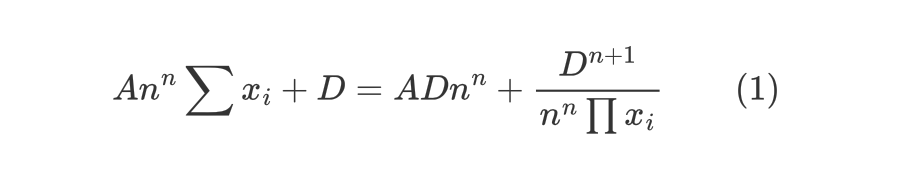
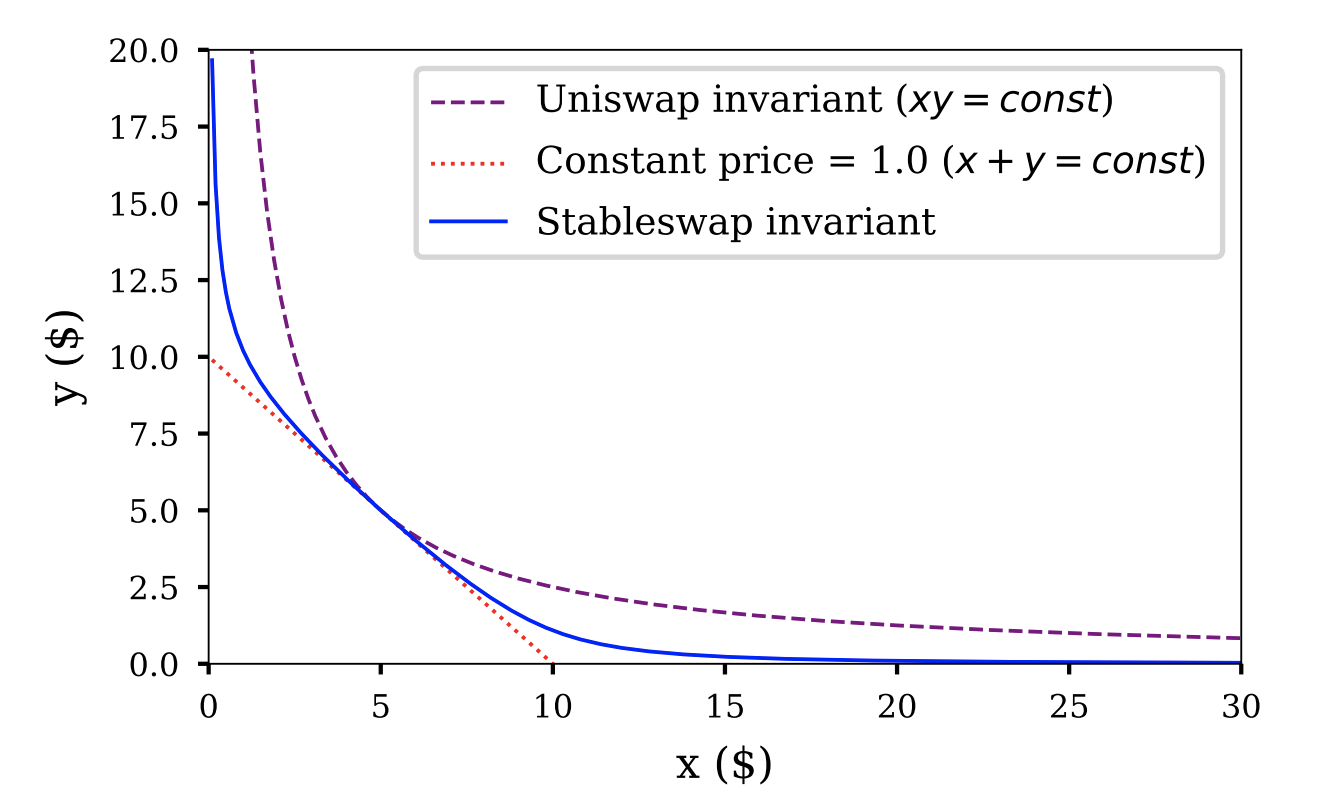
StableSwap 모델의 CFMM(Constant Function Market Maker Curve)은 다음과 같습니다.
디자인 컨셉은 일정 금액의 낮은 슬리피지와 일정 제품의 무한한 유동성이라는 특징을 가진 일정 금액과 일정 제품의 두 가지 시장 조성 모델의 융합을 기반으로 합니다.
보조 제목
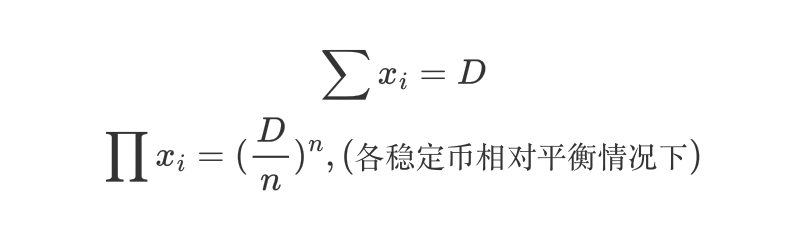
도출하다
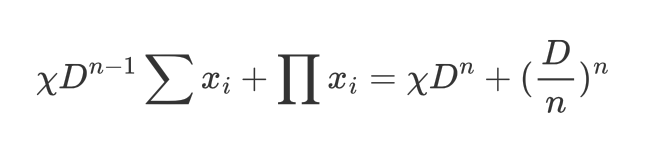
총 n개의 스테이블 코인이 있다고 가정하면 다음과 같습니다.
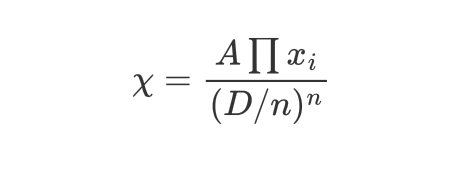
단순화하기 위해 위의 두 공식을 결합하면 공식 (1)을 얻을 수 있습니다.
특징
보조 제목
Basepool
특징
베이스풀은 커브에서 런칭한 기본 거래소 풀로 가장 대표적인 것이 3개의 스테이블 코인 DAI, USDC, USDT로 구성된 3풀입니다.
베이스풀 계약은 기본 StableSwap 트랜잭션 모델을 구현합니다.
보조 제목
@pure
@internal
def _get_D(_xp: uint256[N_COINS], _amp: uint256) -> uint256:
"""
D invariant calculation in non-overflowing integer operations
iteratively
A * sum(x_i) * n**n + D = A * D * n**n + D**(n+1) / (n**n * prod(x_i))
Converging solution:
D[j+1] = (A * n**n * sum(x_i) - D[j]**(n+1) / (n**n prod(x_i))) / (A * n**n - 1)
"""
S: uint256 = 0
Dprev: uint256 = 0
for _x in _xp:
S += _x
if S == 0:
return 0
D: uint256 = S
Ann: uint256 = _amp * N_COINS
for _i in range(255):
D_P: uint256 = D
for _x in _xp:
D_P = D_P * D / (_x * N_COINS) # If division by 0, this will be borked: only withdrawal will work. And that is good
Dprev = D
D = (Ann * S / A_PRECISION + D_P * N_COINS) * D / ((Ann - A_PRECISION) * D / A_PRECISION + (N_COINS + 1) *D_P)
# Equality with the precision of 1
if D > Dprev:
if D - Dprev <= 1:
return D
else:
if Dprev - D <= 1:
return D
# convergence typically occurs in 4 rounds or less, this should be unreachable!
# if it does happen the pool is borked and LPs can withdraw via `remove_liquidity`
raise
매개변수 계산
동일한 알고리즘이 _get_y 함수에서도 y 값을 계산하는 데 사용됩니다.
@view
@internal
def _get_y(i: int128, j: int128, x: uint256, _xp: uint256[N_COINS]) -> uint256:
"""
Calculate x[j] if one makes x[i] = x
Done by solving quadratic equation iteratively.
x_1**2 + x_1 * (sum' - (A*n**n - 1) * D / (A * n**n)) = D ** (n + 1) / (n ** (2 * n) * prod' * A)
x_1**2 + b*x_1 = c
x_1 = (x_1**2 + c) / (2*x_1 + b)
"""
# x in the input is converted to the same price/precision
assert i != j # dev: same coin
assert j >= 0 # dev: j below zero
assert j < N_COINS # dev: j above N_COINS
# should be unreachable, but good for safety
assert i >= 0
assert i < N_COINS
A: uint256 = self._A()
D: uint256 = self._get_D(_xp, A)
Ann: uint256 = A * N_COINS
c: uint256 = D
S: uint256 = 0
_x: uint256 = 0
y_prev: uint256 = 0
for _i in range(N_COINS):
if _i == i:
_x = x
elif _i != j:
_x = _xp[_i]
else:
continue
S += _x
c = c * D / (_x * N_COINS)
c = c * D * A_PRECISION / (Ann * N_COINS)
b: uint256 = S + D * A_PRECISION / Ann # - D
y: uint256 = D
for _i in range(255):
y_prev = y
y = (y*y + c) / (2 * y + b - D)
# Equality with the precision of 1
if y > y_prev:
if y - y_prev <= 1:
return y
else:
if y_prev - y <= 1:
return y
raise
유동성
보조 제목
@external
@nonreentrant('lock')
def add_liquidity(_amounts: uint256[N_COINS], _min_mint_amount: uint256) -> uint256:
"""
@notice Deposit coins into the pool
@param _amounts List of amounts of coins to deposit
@param _min_mint_amount Minimum amount of LP tokens to mint from the deposit
@return Amount of LP tokens received by depositing
"""
assert not self.is_killed # dev: is killed
amp: uint256 = self._A()
old_balances: uint256[N_COINS] = self.balances
# Initial invariant
D0: uint256 = self._get_D_mem(old_balances,유동성
lp_token: address = self.lp_token
token_supply: uint256 = CurveToken(lp_token).totalSupply()
new_balances: uint256[N_COINS] = old_balances
for i in range(N_COINS):
if token_supply == 0:
assert _amounts[i] > 0 # dev: initial deposit requires all coins
# balances store amounts of c-tokens
new_balances[i] += _amounts[i]
# Invariant after change
D1: uint256 = self._get_D_mem(new_balances,Curve pool의 유동성 추가는 Uniswap이 거래 쌍을 추가해야 하는 두 자산과 다르며, basepool은 풀에 특정 자산만 추가할 수 있습니다.
assert D1 > D0
# We need to recalculate the invariant accounting for fees
# to calculate fair user's share
D2: uint256 = D1
fees: uint256[N_COINS] = empty(uint256[N_COINS])
mint_amount: uint256 = 0
if token_supply >amp) #hunya# 초기 상태 D0
# Only account for fees if we are not the first to deposit
fee: uint256 = self.fee * N_COINS / (4 * (N_COINS - 1))
admin_fee: uint256 = self.admin_fee
for i in range(N_COINS):
ideal_balance: uint256 = D1 * old_balances[i] / D0
difference: uint256 = 0
new_balance: uint256 = new_balances[i]
if ideal_balance > new_balance:
difference = ideal_balance - new_balance
else:
difference = new_balance - ideal_balance
fees[i] = fee * difference / FEE_DENOMINATOR
self.balances[i] = new_balance - (fees[i] * admin_fee / FEE_DENOMINATOR)
new_balances[i] -= fees[i]
D2 = self._get_D_mem(new_balances,amp) #hunya# 이론 D1 유동성 추가 후
0: #hunya# 취급수수료를 차감하기 위해 유동성을 추가한 것은 처음이 아니다
else:
self.balances = new_balances
mint_amount = D1 # Take the dust if there was any
assert mint_amount >= _min_mint_amount, "Slippage screwed you"
# Take coins from the sender
for i in range(N_COINS):
if _amounts[i] > 0:
# "safeTransferFrom" which works for ERC20s which return bool or not
_response: Bytes[32] = raw_call(
self.coins[i],
concat(
method_id("transferFrom(address,address,uint256)"),
convert(msg.sender, bytes32),
convert(self, bytes32),
convert(_amounts[i], bytes32),
),
max_outsize=32,
)
if len(_response) > 0:
assert convert(_response, bool) # dev: failed transfer
# end "safeTransferFrom"
# Mint pool tokens
CurveToken(lp_token).mint(msg.sender, mint_amount)
log AddLiquidity(msg.sender, _amounts, fees, D1, token_supply + mint_amount)
return mint_amount
Metapool
amp) #hunya# 취급수수료 차감 후 D2
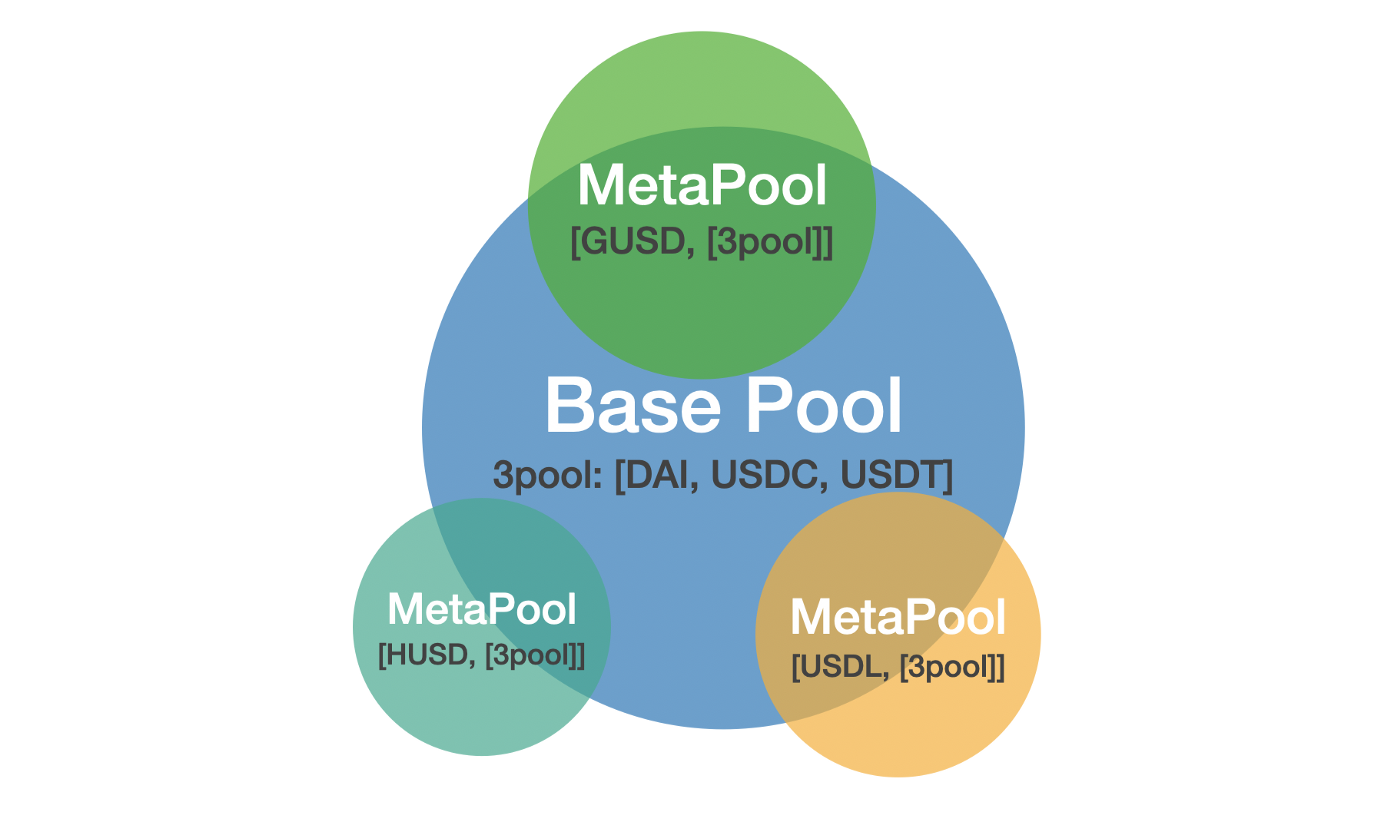
메타풀은 베이스풀의 확장에서 파생된 새로운 풀로, 새로운 스테이블 통화를 베이스풀의 LP 토큰에 고정하는 데 사용됩니다. 베이스풀 풀의 유동성 공급자는 베이스풀의 LP 토큰을 메타풀에 추가하여 다시 유동성을 추가할 수 있으며, 추가로 거래 수수료 수익을 얻을 수 있습니다.
메타풀 컨트랙트에서는 새로운 스테이블 통화와 기본 풀의 스테이블 통화가 간접적으로 결합되며, 서로 다른 스테이블 코인 간의 교환 기능을 제공함과 동시에 새로운 스테이블 통화의 위험도 어느 정도 분리한다.
보조 제목
@external
@nonreentrant('lock')
def exchange_underlying(i: int128, j: int128, _dx: uint256, _min_dy: uint256) -> uint256:
....
# Use base_i or base_j if they are >= 0
base_i: int128 = i - MAX_COIN
base_j: int128 = j - MAX_COIN
meta_i: int128 = MAX_COIN
meta_j: int128 = MAX_COIN
if base_i < 0:
meta_i = i
if base_j < 0:
meta_j = j
dy: uint256 = 0
...
스테이블 코인 교환
old_balances: uint256[N_COINS] = self.balances
xp: uint256[N_COINS] = self._xp_mem(rates[MAX_COIN], old_balances)
x: uint256 = 0
메타풀 컨트랙트의 exchange_underlying 기능은 스테이블 코인 간의 상호 교환 기능을 구현합니다.
x = xp[i] + dx_w_fee * rates[i] / PRECISION
base_i < 0 또는 base_j < 0인 경우: #hunya# 스왑에 메타 풀 토큰 포함
# i is from BasePool
# At first, get the amount of pool tokens
base_inputs: uint256[BASE_N_COINS] = empty(uint256[BASE_N_COINS])
base_inputs[base_i] = dx_w_fee
coin_i: address = self.coins[MAX_COIN]
# Deposit and measure delta
x = ERC20(coin_i).balanceOf(self)
Curve(base_pool).add_liquidity(base_inputs,if base_i < 0: #hunya# 입력 토큰은 메타 풀 토큰입니다.
# Need to convert pool token to "virtual" units using rates
# dx is also different now
dx_w_fee = ERC20(coin_i).balanceOf(self) - x
x = dx_w_fee * rates[MAX_COIN] / PRECISION
# Adding number of pool tokens
x += xp[MAX_COIN]
...
# Withdraw from the base pool if needed
if base_j >else: #hunya# 입력 토큰은 기본 풀 토큰입니다.
out_amount: uint256 = ERC20(output_coin).balanceOf(self)
Curve(base_pool).remove_liquidity_one_coin(dy, base_j,0) #hunya# 기본 풀 유동성 추가
dy = ERC20(output_coin).balanceOf(self) - out_amount
assert dy >= _min_dy, "Too few coins in result"
= 0: #hunya# 출력 토큰은 기본 풀 토큰입니다.
# If both are from the base pool
dy = ERC20(output_coin).balanceOf(self)
Curve(base_pool).exchange(base_i, base_j, dx_w_fee, _min_dy)
dy = ERC20(output_coin).balanceOf(self) - dy
...
log TokenExchangeUnderlying(msg.sender, i, _dx, j, dy)
return dy
else: #hunya# 순수 기본 풀 토큰 교환, 기본 풀 교환 기능을 직접 호출
요약하다
교환이 베이스풀 토큰과 메타풀 풀 토큰을 포함하는 경우 베이스풀의 LP를 통해 유동성을 추가하거나 제거하여 중간 프로세스가 수행되며, 베이스풀 토큰의 교환만 있는 경우에는 베이스풀의 교환 기능이 직접 호출됩니다. 교환.