BTC $6.8 Billion Options Expiry: Why Did the Max Pain Point Stay at $70,000?


- Core View: On November 27, 2026, approximately $6.8 billion in Bitcoin monthly options settled near $61,000. The $70,000 max pain point failed to materialize due to the deep spot discount and the overly low proportion of near-spot contracts; the put-to-call ratio rose from 0.55 to 0.89, indicating that traders significantly shifted toward downside protection amid ETF net outflows and rate hike expectations.
- Key Elements:
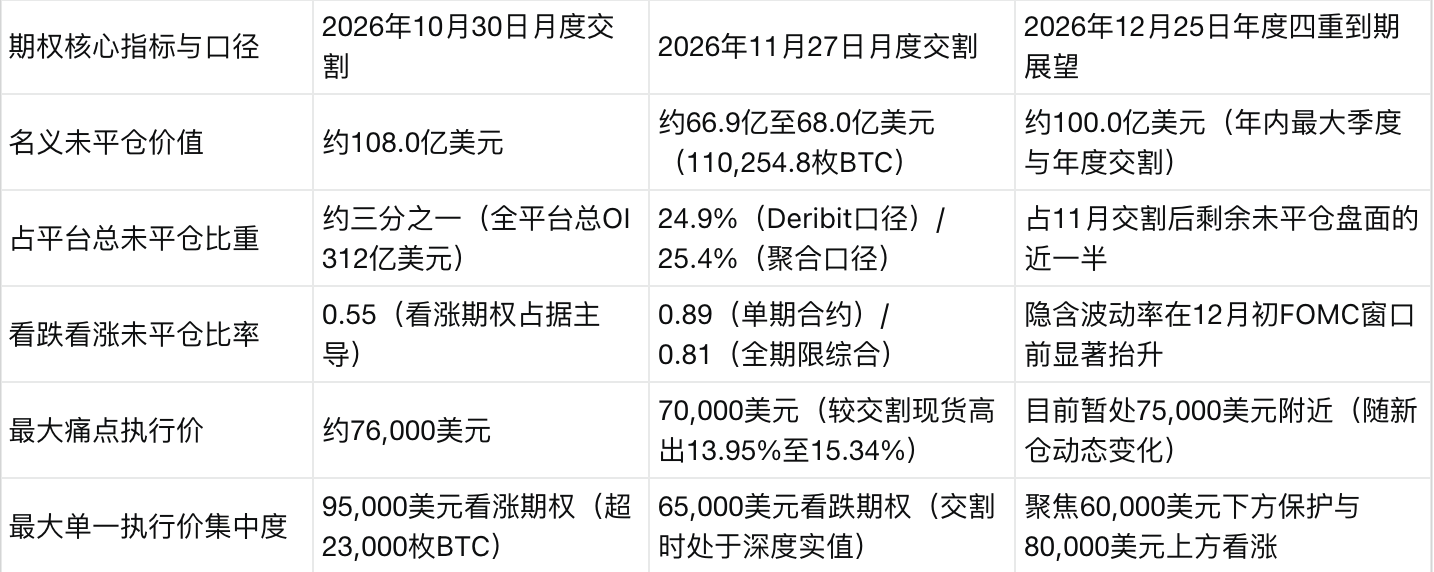
- Deribit's expiring contracts totaled 110,254.8 BTC, accounting for 24.9% of the platform's open interest; at $60,691.54, the notional value was $6.69 billion, and at $61,431, it was approximately $6.77 billion to $6.8 billion.
- The $70,000 max pain point was not realized: before settlement, spot was still about 14% to 15% away from it, and contracts within the 5% near-spot range accounted for only about 14.5% of expiring notional, leaving market makers without upside hedging demand.
- Structural reversal: In October, the largest position was $95,000 call options with a ratio of 0.55; in November, the largest position shifted to $65,000 put options, each about $3,569 to $4,308 in the money at settlement.
- Macro and capital flows: U.S. spot Bitcoin ETFs saw net outflows of $5.39 billion in November; the market priced in a probability of over 94% for a 25 basis point rate hike in December.
- After settlement, about 25% of open interest was cleared, and market makers' short gamma hedges were unwound; the next nodes are the Fed's December 8-9 policy meeting and the approximately $10 billion annual quadruple witching on December 25.
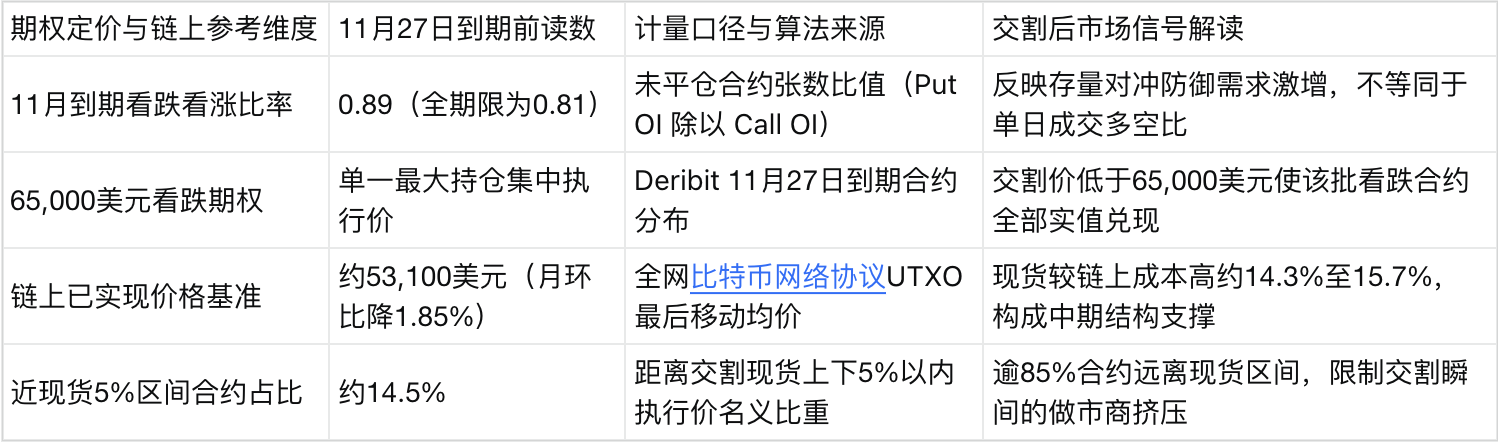
- On-chain realized price is about $53,100, and the spot settlement price is about 14.3% to 15.7% above the network-wide average cost basis, often regarded as a structural reference for extreme downside protection.
As the monthly options expiry window officially completed settlement at 08:00 UTC on November 27, 2026 (16:00 Singapore time, 03:00 US Eastern time the same day), Bitcoin November-expiry contracts with a notional value of approximately $6.8 billion (precisely $6.69 billion per Deribit's official index snapshot) concluded uneventfully while spot prices traded in the $60,691.54 to $61,431 range, failing to converge toward the $70,000 max pain level. Max pain remained at $70,000, reflecting the distribution of accumulated high-strike call open interest built up over the past several months rather than an inevitable gravitational target for spot prices; meanwhile, the put/call open interest ratio for November-expiry contracts jumped from 0.55 in October to 0.89, with the largest single strike concentrated in $65,000 puts, indicating traders significantly increased downside risk protection during the November pullback.
A clarification on derivatives accounting conventions: $6.8 billion represents the total notional face value of expiring contracts and does not mean an equivalent amount of Bitcoin was dumped into the spot market at the moment of settlement. Under the cash-margin settlement mechanism, all call options above the settlement price (including strikes at $70,000 and above) automatically expire worthless, and only in-the-money protective positions such as the $65,000 puts actually generate fund transfers. Market attention subsequently shifted rapidly to the December 25 quarterly triple-witching window with a scale of approximately $10 billion.
Key Takeaways
According to data snapshots disclosed by CryptoQuant on-chain research and Deribit options exchange prior to settlement at 08:00 UTC on November 27, 2026 (16:00 Singapore time the same day), the November monthly options expiry involved 136 listed contracts totaling 110,254.8 BTC in open interest, representing 24.9% of Deribit's total platform open interest of 442,950 BTC (25.4% on a multi-platform aggregate basis). At the pre-settlement index price of $60,691.54, the notional value was $6.69 billion, rising to approximately $6.77 billion to $6.8 billion as spot recovered to around $61,431 during the settlement window. Approximately $600 million in Ethereum options also expired the same day, while the put/call open interest ratio for Bitcoin November contracts reached 0.89, with the all-tenor composite ratio also rising to 0.81, a significant defensive shift from the bullish tilt of 0.55 in late October.
Combining the October vs. November position comparison accounting disclosed in CoinDesk's derivatives report, the October 30 monthly settlement had a notional scale of $10.8 billion, with the largest single position being $95,000 calls (over 23,000 BTC in open interest) and a put/call ratio of only 0.55. Entering November, the largest single position shifted down to $65,000 puts, which carried intrinsic in-the-money value of approximately $3,569 to $4,308 per contract when the settlement price ranged between $60,692 and $61,431. On-chain valuation metrics show that as of November 27, 2026, the network-wide Bitcoin realized price was approximately $53,100 (down 1.85% from $54,100 a month earlier), with the spot settlement range still about 14.3% to 15.7% above the network-wide average on-chain cost basis.
Settlement Review: Why $70,000 Max Pain Failed to Pull Spot Prices
The options market often misreads max pain as a must-reach target price before expiry, but the failure of $70,000 on November 27, 2026 precisely demonstrates the mathematical limitations of this metric. Max pain is calculated by iterating through all strike prices to find the single price point that minimizes the sum of total intrinsic value for all call and put buyers across the market at expiry (i.e., minimizes seller payouts). During the period from October to early November 2026 when Bitcoin traded above $74,000, the market accumulated massive call open interest in the $70,000 to $95,000 range, and these legacy call contracts anchored the lowest point of the aggregate payout curve at $70,000 in the algorithm.
However, after macro tightening expectations pushed spot below $62,000 in mid-November, with only days remaining until settlement, spot still had a 13.95% to 15.34% upside gap to reach $70,000. According to CryptoQuant's statistics on the past 56 monthly and quarterly options settlements, although 40 of them (71.43%) ultimately settled within 2% of max pain, the remaining 16 (28.57%) deviated significantly from max pain during one-sided trending markets. Per Deribit's settlement rules, the delivery price uses the 30-minute time-weighted average of the index price between 07:30 and 08:00 UTC (15:30 to 16:00 Singapore time), and spot remained in the $60,691.54 to $61,431 range during the settlement window, meaning market makers had no need to buy upside hedges for $70,000 out-of-the-money calls, and max pain's magnetic effect naturally failed under deep discount conditions.
Convention Breakdown: Where the $6.8 Billion Notional Value and Cross-Platform Data Discrepancies Come From
Regarding the scale of options expiring on November 27, different institutions disclosed three similar figures: $6.69 billion, $6.8 billion, and $7 billion. This discrepancy is not a data error but results from different statistical timing, asset scope, and pricing benchmarks. In specific accounting, the total volume of Deribit-listed Bitcoin contracts expiring on November 27 is fixed at 110,254.8 BTC; when calculated at the $60,691.54 index, the notional value precisely equals $6.6915 billion; when spot rebounded to $61,431 hours before settlement, the USD notional face value of the same batch of contracts automatically rose to $6.773 billion (rounded to $6.8 billion); and if further incorporating contemporaneously expiring contracts from CME Bitcoin options, Binance options market, OKX derivatives platform, and Bybit options business, the whole-market aggregate approaches $7 billion.
A more important structural distinction lies in differentiating "notional face value" from "actual settlement cash flow." Options notional value is calculated in full as contract count multiplied by the underlying spot price, but only in-the-money options generate payoff settlements at expiry. At 08:00 UTC settlement on November 27, all calls with strikes above $61,431 and all puts with strikes below $60,691 expired worthless; CoinGlass options data shows that contracts with effective gamma concentration within 5% above and below spot before expiry accounted for only about 14.5% of expiring notional scale, meaning over 80% of notional face value expired worthless and exited accounts directly without triggering equivalent spot selling pressure. For complete parameters on options settlement mechanisms and open interest conventions, further reference can be made to Bitcoin Options Expiry Calendar and Bitcoin Options Explained.
October-November Structural Reversal: From Chasing Calls to $65,000 Put Defense
Comparing the two monthly settlements on October 30 and November 27, 2026, one can clearly see the complete reversal of risk appetite among institutions and derivatives traders within just four weeks. Before the October settlement, the market's dominant position was $95,000 calls betting on a breakout to new highs, with the put/call open interest ratio as low as 0.55; by November 27 pre-settlement, the put/call ratio had surged 61.82% to 0.89, with $65,000 puts replacing high-strike calls as the most concentrated single strike.
Driving this position restructuring was the dual squeeze from macro interest rates and institutional fund flows. According to Farside fund flow tracking, as of November 25, 2026, U.S. spot Bitcoin exchange-traded funds represented by BlackRock's spot trust recorded cumulative net outflows of $5.39 billion in November; meanwhile, the market-implied probability of the Federal Reserve continuing to raise rates by 25 basis points at its December 8-9 meeting remained above 94%, while the U.S. Securities and Exchange Commission continued advancing its regulatory framework for spot crypto assets and derivatives clearing. As spot bore institutional redemption pressure, buyers locked in downside floors by purchasing $65,000 puts and successfully realized over $3,500 per contract in in-the-money protection gains at the November 27 settlement. For deeper observation of fund flow and perpetual contract leverage linkage mechanisms, refer to Bitcoin ETF Flow Tracker and Bitcoin Funding Rate and Open Interest.
December 25 Annual Triple-Witching Preview: Capital Migration After 25.4% Open Interest Release
With the completion of settlement at 08:00 UTC on November 27, approximately 24.9% to 25.4% of Bitcoin open interest on Deribit has been automatically cleared from accounts, and the short gamma exposure that market makers previously held to hedge November puts has been simultaneously unwound. This technical release often alleviates passive suppression on the spot market within hours after settlement, allowing prices to return to being dominated by macro interest rates and spot fund flows.
The next core derivatives time window falls on Friday, December 25, 2026 at 08:00 UTC (16:00 Singapore time the same day), a node that simultaneously combines monthly, Q4, and full-year 2026 options triple-witching, with approximately $10 billion in currently listed notional scale, accounting for nearly half of remaining open interest after November settlement. What traders should note is that the December 8-9 Federal Reserve FOMC meeting and the December 10 U.S. November Consumer Price Index both fall before the December 25 settlement. The options volatility surface shows that short-term implied volatility in early December is significantly higher than far-dated 2027 contracts, indicating the derivatives market is reserving ample volatility premium for mid-December macro policy events. During periods of heightened cross-market volatility, traders can track real-time depth and funding rate changes in Bitcoin spot and perpetual contracts through comprehensive trading platforms such as MEXC.
For traders positioning mainstream spot or derivatives exposure around the year-end settlement window, the MEXC Black Friday campaign page lists eligible trading pairs, fee waiver terms, trading task thresholds, and reward distribution rules. It is recommended to review these alongside underlying asset volatility and liquidation risk disclosures before committing capital.
MEXC Editorial Team Exclusive View
Bitcoin monthly options with a notional value of approximately $6.8 billion settled near $61,000 on November 27, while the $70,000 max pain remained far above and untouched. This outcome has clear corrective value for interpreting options data. The historical statistic that 40 of the past 56 settlements closed within 2% of max pain can easily lead some traders to treat max pain as a short-term price anchor without conditional qualifiers; but when spot fell over 15% in two weeks and open interest within 5% above and below spot accounted for only 14.5%, market makers' delta hedging focus had long shifted down to the $60,000 to $65,000 range, and legacy high-strike call contracts could not generate upward capital pull.
A more forward-looking signal is hidden in the cross-month leap of the put/call ratio. The put/call open interest ratio for November-expiry contracts rose from 0.55 in October to 0.89, with the largest position concentrated in $65,000 puts. This means institutional capital over the past month was not blindly bottom-fishing but systematically buying put protection to hedge downside tail risk from $5.39 billion in monthly net outflows from U.S. spot Bitcoin ETFs and Fed December rate hike expectations. With the completion of settlement at 08:00 UTC on November 27 and roughly a quarter of open interest cleared, market makers' short hedge positions against November $65,000 puts were closed and released, easing short-term technical suppression on the market.
Entering the December trading cycle, the market will face the dual test of the "December 8-9 Federal Reserve FOMC decision" and the "December 25 annual options settlement of approximately $10 billion." Between the network-wide on-chain realized price of $53,100 and the former $65,000 put concentration zone, whether Bitcoin can re-establish spot buying support on the back of macro event resolution will determine whether the new round of max pain near $75,000 before the December 25 annual settlement becomes rebound resistance or evolves into the starting point of a new round of defensive hedging.
FAQ
Does the $6.8 billion in Bitcoin options expiring on November 27, 2026 mean $6.8 billion of BTC was sold?
No. $6.8 billion is the total notional value of expiring contracts (calculated as approximately 110,254.8 BTC in open interest multiplied by the spot price during the settlement window) and does not represent an equivalent amount of Bitcoin being sold in the spot market. Under the cash-margin settlement mechanism, all out-of-the-money calls above the settlement price automatically expire worthless, and only in-the-money options generate profit-and-loss differential transfers.
Why was the max pain for November-expiry Bitcoin options at $70,000, but the settlement price was around $61,000?
Max pain is the theoretical minimum payout point calculated from all outstanding open interest. Because a large volume of $70,000 to $95,000 calls accumulated when Bitcoin traded above $74,000 from October to early November 2026, the algorithm-derived minimum payout point was pulled up to $70,000. Before settlement, spot was approximately 14% to 15% away from $70,000, and contracts within 5% of spot accounted for only 14.5%, so the market lacked hedging buy orders to push prices toward max pain.
What does the put/call ratio for November-expiry rising from 0.55 in October to 0.89 indicate?
The open interest put/call ratio rising from 0.55 on October 30 to 0.89 on November 27 indicates the market substantially increased defensive put positions during the November pullback, with $65,000 puts becoming the most concentrated single strike. This metric measures the defensive tilt of the outstanding open interest structure; when the spot settlement price was below $65,000, this batch of puts all realized in-the-money protection gains.
Why did different media report the scale of Bitcoin options expiring on November 27 as $6.69 billion, $6.8 billion, and $7 billion respectively?
The three figures stem from convention differences in pricing timing and statistical coverage: Deribit's single-platform 110,254.8 BTC expiring contracts at the $60,691.54 index calculates precisely to $6.69 billion; at the $61,431 spot during the settlement window it is approximately $6.77 billion to $6.8 billion; and adding contemporaneous contracts from CME, Binance, OKX, and other exchanges gives a whole-market aggregate approaching $7 billion.
After the completion of settlement at 08:00 UTC on November