If gold falls another 17%, USDT could truly be at risk of blowing up


- Core View: Tether's reserve safety buffer has shrunk from $7.95 billion at the end of September to about $2.8 billion due to declines in Bitcoin and gold prices. If gold falls another 17%, or if both asset classes decline 13% in tandem, the safety buffer will be wiped out and the reserve coverage ratio could fall below 100%.
- Key Elements:
- The safety buffer shrank by about $5.1 billion within 7 weeks: gold holdings lost about $2.8 billion, and Bitcoin holdings lost about $2.3 billion.
- Tether holds $16.3 billion in gold (4.59 million ounces) and $6 billion in Bitcoin (about 100,000 coins). A 1% change in the gold price has about 3 times the impact on the safety buffer as Bitcoin.
- If the safety buffer were breached by a decline in gold alone, gold would need to fall another 17% (to about $2,940/oz); if by Bitcoin alone, Bitcoin would need to fall another 47% (to about $32,100).
- The $4.18 billion in equity assets has not been marked to market. If it declines in line with XXI (down 38%) or GDX (down 22%), the safety buffer would drop to $1.2-1.9 billion.
- Data from Tether's official website interface shows shareholders' equity of $5.47 billion, which appears to account only for Bitcoin losses and not the impact of gold's decline.
- Since the end of September, about $8.75 billion of USDT has been redeemed. The current trading price is $0.9985, and redemptions are still proceeding normally.
- The next reserve report is expected to be released at the end of January next year. At that time, the reserve coverage ratio may fall below 100%, which could trigger concentrated redemptions by large holders.
This article is from: punkquidity (@punkquidity)
Compiled by | Odaily (@OdailyChina); Translator | Azuma (@azuma_eth)

Tether's Safety Net Shrinks by About $5 Billion in 7 Weeks
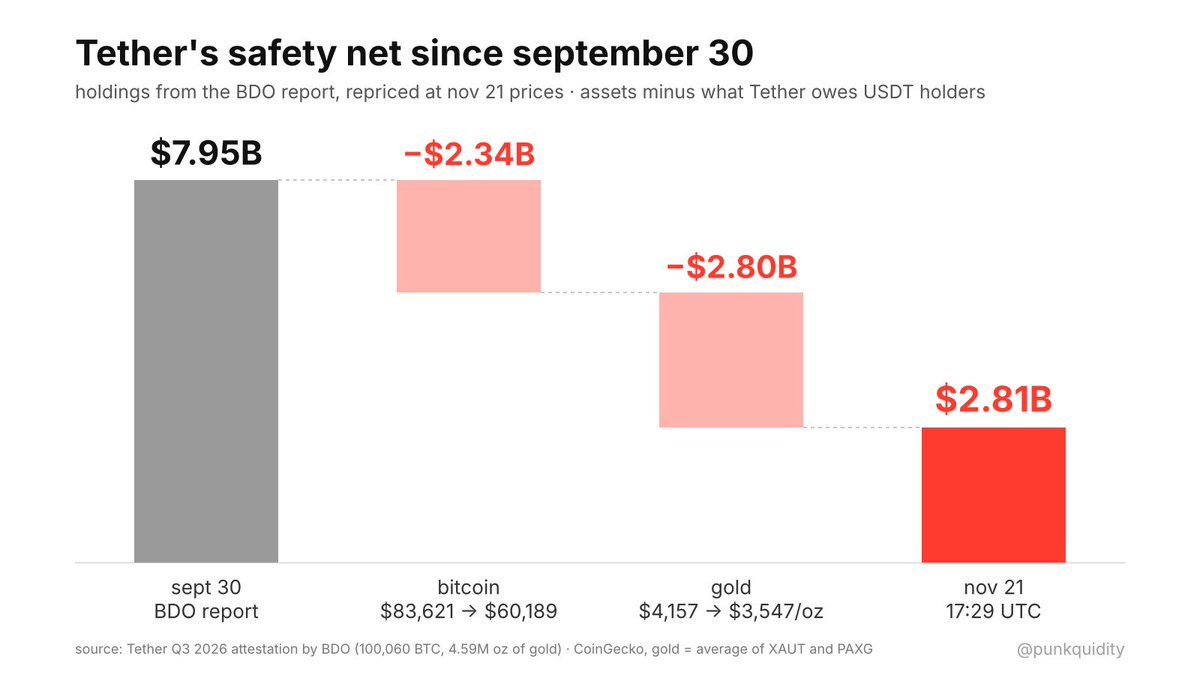
On September 30, Tether held $7.95 billion more in assets than its liabilities to USDT holders. This excess is Tether's Safety Net, which absorbs losses on the asset side before USDT holders suffer any losses.
However, at today's market prices, this safety net has shrunk to approximately $2.8 billion.
A post widely circulated on social media today emphasized that if Bitcoin and gold each fall another 16%–20%, Tether will be unable to maintain full reserves. According to my calculations, if both assets decline in tandem, a drop of just 13% would be enough to pierce the safety net. However, the two assets do not affect the safety net equally — every 1% decline in gold shrinks the safety net by about $163 million, while every 1% decline in Bitcoin shrinks it by about $60 million.
Moreover, this is a relatively optimistic estimate. In my calculations, I still assume that Tether's $4.18 billion in equity assets remain at their September valuation levels, but since then, shares of Twenty One Capital, the Bitcoin treasury company controlled by Tether's issuing company, have fallen 38%.
Key Takeaways (TL; DR)
- Tether's $7.95 billion safety net as of September has shrunk to approximately $2.8 billion at current market prices.
- Of this, the decline in gold prices caused about $2.8 billion in losses, while Bitcoin caused about $2.3 billion in losses. This is because Tether holds $16.3 billion worth of gold, while its Bitcoin holdings are worth only $6 billion.
- If Bitcoin remains at its current price and gold falls to about $2,940 per ounce, the safety net would be wiped out. That means gold would need to fall another 17% from current levels. If the safety net were to be pierced solely by a Bitcoin decline, Bitcoin would need to fall 47% to about $32,100.
- The above calculations assume that Tether's $4.18 billion in equity assets maintain their original value. If these equities decline in line with gold mining stocks or Twenty One Capital, the safety net would shrink further to $1.2–1.9 billion, and gold would only need to fall another 8%–12% to potentially pierce it.
- Tether's own real-time data currently shows a safety net of $5.47 billion. It appears this figure accounts for the impact of Bitcoin's price decline but not the impact of gold's price decline.
- If you hold USDT, redemptions are still proceeding normally. Since September, $8.75 billion in USDT has been redeemed, and USDT is currently trading at $0.9985. What is truly worth watching is Tether's report to be released in January next year, when its reserve coverage ratio may fall below 100%.
All data above is as of 17:29 UTC on November 21, 2026. Data sources include Tether's September reserve report audited by accounting firm BDO, Tether's reserve transparency page, CoinGecko price data, and Tether's Bitcoin wallet records on mempool.space.
What Assets Does Tether Hold?
Tether publishes a quarterly reserve report audited by BDO, and the latest report covers data as of September 30.
On that date, Tether's total liabilities were $183.5 billion, almost entirely from liabilities to USDT holders; meanwhile, its total assets were $191.45 billion. The $7.95 billion difference between the two is Tether's safety net. Tether calls it "Excess Reserves," and some also refer to it as a "Buffer."
Most of Tether's assets are actually quite stable. $139.6 billion is allocated to U.S. Treasuries, short-term loans collateralized by U.S. Treasuries, and cash, covering 76% of its liabilities. The remaining assets fluctuate with the market.
- $19.08 billion in gold;
- $14.18 billion in loans to other companies, backed by collateral;
- $8.37 billion in Bitcoin;
- $6 billion in "other investments";
- $4.18 billion in equities, which the report says provide exposure to gold, Bitcoin, and other assets.
BDO used closing prices as of September 30 in the report: Bitcoin at $83,621 per coin and gold at $4,157 per ounce — this means Tether held 100,060 BTC and 4.59 million ounces of gold, approximately 143 tons, at that time.
It should be noted that this report is only a snapshot of the asset situation on September 30, and Tether has not yet released updated data. All calculations below regarding current asset values are my own estimates based on these holdings and today's market prices.
Where Did the $5 Billion Go?
Since September 30, Bitcoin's price has fallen from $83,621 to $60,189, a decline of 28%. Based on Tether's 100,060 BTC holdings, this means its Bitcoin assets have shrunk by approximately $2.34 billion.
Over the same period, gold's price has fallen from $4,157 per ounce to about $3,547, a decline of 15%. Based on its 4.59 million ounce holdings, this means its gold assets have shrunk by approximately $2.8 billion.
Combined, Tether's asset value has evaporated by approximately $5.14 billion, and the safety net has therefore shrunk from $7.95 billion to approximately $2.81 billion.
At 6:00 UTC on November 21, Bitcoin briefly fell to about $55,700, at which point Tether's safety net shrank further to approximately $2.3 billion. For comparison, Tether reported a safety net of $8.23 billion at the end of March this year and $4.11 billion at the end of June. Based on today's estimates, its safety net has fallen below both of those levels.
Why Is Gold's Price the Most Important to Watch?
Tether is known for buying large amounts of Bitcoin, but at current prices, its gold holdings are worth $16.3 billion, while its Bitcoin holdings are worth only $6 billion. This means every 1% change in gold's price has nearly 3 times the impact on Tether's safety net compared with Bitcoin.
Gold falling another 17% may sound like a significant drop; but in just the past 7 weeks, gold has already fallen 15%.
If Bitcoin remains at its current price, gold only needs to fall further to about $2,940 per ounce to wipe out Tether's safety net. That means gold would need to fall another 17%. By contrast, if the safety net were to be pierced solely by a Bitcoin decline, Bitcoin would need to fall another 47% to about $32,100. Bitcoin has already fallen 28%.
If both assets decline in tandem, then another 13% drop would be enough, corresponding to a Bitcoin price of about $52,600 and a gold price of about $3,100.
In other words, gold only needs to fall another $610 per ounce to exhaust Tether's safety net, which is exactly equivalent to the decline gold has just experienced. Bitcoin, on the other hand, would need to experience another crash even more severe than the previous one.
What Does Tether's Own Data Reveal?
Tether's official website displays September reserve data. However, the data interface behind its webpage, app.tether.to/transparency.json, also contains a field called shareholder_eq (shareholder equity).
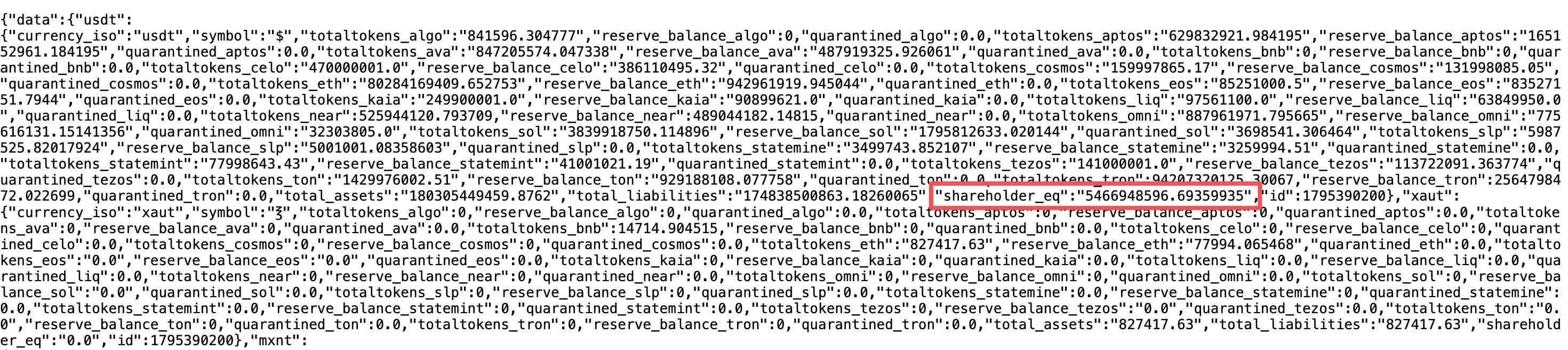
As of 23:59 UTC on November 20, this field showed a value of $5.47 billion. That is $2.49 billion lower than the September figure, differing by only about $6 million from the loss generated by the price decline of Tether's 100,060 BTC holdings as of that time. Therefore, this field appears to account for the impact of Bitcoin's price decline but not the impact of gold's price decline.
I have not found a specific explanation from Tether for this field, so I will not treat it as the true safety net value. If it indeed does not account for the impact of gold's price decline, that means the safety net it displays is overstated by about $2.8 billion compared with the actual situation.
Equity Assets Make the Situation Worse
The reserve report does not disclose exactly what Tether's $4.18 billion in equities are, only stating that they can provide "indirect exposure to gold, Bitcoin, and other assets." So far, I have still assumed in my calculations that these equities maintain their September valuation, which is also a relatively optimistic scenario.
However, we know at least one of these investments. Tether International, the company that issues USDT, is the controlling shareholder of Twenty One Capital (ticker: XXI). Twenty One Capital is a Bitcoin treasury company, and all assets held by the company are included in Tether's reserves.
XXI's share price fell from $6.50 on September 30 to $4.03 on November 20, a decline of 38%. Over the same period, GDX, the largest gold miners ETF, fell 22%.
If Tether's equity assets experience a similar decline, assuming their decline falls between these two, the safety net would shrink by a further $900 million to $1.6 billion.
As a result, the safety net would be left with only about $1.2–1.9 billion, and gold would only need to fall another 8%–12% from current levels to potentially pierce it completely.
What Factors Could Make the Situation Worse or Better?
Factors that could worsen the situation include the following.
First, the $14.18 billion in loans. The reserve report does not specify what assets collateralize these loans. If the collateral is crypto assets and borrowers are unable to post additional collateral, the related losses could ultimately fall on the safety net.
Second, the gold market will reopen later on Sunday, and prices could see significant gap moves up or down at that time.
Factors that could improve the situation include the following.
Tether earns interest income from U.S. Treasuries every day, with quarterly operating profit of about $1.5 billion. However, not all of these profits translate into the safety net — in the first nine months of this year, Tether's safety net actually grew by only $1.14 billion.
Tether's official website also states that other companies under the group hold some funds that are not reserve assets. These funds might help, but USDT holders have no right to claim them.
Is Your USDT Still Safe?
So far, those who want to exit are still able to do so smoothly. According to Tether's official website data, as of November 20, USDT's circulating supply was $174.7 billion, down $8.75 billion from September 30.
However, since mid-October, USDT has been trading slightly below $1, currently at $0.9985. These redemptions do not directly consume the safety net. Tether pays out dollars, and a corresponding amount of USDT is burned, reducing liabilities accordingly.
Tether's main Bitcoin wallet address bc1qjas…c27a4 currently holds 96,932 BTC. The wallet last transferred to another address on July 10, in the amount of 4 BTC. Therefore, at least from this wallet, there are no obvious signs of selling yet.
Even if the safety net falls below zero, USDT will not stop redeeming the next day. Tether still holds U.S. Treasuries, short-term loans, and cash, assets worth about 75% of its liabilities.
What would truly change if the safety net turns negative is the next reserve report. At that point, the report would show Tether's reserve coverage ratio below 100%. And that is precisely the kind of report most likely to make large holders uneasy.
My judgment is — if you hold USDT today, you can still get your dollars back, and most of the assets backing USDT are U.S. Treasuries, but Tether has already lost its extra buffer space.
Another round of gold declines, or unexpected losses on equities or loan assets, could cause the next report to show that its asset value is below its liabilities. Once that happens, what was originally a slow, orderly exit process could quickly turn into concentrated redemptions.
What Will I Watch Next?
I believe gold has become the price indicator USDT holders most need to watch. If gold falls another $610 per ounce, repeating the decline it has just experienced, Tether's safety net will be exhausted.
Tether's next reserve report is expected to be released around the end of January next year. Before then, the key price level I am focused on is $3,000 per ounce. With Bitcoin holding at its current price, if gold falls to that level, Tether's safety net would be left with only about $300 million.
Details of My Calculations
The asset holdings data as of September 30 comes from page 4 of the BDO audit report:
- Bitcoin: $8.36717 billion, calculated at $83,621.23 per BTC.
- Gold: $19.08465 billion, calculated at $4,157.41 per ounce.
Price data comes from CoinGecko as of 17:29 UTC on November 21:
- Bitcoin: $60,189.
- Gold: $3,547.
In the main estimates, equities, loans, and other investments are maintained at their book value as of September 30.
The estimated range for equity assets uses closing prices from Yahoo Finance:
- XXI: $6.50 on September 30, $4.03 on November 20, a decline of 38%.
- GDX: $87.80 on September 30, $68.40 on November 20, a decline of 22%.
The above declines are applied to Tether's entire $4.18 billion in equity assets. In addition, using data from the LD gold fund, its decline from September 30 to the close on November 20 was 15.2%. If this figure were used instead of the prices of XAUT and PAXG, the calculated safety net would be about $100 million higher than the main estimate.
The relationship between profit and the safety net:
- Over the past 9 months, Tether achieved $4.5 billion in operating profit, but the final total income in the BDO report was only $1.66 billion, with another $519 million listed as "Net Capital Movements."
- Over the same period, Tether's safety net grew from $6.81 billion to $7.95 billion.
USDT circulating supply:
- The USDT circulating supply uses Tether's own published data. As of November 20, it was $174.72 billion, while the BDO report showed total tokens issued as of September 30 were $183.47 billion.
75% reserve coverage estimate:
- This estimate assumes that the entire $8.75 billion in redemptions came from the $139.6 billion in U.S. Treasuries, short-term loans, and cash assets.
Tether's Bitcoin wallet:
- The full wallet address is bc1qjasf9z3h7w3jspkhtgatgpyvvzgpa2wwd2lr0eh5tx44reyn2k7sfc27a4, currently holding 96,932 BTC.