Glassnode Institutional Strategy Monthly Report: Stablecoin Outflows Exceed $6 Billion as Institutional Capital Turns Defensive


- Key Takeaways: In October, crypto market funding conditions clearly turned defensive. Bitcoin net inflows peaked in mid-month before slowing, U.S. spot ETFs shifted from net buying to net selling, stablecoins saw large-scale redemptions and outflows, institutional allocation pace tightened, and the market entered a liquidity rebalancing cycle.
- Key Elements:
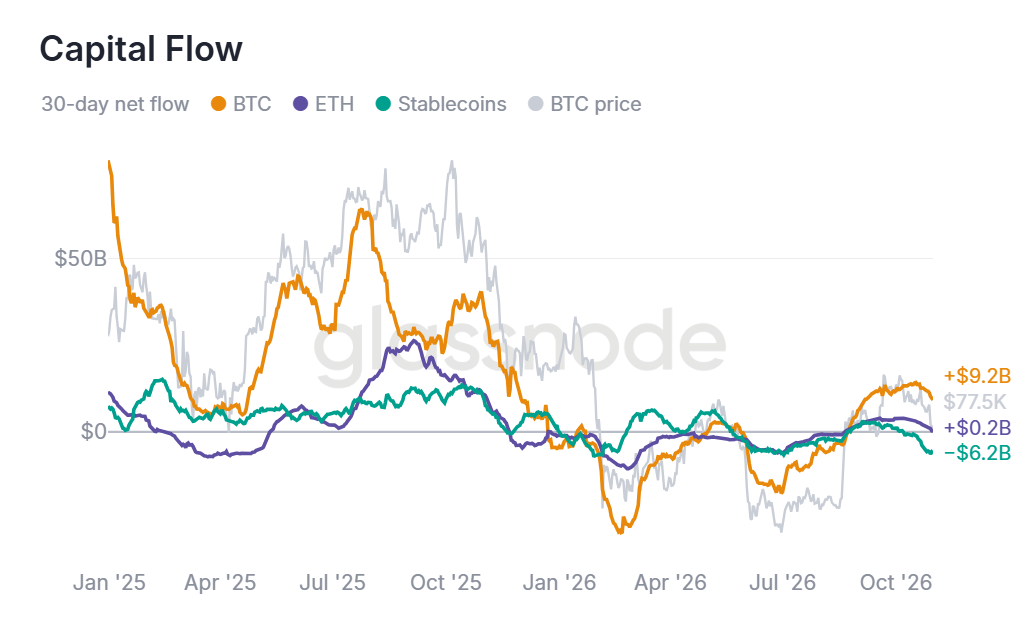
- Bitcoin's 30-day net inflow peaked at $14.2 billion on October 17 and fell back to $9.2 billion by month-end; Ethereum inflows were nearly zero.
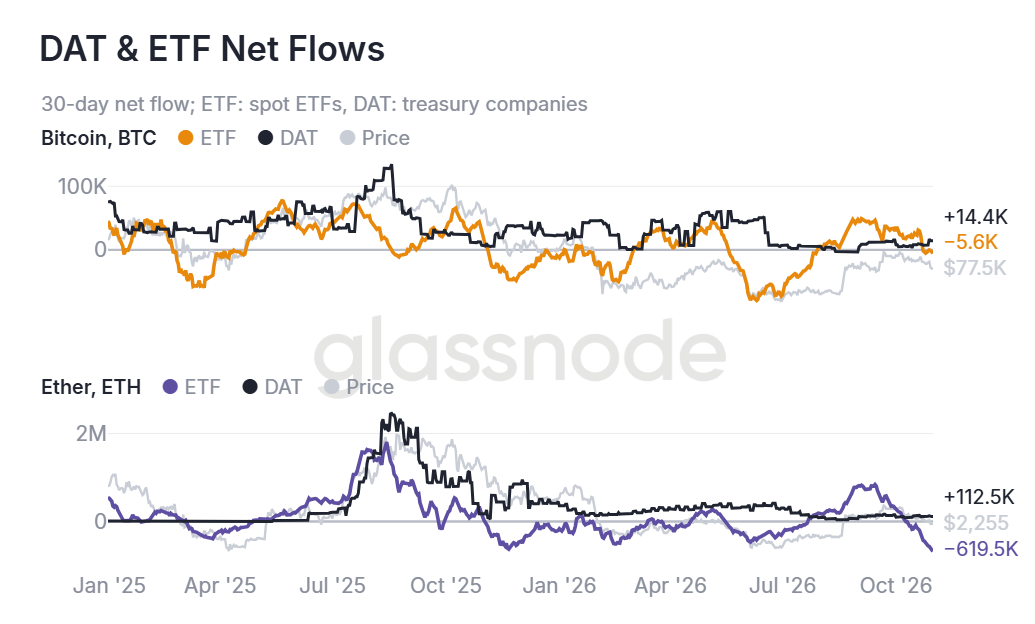
- U.S. spot Bitcoin ETFs recorded a net outflow of 5,600 BTC (the first since July), while Ethereum ETFs saw a net outflow of 643,000 ETH, the highest since tracking began in August 2024.
- Stablecoins saw outflows exceeding $6 billion in late October, the largest on record since early July, with signs of capital exiting by converting back into U.S. dollars.
- Directional strategy funds posted an overall drawdown of 7.04%, event-driven strategies fell 16.25%, and market-neutral strategies were only -0.08%.
- The cash reserve ratio among fund managers rose from 12.2% to 15.7%, attention to Ethereum dropped from 42% to 25%, and Bitcoin rose from 8% to 22%.
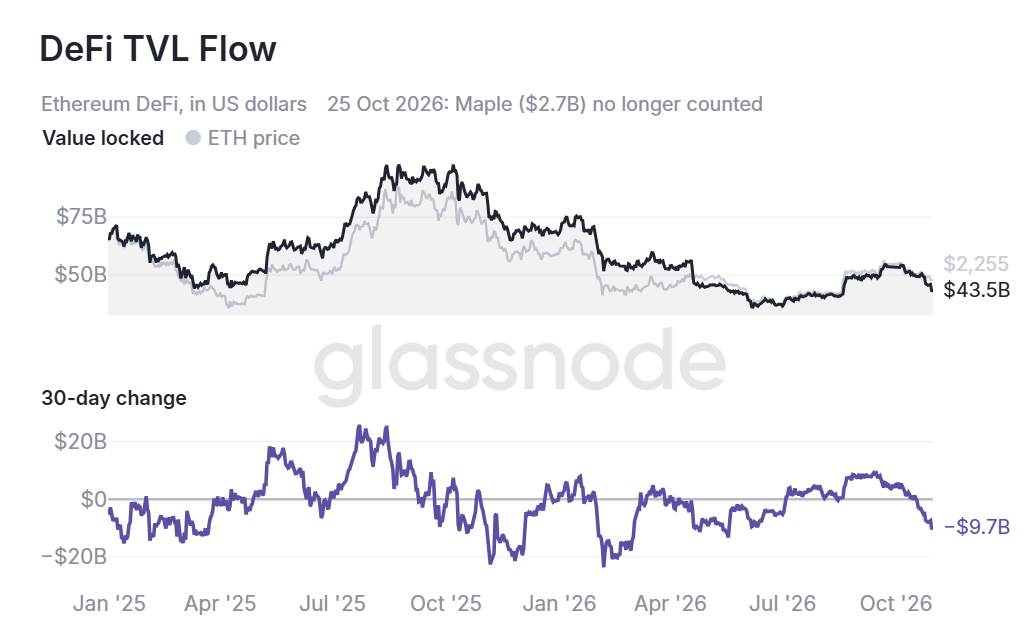
- Ethereum DeFi TVL fell to $43.5 billion by month-end, down about 13% month-over-month; CME Bitcoin basis returns rebounded to $168 million by month-end, only one-third of the August 2025 peak.
Original Author: Glassnode Insights
Original Compilation: TechFlow
TechFlow Introduction: This month's institutional strategy report reveals a subtle shift in the crypto market's recent capital flows. Although Bitcoin's 30-day net inflow briefly hit a stage high of $14.2 billion in mid-October, it subsequently slowed significantly; more critically, U.S. spot Bitcoin and Ethereum ETFs shifted from net buying to net selling, and the pace of institutional allocation has clearly tightened.
Stablecoins recorded over $6 billion in redemption outflows in October. Funds are not only staying on-chain on the sidelines but also showing signs of exiting and redeeming into USD. Combined with drawdowns in directional strategy funds and a reassessment of crypto lending risk, the market has entered a defensive and liquidity rebalancing cycle, and arbitrage yields such as the CME futures basis are also at relatively low levels.

Report Overview: Tracking Across Six Core Dimensions
The "Strategy Watch" report aims to meet the market's clear demand for high-signal, objective and neutral analysis of fund-level performance and allocation trends in the digital asset space. Our goal is clear: to make it a must-read in-depth reference publication for digital asset investment institutions every month.
This report is divided into six core sections, each focusing on the latest developments of institutions across different dimensions of the digital asset space:
01 Institutional Flow Monitor: Bitcoin net inflows peaked in mid-October, spot ETFs shifted from net buying to net selling for both Bitcoin and Ethereum, corporate treasury companies continued to increase holdings, while stablecoin funds saw net outflows.
02 Fund and SMA Performance: Directional strategy funds overall drew down 7.04%, with event-driven strategies drawing down as much as 16.25%. Market-neutral strategies performed relatively steadily, recording -0.08%, with the Binance hack incident having almost no impact on their returns.
03 Strategy Deep Dive: Reading the Decline: James Butterfill of CoinShares, Rupam Shrivastava of Frontiers Capital, and David Finkenstädt of Postera Capital delved into October's anomalous signals, the market's current misconceptions, and the key catalysts that could change their views before year-end.
04 On-chain Vault Performance: USD vault yields outperformed U.S. Treasuries for the fourth consecutive month (0.41% vs. 0.34%), Ethereum vault yields remained below native staking; total vault deposits in the tracked sample edged down about 2% to $9.5 billion, with most redemptions occurring after the Binance hack incident.
05 Manager Monitor: The average cash reserve ratio of fund managers rose from 12.2% to 15.7%, above the long-term average; fundraising communications maintained September's momentum; Ethereum's share of fund manager attention fell from 42% to 25%, while Bitcoin's attention rose from 8% to 22%.
06 Allocation Updates: U.S. spot Bitcoin ETFs recorded their first monthly net outflow since June; hackers stole approximately $6.3 billion in assets from Binance; Room40 Capital is returning funds to external investors; Janus Henderson announced the launch of a fund tracking the Nasdaq 100 index on the Stellar network.
Institutional Flow Monitor
Key Takeaways: Bitcoin net inflows peaked in mid-October, Ethereum inflows nearly stalled, and stablecoins continued to flow out of the crypto ecosystem.
Bitcoin's 30-day rolling net inflow continued to climb in mid-October, reaching a peak of $14.2 billion on October 17, the highest record since November 2025. However, by the end of October, net inflow had fallen back to $9.2 billion. Against the backdrop of a 7% price decline for Bitcoin that month, this still represented new inflow capital. Meanwhile, Ethereum's capital inflows nearly dropped to zero.
More critically, stablecoins' 30-day net flow turned negative on October 7, and by late October outflow exceeded $6 billion, the largest outflow record since early July. Holders are redeeming stablecoins into USD on a large scale, indicating that some funds are completely exiting the crypto market, and this capital outflow trend intensified further in November.
Spot ETF and Corporate Treasury Net Flows
Key Takeaways: Spot ETFs shifted from net buyers to net sellers for both Bitcoin and Ethereum, while corporate balance sheet institutions continued to increase holdings against the trend.
On a 30-day basis, U.S. spot ETFs were still in buying mode in early October but turned to net selling by month-end. Among them, Ethereum spot ETFs reversed first on October 9, and Bitcoin spot ETFs followed two weeks later, turning to net outflow.
As of end-October, Bitcoin spot ETFs recorded a net outflow of 5,600 BTC, the first monthly net selling since July; Ethereum spot ETFs saw net outflows of as much as 643,000 ETH, the highest record since we began tracking in August 2024. Although corporate treasury companies continued to increase holdings of both assets, their Ethereum purchases were less than one-fifth of ETF selling. In September, both institutional groups were buying, but now only corporate treasury companies remain increasing holdings.
Ethereum DeFi Total Value Locked Trend
Key Takeaways: Ethereum DeFi USD-denominated TVL shrank as ETH prices fell, erasing more than half of the gains since August.
Total Value Locked (TVL) refers to the total USD value of assets deposited in various DeFi protocols on Ethereum. As of end-October, Ethereum DeFi TVL fell to $43.5 billion, down about 13% from the beginning of the month. Note that the chart shows a more pronounced decline because the data source stopped including the lending protocol Maple (involving approximately $2.7 billion) in Ethereum on-chain statistics starting October 25.
ETH spot prices fell 16% in October, while TVL was relatively resilient, mainly because some assets are denominated in stablecoins and maintained par value. The largest single-day decline occurred when the Binance hack incident happened, when Ethereum TVL dropped 7% in a single day and ETH prices fell 5%, indicating that some depositors were choosing to actively withdraw funds.
CME Basis Annualized Yield
Key Takeaways: The cash-and-carry arbitrage yield from buying spot and selling futures recovered somewhat at month-end, while Ethereum's arbitrage yield fell by about two-fifths.
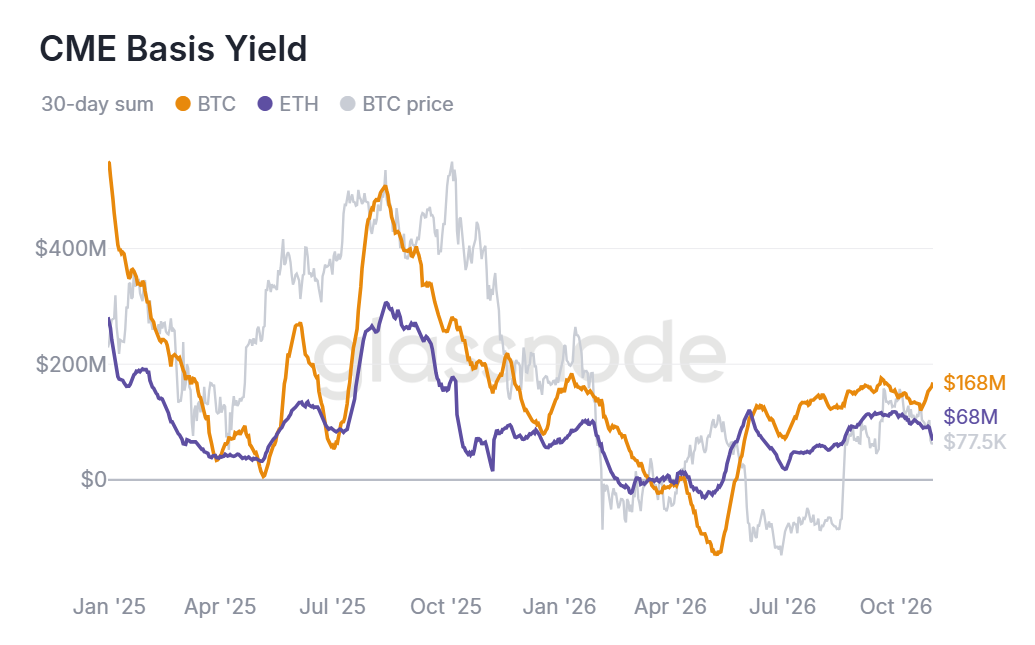
This metric measures the 30-day cumulative yield captured by traders buying spot while shorting futures. Bitcoin basis yield readings dipped to $120 million on October 21 (a new low since July), then recovered to $168 million by month-end, showing that even with lower prices, traders are still willing to pay a premium to hold long futures positions.
In contrast, Ethereum basis yield slid to $68 million, the lowest level since August. In the last three days of October, Ethereum funding rates turned negative, and shorts began paying longs. Even after the rebound, Bitcoin's current basis yield level is only one-third of its August 2025 peak, confirming feedback from multiple fund managers: funding rate arbitrage on major tokens is still generating positive cash flow, but far below normal levels.
Disclaimer
This report does not constitute any investment advice. All data is for informational and academic research purposes only. No investment decision should be made based on the information provided herein, and you bear full legal and financial responsibility for your own investment activities. Exchange asset balances are derived from Glassnode's comprehensive address label database, generated by combining publicly disclosed information with proprietary clustering algorithms.