Amid the crash, small and mid-sized crypto treasuries are quietly selling coins


- Core Viewpoint: Multiple digital asset treasury companies, facing mNAV falling below 1 and the closure of equity issuance financing channels, have been forced to sell crypto assets to cope with margin call pressure on loans, but information disclosure severely lags behind actual on-chain capital flows.
- Key Elements:
- Five treasury companies with mNAV below 1 collectively sold approximately 410 BTC, 57,300 ETH, and 986,000 SOL, totaling about $203 million.
- The sales were all completed through custodians, prime brokers, and OTC platforms, leaving no large block records on exchange order books.
- The primary reason for selling was balance sheet pressure: BTCS reduced its Aave borrowings, Bit Digital repaid its Galaxy loan, and Upexi approached the 150% collateral ratio warning line.
- On-chain tracking closely matches the companies' historical disclosure data; Bit Digital's selling was identified by on-chain data ahead of its formal announcement.
- Silvia, Solana Company, and Upexi did not disclose asset sales that had already occurred in their 10-Q filings, with information lag potentially reaching several months.
- Since mid-October, about 25 treasury and mining companies have disclosed sales, including MARA selling 13,597 BTC and Riot selling 20,264 BTC.
- Nakamoto, Upexi, Solana Company, and others face loan liquidation pressure and may become the next batch of forced sellers.
This article is from: Kairos Research
Compiled by: Odaily (@OdailyChina); Translator: Azuma (@azuma_eth)

Some digital asset treasury companies appear to have begun selling their crypto holdings to help bring their mNAV (market cap to net asset value ratio) back near 1.
Over the past few weeks, Silvia (SVIA, formerly ProCap Financial), Bit Digital (BTBT), BTCS (BTCS), Upexi (UPXI), and Solana Company (HSDT) appear to have collectively sold approximately 410 BTC, 57,300 ETH, and 986,000 SOL. Based on prices on the days the tokens were transferred, these assets were worth approximately $203 million in total.
What these five companies have in common is that their current stock market valuations are significantly below their net asset values (mNAV below 1). This makes it difficult for them to continue the financing strategy that previously drove business growth — namely, issuing more shares or taking on debt to purchase more underlying crypto assets. The reason is simple: when a company issues shares at a price below the value of the assets it holds, the amount of assets per share actually decreases rather than increases.
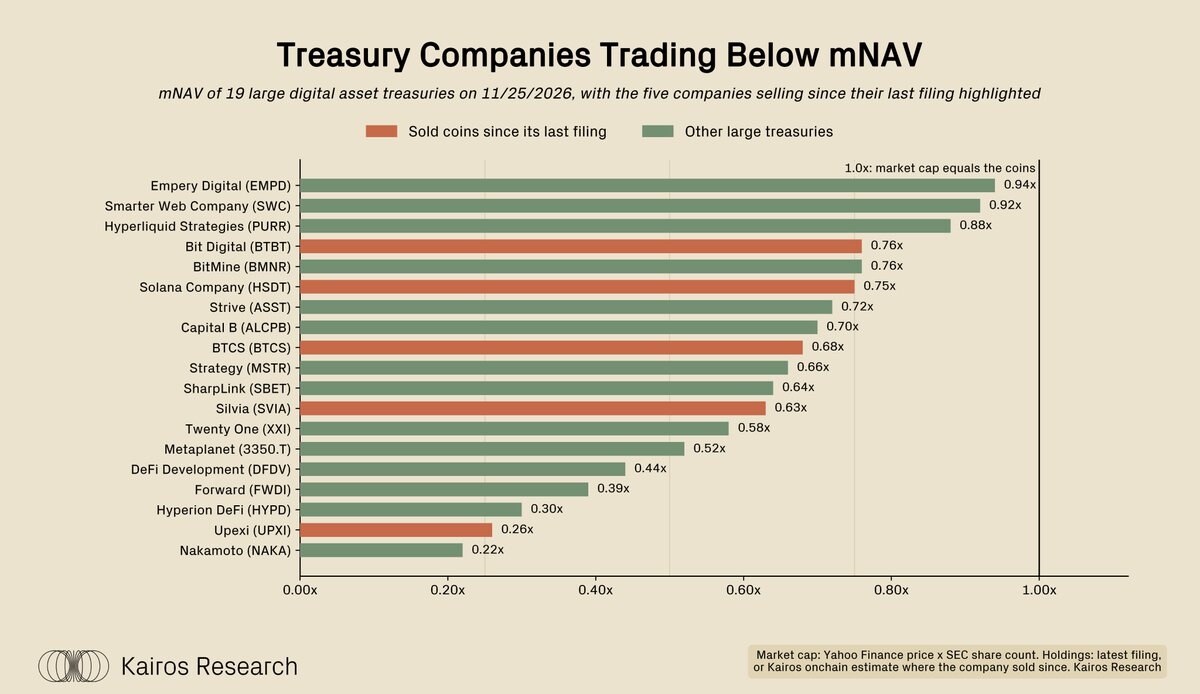
Methodology: Onchain Tracing, Cross-Referenced with Disclosures
Of the five companies, two have publicly acknowledged the relevant sales.
BTCS disclosed in an 8-K filed on November 23 that it sold approximately 27,300 ETH on November 20 to repay a $43.8 million loan on Aave.
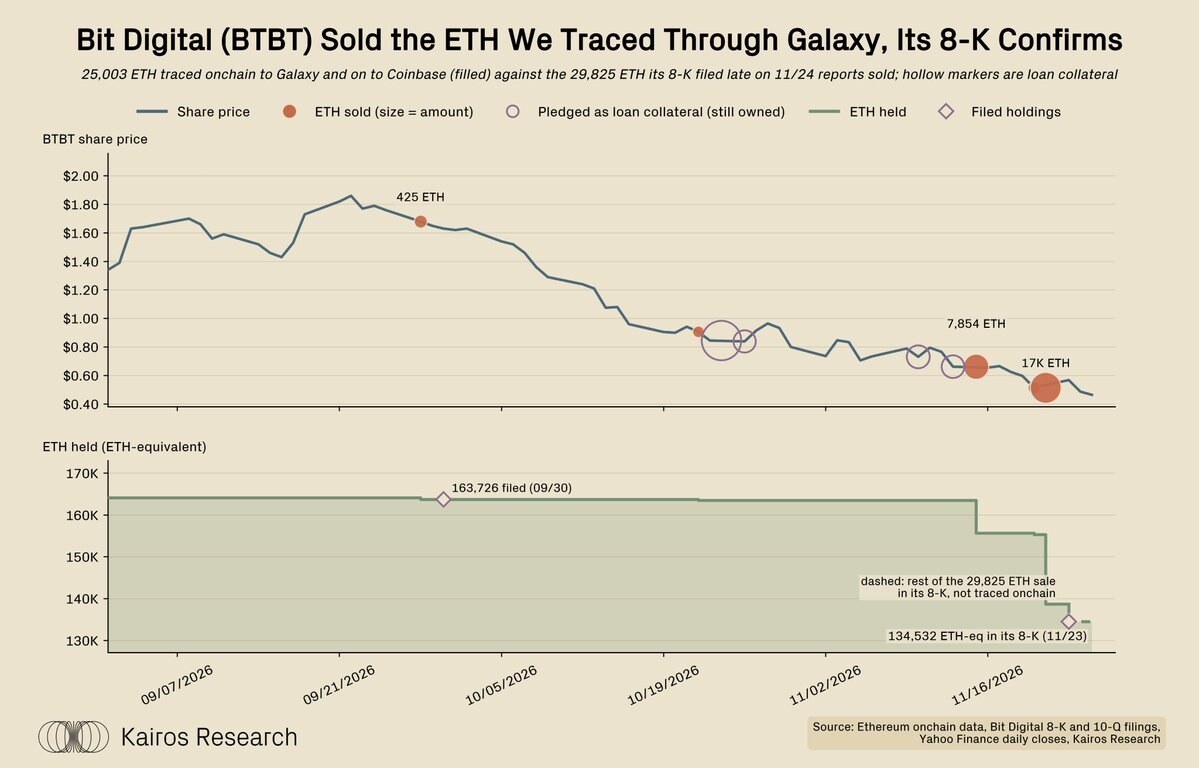
Bit Digital disclosed in an 8-K filed late on the night of November 24 that it sold 29,825 ETH between November 15 and 23, cashing out approximately $50 million and cutting its Galaxy loan in half. By the time this announcement was published, we had already completed our onchain tracing of its selling activity.
The selling activity of the other three companies came from our own onchain tracing. Our analytical approach is to map each company's treasury wallets to its historical regulatory filings. Before classifying any recent fund transfer as a sale, we check whether the same wallets and sale paths can reproduce transactions the company has previously disclosed.
This method has yielded strong validation results:
- Silvia's Q3 sales volume: onchain tracing found 320 BTC, exactly matching the company's disclosed 320 BTC.
- Bit Digital's Q3 sales volume: onchain tracing found 1,625 ETH, exactly matching the company's disclosed 1,625 ETH.
- Solana Company's Q1 sales amount: onchain tracing found $5.459 million, roughly consistent with the company's disclosed $5.452 million.
- Upexi: based on quarterly net sales volume, the discrepancy between onchain tracing and the company's disclosed data is approximately 4,000 SOL.
It is precisely this alignment with historical data that gives us reason to maintain high confidence in the fund flows of the same set of wallets after the most recent earnings disclosures.
Bit Digital's announcement was the first real-time test of this method. We identified the relevant transactions through onchain data before the company disclosed the sales, and the results largely matched.
Using onchain data alone, we identified that between November 15 and 21, 24,793 ETH flowed out through Galaxy, representing approximately 83% of the 29,825 ETH the company later disclosed. We estimated Bit Digital's remaining holdings at approximately 138,900 ETH-equivalent assets, while the company's latest disclosure shows 134,532. We also correctly identified the LsETH the company transferred to Galaxy in November: these assets were in fact collateral provided for the loan. The collateral amount we traced was 69,088 LsETH, almost exactly matching the 69,089 disclosed in the company's announcement.
The Five DATs Sold at Varying Scales
Looking at each company's treasury size, the impact of these sales varies significantly across companies:
- BTCS: sold nearly half of the ETH holdings it disclosed as of the end of September.
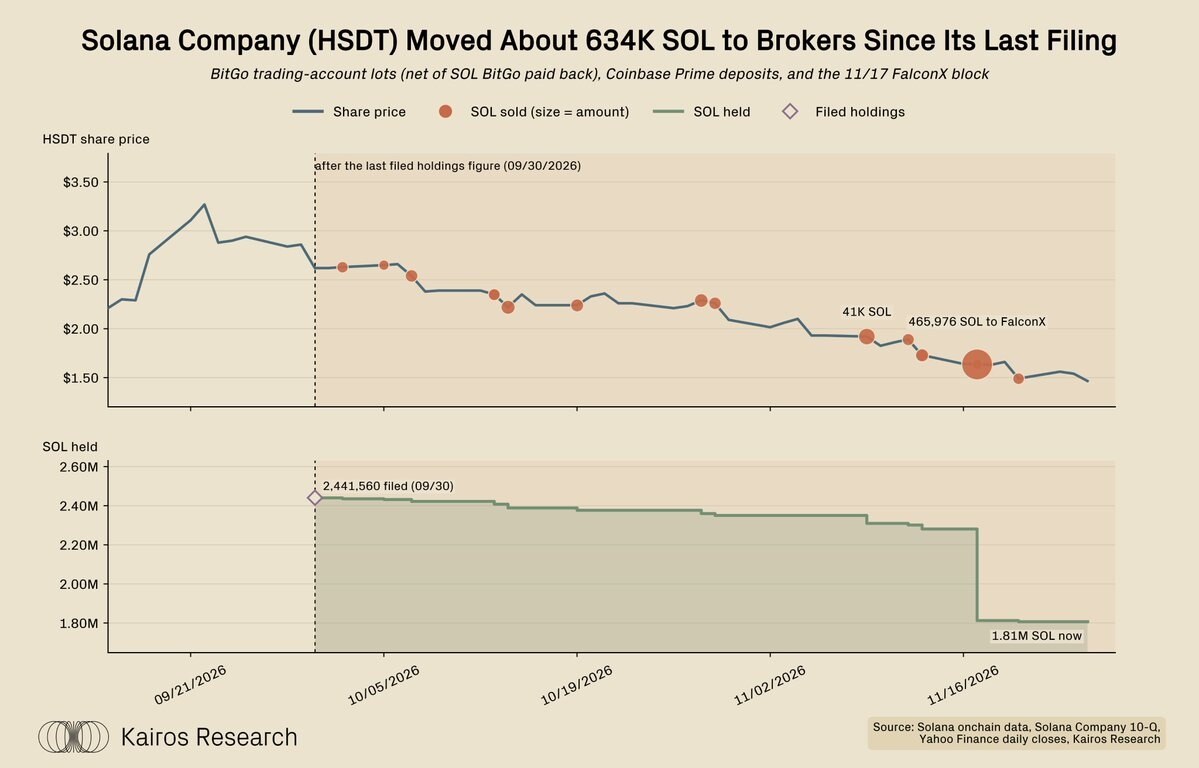
- Solana Company: transferred approximately one-quarter of its SOL to brokers and trading accounts, with no assets having returned to date.
- Bit Digital: sold approximately 18% of its ETH holdings.
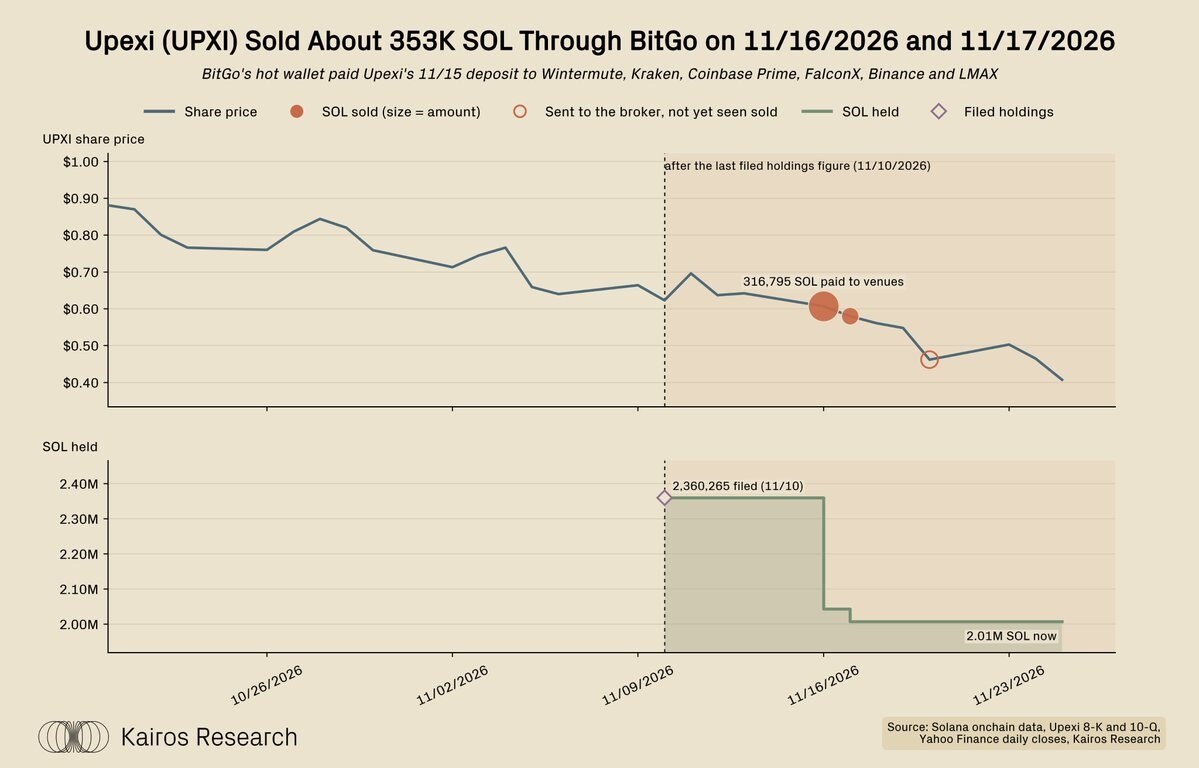
- Upexi: sold approximately 15% of its SOL holdings.
- Silvia: sold 410 BTC, the lowest percentage of holdings at approximately 8%. However, its selling activity was the most systematic — transferred in nine batches of 35 to 80 BTC each, all paid to the same address, which had previously received all of Silvia's prior sale batches and had only ever received transfers from Silvia's wallets.
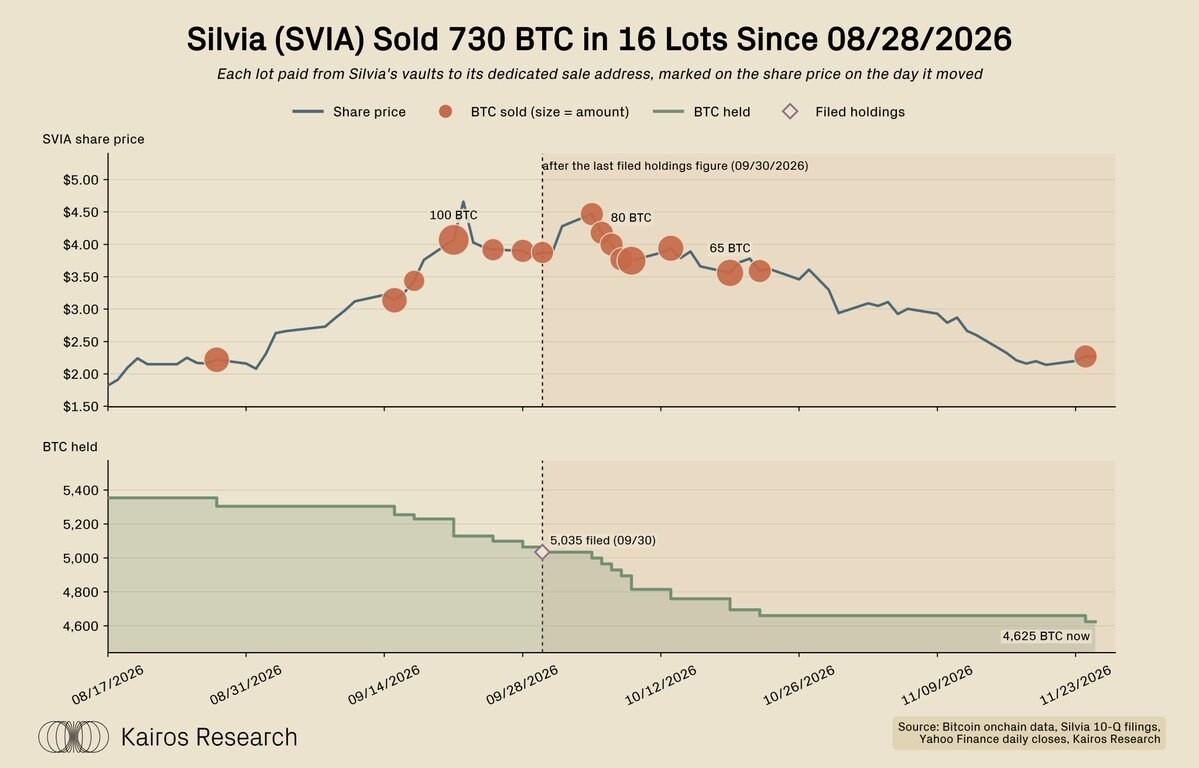
Notably, none of these companies sold assets directly through exchange order books. The tokens were all transferred out via custodians, prime broker hot wallets, and over-the-counter (OTC) platforms, so these transactions did not leave obvious block trade records on public exchanges.
The specific paths are as follows:
- Silvia: one batch of assets was included in a 1,000 BTC transfer to a Cumberland DRW wallet.
- Upexi: on November 15 (Sunday), transferred 329,499 SOL to a BitGo shared hot wallet. Within the following 36 hours, that wallet transferred out 352,530 SOL to trading firms and exchanges, including Wintermute, Kraken, Coinbase Prime, FalconX, Binance, and LMAX. That wallet typically holds only about 198,000 SOL, and during those three days, Upexi accounted for 96% of all inflows to that wallet. Moreover, none of these funds flowed to BitGo or other lenders, so these outflows could not have occurred without Upexi's assets being involved, nor were they loan collateral.
- Solana Company: a large transfer of 465,976 SOL went to FalconX, and within a single day an equivalent amount entered OKX and Kraken deposit addresses.
- Bit Digital: Galaxy Digital transferred out approximately 24,800 ETH through its hot wallet and moved it to Coinbase deposit addresses within three and a half days. Bit Digital has since confirmed the sale of this ETH.
Primary Driver: Balance Sheet Pressure
Judging by the timing of the transactions, these sales appear more like the result of balance sheet pressure rather than a change in the companies' long-term views on the relevant crypto assets.
Specifically:
- BTCS: sold assets when ETH fell to approximately $1,561 to reduce its Aave borrowings.
- Solana Company: began unstaking SOL on the same day that 390,000 SOL put options it had previously sold expired deep in the money, with an estimated loss of approximately $12 million.
- Upexi: sold SOL when the SOL price fell to approximately $70, already close to our estimated $67 level. At that price, the collateral ratio on its $57.3 million BitGo loan would hit 150%, at which point the lender could initiate a margin call. The amount of SOL it actually sold was within 1% of the amount needed to restore that loan's collateral ratio to 200%.
- Bit Digital: began transferring assets when the value of the ETH collateral on its $100 million Galaxy loan fell to approximately 131% of the loan amount. The company has now confirmed that the sale proceeds were used to repay half the loan.
When a treasury company's stock price falls below the value of the assets it holds, its own crypto holdings become the most readily available source of cash. This is the reality after the model of relying on equity issuance to continuously expand crypto holdings has run its course.
What's More Concerning Is the Disclosure Lag
For investors, what truly deserves attention is the time gap between these transactions and the companies' public disclosures.
Silvia, Solana Company, and Upexi all filed their Q3 10-Q reports in November. These reports all included disclosures about material events after the end of the quarter. Among them, Silvia and Solana Company disclosed share buybacks, new loans, and executive departures in their respective disclosures, yet neither mentioned crypto asset sales that had already occurred before the filings; Upexi began selling assets two days after releasing its earnings report and has yet to provide any explanation.
Bit Digital's disclosure approach provides a reference point. The company's 10-Q filed on November 12 predated its selling activity, so the day after the final batch of assets was transferred out, it disclosed the relevant transactions through an 8-K filing. This is the standard the other three companies have yet to meet.
Take Silvia as an example: its announcement disclosed that the company repurchased 6.1 million shares between October 1 and November 10 at a cost of $24.4 million, yet did not disclose that approximately 375 BTC had been transferred out of its treasury during the same period to fund the buyback.
Holdings data on public tracking platforms shows similar lag. Currently, these platforms still show Silvia holding 4,965 BTC, while our tracing shows actual holdings of approximately 4,625; Phoenix Group is similar — public platforms show it holding 559 BTC, but its Q3 earnings report disclosed holdings of only 331 BTC.
Selling Coins to Buy Back Stock Isn't as Beneficial as It Seems
Buying back stock by selling crypto assets may improve mNAV far less than it appears on the surface. There's an uncomfortable math problem behind this. Let's use Silvia as an example.
- First, BTC holdings per share barely improved. The company sold BTC and retired shares at nearly the same ratio. As a result, its BTC holdings per million shares actually declined slightly, from approximately 62.2 at the end of September to approximately 61.8 on November 10.
- Second, the buyback price was actually close to net asset value, with no significant discount. After deducting $99.6 million in convertible bonds, Silvia's cost to repurchase shares was approximately 1x its net asset value.
- Third, the mNAV discount the market sees may be overstated. Using the same debt-adjusted basis, Silvia's actual mNAV is approximately 0.98x, not the 0.63x shown in the first chart. This means the value creation potential from share buybacks is far smaller than the surface data suggests.
- Fourth, the BTC available for discretionary use is less than it appears. Under its bond terms, pledged BTC is valued at only half its actual value. At current prices, of Silvia's approximately 4,625 BTC, approximately 3,420 must remain as collateral. Additionally, bondholders have the right to require the company to repay the full $99.6 million in bonds at par in June 2027.
The Market Appears Not to Have Noticed These Sales
These companies' stocks did not show明显的 abnormal trading during the periods when the sales occurred, consistent with the fact that the relevant transactions had not yet been publicly disclosed at the time.
Trading volume on the days of the sales was mostly at normal levels, or even below average. Since September 30, four of the five companies' stock prices have declined significantly more than the crypto assets they hold, while Solana Company's stock price has largely tracked SOL. Therefore, these sales did not provide obvious support to the relevant stocks.
The only time window with a notable stock price anomaly was Bit Digital — during the period when Galaxy transferred ETH to Coinbase, Bit Digital's stock fell 15%, while ETH fell only 4% over the same period, and its performance was notably weaker than its closest peers.
This Is Not an Isolated Case: Approximately 25 Treasury Companies and Miners Have Disclosed Sales
Since mid-October, approximately 25 treasury companies and mining companies have disclosed crypto asset sales in SEC filings, including:
- Complete liquidation: KULR, Hyperscale Data, and Rumble have sold their entire BTC holdings; GameSquare sold most of its ETH to repay ETH-collateralized bonds.
- Massive losses: Empery Digital sold 3,170 BTC this year, realizing losses of $160 million.
- Miner selling: MARA sold 13,597 BTC after the end of Q3 to repay a $750 million Bitcoin-collateralized loan; Riot has sold 20,264 BTC this year.
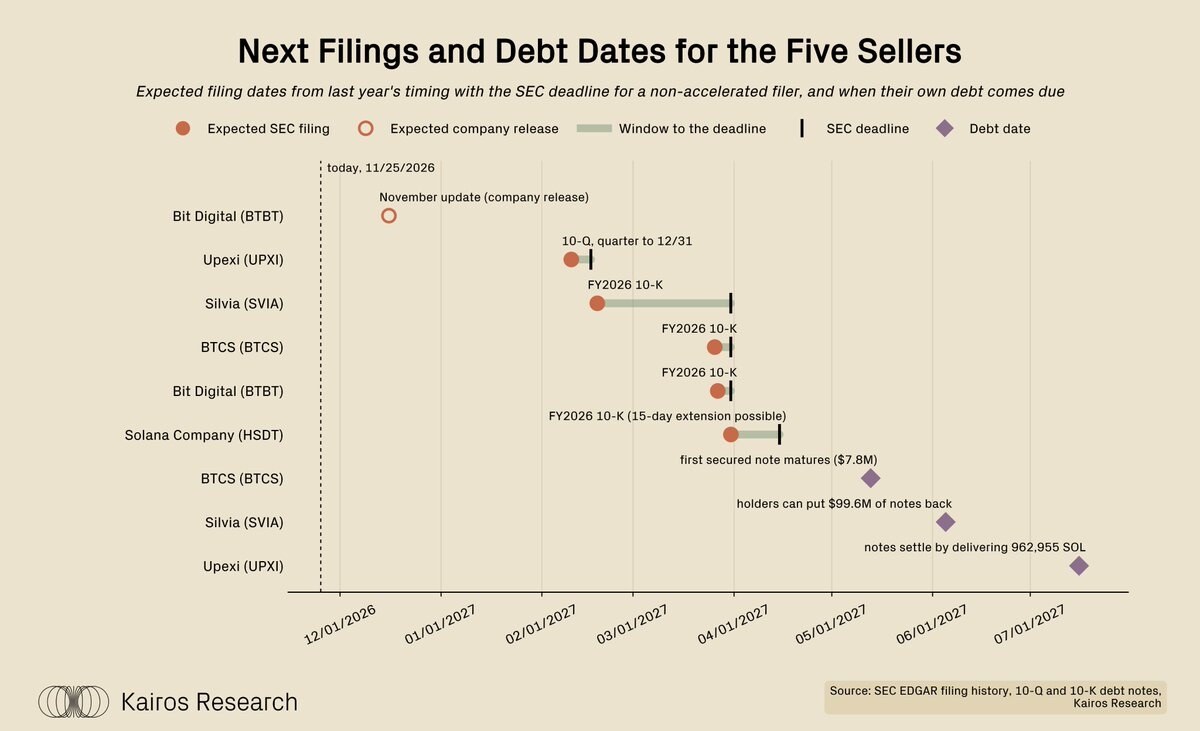
What sets these five companies apart from the others is that sales by Silvia, Upexi, and Solana Company after September 30 may not appear in public filings until months later. This is because all five companies are non-accelerated filers, which can use the longest earnings disclosure deadlines permitted by the SEC.
The key upcoming disclosure dates are expected as follows:
- Bit Digital: mid-December. The company will release its November holdings update at that time. This is a company announcement rather than a regulatory filing, and it will confirm whether it continued selling beyond the 134,532 ETH-equivalent holdings disclosed on November 23.
- Upexi: around February 10, 2027 (deadline February 16). The company's first filing that must disclose the relevant transactions will be its 10-Q for the period ending December 31, which will disclose sale proceeds and year-end SOL holdings.
- Silvia: around mid-February 2027 (deadline March 31). The company filed its 10-K annual report on February 18 last year.
- Bit Digital, BTCS, and Solana Company: late March 2027 (deadline March 31). Solana Company has previously used a 15-day extension, so its 10-K annual report may be delayed to around April 15.
However, before these disclosure dates arrive, onchain fund flows are likely to change further.
On November 24, Solana Company began unstaking 218,539 SOL from Anchorage margin vaults, worth approximately $14.5 million. This is exactly the same operation it took four days before its previous large SOL transfer to FalconX.
Meanwhile, Upexi still has 139,870 unstaked SOL sitting in one wallet, plus another 30,000 SOL that has been held at BitGo since November 20.
The Next Wave of Sellers May Be Companies Facing Loan Liquidation Pressure
The next group most likely to sell crypto assets are treasury companies whose lenders can force their hand.
Once a crypto-collateralized loan triggers a margin call, it creates a price threshold at which selling assets shifts from optional to unavoidable. At the same time, lower mNAV closes off the channel for obtaining cheaper financing through equity issuance.
Companies worth watching currently include:
- Nakamoto (NAKA): pledged 3,030 BTC as collateral to borrow 165 million USDT from Kraken. At current prices, these BTC cover the loan by only approximately 1.07x, with 105 million USDT maturing on June 30, 2027.
- Upexi: as of the end of September, the company owed BitGo $57.3 million. This loan can be called with 30 days' notice and triggers a margin call when the collateral ratio falls to 150%. Additionally, the company's $150 million in bonds mature on July 16, 2027, at which point it must deliver 962,955 SOL to holders.
- Solana Company: the company signed a new loan agreement with Maple on November 11 that includes margin and liquidation provisions. Meanwhile, as of the end of September, the company had only approximately $1.1 million in cash, and its options trading had already generated losses.
- Forward Industries (FWDI): the company borrowed $50 million from Erebor Bank on November 16 using SOL held at BitGo as collateral, in addition to a loan from Galaxy.
- Metaplanet: as of the end of September, its borrowings equaled 17.7% of its BTC holdings, exceeding the company's own 10% guideline. In Q3, the company sold 10