ETH Burn Can't Keep Up with Issuance—Is Vitalik Now Talking About Store of Value?


- Core Viewpoint: Vitalik Buterin rejects the narrative of fee burning as a reliable valuation floor for ETH, pointing out that burn volume fluctuates with speculative activity and is hard to form stable cash flow; when the burn logic fails, public chain tokens need to find new value support, and ETH's valuation logic is shifting toward decentralization, security, and store of value.
- Key Elements:
- ETH's burn over the past 30 days offset only about 3.2% of new issuance; cumulative burn in 2026 is about 19,200 ETH (roughly $43 million), far below the 1.48 million ETH burned in 2022.
- Calculated using the "annual burn amount ÷ discount rate" model, ETH's theoretical valuation is only about $1.25 billion, while its actual market cap is about $270 billion—a gap of over 200x, exposing the model's limitations.
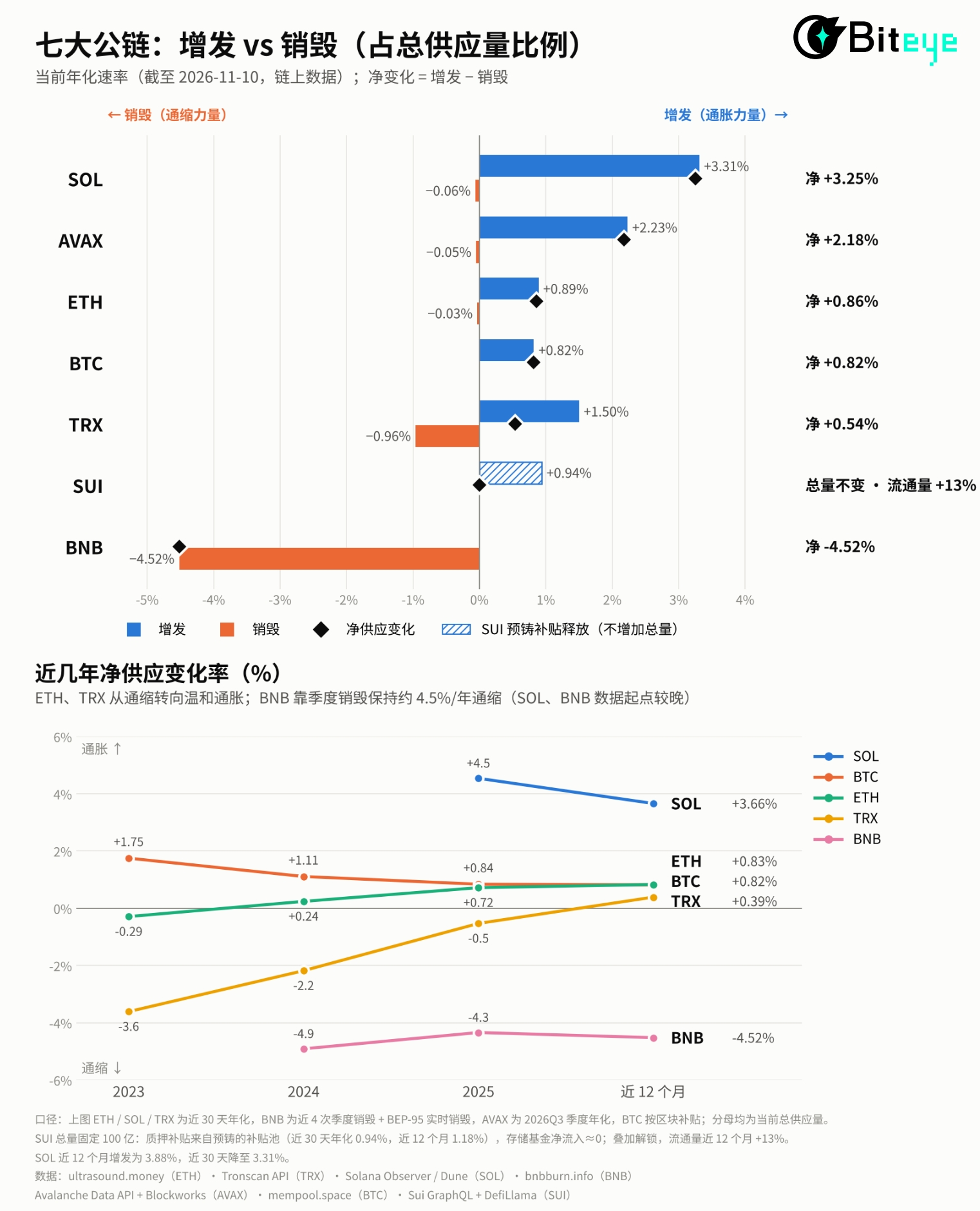
- Supply mechanisms diverge across public chains: BTC has annual inflation of about 0.82% with a four-year halving; SOL starts at 8% initial inflation and decreases yearly; BNB has no new issuance and relies on quarterly burns toward a target of 100 million tokens; AVAX has burned a cumulative 5.18 million tokens, still insufficient to offset new issuance.
- Fee revenue is unstable; high burn volume mainly stems from speculative activities such as NFTs and shrinks in tandem when the market cools, making it difficult to regard as long-term stable cash flow.
- Burning is only one way of value distribution: SOL priority fees go to validators, TRX resource rents go to stakers, and economic value is not necessarily reflected in burns, so it cannot serve as a unified valuation standard.
- Vitalik emphasizes Ethereum's decentralization, censorship resistance, open source, and privacy security, believing that in the AI era, systems not controlled by a single entity will be more valuable.
On November 8, Vitalik @VitalikButerin published a long post on X, revisiting the sources of ETH's value.
In the past, Ethereum has long had the "Ultrasound Money" narrative: ecosystem activity drives up Gas consumption, and the continuous burning of transaction fees not only offsets inflation but can even push ETH into deflation.
But Vitalik argues that fee burning has never been a reliable valuation floor. This is because in the past a large share of fees came from speculative activity within the crypto market, and once the market turns down, burn revenue shrinks along with it.
He still supports keeping EIP-1559, but even if future burn volume remains below 10% of new issuance for a long time, there is no need to regret it. Deliberately pursuing higher fees in order to sustain a high burn rate could instead harm Ethereum's decentralization and long-term development.
This also raises a question: if the logic that "the more prosperous the applications, the more is burned, and the more valuable the token" is no longer reliable, then what exactly can public chain tokens that continuously increase issuance every year rely on to support their valuations?
How much do mainstream public chains issue each year, and how much do they burn?
Most PoS public chains need to issue tokens to reward validators while reducing supply through fee burning. Different issuance and burn rules also determine the actual supply changes of each public chain.
1. BTC: Halves every four years, with the inflation rate continuously declining.
BTC has the simplest supply rules, with a total cap of about 21 million coins. Currently each block rewards 3.125 BTC; calculated at an average of one block every ten minutes, about 164,300 coins are added each year, for an annualized supply inflation rate of about 0.82%.
2. ETH: Supply growth has been very low since the Merge, but has recently accelerated again.
After The Merge in 2022, ETH's new issuance dropped sharply, and cumulative supply growth since the Merge is about 1.37%.
EIP-1559 burns all base fees, but with the spread of L2s and falling Gas fees, burn volume over the past 30 days has offset only about 3.2% of new issuance, challenging the erstwhile deflation narrative.
3. SOL: Continuous issuance, but the inflation rate will gradually decline.
Solana's initial annual inflation rate was 8%, decreasing by 15% each year, with a long-term target of 1.5%.
During the 2024 Meme boom, daily burn volume once exceeded 10,000 SOL; in January 2025, burn volume once offset about 23% of new issuance.
But after SIMD-0096 was implemented, priority fees all go to validators, and only 50% of base fees are burned. Since then, daily burn volume has at times dropped to about 700 SOL.
4. BNB: Does not rely on continuous issuance, but reduces total supply through burning.
BNB has no continuous issuance and reduces supply through quarterly Auto-Burn and BEP-95 real-time Gas burning, with a target total supply of 100 million coins.
The first four quarterly burns before 2026 totaled about 6.2 million BNB. Auto-Burn determines the burn amount based on token price and block production, while BEP-95 burns a portion of network fees.
5. TRX: The more active stablecoin transfers are, the more may be burned.
TRON issues TRX through block rewards while burning the Energy and Bandwidth resource fees paid by users.
But users can also obtain resources through staking or leasing. Therefore, even if USDT transfer volume increases, TRX burn volume may not grow in tandem.
6. AVAX: Has both a supply cap and fee burning.
AVAX has a total cap of 720 million coins, rewards validators through new issuance, and burns all fees on the main network's X, C, and P chains.
As of early November 2026, about 474 million coins had been minted cumulatively, including about 114 million in staking rewards, while about 5.18 million had been burned cumulatively, still insufficient to offset new issuance.
7. SUI: No unlimited issuance; what really matters is unlocking.
SUI has a fixed total supply of 10 billion coins, and circulating supply mainly increases as tokens unlock.
Its Storage Fund locks up part of storage fees and compensates validators through staking yields. Deleting data recovers most of the fees, and the unrefunded portion remains in the fund, reducing free circulation supply, but it is not a permanent burn.
If valued by burn volume, how much are public chains actually worth?
In the discussion, Vitalik reviewed a once-popular "burn valuation" model:
Token valuation = annual burn amount ÷ discount rate
Assuming a public chain steadily burns $1 billion worth of tokens each year, at a 4% discount rate, the theoretical valuation would be about $25 billion.
But Vitalik then pointed out that this so-called "valuation floor" is not reliable.
Take ETH as an example: in 2022, Ethereum burned about 1.48 million ETH, worth about $3.6 billion; while in 2026, as of November 8, cumulative burn was only about 19,200 ETH, worth about $43 million.
If this year's burn amount is simply annualized to about $50 million, at the same discount rate, the theoretical valuation would be only about $1.25 billion, while ETH's market cap over the same period was about $270 billion.
The two differ by more than 200 times, which instead exposes the limitations of the model itself.
Other public chains face similar valuation problems.
1. Fee revenue is not stable. Past high burn volumes mainly came from speculative activities such as NFTs, and after the market cooled, revenue declined accordingly, making it hard to regard it as long-term stable cash flow.
2. Burning is only one way public chains distribute value. SOL's priority fees flow to validators, and TRX's resource rents may become stakers' returns; these economic values are not all reflected in token burns.
Therefore, burn amount can measure part of value capture, but it cannot become a unified valuation standard for all public chains.
From fee burning to store of value, is ETH's valuation logic changing?
If fee burning cannot serve as a reliable valuation foundation, where else can ETH's long-term value come from?
Vitalik places more emphasis on Ethereum's decentralization, censorship resistance, open source, privacy, and security. He particularly mentioned that in an era of rapid AI development, systems that can operate stably over the long term and are not controlled by a single entity may become more valuable.
But there is also plenty of skepticism:
1. ETH has long had a market cap of hundreds of billions of dollars, which clearly cannot be fully explained by fee revenue. Its demand as an on-chain collateral asset, medium of exchange, and native asset of financial infrastructure may itself create a monetary premium.
2. ETH has no fixed supply cap, and its issuance rules can be adjusted through protocol upgrades. If it is to compete with BTC in the store-of-value market, it must answer one question: when it comes to supply rules and monetary policy, on what basis does ETH deserve the same long-term trust?
Fee burning can at least be calculated, while the monetary premium brought by store of value is hard to pin down with a unified valuation standard.
Narratives can change, but the market ultimately still needs a reason to explain why it is willing to hold ETH for the long term.
Final Thoughts
Over the past few years, Crypto has been pursuing higher trading volume, lower fees, and a more prosperous on-chain ecosystem.
But as fees keep getting lower and burn volume struggles to support valuations, public chains have also begun to rethink the sources of value for native tokens.
Vitalik turning his attention back to store of value may also foreshadow a shift in the valuation logic of public chains.
But as more and more public chains begin to emphasize scarcity, security, and long-term consensus, is the market really willing to pay them a monetary premium similar to BTC's?
But if the application scale of public chains grows tenfold in the future while fee revenue continues to decline, what else can native tokens rely on to maintain their value?