Revenue Exceeds 100 Trillion KRW for the First Time, SK Hynix Surges 10%


- Core Viewpoint: SK Hynix's revenue for the third quarter of fiscal year 2026 exceeded 100 trillion KRW for the first time, with an operating margin approaching 80%, and asserted that the supply shortage in memory chips will persist until 2030. The industry's valuation logic is shifting from a strong cyclical pattern to high certainty locked in by long-term agreements.
- Key Elements:
- Third-quarter revenue reached 104.62 trillion KRW (approximately $78.32 billion), up over 320% year-over-year; operating profit was 83.33 trillion KRW, surging 632.1% year-over-year, with an operating margin of nearly 80%.
- Net profit was 39.78 trillion KRW, up 216% year-over-year but down 58% quarter-over-quarter, mainly due to non-operating factors such as tax provisions on Kioxia investment gains, foreign exchange gains and losses, and large-scale share buybacks and cancellations.
- Dual growth engines: HBM4 shipments will surpass HBM3E in the fourth quarter; average prices for conventional DRAM and NAND rose approximately 20% and 25% quarter-over-quarter respectively, becoming the biggest drivers of exponential profit growth.
- Announced annual shareholder returns of approximately 100 trillion KRW, including over 30 trillion in cash dividends (2万 KRW per share in the third quarter including special dividends) and over 60 trillion in buybacks and cancellations, while suspending Solidigm's U.S. IPO.
- Has signed approximately 5-year long-term agreements with 14 core customers, locking in over 50% of total capacity for 2027 to 2028, and established a dynamic pricing mechanism to mitigate cyclical fluctuations.
- Supply shortages are expected to continue until 2030, with demand expanding from cloud giants to sovereign nations and enterprises, and physical AI taking over; next year's Yongin Phase 1 production ramp-up will drive a significant jump in capital expenditure.
- Risk warning: Memory price increases and capacity shifting toward servers have already suppressed demand for consumer electronics terminals such as PCs and smartphones.
Original | Odaily (@OdailyChina)
Author | Azuma (@azuma_eth)
On October 28, SK Hynix, the global memory chip giant, delivered what can only be described as a "blowout" financial report for the third quarter of fiscal year 2026.
Driven by the dual engines of the AI infrastructure boom and surging demand for high-value-added products, SK Hynix's quarterly revenue surpassed the 100 trillion KRW mark for the first time in its history; operating profit exploded with a year-over-year surge of 632.1%; and net profit came in at 39.77 trillion KRW, up 215.7% year-over-year.
At the same time, SK Hynix not only unveiled an annual shareholder return plan totaling 100 trillion KRW but also publicly asserted: "The global memory chip supply shortage will persist throughout the second half of the 2020s, continuing all the way to 2030."
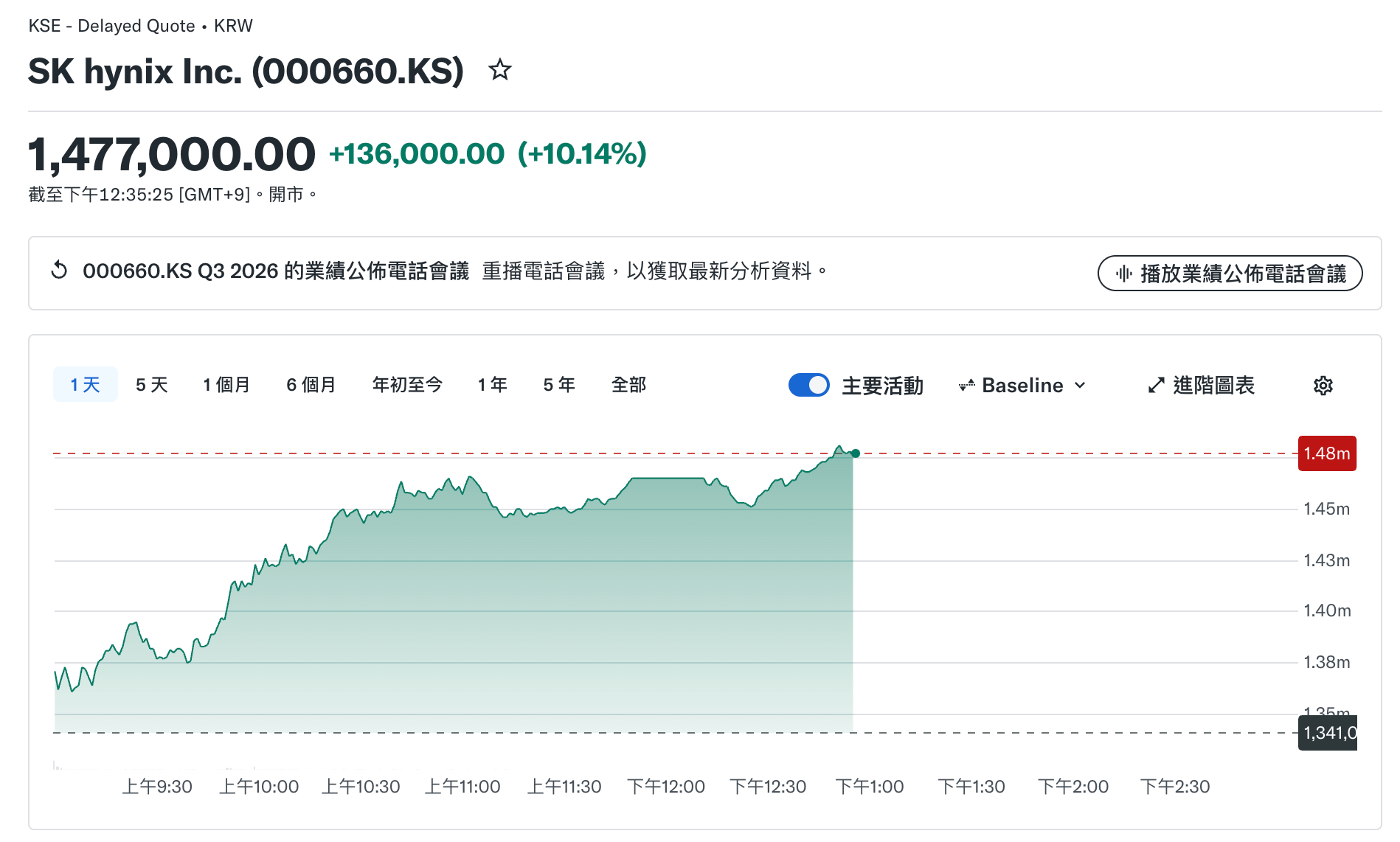
Buoyed by this strong earnings report, SK Hynix's stock price rose accordingly in the Korean market today, lifting memory peers across Asian markets and even the U.S. overnight session, as well as the upstream semiconductor equipment sector. As of 12:35 local time in Korea, SK Hynix was trading at 1,477,000 KRW, up 10.14% on the day.
Blowout Numbers: Revenue Historically Breaks the Trillion-Mark
The earnings report shows that in the third quarter of fiscal year 2026 (July–September), SK Hynix delivered a rather staggering report card.
- Revenue: 104.62 trillion KRW (approximately $78.32 billion), up 32% quarter-over-quarter and surging over 320% year-over-year. Quarterly revenue crossed the 100 trillion KRW threshold for the first time, far exceeding market expectations of around 98 trillion KRW.
- Operating Profit: 83.33 trillion KRW (approximately $62.38 billion), an eye-popping year-over-year surge of over 630%, far above market expectations (around 76.7 trillion KRW). What stunned the market most was the quality of its earnings — the quarterly operating margin approached 80% (up another 4 percentage points quarter-over-quarter), meaning that for every 100 won of chips sold, nearly 80 won converted directly into operating profit. This near-monopoly level of pricing power even surpassed that of most asset-light software giants.
- Net Profit: 39.78 trillion KRW (approximately $29.78 billion), up 216% year-over-year but down 58% quarter-over-quarter, also below market expectations of 60.73 trillion KRW.
- Cash Flow: As of the end of the third quarter, cash and cash equivalents reached 114.5 trillion KRW (approximately $85.72 billion), an increase of 26.5 trillion KRW from the end of the previous quarter, while borrowings decreased by 2.8 trillion KRW to 15.8 trillion KRW. Accordingly, the net cash position expanded to 98.7 trillion KRW (approximately $78.39 billion), with book liquidity at an all-time high.
It should be noted that although the net profit figure fell about one-third short of market expectations, this was not a stall in business fundamentals but rather an "accounting dent" caused by a confluence of multiple non-operating factors. On one hand, the company concentrated this year on realizing substantial investment gains from its stake in Japan's Kioxia, generating large tax provisions; on the other hand, foreign exchange gains and losses, along with tens of trillions of KRW in share buybacks and cancellations, created a sharp offset against net profit for the period on the accounting books.
Beyond HBM: Traditional Memory Price Hikes Are the Real "Profit Multiplier"
In the past, when outsiders mentioned SK Hynix, their first reaction was often "the HBM (High Bandwidth Memory) kingpin behind Nvidia." But in the third quarter, what truly pushed the company's revenue past the 100 trillion KRW milestone was actually the dual-engine resonance of "cutting-edge HBM iteration + across-the-board price hikes on traditional memory."
On the high-end front, HBM's dominance remains solid. With the M15X fab ramping capacity to full by year-end, the higher-premium HBM4 has been fully rolled out for shipment. Management has explicitly provided a timeline — in the fourth quarter of this year, HBM4 will officially overtake HBM3E in both shipment volume and revenue scale, becoming the absolute mainstay.
But in the third quarter, what deserves more attention is actually the explosion in traditional DRAM and NAND flash. Because the three major memory manufacturers (SK Hynix, Samsung, Micron) collectively tilted advanced capacity and capital expenditure toward HBM over the past two years, they inadvertently drained the supply pool for traditional memory. Against the backdrop of AI data centers frantically snapping up server DDR5 and high-capacity 321-layer enterprise SSDs (eSSDs), the supply-demand balance for traditional memory has become completely unhinged.
Data shows that SK Hynix's average selling prices for DRAM and NAND surged approximately 20% and 25% quarter-over-quarter, respectively, in the third quarter. Counterpoint Research commented that while HBM certainly set the tone for high margins, the rapid price increases on the massive volume of traditional DRAM and NAND in a short period were the biggest driver behind this quarter's exponential profit leap.
A Trillion-Won Shareholder Return Plan
Alongside the earnings announcement, SK Hynix officially announced an unprecedented shareholder return initiative, further fueling market sentiment.
SK Hynix declared: For fiscal year 2026, it will return approximately 100 trillion KRW (approximately $74.86 billion) to shareholders in total, fully honoring its commitment to allocate more than 50% of free cash flow (FCF) to shareholder returns. The specific execution plan is divided into two main parts:
- Cash Dividends: The total annual cash dividend will exceed 30 trillion KRW. Of this, the third-quarter dividend alone is 20,000 KRW per share — notably, this includes a special dividend of 10,000 KRW per share. SK Hynix explicitly stated that this is intended to return most of the gains realized this year from its strategic investment in Japan's Kioxia to shareholders without reservation.
- Share Buybacks and Cancellations: The full-year plan calls for over 60 trillion KRW in share buybacks and cancellations. In addition to the 40 trillion KRW buyback previously announced in August and completed last week, the board further approved an additional 20 trillion KRW buyback plan on Wednesday (approximately half for cancellation and the other half reserved for employee performance incentives).
Behind this series of generous moves lies a sophisticated capital strategy calculation. At today's earnings call, SK Hynix CEO Kwak Noh-jung personally confirmed that given the unfavorable financial market environment, the company has decided to suspend the review of a U.S. IPO for its NAND subsidiary Solidigm.
Previously, the market had been concerned that a Solidigm spin-off listing would dilute the parent company's shareholder equity or continue to drag on SK Hynix's cash flow due to capacity expansion. Now, management has decisively halted the IPO on one hand while laying all the Kioxia investment fruits on the table and undertaking large-scale buybacks and cancellations on the other — clearly aiming to send a more positive signal to the market: the company's current cash flow is fully self-sufficient, it does not need to "draw blood" externally through a spin-off listing, and shareholder interests remain the top priority.
Industry Outlook: Supply Shortage to Persist Until 2030
Why does SK Hynix dare to distribute 100 trillion KRW in one go at this point in time? The confidence likely stems from its absolute conviction about the industry's prosperity over the next four years.
In the earnings report, SK Hynix provided a clear judgment on the medium- to long-term industry supply-demand conditions, asserting that the supply shortage will persist until 2030 — AI investment has expanded from a handful of cloud giants to sovereign nations and ordinary enterprises; future market demand will be carried forward by "Physical AI" such as autonomous driving and embodied intelligence; yet the supply side remains constrained by the extremely high technical barriers of advanced processes (such as the 1c node) and the lengthy fab construction cycles. The supply shortage will continue through 2030, and the profit peak is far from arrival.
Against this backdrop, SK Hynix has now signed long-term agreements — typically five years in duration — with 14 core customers globally (mainly large North American cloud service providers, or CSPs). The locked-in long-term supply volume is equivalent to more than 50% of total capacity for 2027 and 2028, and the pricing mechanism has been fully structured with a dynamic framework capable of flexibly reflecting market conditions.
This deep long-term agreement binding is fundamentally rewriting the valuation logic of the memory industry. In the past, memory chips were regarded as a typical strongly cyclical commodity — price surges tended to trigger blind capacity expansion, and once downstream orders were cut, the industry would quickly sink into a price war quagmire. As a result, capital markets tended to assign low valuations at industry profit peaks. But now, through LTA agreements covering more than half of capacity and a "market-linked" dynamic pricing mechanism, SK Hynix is effectively locking in what was originally a highly volatile cyclical buy-and-sell business into a "quasi-customized" business with extremely high certainty — thereby addressing market concerns about whether next year's performance will peak.
At the same time, the confidence from holding long-term agreement orders has directly translated into a new round of capacity expansion calls. SK Hynix explicitly stated that with the official commencement of production at its Yongin Phase 1 fab next year, the company's capital expenditure (CapEx) and infrastructure investment scale next year will jump significantly compared to this year. This perfectly explains today's market linkage effect — the memory leader's real-money capacity expansion plan not only anchors the prosperity cycle for peers like Micron and Samsung but also directly feeds the upstream wafer fabrication equipment, etching and deposition, and advanced packaging supply chains, triggering a collective resonance across the entire semiconductor hardware sector.
However, behind this AI-driven memory frenzy, the temperature gap within the industry is widening further. SK Hynix simultaneously warned at the earnings call that due to persistently rising memory prices and capacity being heavily skewed toward servers, downstream PC and smartphone manufacturers are under significant cost pressure, and end demand for traditional consumer electronics has begun to be suppressed.
On one side, consumer electronics are struggling to test the boundaries of demand amid a wave of price hikes; on the other side, cloud giants are sparing no expense in signing five-year long-term agreements to lock in computing power chips. SK Hynix has proven, with a financial report that breaks the 100 trillion KRW mark for the first time, the absolute pricing power of upstream core hardware in the current AI wave. But standing at a historic high of nearly 80% operating margin, while the market pays for present certainty, its gaze will inevitably turn further ahead — when the upstream has pulled forward expectations for the coming years to the maximum, whether downstream AI commercialization can generate matching cash flow on schedule will be the next key variable determining the quality of this super-cycle.