Three Innovative Exemption TSVs Emerge, OKXICE First to Receive 22 "Objection Votes"


- Key Takeaways:The U.S. SEC's innovation exemption order establishes a five-year legal pathway for tokenized US stock trading, but none of the three notified TSVs are actually operational and all face dual resistance from listed companies' opposition and traditional market skepticism.
- Key Elements:
- The SEC issued the innovation exemption order on September 17, exempting TSVs from "exchange" designation and liquidity institutions from "dealer" designation, valid until September 2031.
- The three TSVs that notified operations are OKXICE, TSV LLC, and Kephas Corp. None have completed their first trade, with the earliest launch time pointing to November.
- OKXICE plans to list stocks of 62 companies, with 22 already opposed, including Microsoft, Alphabet, Goldman Sachs, Broadcom, and others; valid objections will directly block the listing of corresponding targets.
- OKXICE is 50/50 owned by OKX and Intercontinental Exchange; Kephas's parent company Perpetuals.com has operational background in stock tokenization during the FTX era.
- Nasdaq has stated it will not participate in the framework, SIFMA questions the blockchain qualification standards and issuer consent mechanism, and Better Markets calls for withdrawal of the exemption.
- The exemption is a five-year temporary measure, and the SEC reserves the right to modify or shorten the period; the tokenized US stock model still faces significant uncertainty.
原创 |Odaily(@OdailyChina)
Author | Golem(@web3_golem)
On September 17, the U.S. SEC issued an innovation exemption (Release No. 34-106402), valid for five years until September 17, 2031. This document formally establishes a legal channel for tokenized U.S. stock trading.
The order provides two exemptions: qualifying tokenized securities trading venues (TSVs) are exempt from being deemed an "exchange," and institutions providing liquidity to TSVs (Covered Firms) are exempt from being deemed a "dealer." TSVs may operate permissioned-participant AMM liquidity pools on public blockchains to trade tokenized NMS stocks; if the tokenization is initiated by an unaffiliated third party, the listed company has a 30-calendar-day objection period after receiving notice.
According to the SEC's official website, as of now three companies have notified the SEC of their intent to operate a TSV under the innovation exemption: TSV LLC (filed September 23), OKXICE (filed October 4), and Kephas Corp. (filed October 14, operating under the name Perpetuals.com). The SEC also clarified that inclusion on the list does not mean these three companies have met the exemption conditions.
Odaily will introduce the above three TSVs in this article, including ownership structure, trading fees and thresholds, stock lists, and current progress.
OKXICE: Plans to List 63 Stocks, 22 Already Objected
OKXICE is a joint venture owned 50/50 by OKX and Intercontinental Exchange (ICE, parent company of the NYSE), registered in Texas. Its co-chairs include former New York Governor Andrew Cuomo, who is also a member of OKX's global board. OKXICE plans to operate on X Layer, OKX's self-developed Ethereum L2 network, with tokenized stocks paired against USDC, USDG, and USDT.
OKXICE's fees are two-tiered: first, a service fee charged on each transaction, paid in stablecoins and deducted before trading, with the rate not yet announced; second, a liquidity pool fee for each trading pair, distributed to LPs in proportion to their contributions. Traders also need to pay X Layer network gas fees.
OKXICE has KYC requirements. Individual participants must provide their name, date of birth, residential address, nationality, and social security number; institutional participants must provide the institution's legal name, address, organizational structure, registration number, corporate documents, and identity information of key personnel and owners.
OKXICE first published a public notice on October 4, planning to list 63 ticker symbols corresponding to 62 U.S.-listed companies. The objection period runs 30 calendar days from each issuer's receipt of notice, so the earliest it could open is early November; the official website currently marks it as "coming." As of October 24, 22 of the 62 companies had objected, including CoreWeave, Broadcom, Cerebras, Microsoft, Alphabet, Goldman Sachs, Wells Fargo, Arm, and Intuit.
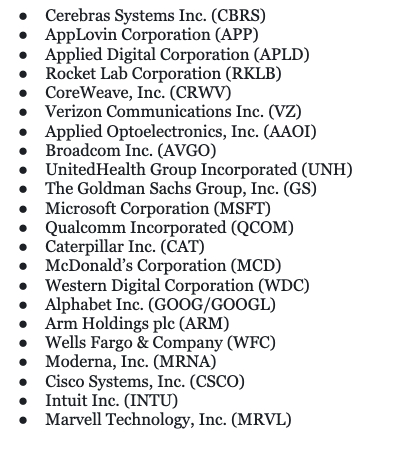
List of listed companies that rejected OKXICE's tokenized stock issuance
Most companies did not explain their reasons for objection, nor did they disclose whether they coordinated their positions with other issuers. Applied Optoelectronics (AAOI) is one of the few companies to publicly explain, stating that this regulatory framework is still brand new, the impact on share price, liquidity, and volatility cannot be predicted, and there are no clear benefits at this stage—"we don't see a clear benefit to AAOI or its shareholders"—and it is concerned that investors might mistakenly believe the tokenized products are endorsed by the company.
Dan Gibbons, a partner at Latham & Watkins who advises listed companies on responding to stock tokenization requests, also said: "Issuers don't want to try something new and concerning without incentives. What we're seeing is a lot of hesitancy."
Under the SEC order, if a company raises a valid objection, the TSV may not list its tokenized stock and must disclose the objection in public filings. With 22 of 62 objecting, OKXICE's first batch of tradable targets has already shrunk by more than a third. This trend may also pose obstacles to OKXICE's operations and the SEC's vision of promoting tokenized U.S. stock trading.
TSV LLC: Respecting Voluntary Issuance by Listed Companies
TSV LLC is jointly owned by Obsidian Systems co-founders Ali Abrar and Ryan Trinkle (50% each) and is registered in Puerto Rico, USA. The platform plans to operate on Canton Network, and Ryan Trinkle also serves on the board of the Canton Foundation.(Odaily note: Canton was the last crypto-native project publicly disclosed as an investment by a16z crypto before it announced its rebrand.)
TSV LLC uses Obsidian's automated market maker software Tradecraft, designed similarly to Uniswap v3, with initial paired assets being USDC and SBC issued by Brale, both issued on Canton Network. Tradecraft also provides TSV LLC with software development, maintenance, technical support, monitoring, and some operational and trading supervision systems. It should also be noted that Tradecraft is itself building a tokenized securities trading platform, Tradecraft ATS—creating a potential competitive relationship between the software vendor and the platform.
On fees, for standard pools, TSV LLC sets a baseline swap fee of 0.30%, of which 0.20% is distributed to liquidity providers and 0.10% to TSV LLC. TSV LLC also has KYC requirements for traders.
TSV LLC first published its notice on September 23. The company stated that operations would begin no earlier than the 31st calendar day from the notice date (October 24), with the final launch expected in early November.
TSV LLC has not published a specific list of tokenized stocks it plans to issue, nor does it have any rejection records. The reason is likely the same as its issuance mechanism: TSV LLC stipulates that tokenized stocks are tokenized only on a voluntary basis by the issuer, through the issuer's transfer agent under the issuer's authorization. Therefore, the "issuer notice + objection" process is not triggered.
Kephas Corporation: Self-Developed L2, Permissioned AMM Liquidity Pools
Kephas Corporation is an indirect wholly-owned U.S. subsidiary of Nasdaq-listed Perpetuals.com (NASDAQ: PDC), registered in Delaware.
Perpetuals.com is headquartered in Tokyo and was formed in January 2026 through the merger of Perpetuals.com Group and EarlyWorks. Co-founder and Co-CEO Patrick Gruhn previously headed FTX Europe. In 2021, Gruhn co-founded the Swiss company Digital Assets AG, which partnered with CM-Equity to provide wrapped tokens of stocks such as Tesla and Coinbase for platforms including Binance and FTX, and was later acquired by FTX Group. As such, Perpetuals.com is the earliest company to begin stock tokenization-related business and has a certain operational foundation(Odaily note: the earliest stock tokens only provided price exposure and did not include voting rights).
Kephas will operate on Kronos X Public, Perpetuals.com's self-developed Ethereum L2 network, with initial tokenized stocks paired against USDC. On fees, each swap is charged 0.30%, of which 0.05% goes to the platform and 0.25% remains in the pool for distribution to LPs. Investors must complete KYC to participate in trading.
Although Kronos X Public as an L2 is itself permissionless, the TSV's AMM trading pools are permissioned—only KYC-verified wallets can participate in trading.
Perpetuals.com first published its notice on October 14 and has not yet begun operations. The company says trading could potentially launch in mid-November, but it still needs to complete market data integration, compliance preparation, and smart contract security audits. As of now, Perpetuals.com has neither published a list of tokenized stocks it plans to list nor received any issuer objections.
Closing Remarks
Currently, none of the three TSVs has executed a single actual trade. OKXICE's website still marks it as "coming," TSV LLC's earliest opening date of October 24 has already passed, and Kephas has set its timeline for mid-November, with market data integration, compliance preparation, and smart contract security audits still to be completed first.
And the resistance they face does not come only from issuers—greater uncertainty comes from the traditional market side. Nasdaq has separately stated that it will not allow its stocks to be tokenized under this framework—TSVs neither display real-time best prices nor report trades to consolidated market data systems. The Securities Industry and Financial Markets Association (SIFMA) has asked the SEC to clarify which blockchains qualify and questioned whether stock tokenization should require issuer consent in advance rather than leaving it to issuers to file objections themselves; Better Markets has directly called for withdrawing this exemption and pursuing formal rulemaking instead.
This exemption itself is a five-year temporary measure, and the SEC retains the power to modify or shorten the period. Whether tokenized U.S. stocks can work remains unclear for now.