




Gemini 4.0 is so powerful it's "flooding the feed"—is Google's AI counterattack finally here?


- Core takeaway: Google's key upside isn't whether Gemini reclaims the top spot, but that its full-stack AI architecture (app entry points, Cloud, TPU) has begun to mesh and work in concert—the model only needs to return to the top tier to drive the distribution machine.
- Key points:
- Gemini 4.0 has not yet been officially released, and blind-test results should be treated as rumors; however, the July earnings call will confirm that "the most ambitious pretraining" has been initiated.
- Gemini 3.8 Flash scored 73.7% on DeepSWE v1.1, close to Claude Opus 5's 74.0%, positioned as lightweight and low-cost.
- The Gemini App surpassed 1 billion monthly active users in August, and the underlying model for Apple's new Siri was jointly developed by Apple and Google based on Gemini.
- Google Search revenue grew 17% year-over-year in Q2, AI Mode has begun testing native ads, and the "AI kills search" thesis has yet to materialize.
- Google Cloud revenue surged 82% in Q2 to $24.8 billion, with unfulfilled contract backlog exceeding $510 billion.
- Anthropic has secured up to 1 million TPUs and will receive approximately 3.5GW of next-generation TPU compute through Broadcom starting in 2027.
- TPUs are shifting from internal use to external compute products, with the Broadcom partnership extending to 2031, and Marvell also entering the custom chip ecosystem.
This weekend, the AI world is hyping Google again.
The star of the show is "Gemini 4.0," which hasn't been officially released yet but is suspected to be running secretly on platforms like Arena. Various blind-test screenshots and user feedback are spreading like wildfire on social media, with some even proclaiming "Google is back."
But let's pour a little cold water on this first.
As of now, Google has not officially released Gemini 4. It did confirm during its July earnings call that it has begun what it calls its "most ambitious pretraining effort to date." In other words, Gemini 4 exists, but the various "benchmark results" circulating over the weekend are best treated as rumors for now.
That said, to be fair, even if we set aside all the Gemini 4 rumors entirely, Google does seem to have reached a point where it's worth taking another look.
Because beyond the model, its other cards are improving at the same time.
1. Gemini Doesn't Need to Be "the Best in the World" — Just Back in the Top Tier
For the past six months or so, Google's most awkward problem has been that it always seems a beat behind in the eyes of the public.
OpenAI and Anthropic drop a bombshell every few months (and today it's the Goldbach Conjecture again), top open-source models in China are racing ahead at breakneck speed, and even DeepSeek's release cadence has visibly accelerated.
Meanwhile, Google seems busy every day, but what it keeps serving up is yet another Flash-series model.
This has led to a situation where Gemini isn't even in a hurry to talk about reclaiming the top spot — it first needs to prove that it still has what it takes to remain in the frontier's top tier.
Recently, there have indeed been some early signs.
Gemini 3.8 Flash, released in early September, scored 73.7% on DeepSWE v1.1 in Google's official benchmarks — very close to Claude Opus 5's 74.0%, and this is just a Flash-tier model focused on being lightweight and low-cost.
Google these days is indeed obsessed with using extreme speed to crush the latency and per-inference cost of frontier intelligence. For Google, this matters even more than simply topping a model leaderboard once, and it reveals the biggest divide between it and model startups:
OpenAI and Anthropic need to rely on their models themselves to win users, developers, and enterprise customers, whereas Google already has Search, Android, Chrome, YouTube, Workspace, and Cloud.
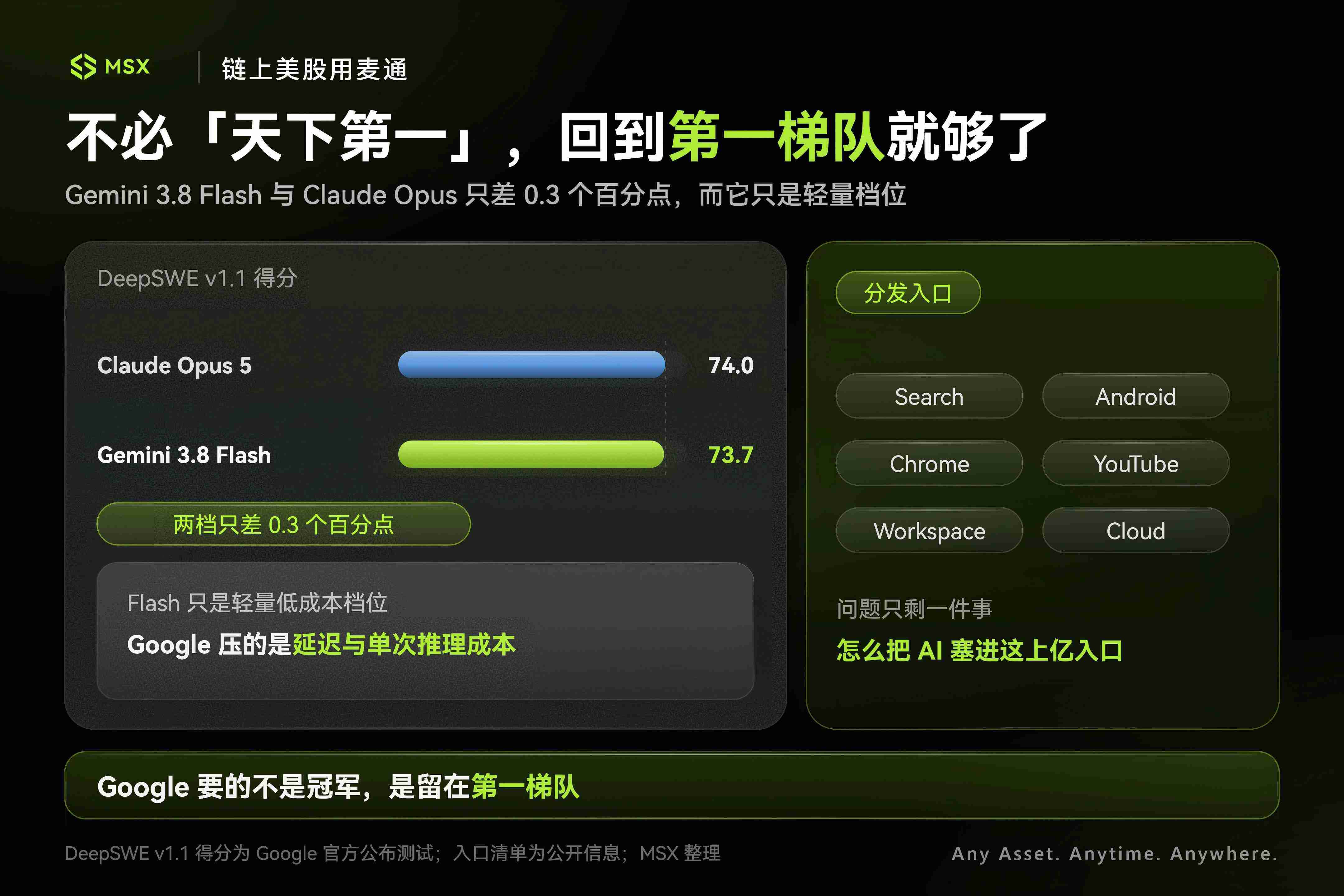
Put simply, Google doesn't need Gemini to always be number one. As long as the model is back in the top tier, the massive distribution machine behind it — one that covers virtually the entire lifecycle of human digital life — can start spinning.
And that's indeed what's happening. The Gemini App's monthly active users crossed the 1 billion mark in August, with over 100 million on iOS alone, and Android's system-level capabilities can now execute actions across more than 40 commonly used apps.
Recently, two more new entry points worth watching have emerged:
- One is Apple: The Apple Foundation Models powering the new Siri are explicitly being jointly developed by Apple and Google based on Gemini. Whether inference ultimately runs on-device or on Apple's private cloud, the fact that Apple is entrusting the core entry point of its 2 billion active devices to Google for technical backing is itself the most significant vote of confidence for Gemini;
- The other is home hardware: Google Home recently began opening its MCP Server to third-party Agents, allowing external agents like Claude and OpenClaw to directly control home cameras, lights, and thermostats. This is quite interesting — Google isn't building a walled garden with a "closed ecosystem." No matter who the most popular Agent is in the future, if it wants to actually control devices in the real world, it will ultimately have to go through Google's interface;
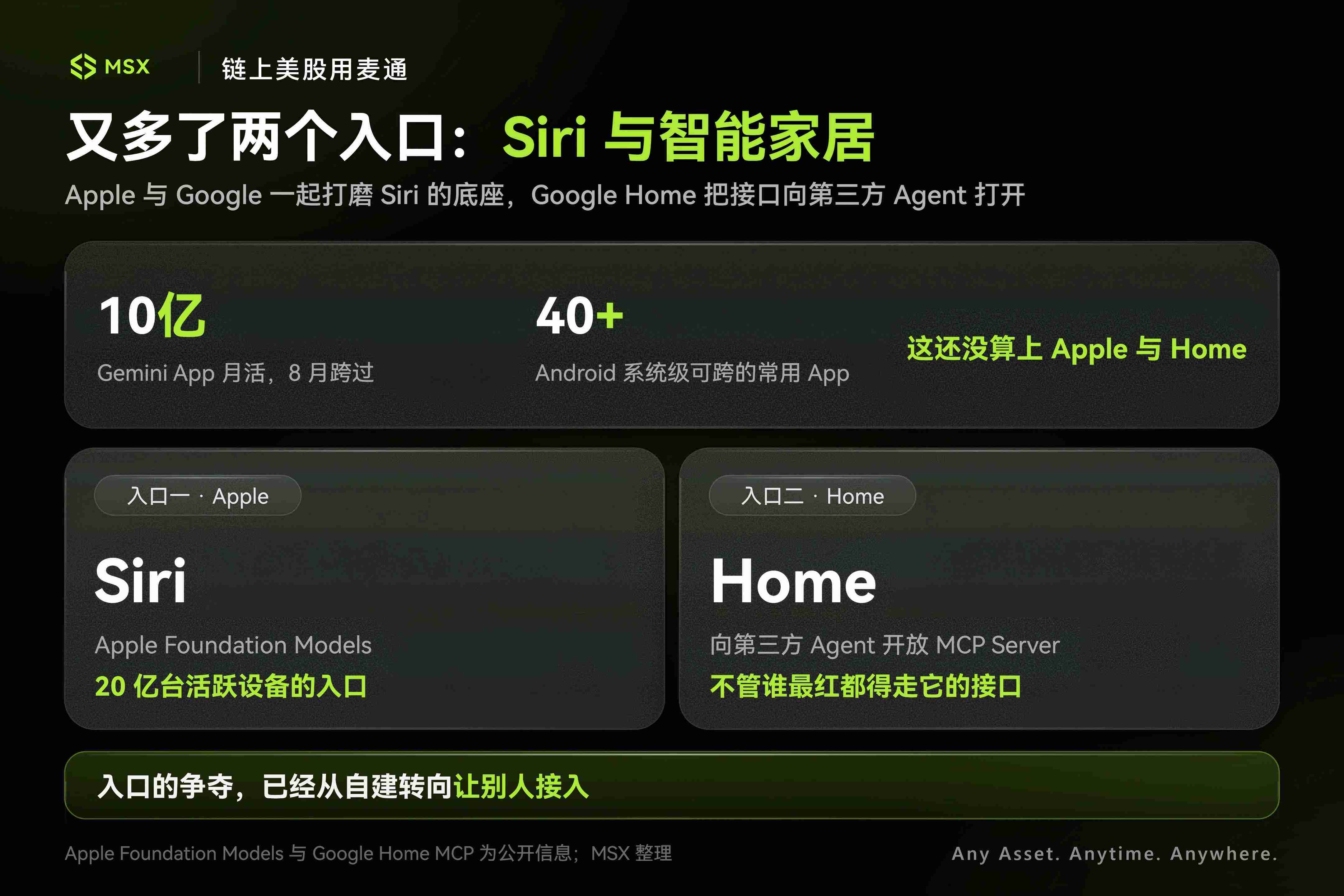
Overall, with Android in phones, Chrome in browsers, Search as an entry point, Workspace for productivity, and now even iPhone and smart homes showing traces of Gemini or Google AI infrastructure.
So for Google today, the only question left is: with hundreds of millions of users already within Google's entry points, how to integrate AI step by step.
2. AI Hasn't Killed Search — It's Helping Google Collect Tolls
For the past two years, the heaviest stone weighing on Alphabet's valuation has been "Will AI kill search?"
When ChatGPT first appeared, the logic seemed quite straightforward: If users can just ask a chatbot directly, who's going to scroll through search results and click on ads? And what happens to Google's most profitable search advertising business?
But at least so far, the financial data hasn't followed that script.
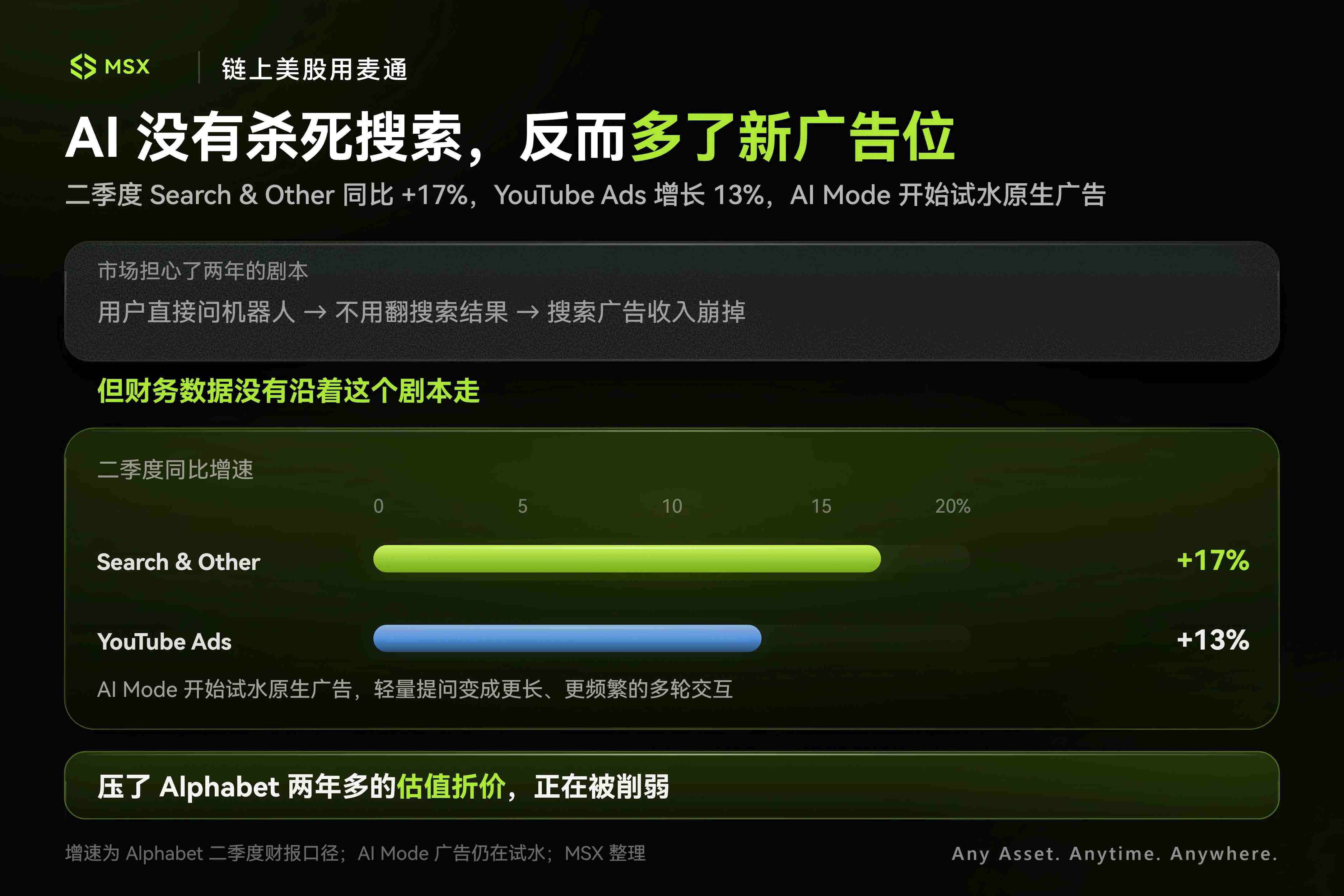
Alphabet's Q2 Google Search & Other revenue grew 17% year-over-year, YouTube Ads grew 13%. Not only has the original cash cow not been swept away, but Google is continuing to push AI Overviews and the deeply interactive AI Mode to more users, and has already begun testing native ads within AI Mode.
After all the panic, everyone found that AI hasn't made search disappear — it has simply transformed what was originally a lightweight search behavior into longer, more frequent multi-turn interactions, while also creating new ad inventory.
If over the next few quarters, AI Mode usage continues to grow while search revenue still maintains double-digit growth, then the valuation discount that has weighed on Alphabet for over two years — "AI will destroy Google's search business model" — will become increasingly untenable.
Beyond that, if search is about defending old territory, then Cloud is pure offense.
In Q2, Google Cloud revenue surged 82% year-over-year to $24.8 billion. Its backlog of unfulfilled contracts exceeds $510 billion, more than half of which will be recognized within the next two years. Management even stated outright that the problem now is that compute supply can no longer keep up with the surging model demand from enterprise customers.
There's also an interesting knock-on logic here.
In mid-September, Anthropic released Claude Docs and Slides, penetrating deeply into everyday office scenarios. On the surface, this looks like Claude going after Google Docs' and Microsoft Office's business. But in reality, the deeper the office interaction and the more intensive the API calls, the more token consumption expands exponentially.
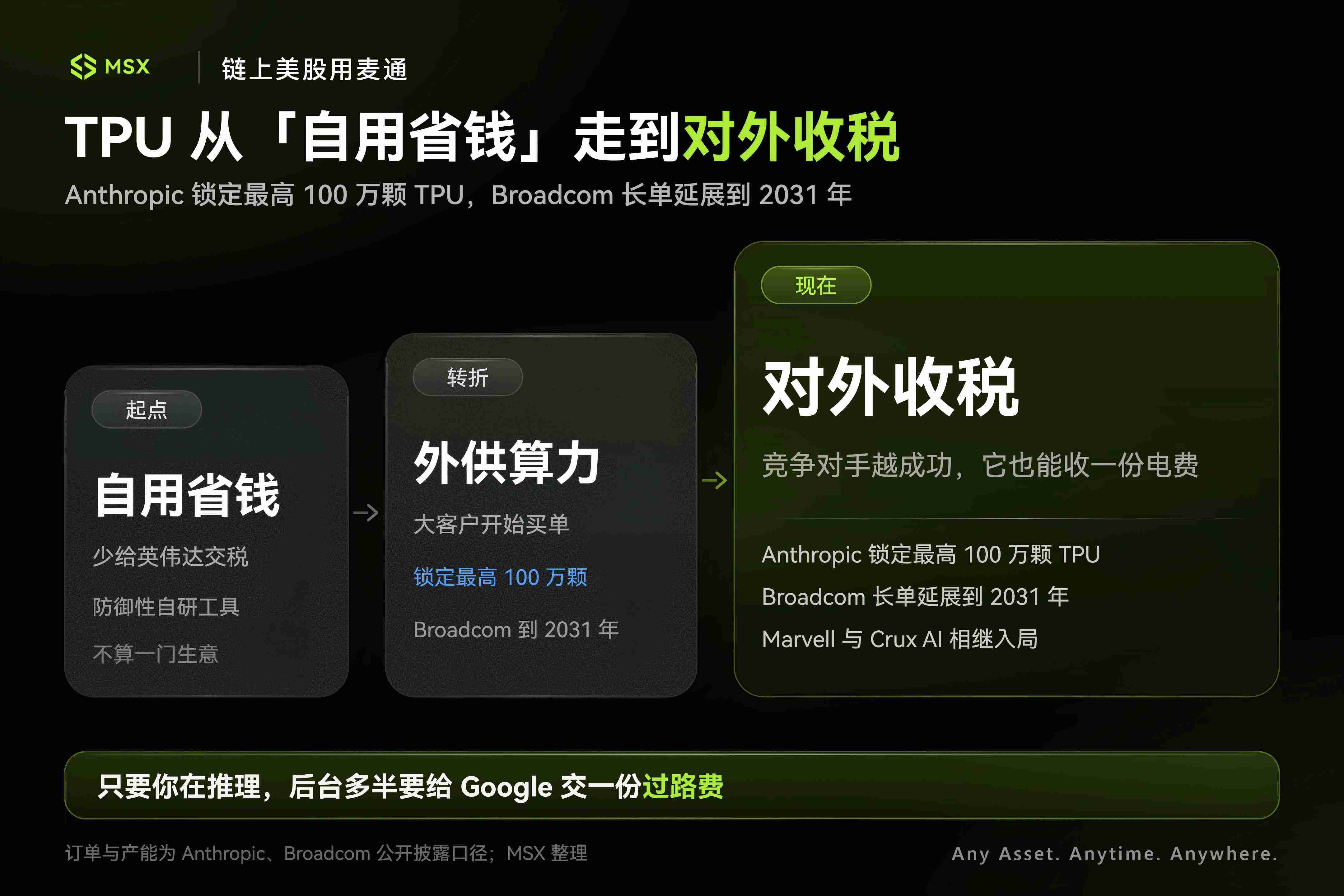
And Anthropic happens to be one of Google TPU's most important external buyers — according to previously disclosed information, Anthropic has secured up to 1 million TPUs, corresponding to tens of billions of dollars in investment and over 1GW of compute. This year, Broadcom further disclosed (extended reading: "Broadcom Can't Hide: AI Money Is Flowing Beyond GPUs") that starting in 2027, Anthropic will obtain approximately 3.5GW of next-generation TPU AI compute through Broadcom.
Of course, we can't simply equate this to "every new Claude Docs user means Google immediately sells a few more TPUs."
Anthropic itself pursues a multi-cloud, multi-chip strategy, using Google TPU, Amazon Trainium, and Nvidia GPU alike, and AWS remains a very important cloud partner for it.
But the broader direction isn't hard to understand.
As AI moves from chat into Coding, documents, PPTs, CRM, and enterprise Agents, model usage time and inference counts will only continue to rise. For Alphabet, which owns both Google Cloud and TPU, it doesn't necessarily need Gemini to kill all its competitors.
Sometimes, the more successful its competitors are, the more Google can collect a share of "tolls" along the way. This is also why Google recently dared to invest €13 billion in Finland to build Europe's largest data center, while locking in long-term power resources in advance.

3. Google's "Full-Stack AI" Is Revealing Its Hand
Pulling these threads together, you'll notice that the market's lens for observing Google is undergoing a subtle shift.
If Gemini 4.0 finally ships and performs strongly, that will of course be directly reflected in the stock price. But Google's bigger bullish thesis is that its Full Stack architecture is finally clicking together seamlessly:
- Applications and endpoints: from Search, Chrome, YouTube, and Android to the Siri and Home ecosystems;
- Enterprise platform: a rapidly growing Google Cloud;
- Underlying hardcore assets: self-developed TPUs, proprietary networks, hyperscale data centers, and self-secured energy supply;
And among these, I think the most easily underestimated card is still the TPU.
In the past, people understood TPUs more as something Google used internally. Put bluntly: making its own chips to pay Nvidia a little less.
But that's no longer the story at all. Anthropic has begun using TPUs at scale; Broadcom and Google's long-term partnership has been extended to 2031, with subsequent generations of TPUs and supporting networks continuing to be built; Marvell has also entered Google's custom AI chip ecosystem, taking on inference chips, interfaces, and networking.
Add to that independent compute platforms like Crux AI, which have raised massive funding and directly adopt Google TPUs, and the TPU has clearly shifted from "a chip Google uses to save money" toward "a product Google can sell compute on."
The impact of this reshaping is all-encompassing.
First, naturally, the upstream custom chip and networking suppliers (like AVGO and MRVL) have become the most certain beneficiaries.
As for Nvidia, the overall pie is still growing, but Google has TPUs, Amazon has Trainium, and other hyperscalers are also ramping up their own ASIC development. The inference market of the future is destined never to have just one winner.
Looking further out, Google also has Waymo. This business won't determine Alphabet's EPS next quarter, but if Robotaxi truly expands from a few U.S. cities to overseas markets like Tokyo and Singapore, it will eventually go from being "thrown in for free in the valuation model" to an asset that needs to be accounted for separately.
Even the antitrust risk that has been hanging over Google hasn't reached the worst-case scenario recently.
So at this juncture, while everyone over the weekend is speculating about whether Gemini 4.0 can return to the "big three," for Google as it stands today:
Does Gemini really still need to be "the best in the world"?
The Gemini App has over 1 billion monthly active users, Search is still growing, Cloud is booming, and TPUs are already being sold externally; Apple is starting to use Gemini's technology, third-party Agents are entering Google Home, and underneath it all, Google is still building data centers, locking in power, and laying down its own compute.
Looking at it this way, Google's insistence on serving up Flash models over the past year or two doesn't seem entirely unreasonable. It just needs to make its models as strong, as fast, and as cheap as possible, then stuff them into its existing products, entry points, and infrastructure. That's enough.
Final Thoughts
Cards have to be turned over one by one. Whether Gemini 4 is a thoroughbred or a donkey will soon be clear.
This AI battle, for Google, has long since ceased to be just about "whether Gemini can fight."
Once the model catches back up, the question is whether the massive distribution machine and money printer behind Google — made up of Search, Android, Chrome, YouTube, Cloud, and TPU — can really roar to life.
That's the biggest thing to watch, and it holds enormous imaginative (all-in) potential.
FollowOfficial Xfor U.S. stock updates
JoinOfficial Communityto discuss hot topics