




ETH HODLers Who Won't Sell: Should You Choose Staking for Yield, or Collateralized Lending?


- Core Viewpoint: Native Staking and DeFi lending address two fundamentally different asset needs—the former capitalizes long-term holding time to generate continuous yield, while the latter unlocks liquidity without giving up your position. The two are complementary tools, not substitutes.
- Key Elements:
- Native Staking yield comes from Ethereum protocol rewards, not borrower interest or DeFi token subsidies. Its essence is converting a committed holding period into a productive asset.
- After the Pectra upgrade, the maximum effective balance for 0x02 validators increased from 32 ETH to 2048 ETH, and rewards can be compounded in 1 ETH increments, giving native staking full compounding capability.
- Lending uses ETH as collateral to borrow stablecoins, preserving your position while gaining liquidity—but it introduces debt, interest rate, and price-driven liquidation risks.
- The core risks of Staking are validator operation, slashing, and exit liquidity; lending additionally bears liquidation risk triggered by a declining Health Factor.
- Looping stETH through staking and lending can stack both yields, but the tighter the capital efficiency, the longer the risk transmission chain.
- Non-custodial wallet tools are productizing node operations, allowing users to retain private keys and withdrawal credentials while lowering the barrier to Native Staking participation.
After holding ETH, what else can you do with it?
A few years ago, the answer to this question was so simple it was almost monotonous: move it to a cold wallet, leave it there, and wait for the bull market.
But today, with Ethereum having completed its PoS transition and on-chain lending markets running smoothly, the ETH in your hands clearly isn't content to just sit idle. The most common options are either Native Staking to earn protocol staking rewards, or depositing ETH into lending markets to borrow stablecoins, extracting liquidity without giving up your position.
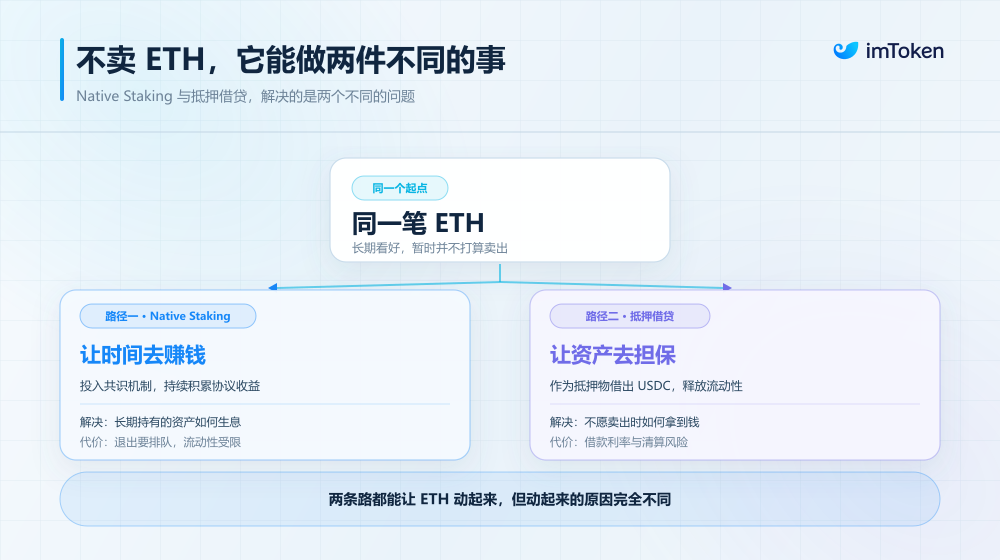
On the surface, both approaches are about "putting the ETH sitting in your wallet to work," but if you only compare whose APR is higher, it's easy to overlook their most fundamental difference:
Native Staking solves the problem of how long-term held assets can continuously generate yield, while lending solves the problem of how to unlock liquidity and capital efficiency when you're unwilling to sell your assets.
What they correspond to, in fact, are two completely different asset needs.
1. Native Staking: Turning Long Holding Periods into Productive Capital
Let's start with the purest scenario.
Suppose you hold 32 (or more) ETH and are almost certain you won't touch it for the next two to three years. At the spot level, you've accepted short-term price volatility, and the only variable you can still work with is the holding time you've committed to.
Native Staking does exactly this — it capitalizes on that time.
As is well known, after Ethereum entered the PoS era, validators participate in network consensus by staking ETH, taking on responsibilities such as attestation and block proposal, and earning corresponding rewards according to protocol rules.
In other words, this yield doesn't come from another borrower's interest, nor from tokens issued as extra incentives by some DeFi protocol — it comes directly from the protocol rewards Ethereum provides to the underlying security maintainers.
Therefore, for long-term holders, the logic of Native Staking is actually quite straightforward — since this ETH wasn't going to be moved anyway, you can let it participate in network operations during the holding period and continuously accumulate more ETH.
And after the Pectra upgrade, this path has further evolved (further reading: "When 8 Million ETH Start 'Moving House': In the Post-Pectra Era, Is Staking Undergoing a Structural Transformation?").
The new 0x02 Compounding Validator raised the maximum effective balance of a single validator from 32 ETH to 2048 ETH. Rewards exceeding 32 ETH can continue to be counted into the effective balance in units of 1 ETH and participate in subsequent yield calculations, giving native staking a more complete compounding capability.
But Native Staking also has a very obvious characteristic — it solves the yield problem, but doesn't directly solve the liquidity problem.
Once ETH enters the validator system, it first and foremost takes on the role of network security capital. New validators need to go through an activation queue, and full exits also require waiting through the exit process depending on network conditions. So it's not like a wallet balance that can be spent, traded, or invested elsewhere at any time (further reading: "Why Do You Have to Wait in Line for a Month to Participate in Ethereum Native Staking Now?").
Of course, the emergence of Liquid Staking partially solves this problem. For example, after staking ETH through Lido, users receive stETH and can still transfer, lend, or participate in other DeFi activities. But from an asset structure perspective, it also adds a layer of LST protocol and token on top of the simplest Native Staking.
So if we abstract the problem further, what Native Staking is best suited to solve is: you have a chunk of ETH you're certain to hold long-term — how do you make that holding time itself generate value?
2. Lending: Preserving Your Position While Drawing on Purchasing Power in Advance
Lending solves an entirely different real-world problem.
You're equally bullish on ETH and absolutely don't want to sell, but suddenly need cash for something, or a highly attractive new opportunity appears on-chain.
Dumping spot is of course the easiest option, but the cost is completely giving up your position. If ETH then enters a major rally, it's very difficult to buy back the sold spot position at a low cost.
DeFi lending offers another approach — don't sell your ETH; use it as collateral, over-collateralize, and borrow the stablecoins you need.
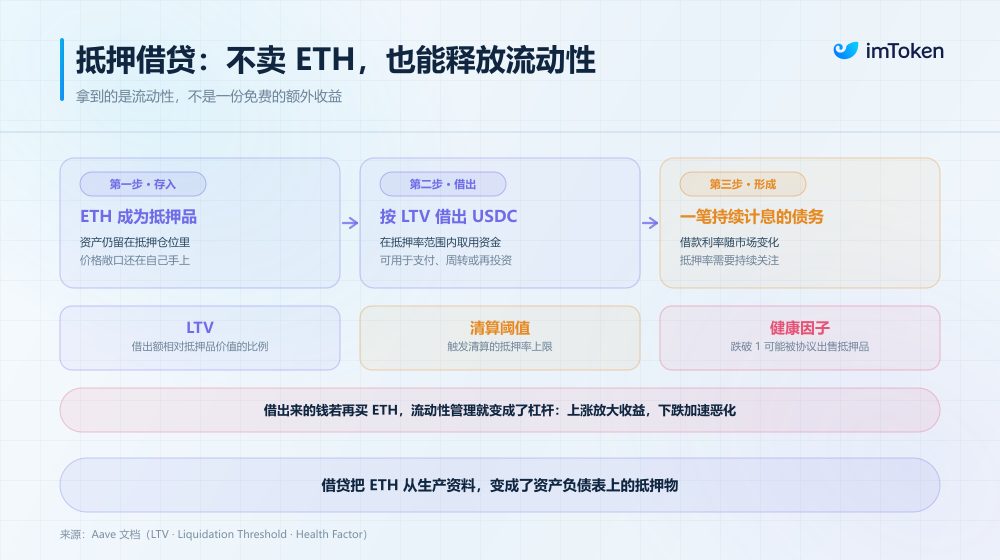
Taking over-collateralized lending protocols like Aave as an example, users can deposit eligible assets as collateral and borrow other assets within a certain LTV range. The borrowed funds can be used for payments, investments, or other capital needs, while the original ETH remains as collateral.
At this point, ETH's role has completely changed.
In Native Staking, ETH is "productive capital," generating protocol yield by participating in network consensus; while in lending, ETH is more like "collateral on the balance sheet," whose greatest value is helping holders obtain new liquidity.
So strictly speaking, lending is not a free "extra yield."
After borrowing assets, users incur a debt and must bear continuously changing borrowing rates. At the same time, if ETH's price drops significantly, the collateral position's Health Factor will also decline, and once liquidation conditions are met, some collateral assets may be sold by the protocol.
Aave therefore requires borrowers to continuously monitor LTV, Liquidation Threshold, and Health Factor. Even more so, if the borrowed stablecoins are used to buy more ETH, things go a step further, turning what was simple liquidity management into leverage — when ETH rises, it amplifies gains; when ETH falls, it accelerates collateral ratio deterioration.
This is also a very important risk boundary between lending and Native Staking. The core risks of staking come from validator operation, slashing, and exit liquidity; collateralized lending additionally introduces debt, interest rates, and market-price-driven liquidation risk.
Therefore, for long-term holders, what lending truly solves is: when you don't want to sell your ETH but need to use funds, can you unlock the liquidity of this portion of assets?
The answer is yes.
It's just that this liquidity isn't free.
3. One Earns "Money from Time," the Other Exchanges "Money for Liquidity"
Looking at it from this angle, Native Staking and lending don't have an absolute substitutive relationship. In actual position management, they're more like complementary tools that address pain points at different stages:
- Core unmoved positions: the bulk of spot holdings you don't plan to liquidate for years — Native Staking is the most natural home, introducing no external debt, bearing no market liquidation, and simply earning Ethereum's network dividends;
- Tactical flexible funds: the portion with clear short-term cash flow needs and willingness to bear monitoring costs — lending provides a buffer zone without selling spot;
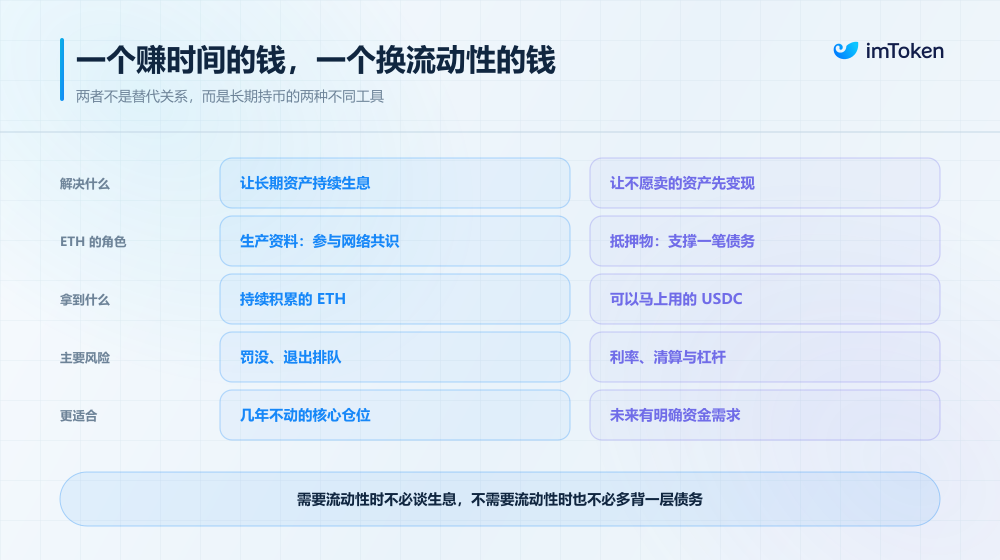
Simply put, when you don't need liquidity, let ETH go to work in the factory; when you do need liquidity, pull ETH out to act as guarantor. The former improves yield efficiency during the long-term holding phase, while the latter improves capital efficiency on the balance sheet.
Of course, DeFi also has various fancy operations that twist the two together, such as swapping ETH for stETH and then looping it through staking and lending, trying to get the best of both worlds. But the tighter the capital efficiency, the longer the chain of risk exposure and transmission.
But honestly, for those planning to hold long-term, "one less layer of smart contract risk" is often worth more than "two extra points of yield on paper."
In reality, the reason many people don't choose Native Staking is actually that they find it troublesome. After all, the barrier to running your own validator node is too high for most people — configuring machines, setting up clients, preventing downtime penalties. Even in the Pectra era, operational costs remain. And if you take the easy route of handing your coins to a centralized exchange, that violates the basic principle of non-custodial ownership.
This is precisely the gap that mature wallet tools are filling — they can further productize what used to be complex validator operations.
Taking imToken's non-custodial Native Staking as an example, you can directly spin up an independent validator starting from 32 ETH, with support for both compounding (0x02) and auto-withdrawal modes. The underlying hardware deployment, node operations, and round-the-clock monitoring are handled by professional infrastructure, but the most critical private key ownership and Withdrawal Credentials always remain in the user's own hands.
In other words, it compresses an entire set of originally geeky, cumbersome node management processes into an intuitive, controllable native product experience.
Final Thoughts
This is perhaps a question increasingly worth reconsidering when holding ETH long-term today. In the past, what we cared about most was "should I keep holding ETH?"
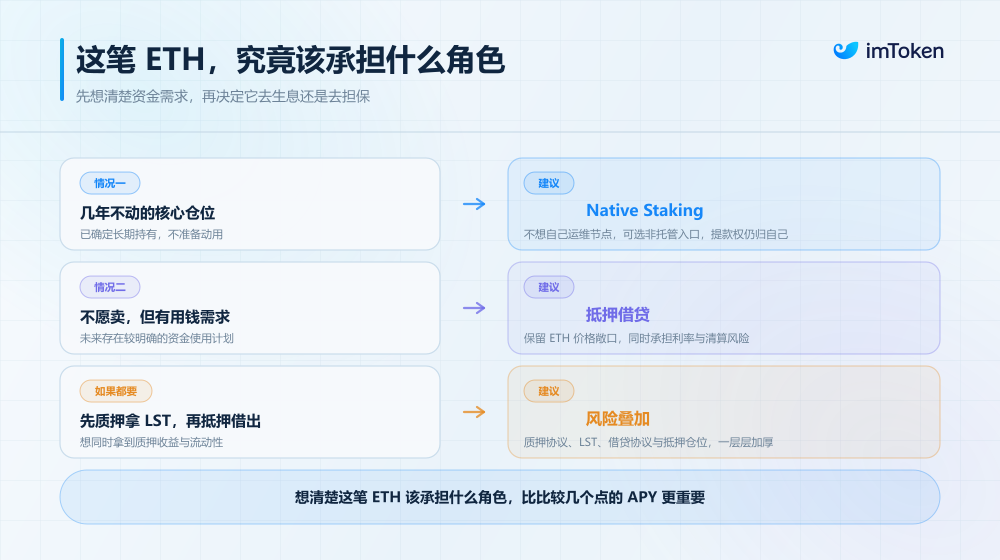
But as staking, lending, and various on-chain financial tools gradually mature, the question becomes since you plan to hold long-term, what role should this ETH actually play?
Should it become a long-term asset that continuously generates protocol yield, or a collateral asset that can be mobilized for funds at any time?
Thinking this through may be more important than simply comparing a few percentage points of APR.