Cerebras 2026年Q3财报前瞻:2.15亿营收难掩毛利下滑


Overview
Cerebras Systems, a developer of wafer-scale AI chips (Nasdaq: CBRS), will release its third-quarter 2026 financial results after the U.S. market close on Thursday, November 12, 2026, Eastern Standard Time, and will host a conference call at 06:00 a.m. Singapore Time on Friday, November 13 (17:00 Eastern Standard Time on November 12). The company's official guidance for the quarter is core non-GAAP revenue of $214 million to $216 million (Wall Street consensus is $215.82 million, up 2.0% to 2.9% quarter-over-quarter from $209.87 million in Q2), with core gross margin expected to fall to a year-low of 38% to 40%, and a consensus loss per share of $0.13. What will determine whether CBRS can stabilize after a three-month decline of more than 58% (it rebounded 7.92% to $101.08 at the November 11 close) is whether management can confirm that the 38% to 40% gross margin is indeed a temporary bottom caused by "renting back customers' compute," and whether it can drive fourth-quarter core revenue to an implied $263 million to $275 million through the launch of its own CS-3 and CS-4 systems, thereby delivering on full-year revenue guidance of $880 million to $890 million and a full-year gross margin target of 41% to 43%.
Key Takeaways
Tonight's after-hours third-quarter earnings report is the most critical test of earnings quality Cerebras has faced since its $6.4 billion initial public offering (IPO) in May 2026 at an issue price of $185. Looking back at the second-quarter report released on August 12, although core total revenue grew 103% year-over-year to a record $209.9 million (including core cloud services revenue surging 287% year-over-year to $127.7 million, surpassing hardware sales for the first time), and remaining performance obligations (RPO) at period-end reached as high as $25.4 billion, the IPO triggered the vesting of massive stock-based compensation, resulting in a GAAP loss per share of $2.98. Combined with management's reduction of third-quarter core gross margin guidance to 38% to 40% (below 46.5% in Q1 and 40.6% in Q2), this previously triggered the after-hours selloff reviewed in Why Cerebras Stock Dropped 16% After Q2 Earnings: AI Growth Was Not Enough. Over the past month, the stock has faced multiple external pressures: at the end of September, research reports circulated that OpenAI had shifted some ultra-fast mode workloads to competitor chips; on October 28, a short seller questioned its wafer lifespan and changes to equipment depreciation periods; and on November 10, the IPO lock-up period expired, pushing the stock at one point to a 52-week low of $77.84. With $8.6 billion in abundant cash reserves and more than $410 million in quarterly capital expenditure on its own cloud, tonight the market will focus on order conversion, Abu Dhabi customer concentration, and the path for fourth-quarter gross margin recovery.
Earnings Release Timing, Standard Time Conversion, and Derivation of Core Financial Guidance
According to the company's official announcement of the Q3 earnings date released on October 20, 2026, and its investor relations calendar, Cerebras will release its third-quarter financial report for the period ended September 30, 2026, after the close of regular Nasdaq trading on Thursday, November 12, 2026 (16:00 Eastern Standard Time / 21:00 UTC), and will hold a webcast audio conference call at 17:00 Eastern Standard Time that day (14:00 Pacific Standard Time).
For cross-time-zone investors in Asia and Europe, locking in the time of this conference call must account for the one-hour time shift caused by the switch to standard time in North America. The United States ended daylight saving time on the first Sunday of November 2026 (November 1) and returned to standard time, with Eastern Time switching from daylight saving time (EDT, UTC-4) to standard time (EST, UTC-5). Therefore, although the conference call is fixed at 17:00 Eastern Time in the United States, when the second-quarter earnings report was released on August 12 this year, it corresponded to 21:00 UTC and 05:00 the next morning in Singapore and Beijing time (UTC+8). In contrast, this third-quarter conference call on November 12 will be postponed by one hour, corresponding to 22:00 UTC and 06:00 a.m. Singapore Time on Friday, November 13. Readers who follow the old August timing without adjusting their clocks will arrive one hour early.
To accurately measure the thresholds for a beat or miss in tonight's earnings report, it is first necessary to clarify the difference between the "GAAP basis" and the "Core (core non-GAAP) basis" in Cerebras' financial reports: because the company granted customer warrants tied to purchases to strategic large customers such as OpenAI and Abu Dhabi's G42 (non-current customer warrant assets reached $960.6 million as of June 30), under GAAP accounting standards, the amortization of the fair value of customer warrants must be deducted directly from operating revenue as a "contra-revenue" item; while the "Core" basis used by management for guidance adds back non-cash customer warrant deductions, pass-through revenue collected and paid on behalf of others, and stock-based compensation expenses. Combining the official first-quarter financial report, the official second-quarter financial report, and Zacks' Q3 consensus estimates, the table below fully derives the trajectory of the first three quarters and the implied sprint requirements for the fourth quarter.
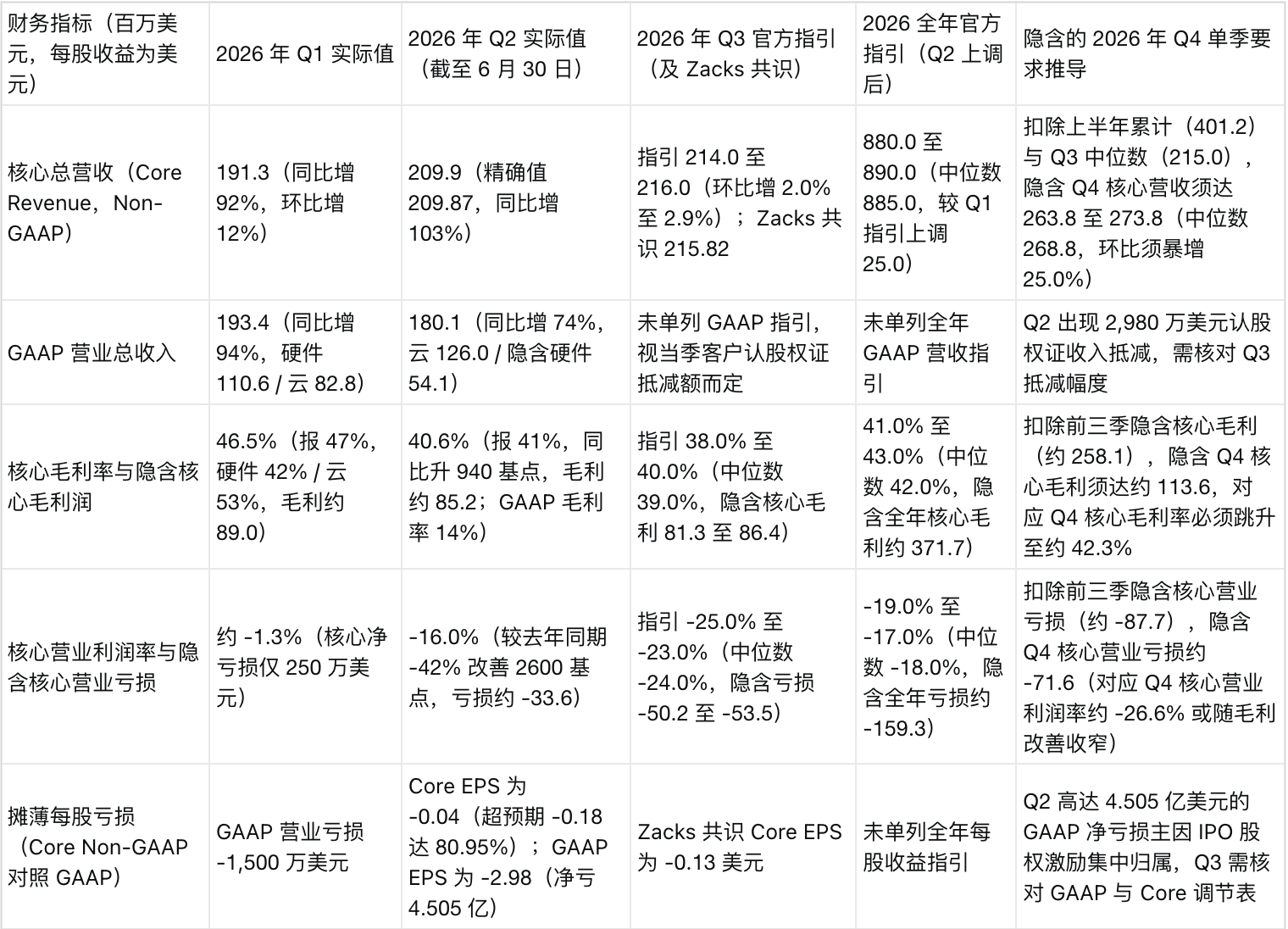
Full-year earnings per share guidance was not separately provided
Q2's GAAP net loss of $450.5 million was mainly due to concentrated vesting of IPO-related stock-based compensation; Q3 requires verification of the GAAP-to-Core reconciliation table
From the arithmetic derivation in the table above, two of the most critical expectation benchmarks for tonight can be distilled:
First, third-quarter revenue guidance ($214 million to $216 million) is only $4.13 million to $6.13 million higher than Q2's $209.87 million (quarter-over-quarter growth of only 2.0% to 2.9%), essentially flat; while to meet the full-year core revenue guidance of $880 million to $890 million just raised in August, fourth-quarter core revenue must jump from about $215 million in Q3 to $263.8 million to $273.8 million (median $268.8 million, implying quarter-over-quarter growth of 25.0%).
Second, to achieve full-year core gross margin guidance of 41.0% to 43.0% (median 42.0%), after achieving 46.5% in Q1, 40.6% in Q2, and guidance of 38.0% to 40.0% (median 39.0%) in Q3, fourth-quarter core gross margin must immediately rebound to above 42.3%. This means the fourth-quarter quarterly guidance management gives tonight is far more important than the small expectation gap for the third quarter itself.
Orders, Contract Value, and Revenue Recognized in the Quarter: Breaking Down the $25.4 Billion Backlog and Major Customer Structure
When evaluating Cerebras' commercialization progress, investors must strictly distinguish between the "framework contract value" of tens of billions of dollars in headlines, the "remaining performance obligations (RPO)" in balance sheet notes, and the "recognized revenue" on the quarterly income statement, and examine the evolution of its major customer concentration.
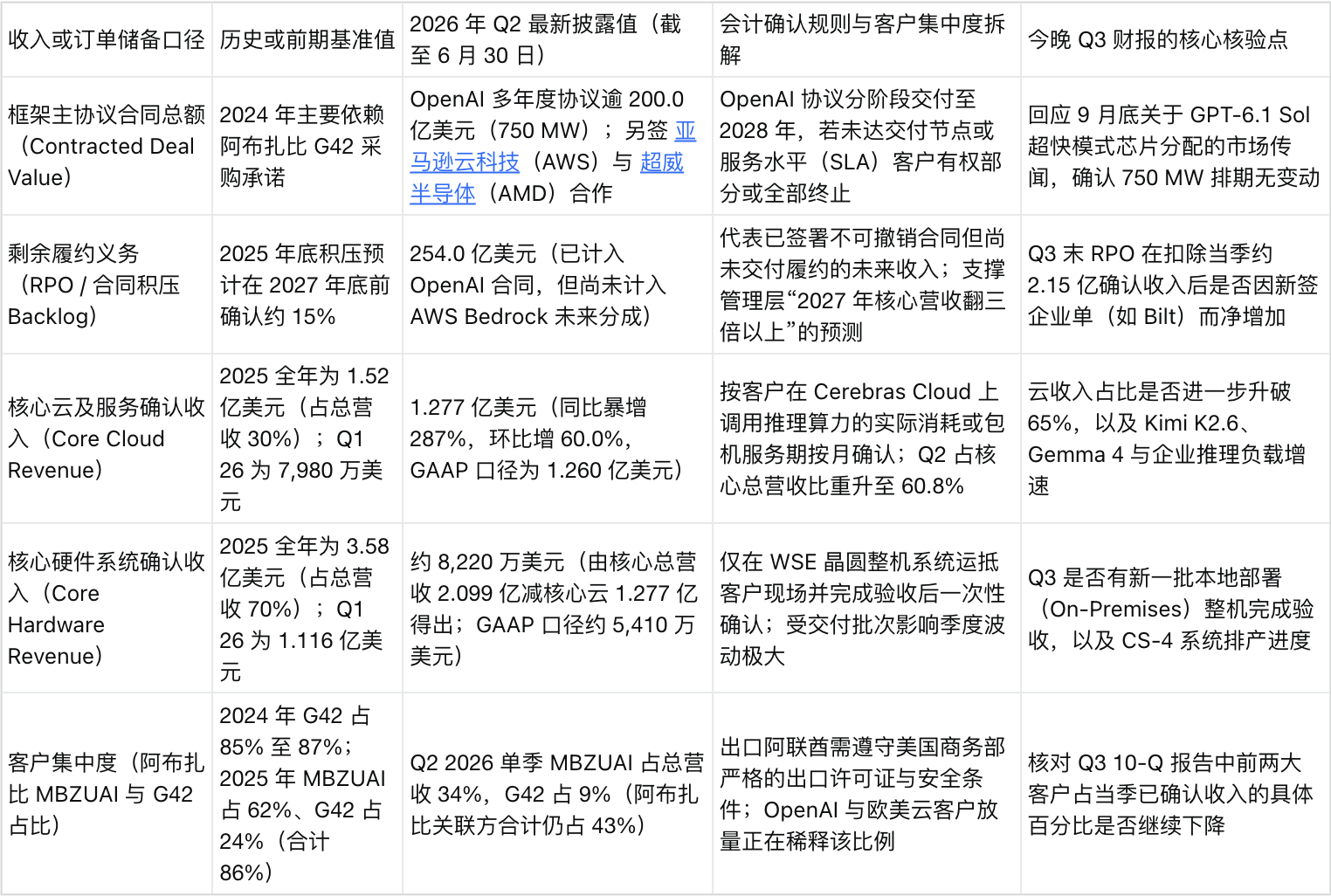
Comparing the table above with Cerebras' $20 Billion Contract Analysis, it is clear that Cerebras is undergoing a strategic transformation from "selling hardware boxes to a single UAE customer" to "selling cloud inference compute to large North American model and enterprise customers":
First, on the contract reserve side, the $25.4 billion in remaining performance obligations (RPO) is equivalent to 28.7 times the company's full-year 2026 core revenue guidance (median $885 million). The core pillar of this $25.4 billion is the master cooperation agreement signed with OpenAI in January this year, valued at more than $20 billion, for the phased delivery of 750 megawatts (MW) of high-speed inference compute through 2028 (which has successively launched support for the real-time coding model Codex-Spark and the GPT-5.6 Sol ultra-fast mode at 750 tokens per second). However, according to SEC filing details disclosed in Okara's research on the prospectus and customer concentration, although OpenAI dominates future backlog (RPO), in the revenue recognized in the second quarter ended June 30, Abu Dhabi's Mohamed bin Zayed University of Artificial Intelligence (MBZUAI) still contributed 34% of revenue, G42 contributed 9%, and Abu Dhabi-related customers combined still accounted for 43% of quarterly revenue (down significantly by half from 86% for full-year 2025, but the absolute share remains considerable).
Second, on the product and ecosystem delivery side, the company released its fourth-generation system CS-4 on August 18, featuring a 7,000-square-millimeter wafer-scale engine with 1.4 trillion transistors (and previewed that CS-5 will launch in the second half of 2027); at the same time, it reached a "disaggregated inference" partnership with AWS and AMD: using AWS's Trainium 3 or AMD chips to handle the compute-intensive prefill stage, then handing the latency-sensitive decode stage to Cerebras CS-3/CS-4 systems with ultra-high on-chip memory bandwidth. According to management's timetable, the disaggregated inference solution with AMD is scheduled for deployment in the fourth quarter of 2026, AWS Bedrock integration is scheduled to launch in the first quarter of 2027, and it will begin contributing hyperscaler revenue in mid-2027. In addition, on November 10, neighborhood commerce and rewards platform Bilt announced it had selected Cerebras to provide AI concierge services to its 8 million members, further expanding its list of non-sovereign-wealth enterprise customers.
Product Delivery, Supply Chain Advantages, and Revenue Recognition Bottlenecks: 600 MW of Data Center Capacity and TSMC Wafer Allocation
Why, with $25.4 billion in backlog, can Cerebras only guide third-quarter core revenue to $214 million to $216 million? The answer is not that the chips cannot be manufactured, but that data center space with power became the physical bottleneck limiting the conversion of orders into revenue.
On the chip manufacturing side, Cerebras' wafer-scale engine (WSE) has a unique supply chain advantage that distinguishes it from traditional GPU manufacturers. As analyzed in Nvidia vs. TSMC: AI Computing Platform vs. Semiconductor Foundry — What's the Difference?, the three major chokepoints currently limiting shipments of traditional AI accelerators are high-bandwidth memory (HBM), TSMC's CoWoS advanced packaging capacity, and the 3nm extreme ultraviolet lithography node; Cerebras, by contrast, directly turns an entire 300mm silicon wafer into a single giant processor, using all on-chip static random-access memory (SRAM), so it does not need to purchase scarce HBM memory at all, nor does it need to occupy TSMC's tight CoWoS packaging capacity or 3nm production lines. Management confirmed in the second-quarter report that the company has locked in all TSMC wafer allocations needed to support rapid growth in 2027 and beyond, and has added assembly lines at contract manufacturing partners Flex, Sanmina, and Rocket EMS, increasing full-system manufacturing capacity by more than 10x in 2026.
The real delivery bottleneck lies in data center power and rack space. Because more than 60% of the company's revenue has shifted to its own Cerebras Cloud service, after chips leave the foundry they must be installed in liquid-cooled data center halls connected to high-voltage power and brought online before the $25.4 billion RPO can be converted into recognized revenue on a monthly basis. As of the end of the second quarter, the company's data center capacity in operation and under contract for delivery by the end of 2027 exceeded 600 MW (including the 165 MW AI data center announced with Compute Nordic in Mikkeli, Finland, on August 31). On tonight's conference call, the actual number of megawatts of this 600 MW of data center capacity energized and online by the end of the third quarter will directly determine whether the promise of "more than tripling core revenue in 2027 (i.e., exceeding $2.64 billion)" can be fulfilled.
Gross Margin Trough (38%–40%), Depreciation Period Controversy, and Analysis of the $8.6 Billion Cash Reserve Burn
The most fiercely contested battleground in tonight's earnings report is the trajectory of core gross margin and the accounting controversy over fixed asset depreciation triggered by a short-seller report two weeks ago.
First, look at management's explanation of the "third-quarter margin trough." In the first quarter of 2026, Cerebras' core gross margin was as high as 46.5% (including 53% for core cloud services and 42% for core hardware); by the second quarter, although core cloud services revenue surged 287% to $127.7 million, core total gross margin fell 590 basis points to 40.6% (GAAP gross margin even plunged from 45% in Q1 to 14%), and management guided third-quarter core gross margin to bottom further at 38% to 40%. Why did the growing share of the originally high-margin cloud business actually drag down overall gross margin? According to Investing.com's preview of key Q3 metrics, this is because in Q2 and Q3, in order to prioritize meeting surging inference demand from cloud customers such as OpenAI, during the transition period before its own new data centers were fully energized, Cerebras adopted a costly stopgap measure—"renting back systems" from customers who had already purchased hardware earlier to provide cloud services externally. Rental fees for rented-back systems are recorded directly in cost of revenue, significantly squeezing gross margin in Q2 and Q3; management promised that 38% to 40% in Q3 would be the lowest point of full-year gross margin, and that entering Q4, as a large number of lower-cost Cerebras-owned systems built with the company's own funds come online, gross margin will immediately rebound and move toward a long-term target of more than 60%.
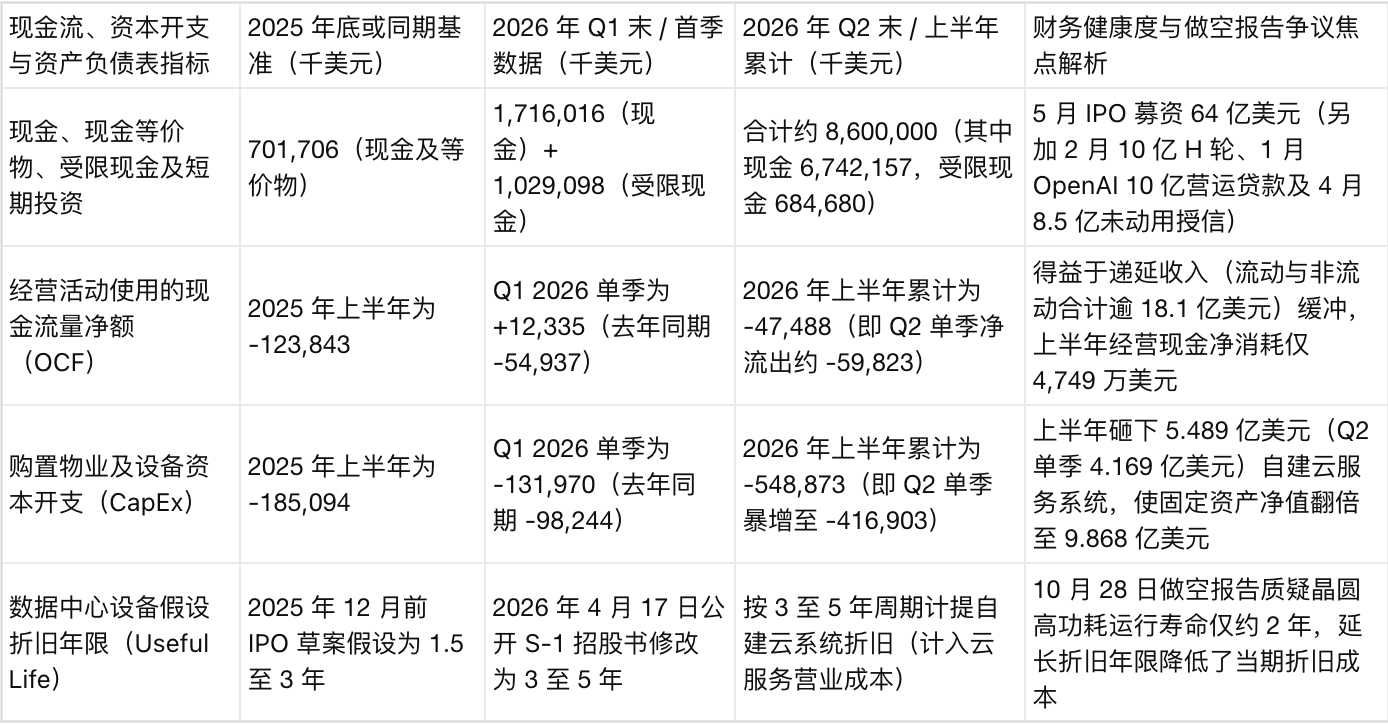
However, as shown in the last row of the table above, regarding whether the launch of owned systems in Q4 can truly boost gross margin, TIKR's short-seller report and depreciation analysis summarizes the core challenge raised by short seller Culper Research on October 28: the short-seller report claimed that to prevent the entire wafer from bending and cracking due to thermal expansion under alternating hot and cold conditions, Cerebras wafers still need to run dummy operations when idle and maintain 70% to 80% of peak power consumption, resulting in an actual wafer lifespan of only about 1.5 to 2.5 years; at the same time, the short-seller report pointed out