AI Selloff: Nvidia Isn't the First to Fall — Optical Communications Drop Nearly 10% in a Single Day, Broadcom CEO Points to Capital Constraints


- Core View: The AI hardware sector is undergoing a sustained correction, with the market shifting from pricing in a "chip shortage" to pricing in a "capital shortage." Broadcom CEO's remarks that capital is the biggest constraint, along with ChangXin Memory Technologies' new architecture progress, point to tightening financing conditions and changes in the long-term supply landscape, respectively.
- Key Elements:
- The Philadelphia Semiconductor Index fell 2.67% on October 12, with four consecutive declines erasing early-October gains. 28 of 30 constituent stocks declined, led by optical communications and memory component names.
- Broadcom CEO Hock Tan stated that the biggest constraint on AI expansion is capital, not chip shortages. Broadcom has agreed to provide up to $42 billion in loans to Anthropic.
- ChangXin Technology unveiled progress on its 4F² DRAM architecture, with plans to launch server-grade DDR5 RDIMMs by year-end. Its roadmap may lead Samsung by approximately two years.
- Memory demand remains strong, with TrendForce forecasting Q4 DRAM contract prices to rise 10%-15% quarter-over-quarter and NAND to rise 15%-20%.
- The five major AI companies have issued approximately $220 billion in bonds this year, while Alphabet, Amazon, and Meta have seen their annual free cash flow turn negative.
- This round of selling is more likely a reflection of expectations for marginally tighter financing conditions rather than shrinking AI demand. Cloud providers' earnings report language will be a key verification point.
On Monday (October 12), U.S. markets observed Columbus Day — the bond market was closed while equities traded normally, and the AI hardware sector underwent a concentrated, high-volume correction at low levels. The Philadelphia Semiconductor Index closed down 2.67%, marking its fourth consecutive trading day of declines and pushing Friday's divergent session toward a clearer direction. On the same day, a warning about capital from Broadcom's CEO came out of Singapore, while three days earlier, news of ChangXin Memory Technologies' new architecture emerged from Shanghai — one pointing to where the money on the demand side will come from, the other to whether the supply-side landscape will shift. On Tuesday morning, the KOSPI and Nikkei fell in succession, extending this round of correction into Asia-Pacific. This article breaks down these two threads in order of transmission.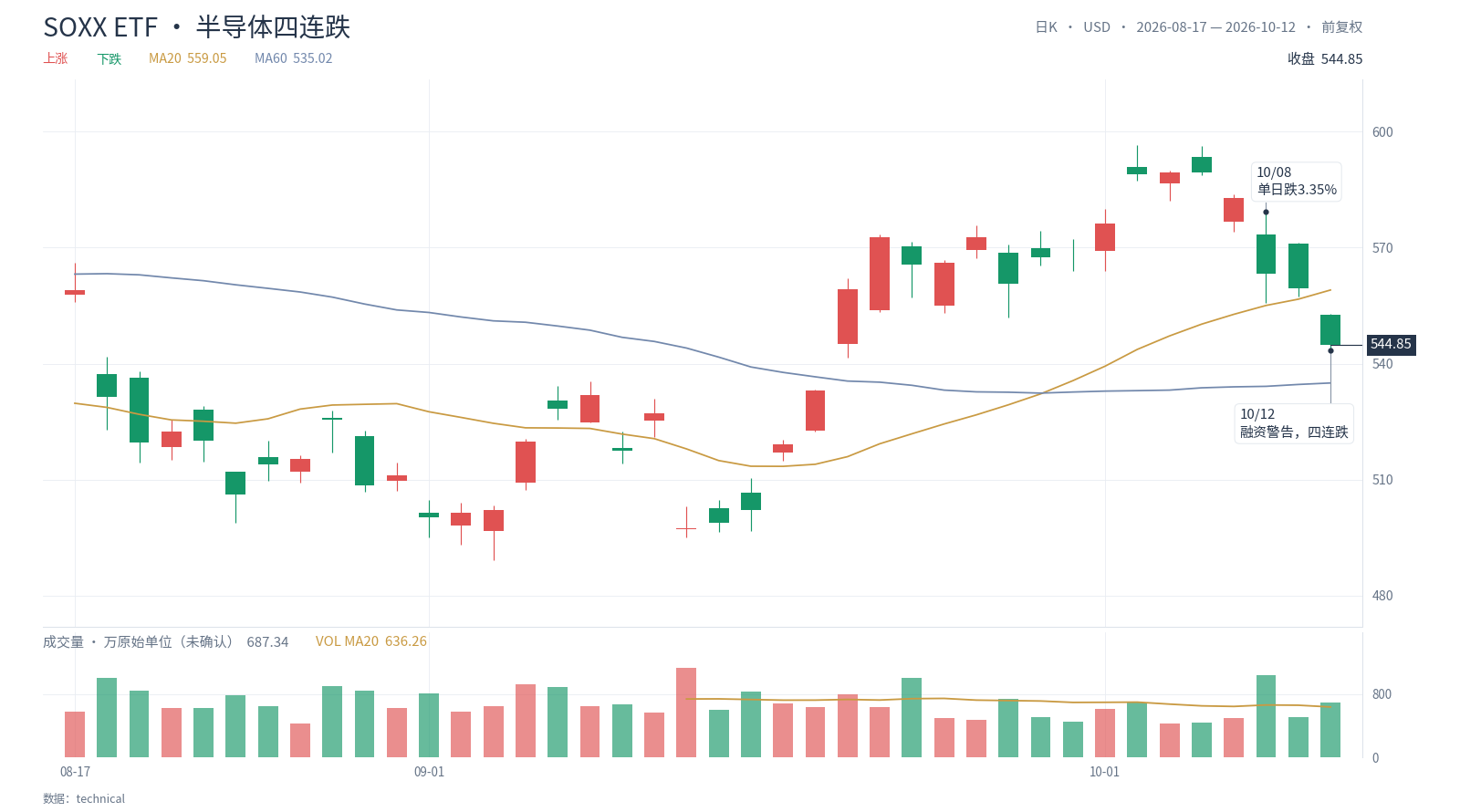
1. The Path of a Single Day's Selloff
Let's first look at the single-day structure. The SOXX ETF closed down 2.60% on Monday, following declines of 1.12%, 3.35%, and 0.69% over the prior three trading sessions. The cumulative loss from four consecutive down days has now erased all of early October's gains. Of the Philadelphia Semiconductor Index's 30 constituents, 28 declined, with the index closing at 12,236.79.
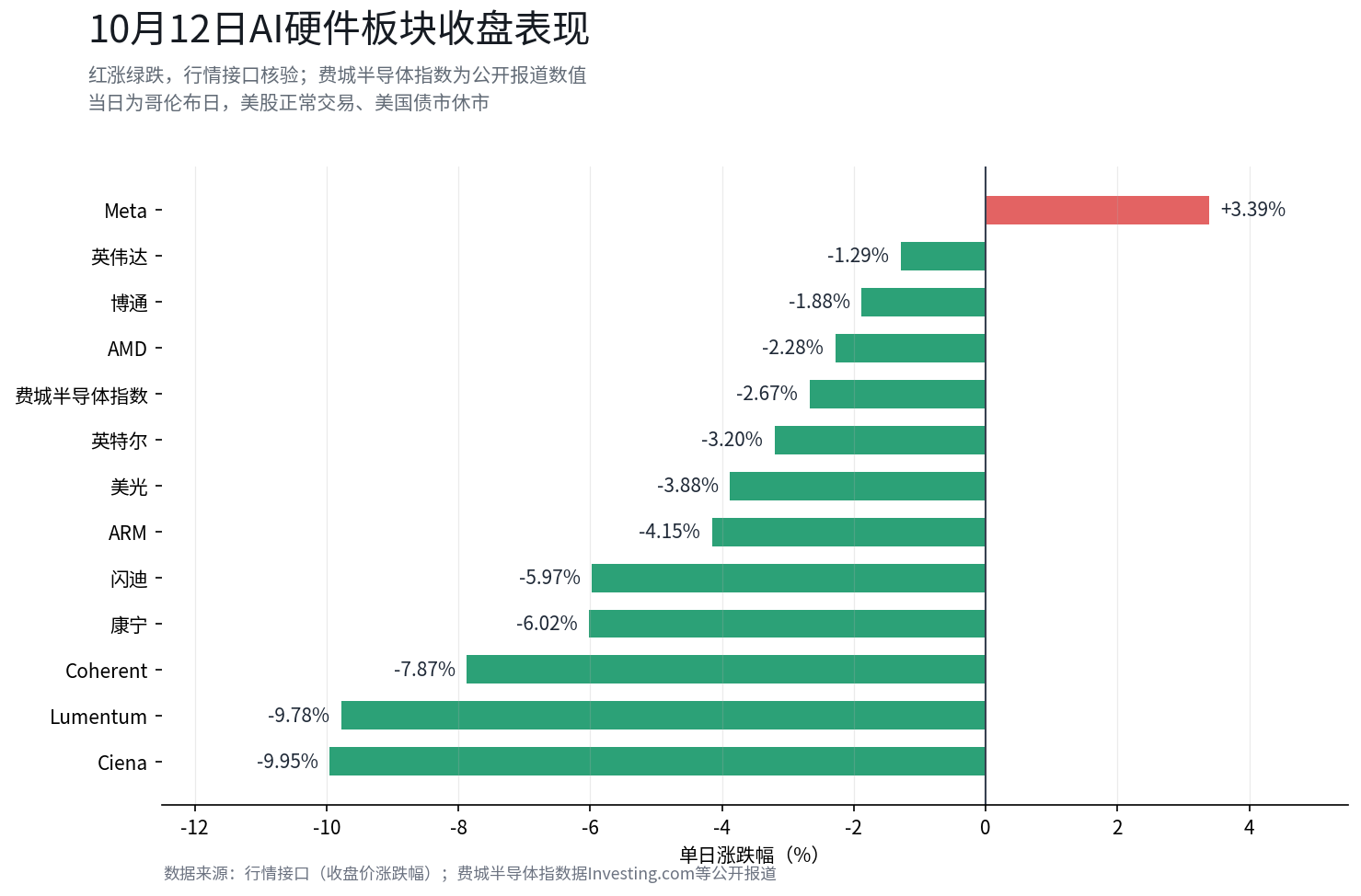 The ranking of declines is itself informative. Optical communications and memory component names led the selloff: Ciena fell 9.95%, Lumentum dropped 9.78%, Coherent declined 7.87%, Corning lost 6.02%, SanDisk fell 5.97%, Micron dropped 3.88%, ARM declined 4.15%, Intel fell 3.20%, and AMD slipped 2.28%, while Nvidia dipped 1.29%, Broadcom fell 1.88%, and Meta bucked the trend with a 3.39% gain. One testable interpretation is that panic propagated along the AI chain in decreasing order from the segments most dependent on capex revenue toward the core, consistent with the pattern seen after OpenAI's revenue forecast miss was exposed on October 8. If subsequent earnings show optical communications orders remain strong, this interpretation would need revision, as that would indicate the market is pricing financing conditions rather than demand contraction.
2. Why Broadcom CEO's Remark Matters
On Monday at DBS Bank's Asia Future Forward Summit in Singapore, Broadcom CEO Hock Tan said that as the entire industry races to build infrastructure, financing may become a bigger obstacle to AI expansion, with an impact potentially exceeding shortages of semiconductors, memory chips, or power. According to CNBC's transcript, his exact words were "[I think] the biggest constraint is capital." He also noted that wafer and memory shortages are easing and that demand has not contracted; according to Yahoo Finance and others, Broadcom still believes demand for computing infrastructure will continue to outpace supply. Intel CEO Lip-Bu Tan, sharing the stage, expressed similar views.
The weight of this statement lies in reframing the problem from a chip shortage to a money shortage. There is another detail worth recording separately: according to Reuters citing Anthropic's IPO filing, Broadcom has agreed to provide up to $42 billion in loans to Anthropic, roughly equivalent to one-third of the latter's $125.2 billion chip procurement commitment. The fact that a chip company has begun directly providing financing to customers is itself a footnote to the financing problem moving to the center of pricing.
3. What ChangXin Is Rewriting
On October 10, Cao Kanyu, President of ChangXin Technology, announced at the 4th Integrated Circuit and Chiplet Conference in Shanghai that R&D on the 4F² DRAM architecture has made progress, with plans to launch server-grade DDR5 RDIMM products combining 4F² architecture and hybrid bonding technology by year-end. The 4F² design compresses memory cell area to roughly two-thirds of the traditional 6F² structure. According to public reports, some commentators believe its roadmap progress leads Samsung's comparable architecture by approximately two years. It should be emphasized that, according to TrendForce, this remains an R&D milestone and product target, not yet a customer-ready mature product.
 The impact of the ChangXin news should be read against the backdrop of the memory upcycle. Demand remains extremely strong: according to TrendForce forecasts, conventional DRAM contract prices could rise 10% to 15% quarter-over-quarter in Q4, while NAND flash could rise 15% to 20%. Micron's earnings released on September 30 showed Q4 FY2026 revenue of $54.23 billion, up approximately 379% year-over-year, with full-year revenue of $133.19 billion — more than triple the prior year. Samsung Electronics' Q3 operating profit guidance set a record. On the supply side, according to Goldman Sachs, the probability of new DRAM supply before Q4 2027 is extremely low. Against this backdrop, what ChangXin's progress primarily changes is not this year's supply-demand gap, but expectations for the supply landscape after 2027. Forward pricing for companies like Micron and SK Hynix may now include an additional variable that needs to be priced in.
4. From Cash Flow to Bonds: A Regime Change in Pricing Logic
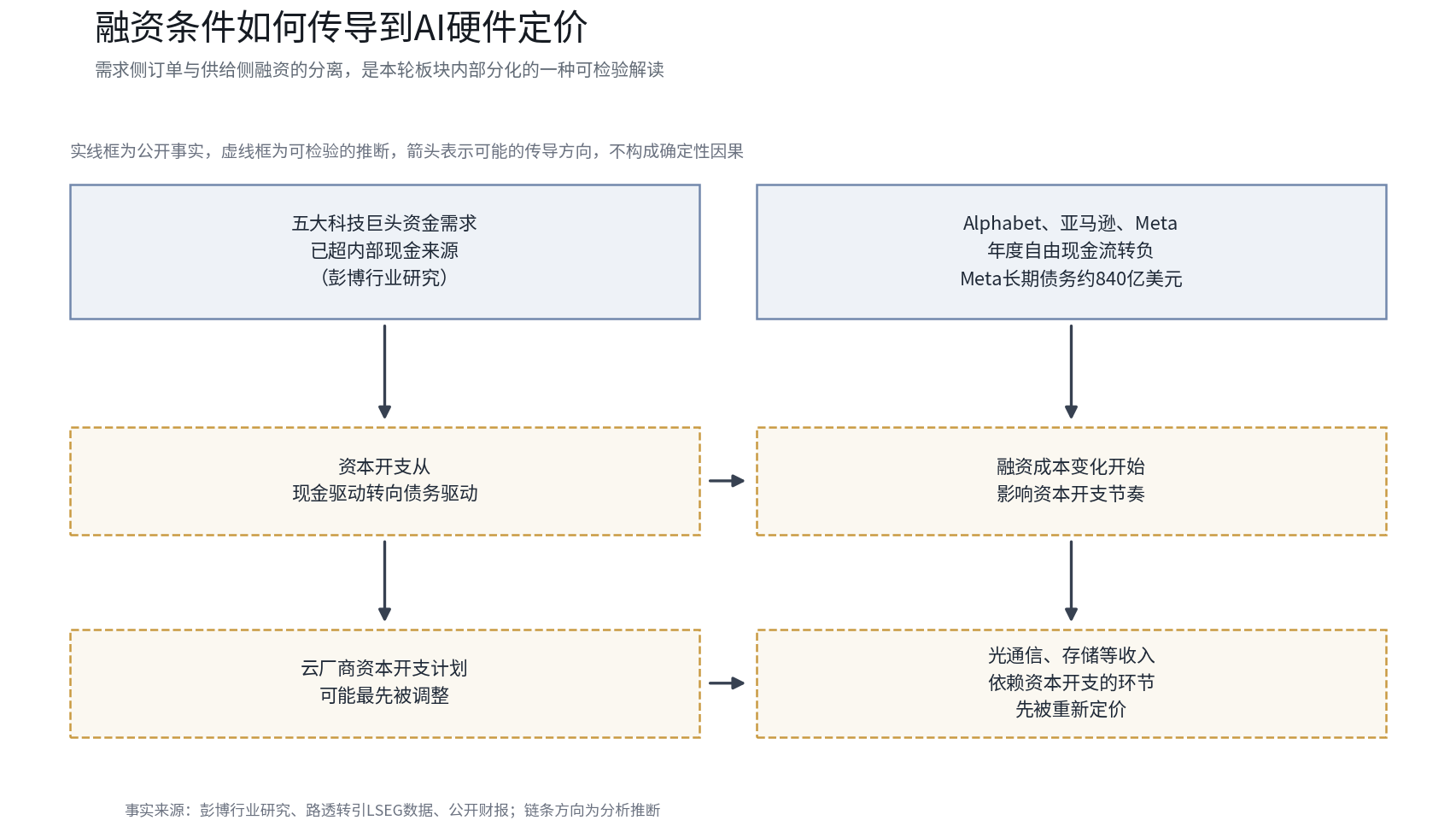
Over the past two years, the implicit premise of AI capex has been that it is cash-driven — tech giants cover spending with their own cash flows, and financing conditions do not enter the pricing equation. That premise is now loosening. According to Bloomberg Intelligence, the funding needs of Meta, Amazon, Alphabet, Microsoft, and Oracle have exceeded internal cash sources, and they will rely more on bond markets over the next two years, with leverage levels trending upward. Alphabet, Amazon, and Meta have already seen annual free cash flow turn negative; Alphabet's Q2 free cash flow was negative $5.9 billion, the first negative quarter since its 2004 IPO, while Meta's long-term debt has reached $84 billion. According to LSEG data cited by Reuters, the five major AI companies have issued approximately $220 billion in bonds this year, and Goldman Sachs estimates the five major buyers will issue about $250 billion in bonds in 2026.
As capex shifts from cash-driven to debt-driven, an environment where the 10-year U.S. Treasury yield is running near 5.3% begins to directly participate in pricing, and changes in financing costs may affect the pace and sequencing of capex. Based on the above readings, this round of selling more likely reflects expectations of marginally tighter financing conditions rather than a contraction in AI demand itself — the two have different directional impacts on valuations. If upcoming cloud provider earnings calls begin discussing financing pace rather than compute shortages, the above interpretation would be validated; otherwise, it would need revision.
What to Watch Next
In the near term, four observation points stand out. First, the language used on cloud providers' earnings calls — capex guidance and financing commentary will be more telling than single-quarter profits. Second, the production timeline for ChangXin's 4F² DDR5 RDIMM — the year-end launch is only the first step; the 2027 capacity ramp-up will determine the magnitude of change in the supply landscape. Third, order visibility for optical communications companies — a combination of strong orders and weakening share prices would indicate the market is pricing financing conditions. Fourth, the sustainability of Asia-Pacific spillover — the KOSPI has fallen for five consecutive sessions with continuous net foreign selling, and the performance of Samsung and SK Hynix serves as a direct read on memory-chain sentiment. How much of this repricing has already been priced in by the market remains to be seen.
Data Notes
- Market data: Philadelphia Semiconductor Index, SOXX, and individual stock price changes, verified via market data interfaces, as of October 12 close.
- Index and Asia-Pacific market data: cited from public reports; Asia-Pacific figures are intraday data for October 13.
- Broadcom and Intel CEO remarks: October 12 DBS Bank Singapore Summit, as reported by CNBC, Reuters, and Yahoo Finance.
- ChangXin Memory: October 10 conference speech, as reported by Yicai and TrendForce.
- Memory and funding data: TrendForce, Micron earnings, Goldman Sachs, Bloomberg Intelligence; the approximately $220 billion bond issuance figure has not been independently verified.
Disclaimer:
This content is provided for general informational and market commentary purposes only, based on publicly available information as of the time stated herein. Relevant market data, expectations, and probabilities may change with market conditions. The views and investment strategies of third-party institutions, analysts, or other individuals cited herein represent only those parties' views at specific times and do not represent the views or recommendations of BIT. This article does not constitute investment advice, investment research, an offer, solicitation, or recommendation of any securities, investment products, or trading strategies, and should not be relied upon as the basis for any investment decision. Financial markets involve risk; securities prices and market performance may fluctuate, and historical performance and past market trends do not represent or guarantee future results. Investors should independently assess relevant risks based on their own circumstances and seek professional advice when needed. BIT's Hong Kong stock trading services are not available to Hong Kong residents or users in other restricted jurisdictions.