



VVV surges over 60% in a day — is privacy + AI becoming the next explosive narrative?


- Core Thesis: The deep involvement of AI models in scientific research and commercial scenarios has triggered a surge in demand for private inference, presenting a value re-rating opportunity for the privacy AI sector. Venice (VVV), NEAR, and Bittensor (TAO) are each capturing this narrative through privacy applications, verifiable computing, and open supply networks, respectively.
- Key Elements:
- A New York University mathematician questioned whether Codex may have accessed his draft data, and OpenAI admitted it could not rule out the use of de-identified data for training — sparking concerns over control of AI workflows and privacy leaks, serving as a catalyst for market sentiment.
- Venice AI provides private inference through layered solutions such as anonymous mode and TEE end-to-end encryption. Its annualized revenue grew from $14 million in January to over $100 million by August, marking initial commercial validation.
- VVV's tokenomics is driven by two engines: for every $100 in API purchases, $5 is used for buybacks and burns of VVV; the DIEM system allows staking VVV in exchange for daily API credits, creating sustained lock-up and demand expectations.
- NEAR provides verifiable private inference within TEEs through its integration with Venice. Its staking payment feature converts staking rewards into inference credits, and NEAR Intents generated approximately $9.32 million in fees in Q2, with retained revenue used to buy back NEAR.
- Bittensor organizes AI supply through a subnet competition mechanism. Subnet Chutes generated approximately $1.37 million in external revenue in Q2; TAO serves as the base asset for staking allocation across subnets, with a total supply cap of 21 million tokens and its first halving already completed.
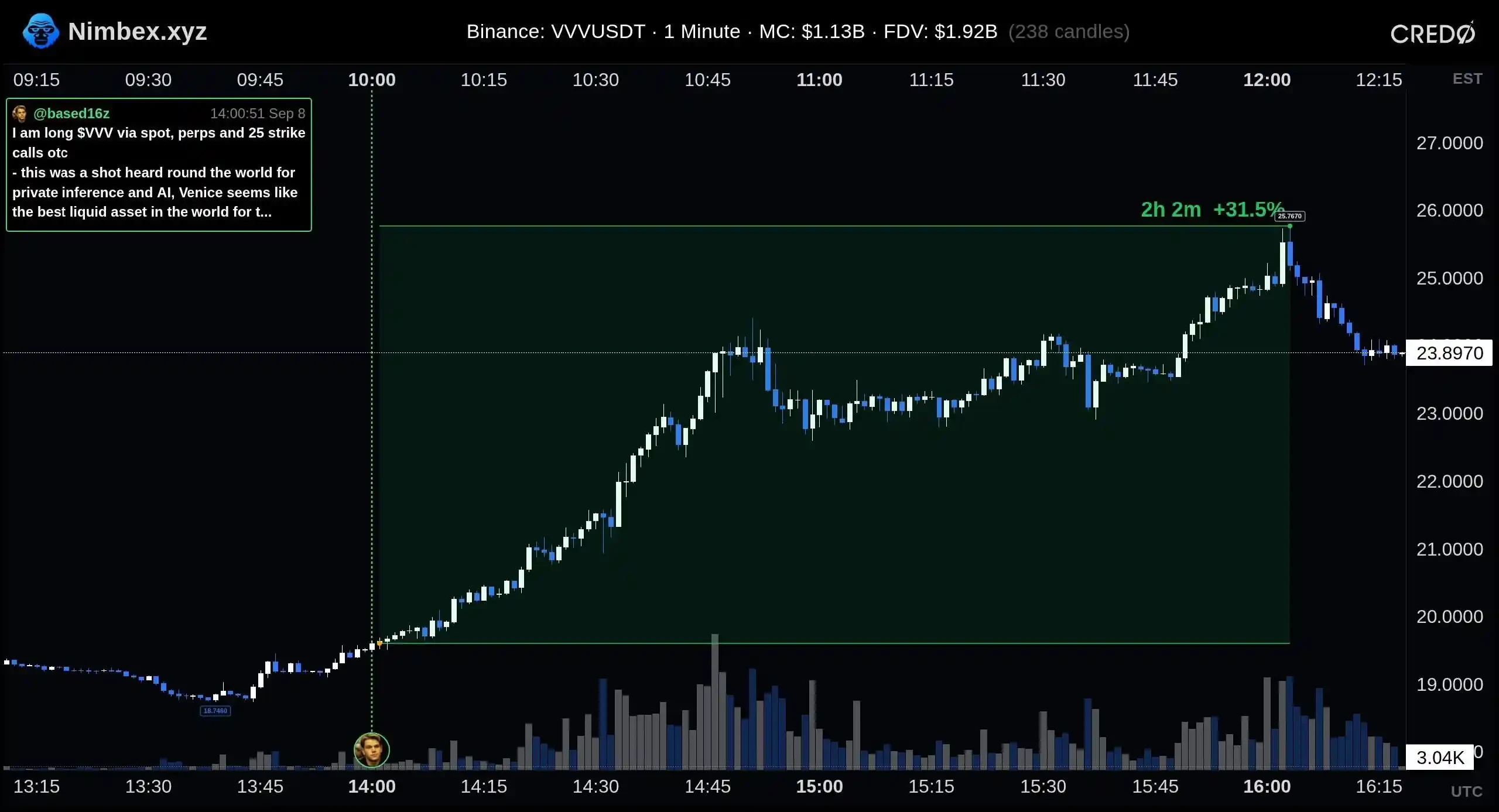
The VVV token from Venice AI hit a new all-time high today, briefly surpassing $25. This surge was triggered by a math research controversy that made many people realize the importance of "private inference."
Tristan Buckmaster, a mathematician at New York University, wrote in a public statement that he and his collaborators had input drafts of their entire project into Codex. After learning that an internal OpenAI team had also made related progress, he asked whether their models had accessed these conversations or been trained on them. He was told the models had not accessed user data, but his question regarding training went unanswered.
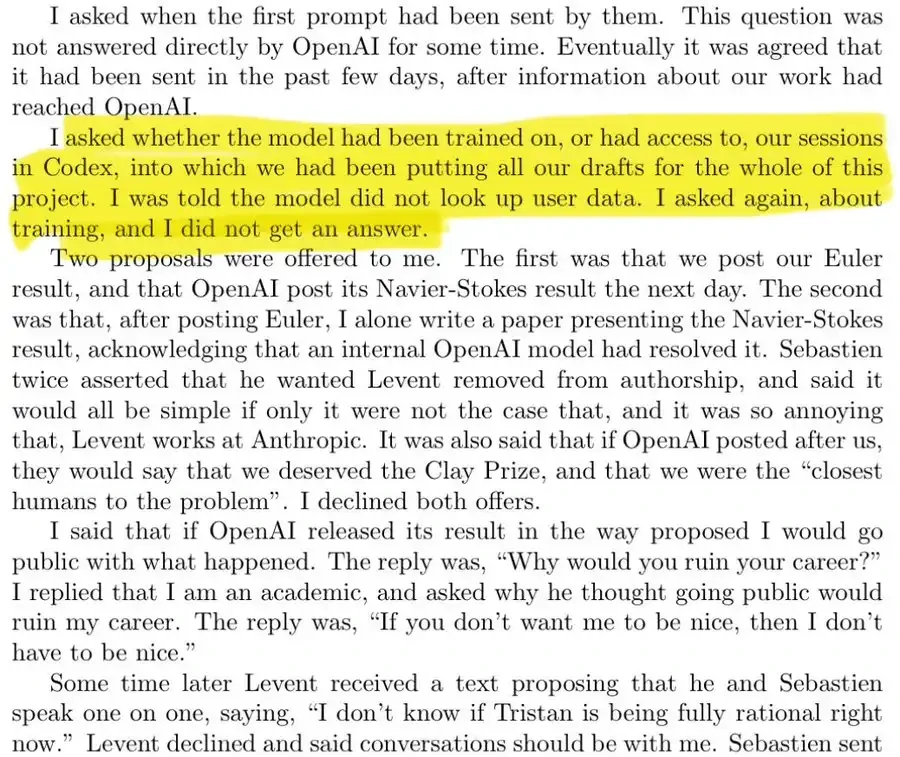
OpenAI's response denied that researchers or agents accessed specific user data to solve the problem, while also acknowledging that, although unlikely, it could not rule out that de-identified data from the research group's private conversations with Codex had helped improve their models.
The community has begun to question: when the stakes are high enough, can these labs see all your work and deliver results before you do?
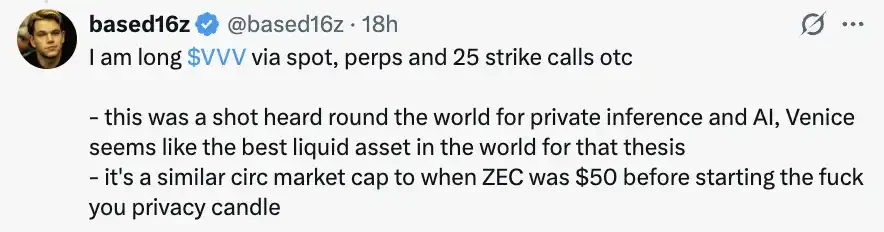
Trader based16z has already expressed his view through trading. He disclosed going long VVV via spot, perpetual contracts, and OTC call options with a $25 strike price. In his view, this incident has brought the importance of private inference into the spotlight, and Venice is the most suitable liquid asset to capture this narrative. He also drew an analogy between VVV's circulating market cap and ZEC's at $50—his assessment of a privacy value re-rating.
As AI moves from answering general questions to participating in research papers, code development, product R&D, and trading strategies, the content users type into the input box has become far more valuable.
Who can let people use AI while retaining control over their work product and execution process? Three Web3 projects have offered their own answers.
VVV: Turning Privacy into a Business
Venice AI, founded by Erik Voorhees, offers chat applications for consumers and APIs for developers to call models. It aggregates different models and differentiates itself with privacy and fewer restrictions.
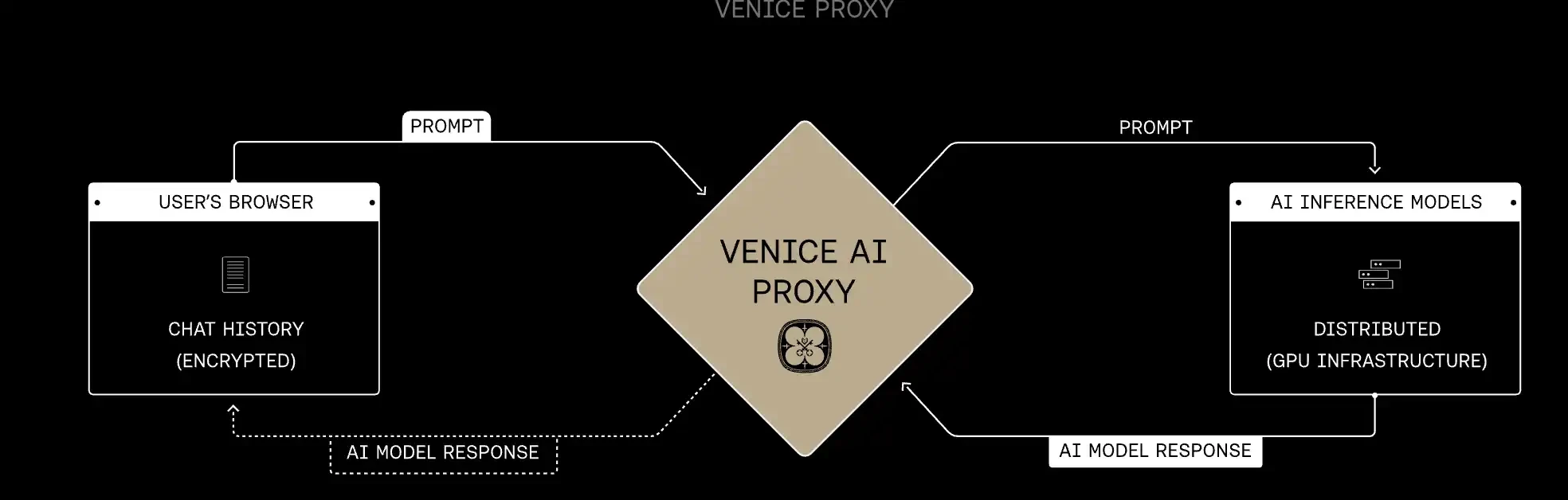
Venice AI's privacy is structured across three layers. Venice's "anonymous mode" hides user identity, though upstream models can still see the request content. "Zero retention mode" relies on service providers honoring their commitments. "TEE mode" runs inference within protected hardware environments, while "end-to-end encryption mode" encrypts from the user's device until decryption occurs inside the protected environment.
This business has already achieved meaningful scale. Banyan, an investor, disclosed that Venice's annualized revenue grew from $14 million in January to over $100 million by August.
VVV is Venice's token issued on Base. For every $100 of Venice API credit purchased, $5 is used to buy and burn VVV. On the supply side, new emissions of VVV are also declining, with annual emissions reduced from 3 million to 2.5 million tokens on September 1, with a further reduction to 2 million planned for October 1.
Another source of demand for VVV comes from DIEM. Holders can lock staked VVV to mint DIEM, and staking 1 DIEM generates $1 of refreshed API credit daily. This allows developers and agents to hold an asset that continuously produces usage credits for future model calls.
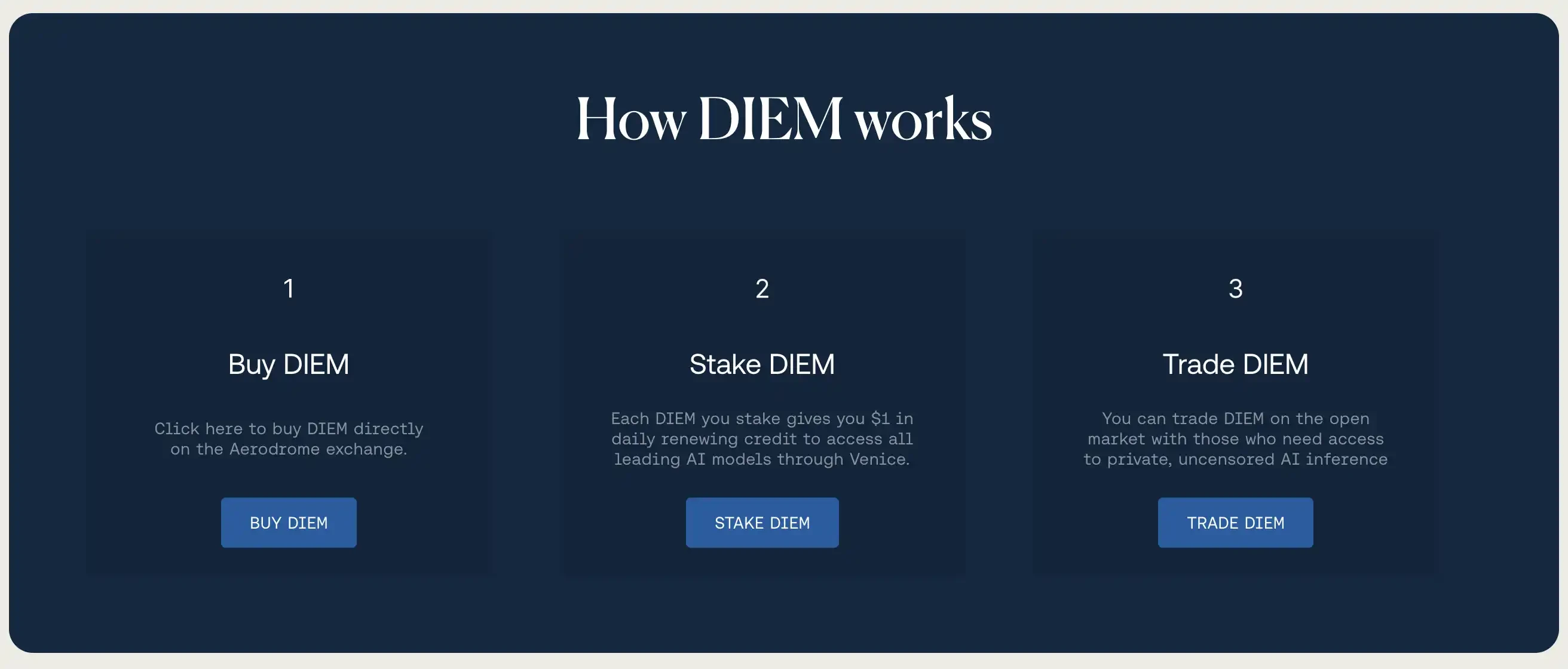
On September 14, DIEM's target supply will complete its staged expansion from 38,000 to 40,000 tokens, creating room for additional minting. This move also signals the Venice team's optimism about user growth.
The bull case for VVV is clear: amid AI privacy threats, Venice has found its market position—more people paying to use Venice leads to more buybacks; more people needing continuous inference credits leads to staking demand.
NEAR: Verifiable Private Inference
Following the Venice AI thread, we also encounter a familiar name: NEAR. This layer-1 blockchain is expanding the utility of the NEAR token through confidential computing and agent services.
In March of this year, Venice and NEAR AI announced an integration allowing users to choose verifiable private inference services provided by NEAR AI. When consumers make requests through Venice, the underlying private computing power is supplied by service providers like NEAR AI.
The core capability of NEAR AI Cloud is running models inside TEEs—trusted execution environments isolated by hardware. By design, plaintext data during computation is confined to the protected zone, where infrastructure operators cannot directly read it. Users can verify hardware attestations to confirm their requests entered the appropriate environment. This provides teams seeking to protect research and business data with a cloud computing option.
Open-weight models can be deployed in this environment. When calling closed-source models such as Claude, GPT, or Gemini through a gateway, requests are still routed to upstream providers, and NEAR's confidential computing guarantees cannot cover their servers. NEAR's value on this path comes from protecting the computing process and its ability to organize model services.
This capability is already tied to the NEAR token. Staking payments, launched on July 30, allow token holders to convert NEAR staking rewards into inference credits, with the amount varying based on stake size, token price, and yield rates. Users retain ownership of the underlying tokens and can unstake to exit. For teams making long-term model calls, this adds another reason to hold NEAR.
Another part of NEAR's opportunity lies in payments. To complete tasks, AI agents need not only model calls, but also data purchases, service payments, and asset movements across different chains. NEAR Intents provides an intent-based execution framework where users submit desired outcomes, and solvers compete to complete the exchange and execution. This infrastructure can connect complex cross-chain operations into AI agents' task workflows.
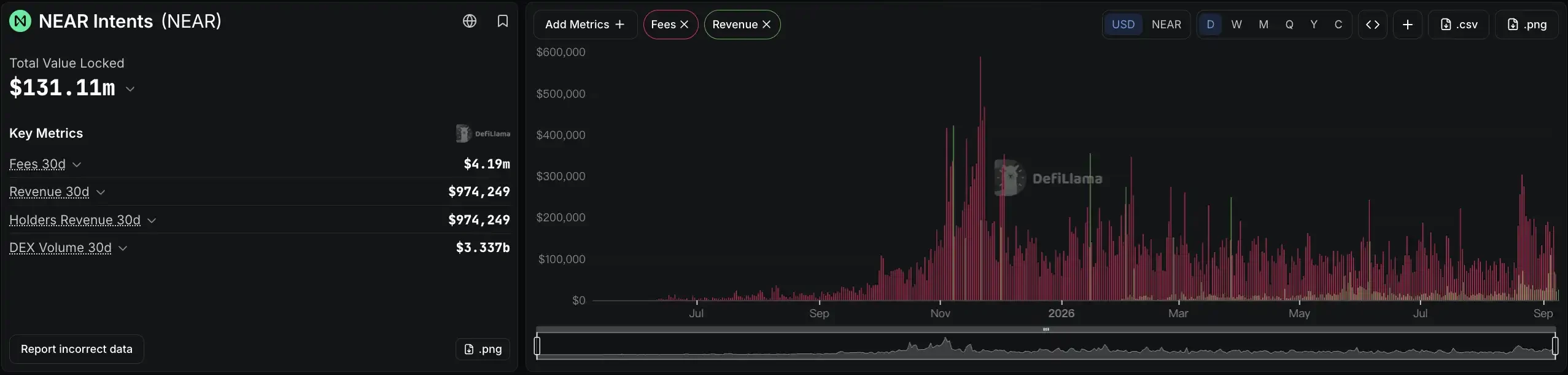
According to DeFillama data, NEAR Intents generated approximately $9.32 million in total fees during Q2 of this year, with roughly $1.5 million actually retained by the protocol; retained revenue is used for market buybacks of NEAR.
Therefore, NEAR's bullish narrative is supported by two business pillars: providing compute for sensitive tasks, and providing execution and payments for cross-chain operations. The former can reach users through applications like Venice, while the latter has the opportunity to grow alongside AI agents.
TAO: Supplying Open AI Models
Bittensor has always been the most prominent AI project in crypto. TAO is the native token of the Bittensor network.
Bittensor organizes different tasks into independent subnets, where miners provide inference, storage, prediction, and other services, validators assess service quality, and the network distributes rewards according to rules. Teams can organize competition around specific needs, while the broader network hosts multiple such markets simultaneously.
As AI demand expands, applications need more substitutable suppliers, and small teams need to find customers, compute resources, and funding. Bittensor attempts to organize this supply through open incentive markets, letting different teams compete on specific tasks.
Some subnets have already begun generating external revenue. Take Chutes, which provides model inference services: its Q2 revenue was roughly $1.37 million, derived from subscriptions, pay-as-you-go usage, and instance services.
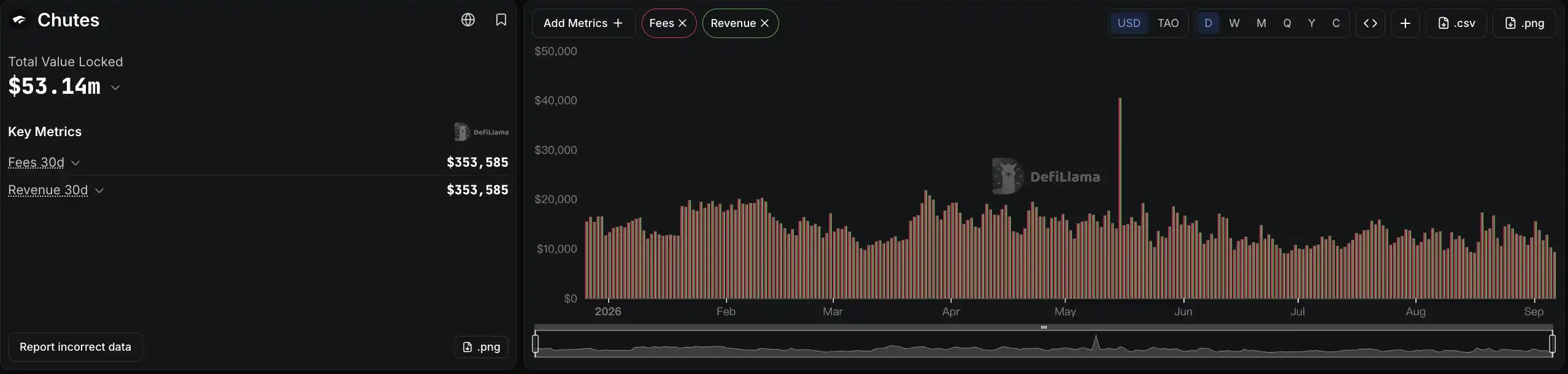
How does TAO capture this growth? Each subnet has its own alpha token paired with TAO to form trading pools. Staking TAO into a subnet effectively converts it into the corresponding alpha token. TAO thus serves as the base asset for capital allocation across subnets. If more competitive services emerge within the network, demand for participating in these markets has the opportunity to expand.
On the supply side, TAO retains the scarcity design familiar to the crypto market. TAO has a maximum supply of 21 million tokens, completed its first halving in December 2025, and currently emits 0.5 tokens per block—approximately 3,600 tokens per day.
VVV's surge offers us a window of observation. As models grow more powerful, the amount of sensitive information people entrust to them increases accordingly, and "crypto/privacy AI" has naturally found its product-market fit.