




September 3 US Stock Pre-Market Report: Silver Prices Rise Less Than 1%, But HL Surges 8.69%. Can CIEN Issue Another Upgrade Tonight?


- Core View: On September 2, all three major US stock indices closed higher, but the market focus was on structural divergence: Broadcom beat earnings expectations yet fell due to lowered margin guidance; Hecla Mining surged 8.69% as weak employment data cooled rate hike bets, far outpacing silver price movements. Despite miners pivoting to AI for over a year, prices have not decoupled from coin prices—the divergence lies in contract quality rather than price correlation.
- Key Elements:
- Broadcom reported last quarter revenue of $29.6 billion (up 86% YoY) and AI semiconductor revenue of $16.7 billion (up 221% YoY), both beating expectations. However, next-quarter margin guidance was cut from 68% to 66%, causing after-hours declines of about 3.5%. High growth is already priced in, making margin the marginal determining factor.
- August ADP private employment rose by only 38,000 (vs. 47,000 expected), cooling rate hike bets and triggering gains in precious metals. Silver, with its dual industrial metal properties (photovoltaic and electronics demand), shows greater elasticity to the same data than gold. Silver prices rose less than 1% while Hecla surged 8.69%, reflecting operating leverage effects.
- Significant divergence within the sector: On the silver side, Hecla and Endeavour Silver both rose 8.69%, and Coeur Mining gained 6.04%. On the gold side, Newmont rose only 2.06% while AngloGold Ashanti closed down 0.28%. The sector average of 2.42% masks the disparity between the two ends.
- The quality of AI transition contracts among five mining companies depends on the counterparty: Cipher Mining secured a direct 300 MW agreement with Amazon (15-year term) and a Fluidstack lease (backed by Google, worth $1.73 billion); Applied Digital's 1,010 MW is diversified across investment-grade cloud providers; while Core Scientific's 243 MW is almost entirely bet on a single customer while carrying $3.3 billion in debt at a 7.75% coupon.
- Mining stock prices have not decoupled from coin price correlation: Recoveries from lows range from Core Scientific's 28.0% to Cipher Mining's 114.3% (Bitcoin at 34.7%), but drawdowns from highs are all concentrated in the 38%-55% range, forming a pattern of "coordinated declines with divergent rebounds." Decoupling is only evident at the contract level.
- Ciena's earnings report will focus on whether full-year guidance is upgraded again from $6.30 billion. Its pillar optical networking business ($1.10 billion, up 42.2% YoY) accounts for 70% of total revenue, while routing and switching (up 87.9%) has a small base but high elasticity, reflecting demand spreading toward east-west traffic in AI clusters.
On September 2, the three major U.S. stock indices closed higher in tandem, with the Dow up +0.56%, the S&P 500 up +0.47%, and the Nasdaq up +0.45%. August ADP private payrolls rose by only 38,000, below the expected 47,000, cooling rate hike bets and moving precious metals and utilities together. The star of the day was Hecla Mining (HL), up 8.69% to close at $20.77—while silver moved less than 1% on the same day. Today's U.S. stock classroom asks a question: It's been over a year since miners pivoted to AI—have they really decoupled from coin prices? Tonight at 12:30 UTC, optical communications equipment maker Ciena (CIEN) reports earnings before the market opens. Data in this article is based on the September 2 U.S. stock market close.
1. Today's Market: Indices Closed Higher in Tandem, But Broadcom Missed on All Three Numbers and Still Fell
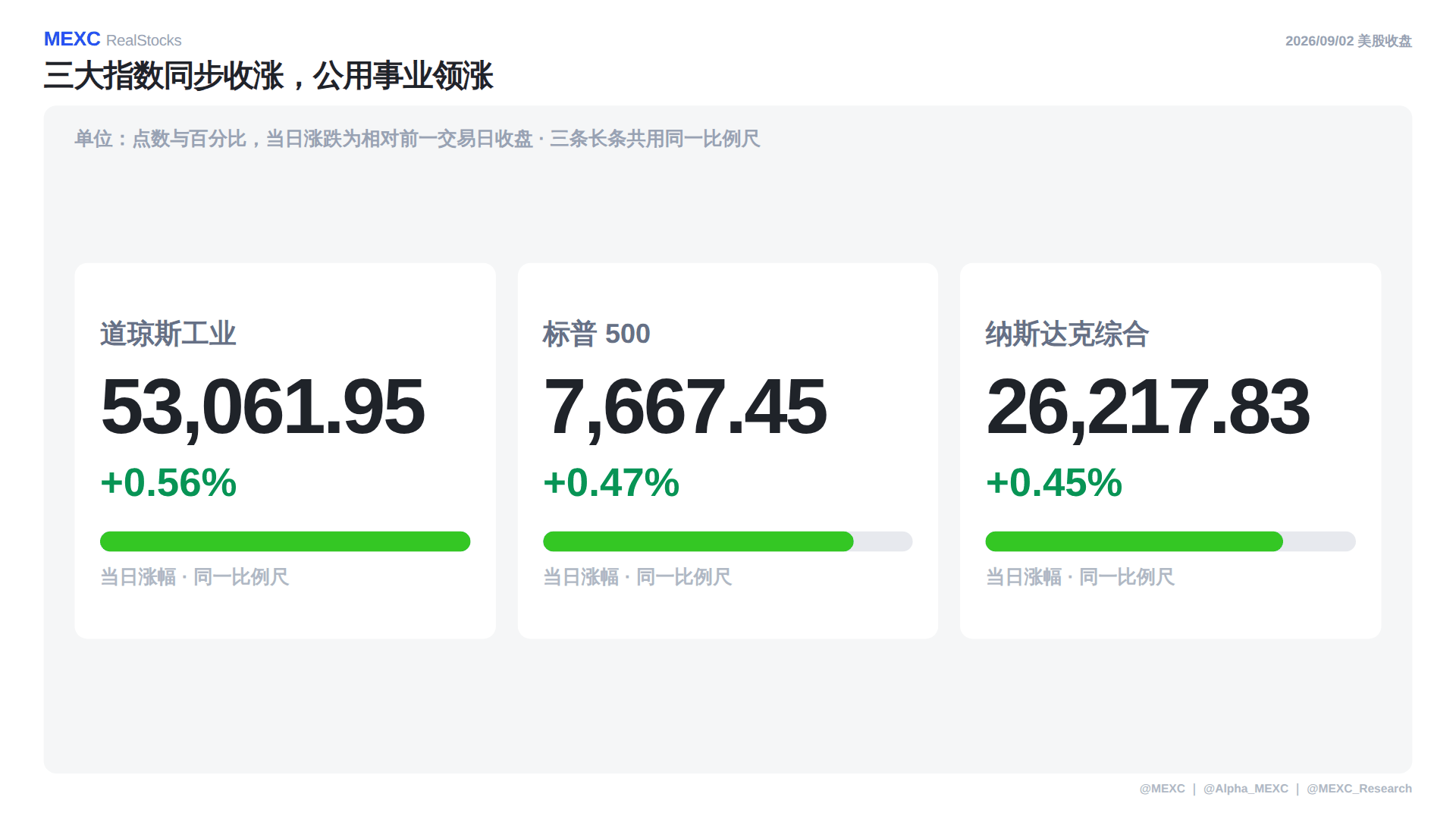
Units are points and percentages, with daily changes relative to the previous trading day's close. All three major indices closed higher with similar magnitude: Dow +0.56% to 53,061.95, S&P 500 +0.47% to 7,667.45, Nasdaq +0.45% to 26,217.83. Sector-level divergence was far more pronounced than the indices: Utilities on the Nasdaq rose +2.26% to lead, Communication Services followed at +1.47%, while Industrials lagged at −1.03%. Capital-heavy, high-leverage industries move first when rate hike bets cool—the same reason precious metals rose that day.
What's truly worth noting is Broadcom (AVGO) last night. Last quarter's revenue was $29.6 billion, up 86% year-over-year; AI semiconductors brought in $16.7 billion, up 221%; next quarter's guidance is $34.8 billion (with AI at $21.7 billion)—all three numbers beat expectations, yet the stock closed down 0.66% at $367.24, falling about 6% after hours before narrowing to roughly 3.5%.
The divergence isn't in revenue—it's in margins: This quarter's adjusted operating margin was about 68%, and the company guided next quarter to 66%. Revenue tells you how much was sold; margin tells you whether the business is becoming more profitable or thinner. When high growth is already priced in, a margin guide that's "slightly worse than last quarter" is enough to push the stock down.
2. Star of the Day: Silver Moved Less Than 1%, Hecla Mining Rose 8.69%
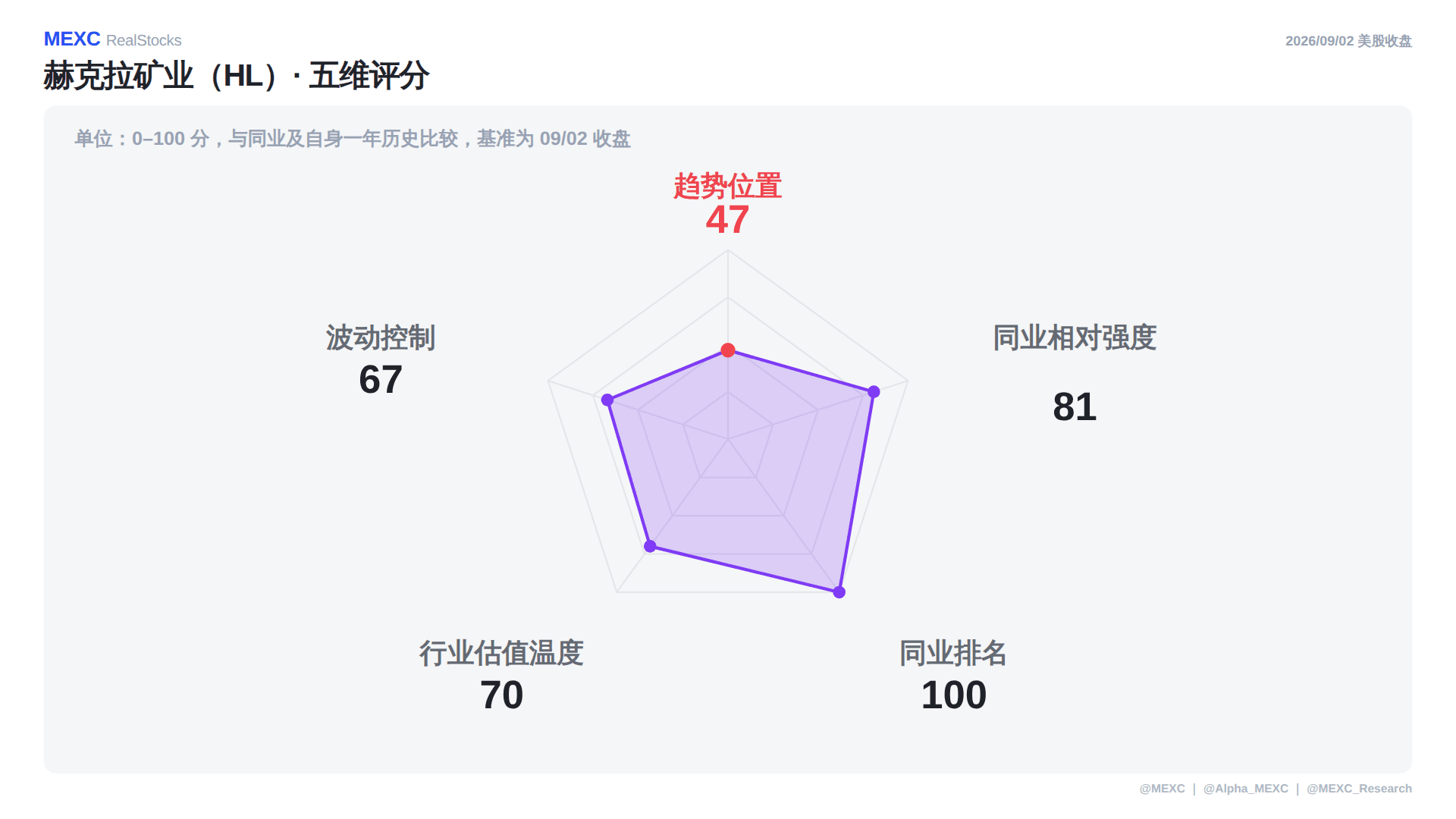
Units are scores from 0–100, compared against peers and its own one-year history, based on the September 2 close. Hecla Mining (HL) is a precious metals miner with a market cap of $13.9 billion. It closed at $20.77, up 8.69%, adding about $1.1 billion in market value in a single day, with volume in line with the daily average—the gain came from pricing, not volume expansion.
Among the five dimensions, peer ranking scored a perfect 100 and peer relative strength was 81—nothing else in this category was stronger that day. But the weakest dimension, trend position, was only 47, meaning the stock still sits in the middle of its 52-week range. This combination looks contradictory but is actually two different things—ranking tells you "who rose the most today," a horizontal single-day comparison; trend position tells you "how far it is from its own high," a vertical cross-time comparison. Reading the two dimensions separately prevents mistaking an event-driven single-day surge for a trend.
The cause is straightforward: August ADP private payrolls rose by only 38,000, below the expected 47,000, cooling rate hike bets and turning silver from falling to rising. Mining costs are roughly fixed within a year, but selling prices fluctuate with metal quotes, so a 1% move in metals can translate into several percentage points on gross profit, which the stock then amplifies—that's operating leverage. Today's numbers show this most clearly: silver moved less than 1%, Hecla rose 8.69%.
One caveat must also be kept in mind: This rally stems from cooling rate hike bets, and before the Fed meeting on September 15–16, there are still nonfarm payrolls and CPI reports to come—bets can change direction with the next data release.
3. Star of the Day Extension: Same Data, Two Different Reactions Between Silver and Gold
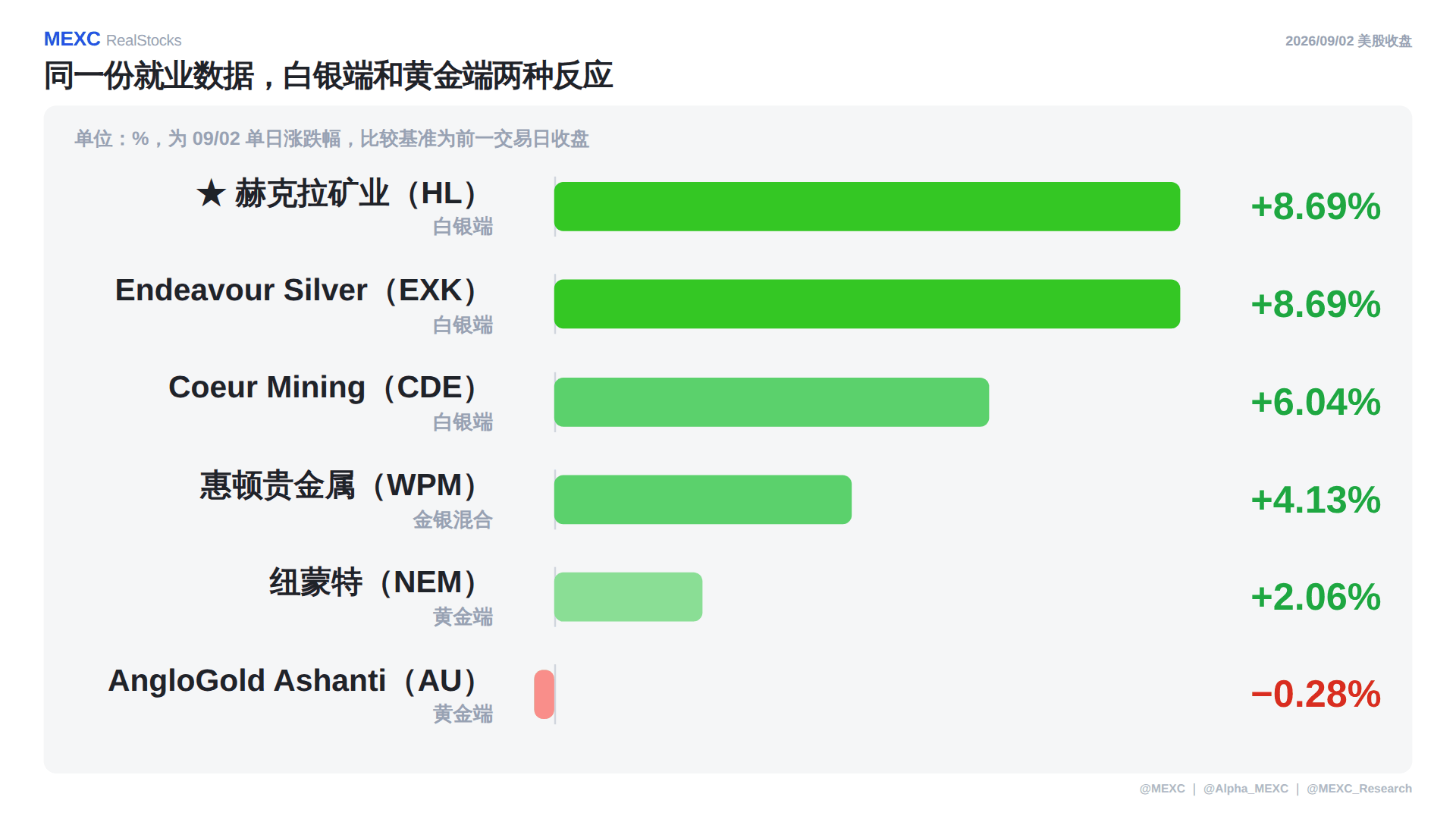
Units are %, representing single-day percentage changes on September 2, compared against the previous trading day's close. All six companies sit under the precious metals sector, yet the same employment data produced completely different reactions across the spectrum: On the silver side, Hecla +8.69%, Endeavour Silver also +8.69%, Coeur Mining +6.04%; mixed gold-silver Wheaton Precious Metals +4.13%; on the gold side, Newmont only +2.06%, and AngloGold Ashanti even closed down 0.28%.
The difference comes from silver's dual identity: It's both a precious metal and an industrial metal—solar, electronics, and solder all use silver. So a data point signaling "economic slowdown, cooling rate hike bets" is mainly a rate-side positive for gold, but for silver it's a double effect of rate-side plus industrial demand expectations, giving it inherently greater elasticity.
The sector averaged a 2.42% gain that day, but this average masks internal divergence—looking only at it, you'd think the whole sector rose by just over two points. When you see sector-wide movement, break it apart first to see which end is rising before deciding which stock to watch—a practice useful every day.
4. U.S. Stock Classroom: Miners Pivoted to AI Over a Year Ago—Have They Really Decoupled?
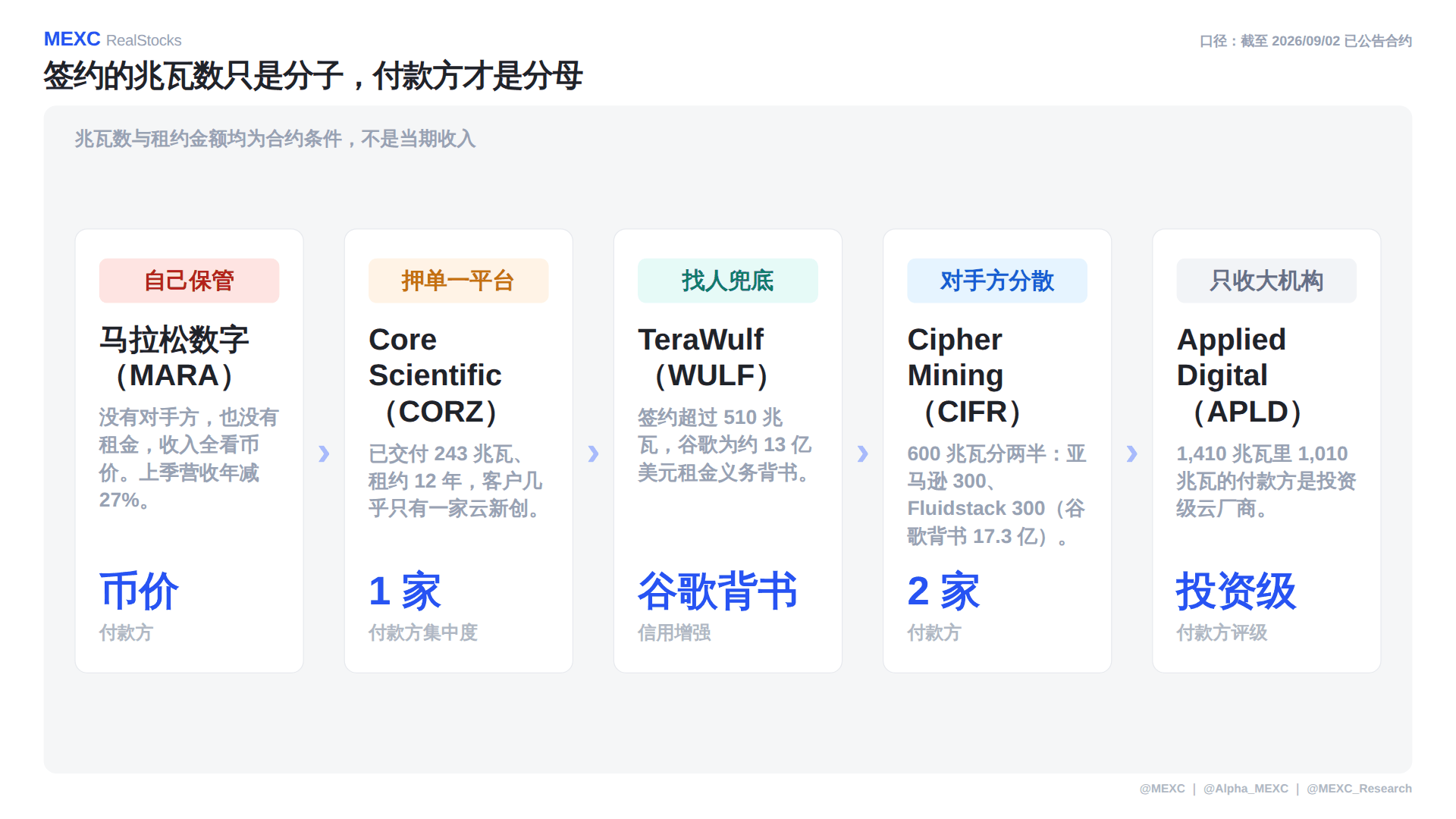
The chart shows signed or delivered capacity and corresponding counterparties for five miners; megawatts and lease amounts are contractual terms, not current revenue. All five are converting mining sites into AI data centers, but signed megawatts are only the numerator—the counterparty is the denominator: For the same long-term contract, who pays determines what it's worth.
Marathon Digital (MARA) hasn't pivoted at all—revenue is entirely at the mercy of coin prices: Hash rate grew 22% year-over-year in Q2, but revenue fell 27% to $174.9 million, while selling 2,213 bitcoins in the period to shore up cash. Core Scientific (CORZ) pivoted earliest, with 243 MW delivered under a 12-year lease, but its customer is almost exclusively one cloud startup, for which it issued $3.3 billion in project debt at a 7.75% coupon. TeraWulf (WULF) has signed over 510 MW, with Google backing approximately $1.3 billion of rent obligations. Cipher Mining (CIFR) split 600 MW between two counterparties: 300 MW directly signed with Amazon for 15 years, and 300 MW leased to Fluidstack for 10 years, with Google additionally backing $1.73 billion. Applied Digital (APLD) holds 1,410 MW, of which 1,010 MW have investment-grade cloud providers as counterparties.
They Fall Together; Divergence Only Appears on the Bounce
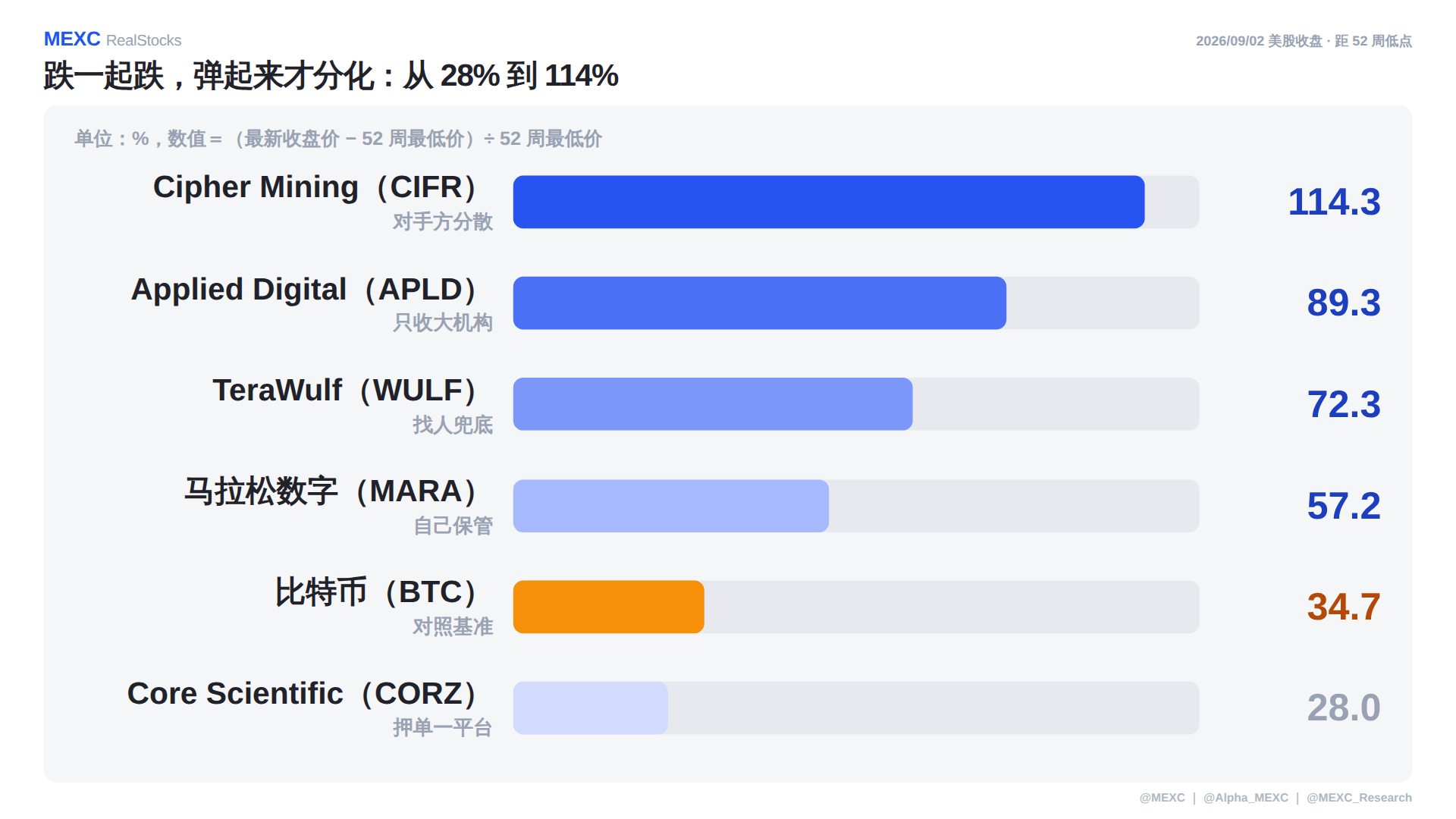
Units are %, calculated as (latest close − 52-week low) ÷ 52-week low, measuring how much each has recovered from its own low. Cipher Mining bounced 114.3%, Applied Digital 89.3%, TeraWulf 72.3%, Marathon Digital 57.2%, while Bitcoin was at 34.7% over the same period, and Core Scientific only 28.0%.
The key is that looking from a different angle yields the opposite impression: In terms of drawdown from highs, all six names cluster between 38% and 55%—very little spread; in terms of recovery, the range stretches from 28% to 114%—a fourfold difference. They fall together and only diverge on the bounce—amplitude has never shrunk. The so-called decoupling hasn't happened in prices; it's happened in contracts. The market isn't rewarding the label of transformation—it's rewarding the quality of contracts.
5. Getting to Know a Company: Cipher Mining Is in the Power Plant Business, Not the Cloud Business
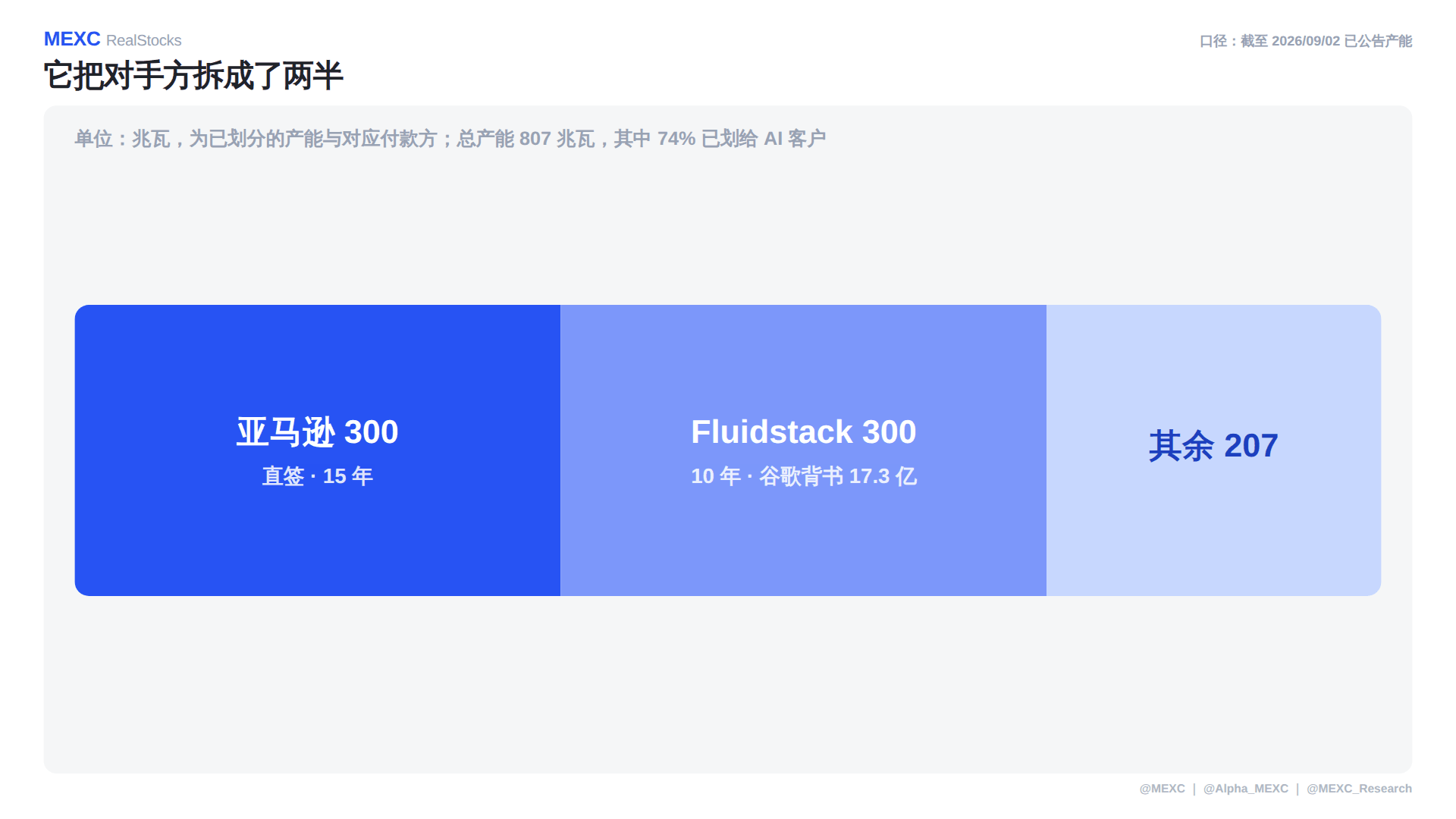
Units are megawatts, representing CIFR's allocated capacity and corresponding counterparties; total capacity is 807 MW, of which 74% has been allocated to AI customers. It doesn't buy GPUs or sell compute—it only provides power, sites, and grid interconnection permits—the entire company has just 66 employees. This sentence is key to understanding it: It doesn't earn money from compute; it earns money from power plants.
It has split its counterparties in half: One half is 300 MW directly signed with Amazon for 15 years; the other half is 300 MW leased to Fluidstack for 10 years, with Google additionally backing $173 million in rent obligations. The benefit of diversification is that one default won't sink the entire balance sheet; the cost is that revenue is locked into rents—how much customers earn from that power is none of its concern. It's a business of trading upside for certainty.
Putting all five together yields today's most valuable takeaway: To assess the quality of an AI contract, first look at who pays—whether the counterparty is Amazon, a Google-backed startup, or a startup expanding on debt financing makes a huge difference in quality. This is counterparty risk, a concept all too familiar in crypto, transplanted to a different setting. Then look at concentration—Applied Digital's 1,010 MW is spread across investment-grade cloud providers, while Core Scientific's 243 MW is nearly all bet on a single name. Finally, look at when money actually starts flowing—the contract amount is the sum of over a decade into the future; this year's cash flow is a different story.
6. What to Watch Tonight: Will CIEN's Full-Year Guidance Be Raised Again?
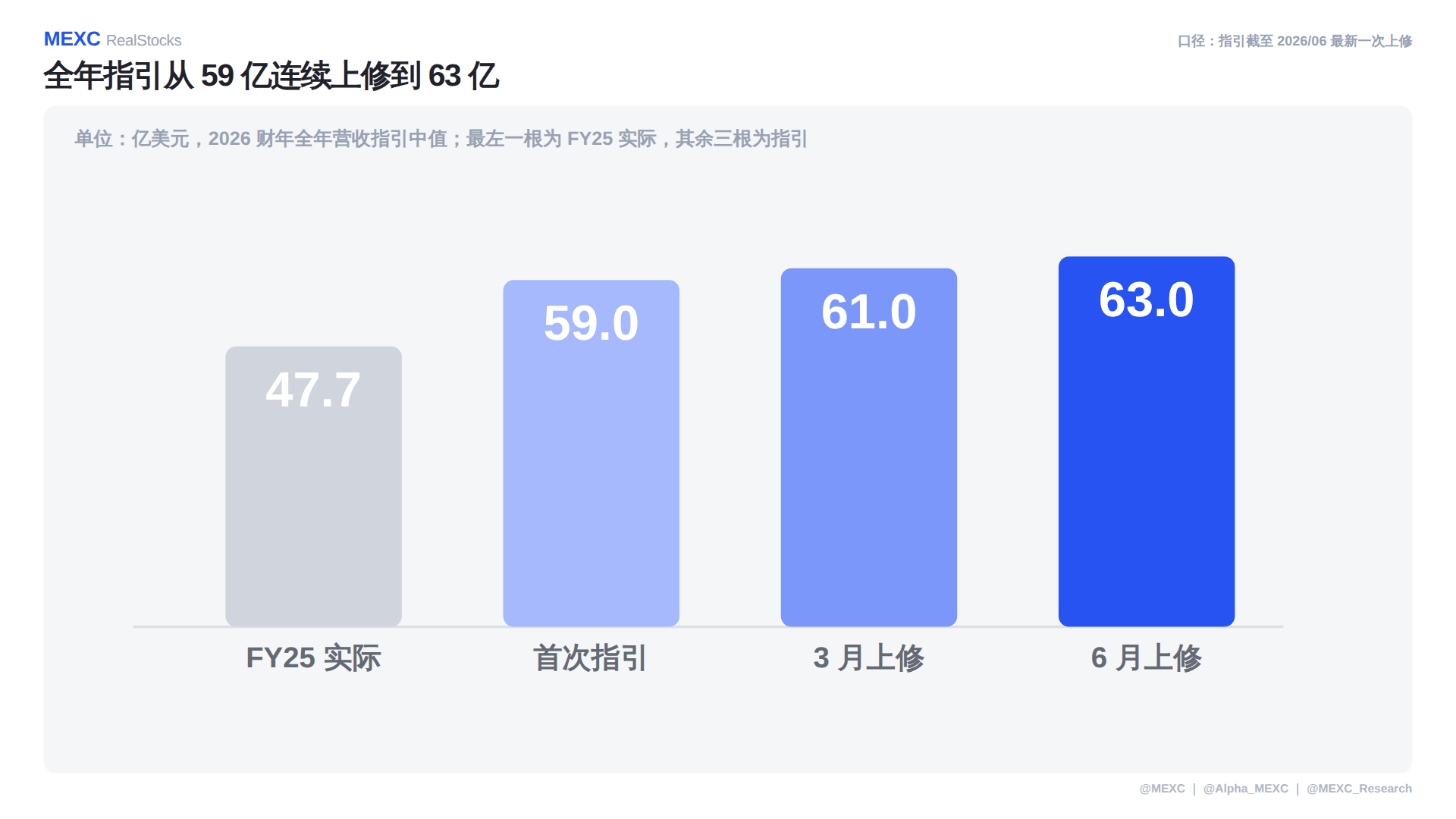
Units are in hundreds of millions of dollars, representing the midpoint of the company's full-year revenue guidance for fiscal 2026 (ending October); the leftmost bar is the actual FY2025 figure of $4.77 billion, and the other three bars are guidance, not realized performance. Initial guidance of $5.90 billion came in December 2025, raised to $6.10 billion in March, then to $6.30 billion in June, with the midpoint year-over-year growth moving from 28% to 32%.
Tonight at 12:30 UTC, Ciena (CIEN) reports earnings before the market opens, alongside initial jobless claims and a Fed governor speech; at 14:00 UTC is the August ISM services PMI. The real watershed this week comes tomorrow with the August nonfarm payrolls report. The company's own guidance midpoint for this quarter's revenue is approximately $1.625 billion, up about +33% year-over-year.
Its position is the second leg of AI capital expenditure: Money flows first into chips, then into the optical channels that connect compute—and Ciena makes precisely the coherent optical transport and routing/switching equipment used between data centers, in metro networks, and on long-haul backbones. Watching the full-year guide rather than quarterly revenue is because single quarters get distorted by delivery cadence and recognition timing—the full-year guidance midpoint is the company's own committed statement on full-year demand. Whether it changes or not says more about order visibility than whether a single quarter hits targets.
Drill Down: Which Line Is Carrying This Earnings Report?
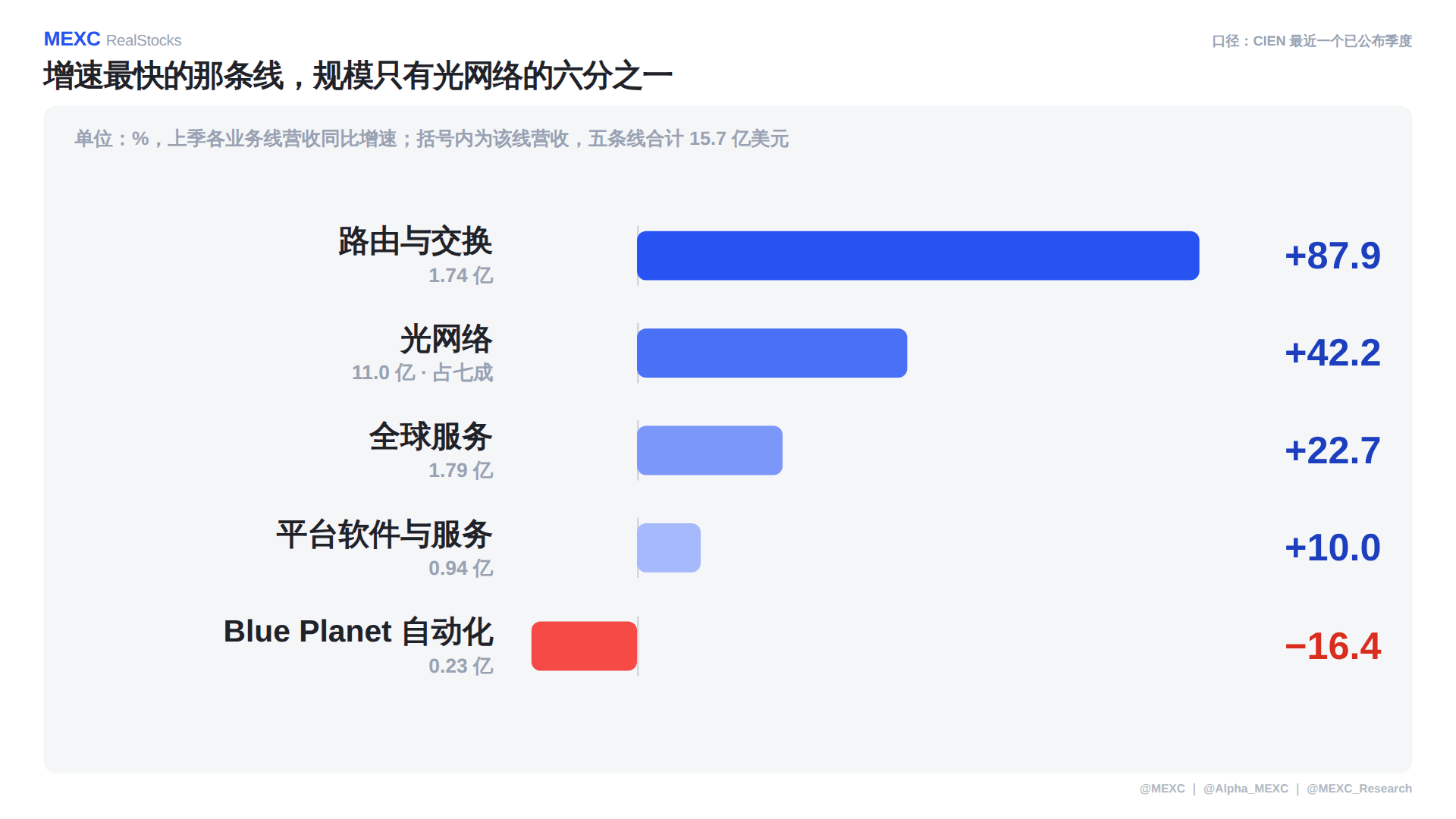
Units are %, representing year-over-year revenue growth for each business line last quarter. Last quarter's total revenue was $1.57 billion, composed of five lines: Optical Networking $1.10 billion, Global Services $179 million, Routing & Switching $174 million, Platform Software & Services $94 million, and Blue Planet Automation $23 million.
Carrying this earnings report is Optical Networking at $1.10 billion, up +42.2% year-over-year, accounting for 70% of revenue alone. But the fastest-growing line is Routing & Switching at +87.9%, albeit with a scale of only $174 million—about one-sixth of Optical Networking. The two lines sell different things: Optical Networking connects data centers to each other; Routing & Switching is the layer where data enters and exits campus networks, following the east-west traffic of AI clusters—small base, greater elasticity.
The way to read it is that growth and scale must be viewed together: A doubling on a small base can't move the overall report, but it tells you where demand is spreading; 42% on a large base is the line that decides this quarter's numbers. Tonight, beyond the headline numbers, it's worth watching whether Routing & Switching can continue to approach doubling and whether Blue Planet's −16.4% has stabilized. Additionally, last quarter's adjusted gross margin was 44.9%, and the company guided this quarter to 45%—when revenue scales on direct purchases from large customers, gross margin is the measure of quality.
Common Questions (FAQ)
Q1: Silver moved less than 1% that day—why could Hecla Mining (HL) rise 8.69%?
Because a miner's extraction costs are roughly fixed within a year, while selling prices fluctuate with metal quotes—small moves in metals flow almost entirely into gross profit, which the stock then amplifies once more. That's operating leverage. Place "metal price change" and "stock price change" side by side, and the multiple between them shows how much leverage exists.
Q2: Both are precious metals—why did silver-side names rise 6% to 9% while gold-side names hovered near 0%?
Because silver is both a precious metal and an industrial metal—solar, electronics, and solder all use silver. A data point signaling "economic slowdown, cooling rate hike bets" is mainly a rate-side positive for gold, but for silver it's a double effect of rate-side plus industrial demand expectations, giving it inherently greater elasticity. The sector averaged a 2.42% gain that day, but this average masks the gap between the two ends.
Q3: In the five-dimension scoring, why do "peer ranking 100" and "trend position 47" appear simultaneously?
Because the two measure different things. Peer ranking compares who rose the most among peers today—a horizontal single-day comparison. Trend position compares how far the price is from its own 52-week high—a vertical cross-time comparison. A stock can easily rise the most on a given day while its price sits only at the midpoint of its own range.
Q4: Miners have all pivoted to AI—why do their stock prices still follow coin prices?
Because the decoupling hasn't happened in prices. Measured by recovery from 52-week lows, Cipher Mining bounced 114.3% while Core Scientific only managed 28.0%—a fourfold difference. But measured by drawdown from highs, all six names cluster between 38% and 55%. They fall together and only diverge on the bounce—amplitude hasn't shrunk. What's diverging is contract quality, not price correlation.
Q5: When assessing a long-term AI contract, which number should you look at first?
Not megawatts—the counterparty. Signed megawatts are only the numerator; the counterparty is the denominator: For the same 10-year lease, whether the payer is Amazon, a Google-backed startup, or a startup expanding on debt financing makes a huge difference in quality. Next, look at concentration (bet on one name or spread across several), and finally, look at when money actually starts flowing—the contract amount is the sum of over a decade into the future; this year's cash flow is a different story.