



Tiger Research: Derivatives Are Beginning to Drive Spot Markets in Reverse, Korea's Asset Pricing Power Is Flowing Overseas


- Core Thesis: Crypto exchanges are entering traditional assets such as equities and commodities through perpetual contracts. Offshore perpetuals tied to Korean stocks have recorded 307 trillion KRW in trading volume within months, creating a "tail wagging the dog" effect that poses both challenges and opportunities for Korea's domestic financial industry.
- Key Elements:
- Driver: Perpetual contracts have no expiry date and require no physical delivery, allowing exchanges to list products tied to traditional assets like stocks at low cost. The share of traditional asset-linked products on platforms such as Hyperliquid has been steadily rising.
- Offshore Scale: From February to August 2026, perpetual contracts tied to Korean stocks accumulated approximately 307 trillion KRW in trading volume, with August alone reaching 166 trillion KRW—roughly four times the combined trading volume (42 trillion KRW) of Korea's top five crypto exchanges during the same period.
- Derivatives Surpassing Spot: In August 2026, perpetual contracts tied to the 3x-leveraged Korea ETF (KORU) saw trading volume of approximately $24.1 billion, 2.7 times the $8.9 billion traded in the KORU ETF itself, indicating derivatives now dominate price discovery.
- Reverse Transmission Mechanism: Market makers hedge perpetual contract exposure by buying or selling stocks or ETFs. The higher derivative trading volume, the greater the impact of hedging capital flows on spot prices, creating a structure where derivatives drive the spot market.
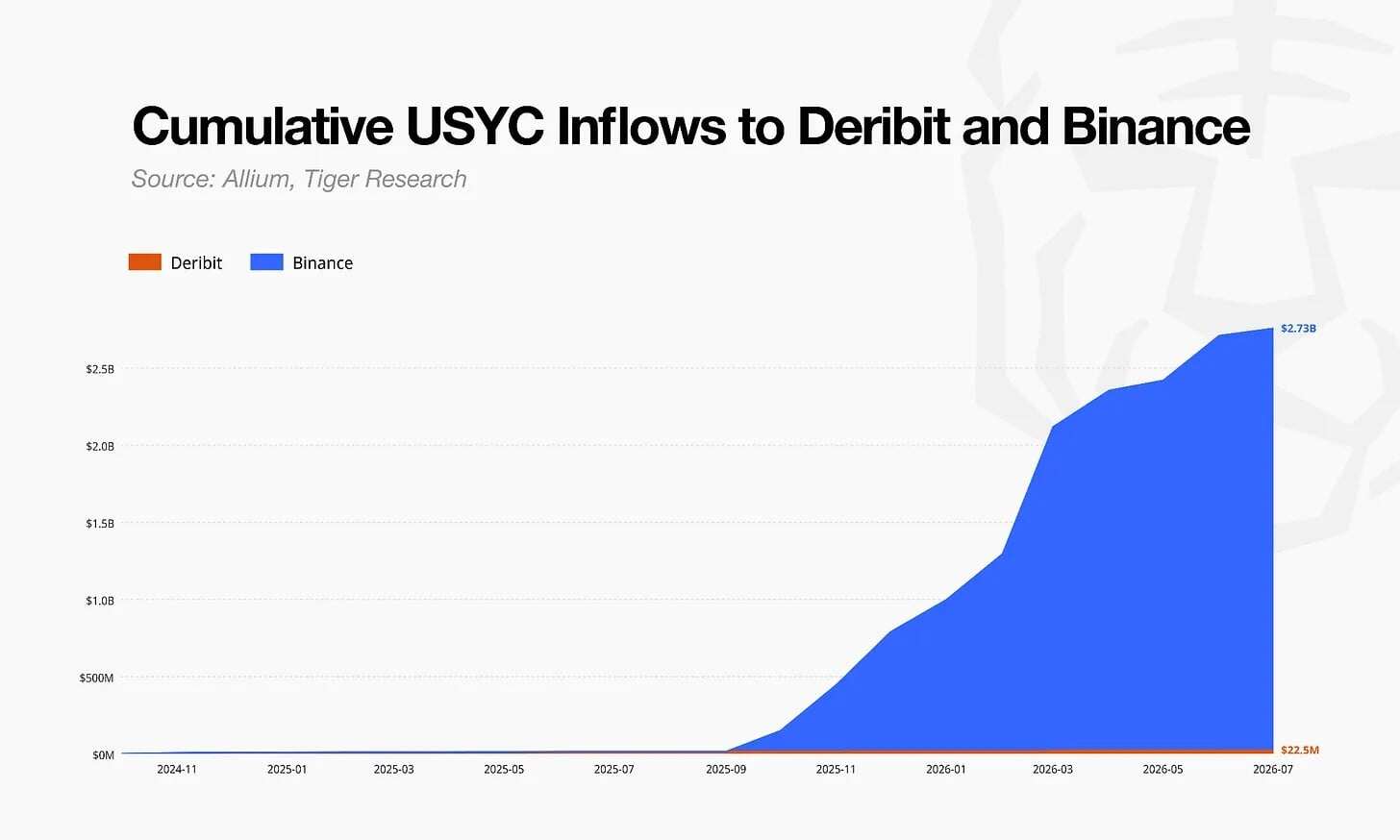
- Shift in Market Participants: On Hyperliquid, the share of traditional asset trading among accounts holding over $10 million in assets is rising rapidly, with Wall Street professional traders using perpetual contracts during off-hours. Tokenized U.S. Treasuries (such as BUIDL and USYC) have entered as collateral, with cumulative transfers of USYC to exchanges reaching approximately $2.75 billion over the past year.
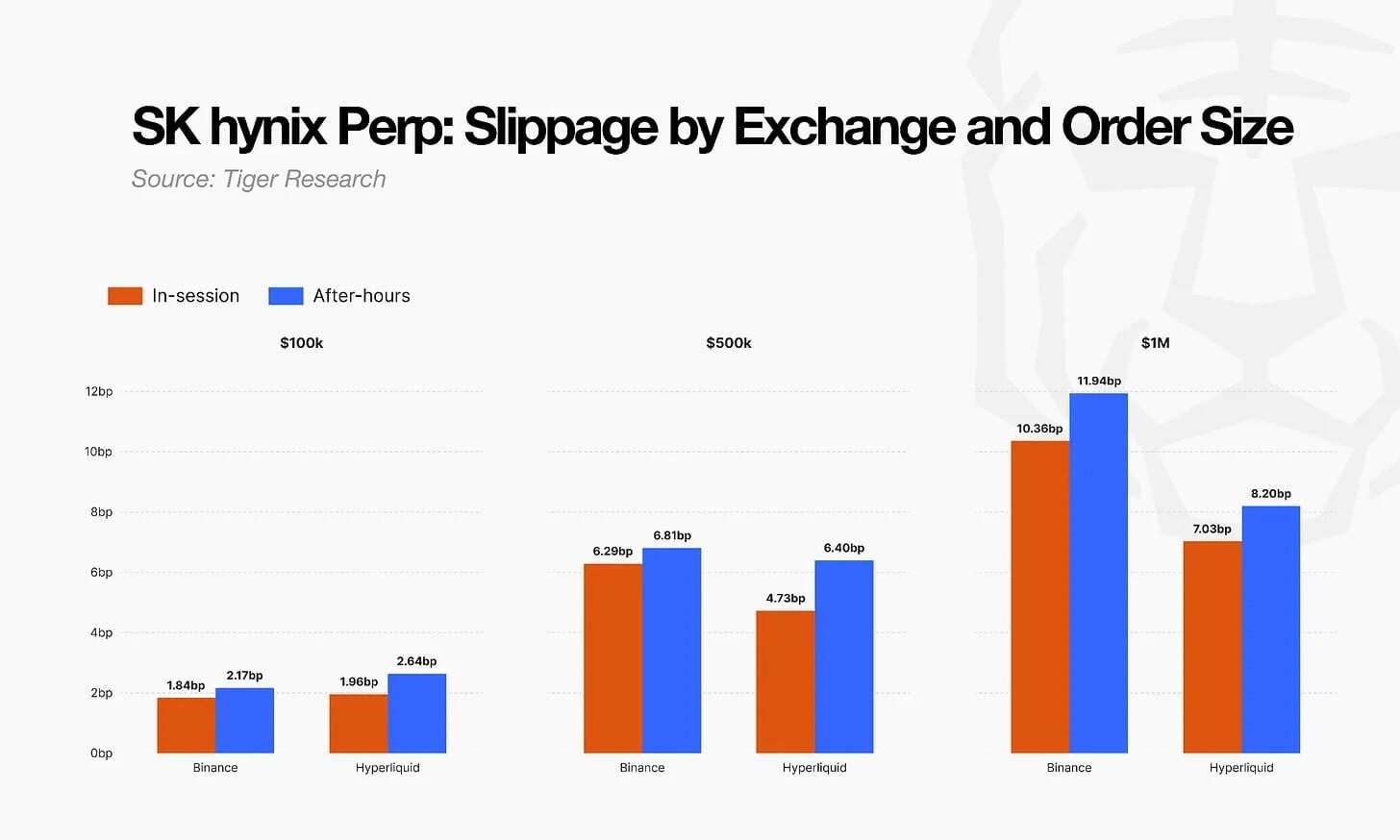
- Liquidity Depth: A $1 million trade on SK Hynix perpetual contracts has a slippage of only single-digit basis points at the 15-day average, maintaining low slippage even when the Korean stock market is closed, demonstrating that the offshore market has established independent liquidity.
- Korea's Response Conditions: Korea needs to allow corporate access to domestic crypto exchanges, establish a formal derivatives regulatory framework, and build out payment and settlement infrastructure such as a KRW stablecoin to convert offshore growth into opportunities for its domestic financial industry.
This article was written by Tiger Research. Crypto exchanges are entering traditional assets such as equities and commodities through perpetual contracts. Perpetual contracts tied to Korean stocks have already reached 307 trillion KRW in trading volume within months. This report outlines the rise of offshore liquidity and the conditions Korea needs to meet to participate in this market.
Key Takeaways
- Crypto exchanges are rapidly entering traditional assets such as equities and commodities through perpetual contracts.
- Perpetual contracts tied to Korean stocks have recorded approximately 307 trillion KRW in trading volume within a few months, highlighting the growing importance of the offshore market.
- Korea needs to allow corporate access to domestic crypto exchanges, establish a formal derivatives framework, and build out KRW stablecoin infrastructure.
Crypto Exchanges Are Moving Into Traditional Markets
Crypto exchanges are no longer just about digital assets. Bitcoin and Ethereum once dominated trading volumes on these platforms, but products tied to traditional assets such as equities and commodities are now growing rapidly.
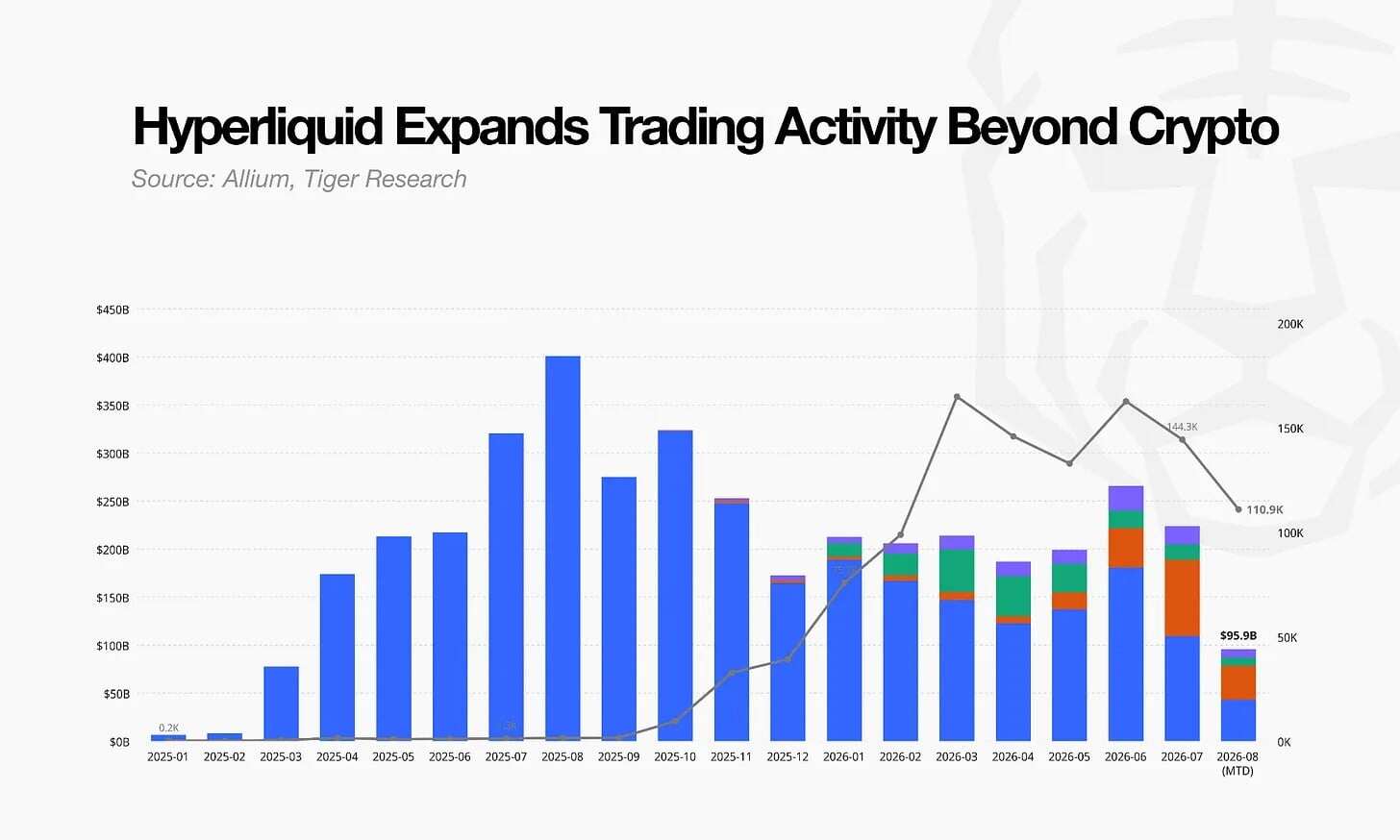
On decentralized exchange Hyperliquid, the share of traditional asset-linked products in the 2026 trading structure has been steadily rising, and the number of users trading these products is also growing. The infrastructure originally built for crypto trading is becoming a new venue for traditional financial markets.
Perpetual contracts are driving this shift. These derivatives allow investors to gain price exposure without holding the underlying asset. Unlike traditional futures, they have no expiration date and do not require physical delivery.
This is why exchanges can relatively easily list products tied to stocks and commodities, giving crypto exchanges a viable path: extending outward from digital assets into traditional markets.
Korea Is No Exception: Korean Stock Trading Is Moving Offshore
Korea is already at the center of this shift. Offshore crypto exchanges are actively trading perpetual contracts tied to major Korean stocks such as Samsung Electronics and SK Hynix. These products can be traded around the clock and on weekends, and they offer high leverage, giving Korean investors and global capital a new way to gain exposure to Korean stocks. An offshore market that allows direct trading of Korean stock price movements without being bound by Korean trading hours is rapidly taking shape.
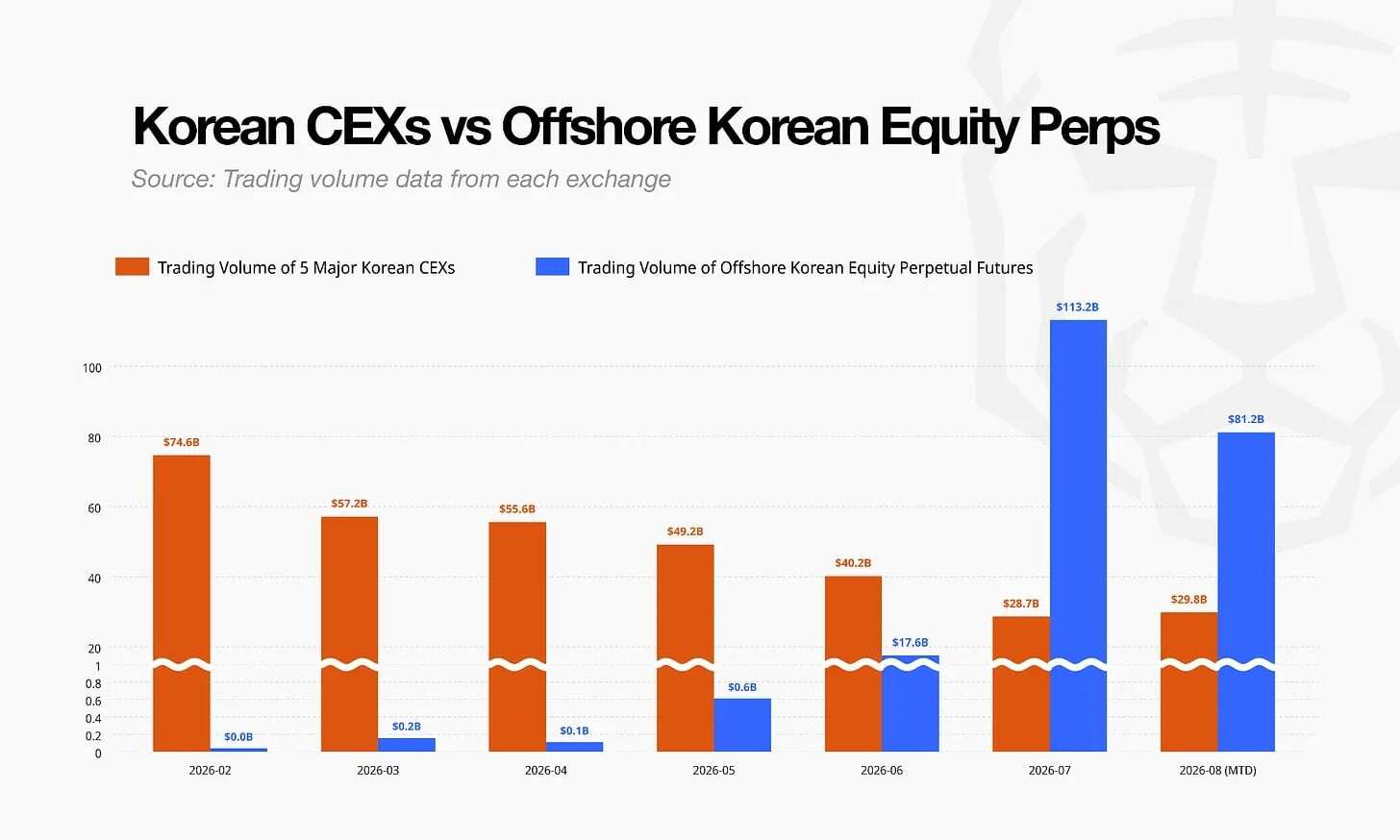
The scale is growing quickly. From February to August 2026, perpetual contracts tied to Korean stocks recorded cumulative trading volume of approximately 307 trillion KRW. August alone saw 166 trillion KRW in trading volume—nearly four times the 42 trillion KRW traded on Korea's top five crypto exchanges during the same period. Within just a few months, offshore perpetual markets tied to Korean stocks have already surpassed the size of Korea's major domestic crypto market.
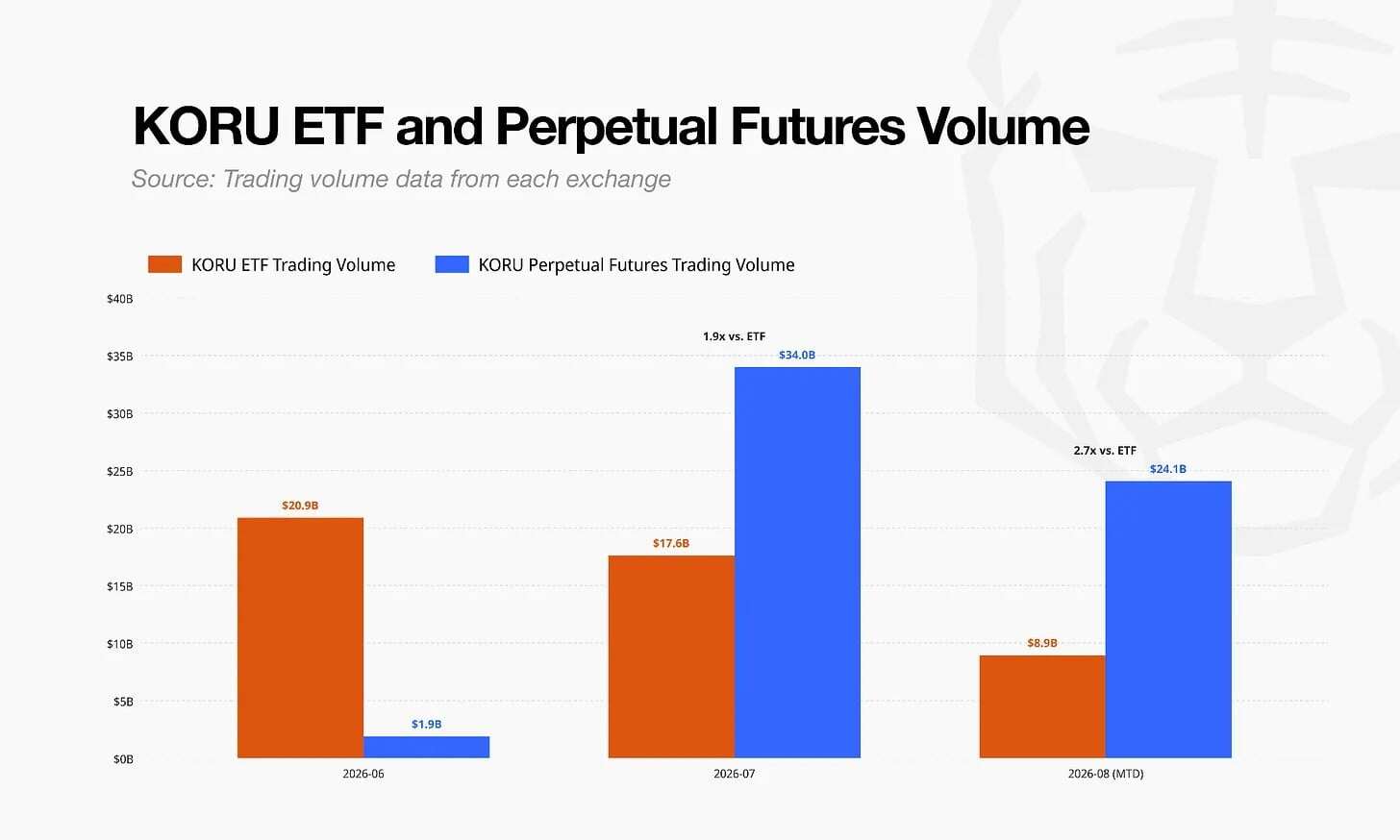
On some products, perpetual contract volume has already far exceeded that of the corresponding ETF. In August 2026, perpetual contracts tied to the 3x leveraged Korea ETF listed in the U.S. (KORU) recorded approximately $24.1 billion in trading volume, while the KORU ETF itself traded $8.9 billion—the former being roughly 2.7 times the latter. In other words, derivatives volume has already surpassed the ETF itself. Once derivatives trading exceeds the underlying market, offshore venues could play a larger role in price discovery.
More critically, the offshore derivatives market can also feed back into the spot market. Market makers providing liquidity for perpetual contracts hedge their exposure by buying or selling the underlying stocks or ETFs. The higher the derivatives volume, the more such hedging activity occurs; this is also amplified during periods of sharp price volatility. These capital flows ultimately transmit to spot prices.
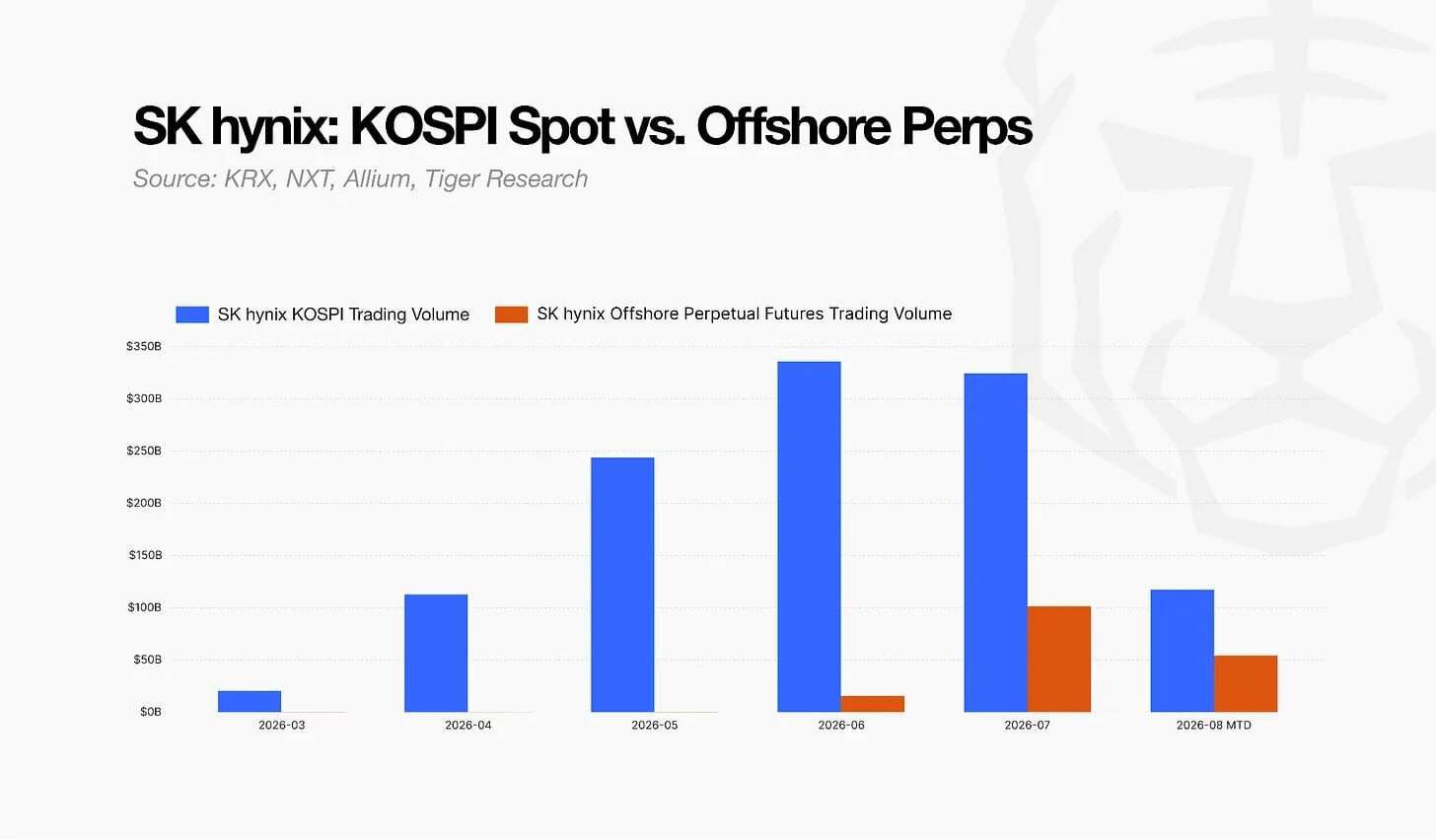
This structure could create a "tail wagging the dog" dynamic: rather than spot leading derivatives, derivatives could end up driving spot. For large-cap stocks like SK Hynix, spot volume is still significantly larger, so the impact is limited for now. But the gap between derivatives and spot volume is narrowing rapidly, and this is a trend worth watching closely.
Global Markets Are Changing—Liquidity Is Going Offshore
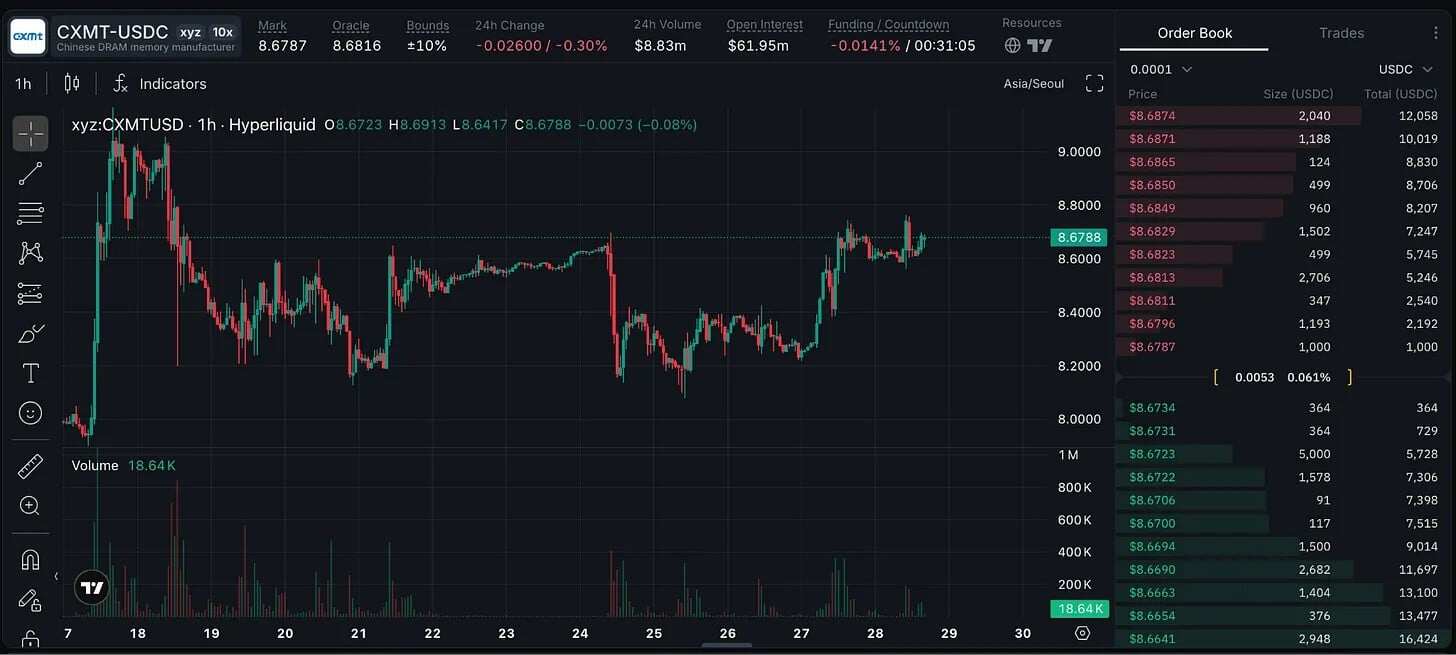
Offshore trading of Korean stocks is not unique to Korea. Perpetual contracts are rapidly expanding across stocks and indices in Korea, Japan, China, and elsewhere, and the scope has already extended beyond listed companies. Offshore venues have listed perpetual contracts tied to unlisted companies like Anthropic, and have also launched products tied to CXMT (ChangXin Memory Technologies), an unlisted Chinese memory chip maker. Assets that were once difficult to trade through traditional securities markets are now entering the perpetual contract market. The traditional boundaries of what investors can trade are being rapidly blurred.
The participants are changing too. Among accounts on Hyperliquid with assets exceeding $10 million, the proportion trading traditional assets like stocks and commodities is rising rapidly. The Wall Street Journal has also reported that professional Wall Street traders use perpetual contracts outside regular trading hours and on weekends. This market was once dominated by crypto investors, but is now attracting professional traders and investors managing large amounts of capital.

Liquidity itself is also worth examining. Based on the 15-day average, trading $1 million on SK Hynix perpetual contracts results in slippage of only a few basis points. Even outside regular trading hours, slippage remains relatively low. This means that even when the Korean stock market is closed, this market has sufficient depth to absorb large orders. Perpetual contracts are no longer just about "extended trading hours"—they are building their own liquidity.
The capital used for trading is also evolving. Some global exchanges now accept tokenized U.S. Treasuries as margin, including BlackRock's BUIDL and Hashnote's USYC. Over the past year, approximately $2.75 billion has been transferred into exchanges in USYC. Not all of it is used as derivatives margin, but institutions can hold familiar Treasury-like assets and deploy them as trading collateral when needed. Traditional financial assets are beginning to serve as margin in these new markets, creating a new capital channel between traditional finance and new trading venues.
What we are witnessing is not just crypto markets expanding into traditional assets. An offshore market where Korean stock prices can be traded—without going through the KRW, domestic brokers, or the Korea Exchange—is growing rapidly. Tokenized Treasuries serve as margin here, and professional traders and large asset managers have already entered. The change is no longer limited to trading instruments; participants and the forms of capital are being rewritten as well.
Perpetual contracts tied to Korean stocks recorded 307 trillion KRW in trading volume within months. This number shows how fast the change is happening. But 307 trillion KRW does not represent the size of a mature market—it is merely the current scale of a market still taking shape. If more assets become tradable and institutional capital enters at scale, offshore liquidity could continue to expand. The long-standing market structure divided by national borders and trading hours, as well as the way capital flows across markets, could both be rewritten.

The Offshore Market Is Growing—What Role Can Korea's Financial Industry Play?
Korea can restrict its own investors from trading these products, but it cannot easily stop the growth of the offshore market itself. Some global exchanges, including Binance, restrict perpetual contract trading for accounts identified as Korean users through KYC. But the market tied to Korean stocks can still continue to expand through overseas investors and global capital. The reality is that Korean regulation primarily limits the participation of domestic investors and financial institutions, not the offshore market itself. Even if domestic demand is suppressed, trading and liquidity can still grow overseas.
Therefore, Korea cannot just try to block this trend—it also needs to turn the growth of this new market into an opportunity for its own financial industry. Korea is not without a starting point: its domestic crypto exchanges. They cannot directly list perpetual contracts tied to stocks in the near term, but they already have experience operating 24/7 digital asset markets and have a sizable user base. These conditions can support expansion into new markets. Global crypto exchanges are rapidly moving into traditional assets, and Korea should also review the rules and market structures needed to support this transition.
Trading infrastructure alone is not enough. Korea also needs corporate access to the market, a derivatives regulatory framework, and KRW-denominated payment and settlement infrastructure. Corporate accounts can bring in the professional capital needed for market making, hedging, and arbitrage, while also adding liquidity. A formal framework for derivatives such as perpetual contracts is necessary to support products tied to a broader range of assets. Payment and settlement instruments like a KRW stablecoin could lower the barrier for overseas investors and facilitate capital flows in and out. These are not separate regulatory issues—they are the supporting conditions required for the market to function.
What Korea needs is a framework that makes these components work together, rather than piecemeal fixes. Only then can Korean crypto exchanges move beyond pure crypto trading and connect a broader range of assets with global liquidity. Trading tied to Korean assets is already growing rapidly offshore. The real question is not how to stop the growth, but how much of this market Korea's financial industry can capture.