




LIT hits new highs repeatedly—what is Lighter doing right?


- Key Insight: Perp DEX Lighter, leveraging its bespoke ZK Rollup architecture designed specifically for trading, encodes order book matching rules into cryptographic proofs, delivering verifiable liquidation mechanisms with Ethereum mainnet-grade security. Against the backdrop of soaring token prices and TVL breaking into the top ranks, it has charted a distinct technical path different from Hyperliquid.
- Key Elements:
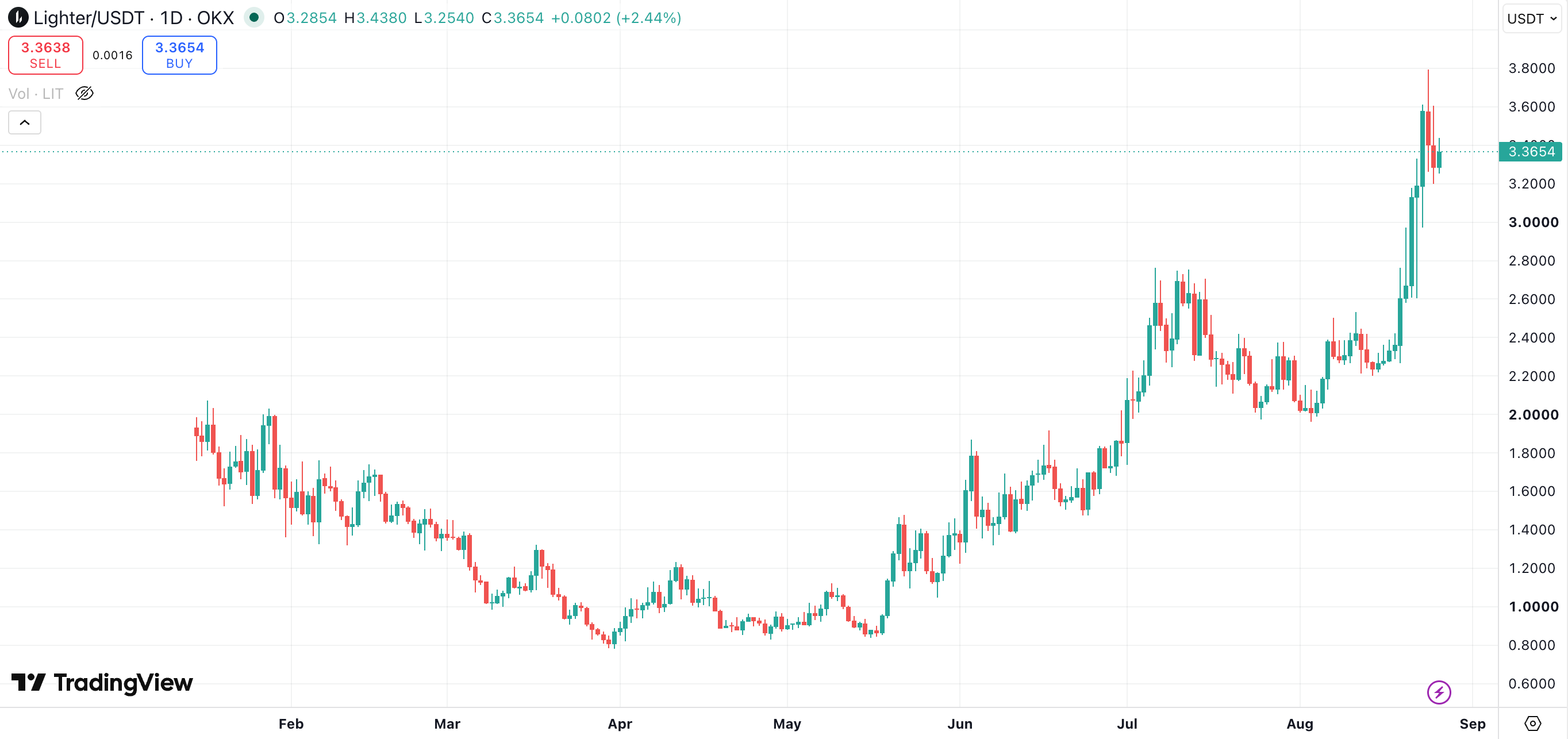
- The LIT token has been hitting new highs continuously since August 20, peaking at $3.8—a nearly 5x increase from its March low. Current circulating supply accounts for only 25% of the total, with team and investor allocations locked until the end of 2026. The main selling pressure comes from staking rewards.
- Buyback and burn efforts are significant. Official data shows 17.3 million LIT tokens have been repurchased, representing 1.73% of the total supply and 6.92% of the circulating supply, further reducing supply amid limited circulation.
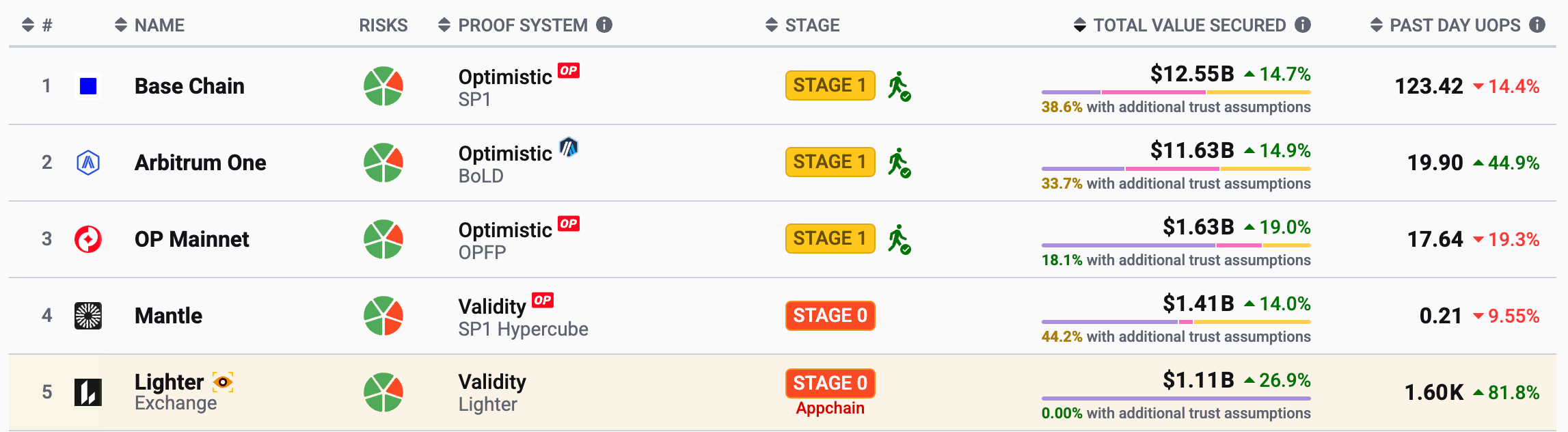
- As an independently developed ZK Rollup application-specific chain, Lighter achieves matching latency below 5 milliseconds and processes 20,000 orders per block. Its TVL exceeds $1.1 billion, ranking fifth in the L2BEAT leaderboard.
- The core innovation lies in encoding exchange rules directly into circuits. The Order Book Tree structure combines logarithmic proof complexity with price-time priority principles, enabling cryptographically verifiable liquidation and funding rate execution.
- Inheriting Ethereum L1 security, it provides an exit guarantee mechanism: when sequencers censor transactions, users can force-submit transactions on L1. If unprocessed for more than 14 days, it enters Desert Mode, supporting state reconstruction and withdrawals from on-chain data.
- Funds are custodied in Ethereum smart contracts, allowing users to deposit directly from multiple chains and reuse ecosystem assets like Aave's, providing a liquidity network effect that Hyperliquid lacks. LighterEVM enables parallel operation of the core trading engine and general-purpose contracts with atomically shared state.
- Block verification time has been reduced from approximately 5.3 minutes to roughly 1 minute, achieved through heavy/light circuit decomposition and Plonky2 prover optimization. This halves verification costs for simple transactions and marks the first batch of improvement results to go live.
Original author: Eric, Foresight News
Starting from August 20, Lighter, a perp DEX backed by former Citadel quant team members, saw its token LIT continuously hit new highs. By August 26, LIT peaked at $3.8, nearly a 5x increase from the low of around $0.78 recorded on March 30 this year.
The first thing to note is that currently only about 25% of LIT's total supply is in circulation. The portions held by the team and investors are locked until December 30, 2026. The current sell pressure on LIT comes only from staking rewards, which are limited in quantity. During a price rally, users have a stronger incentive to stake and tend to hold onto their tokens.

With limited circulating supply, LIT's buyback and burn program is also quite aggressive. According to the official dashboard, the total amount of LIT bought back has reached 17.3 million, accounting for 1.73% of the total supply and 6.92% of the circulating supply.
In July, we analyzed the reasons behind LIT's continuous rise in our article "Running with Robinhood, Is Lighter Playing a Bigger Game?" (https://foresightnews.pro/article/detail/98462), covering aspects such as the buyback and burn mechanism and the partnership with Robinhood. Beyond these business-level catalysts, Lighter has also made unique innovations at the chain level.
Before Lighter, on-chain derivatives essentially faced an impossible trinity. General-purpose L2s like Arbitrum had fees and latency unsuitable for high-frequency order placement; standalone chains like dYdX v4 and Hyperliquid compromised on security to a certain extent; and StarkEx-style hybrid order books relied on centralized matching, posing censorship and MEV risks.
Hyperliquid built its own L1, using the HyperBFT consensus to run the matching engine directly within the validator set, achieving sub-second finality and throughput exceeding 200,000 transactions per second. The cost is that the security model relies entirely on itself, with dozens of validator nodes supporting the entire chain, and cross-chain asset transfers depending on bridges.
Lighter chose a different direction. It is a ZK Rollup built solely for trading, with matching, clearing, and risk management all encapsulated in its self-developed Lighter Core. It uses a customized proof engine to generate zk-SNARK proofs, then submits the compressed state to the Ethereum mainnet. Compared to general-purpose zkVMs, this approach sacrifices versatility in exchange for proof speed, latency stability, and execution efficiency for high-frequency order books. The official metrics cite matching latency below 5 milliseconds, with a single block capable of packing 20,000 orders and cancellations.
According to L2BEAT data, as an independently developed L2 that does not use existing ZK Rollup stacks, Lighter's TVL has exceeded $1.1 billion, ranking fifth, trailing only Base, Arbitrum, OP Mainnet, and Mantle.
Lighter's system consists of three roles. The sequencer orders transactions on a first-in, first-out basis and provides soft finality; the prover generates proofs for each block; and smart contracts on Ethereum custody user funds, store state roots, and verify each proof.
The real differentiator lies in what the circuit proofs contain. Most Rollups only prove that state transitions are valid. Lighter's circuits encode the exchange's rules themselves into zk constraints. It uses a binary prefix tree structure called an Order Book Tree, encoding the price-time priority principle into leaf indices, with proof complexity only logarithmic. This means the protocol can cryptographically prove that the highest-priority orders execute first, that funding rate caps are correctly enforced, and that liquidations use the correct formulas.
This is especially crucial for perpetual contracts. Leveraged positions are collateralized, and liquidation is automatic and mechanical. If you can't verify that liquidations are executed correctly, you're trusting the platform at the exact moment it has the least incentive to be honest with you. Verifiable liquidation isn't just marketing talk—it's the core significance of this architecture.
As an Ethereum L2, Lighter inherits two things that standalone L1s cannot provide.
The first is exit assurance. If the sequencer continuously censors transactions, users can force-submit transactions directly on L1. If transactions remain unprocessed for more than 14 days, the system freezes and enters "Desert Mode," where users can rebuild state from on-chain data, submit balance proofs, and withdraw—all without requiring cooperation from the operator. L2BEAT has actually reproduced this process, rebuilding the state root from L1 blob data and verifying it up to the chain head. All state data needed to construct proofs is published on-chain, which is the prerequisite for the escape hatch to work.
The second is liquidity network effects. Lighter's funds are custodied in Ethereum contracts, allowing users to deposit directly from multiple chains such as Ethereum, Arbitrum, Base, and Solana. They can also reuse assets from Aave, Uniswap, and the Ethereum stablecoin ecosystem without complex cross-chain bridges. Hyperliquid's composability, in contrast, is confined within HyperEVM and cannot directly tap into the hundreds of billions of dollars in TVL on Ethereum.
Another point worth mentioning is LighterEVM's horizontal architecture. The core trading engine runs on customized ZK circuits, while general-purpose smart contracts run in a parallel zkVM environment. The two are logically separated but can atomically share state. No matter how congested on-chain lending protocols become, the core order book's matching speed remains unaffected, while developers can build structured products on the EVM side that directly read from the order book.
Just yesterday, Lighter published an update on its latest progress in the verification system. Over the past month, Lighter's average block verification time dropped from approximately 5.3 minutes to about 1 minute, achieved through two independent improvements: first, a "heavy/light decomposition" that splits the verification circuit based on transaction complexity, allowing the more than 98% of simple transactions to incur lower verification costs—a change that halved verification time; second, results from a prover optimization competition co-hosted with Eigen Labs, focusing on pure infrastructure-level optimizations for the Plonky2 prover, with the first batch going live on August 23, again reducing verification time by more than half.
A piece of trivia: when tokenized RWAs were just beginning to emerge, ZKsync held the most on-chain RWA assets.
For one simple reason: security.
Even today, ZKsync still ranks in the top ten, ahead of chains like Arbitrum, Polygon, and Base that appear stronger on paper. The advantage of ZK proofs is that while finality strictly speaking still requires waiting for Ethereum mainnet confirmation, the verification of transaction credibility is already completed on the L2. For institutions, even if it's slightly slower or more costly than other L2s or self-built L1s, it's completely acceptable.
Compared to general-purpose ZK Rollups like ZKsync and Starknet, and even dedicated L2s built on those general-purpose ZK Rollup stacks, Lighter's biggest advantage is writing trading, clearing, and other logic directly into the circuits. Combined with Ethereum mainnet-level security, this mechanism—even safer than traditional clearing institutions—gives it the full capability to establish a firm foothold in the fiercely competitive perp DEX market.
The partnership with Robinhood is a case in point. Beyond also using payment for order flow and having a team with deep backgrounds, Lighter's mechanism gives it unique advantages in security and compliance. The market's willingness to pay a premium for this architecture has clear logic. For projects looking to sell perpetual contracts to Robinhood users and traditional financial institutions, "matching rules written into circuits, funds secured by Ethereum" is a story that can be told to compliance departments and auditors.
Hyperliquid has proven that performance can come from consensus; Lighter is proving that trust can come from proofs. While other perp DEXs rack their brains over operations and business strategies, Lighter has forged a new "path."