



MLCC has also entered the "long-term agreement era": Samsung Electro-Mechanics signed a $200 million long-term supply agreement with a tech giant, securing supply for 2027


- Core Insight: Samsung Electro-Mechanics has consecutively signed large-scale long-term supply contracts for AI server MLCCs, signaling that the MLCC electronic component category is evolving from a short-term order model to a long-term agreement format to meet the robust demand from AI infrastructure.
- Key Elements:
- In July, Samsung Electro-Mechanics signed an MLCC supply contract worth approximately $204 million for the entire year of 2027. The total value of publicly disclosed AI server MLCC contracts signed this year has reached $510 million.
- When including the approximately $1.03 billion silicon capacitor long-term agreement signed in May, the total value of AI server component supply agreements this year has exceeded $1.5 billion.
- The number of MLCCs required for AI servers far exceeds that for standard servers, with up to 600,000 units installed per rack. These must also meet stringent technical standards for ultra-miniaturization and high-temperature resistance.
- Samsung Electro-Mechanics holds over a 40% market share in the AI server MLCC market, with its technological advantages serving as the core support for continuously securing major customer orders.
Original author: Dong Jing
Original source: Wall Street Insights
Samsung Electro-Mechanics is shifting its AI server MLCC business toward a "long-term contract" trajectory, a trend that is reshaping the supply and demand dynamics of this core electronic component.
According to reports, on July 23, Samsung Electro-Mechanics disclosed that it had signed a MLCC supply contract worth 295.12 billion KRW (approximately $204 million) with a global tech giant, with the supply period covering the entirety of 2027. The counterparty to the transaction was not disclosed due to a confidentiality agreement between the parties.
This marks the second consecutive month that Samsung Electro-Mechanics has secured a large-scale order of this kind, following a roughly 450 billion KRW AI server MLCC order in June. The total value of publicly disclosed AI server MLCC contracts this year has now reached 750 billion KRW (approximately $510 million). If the long-term silicon capacitor contract of about 1.5 trillion KRW signed in May is included, the total value of AI server component supply agreements this year has exceeded 2.25 trillion KRW (approximately $1.5 billion).
Samsung Electro-Mechanics President Chang Duck-hyun stated:
"This large-scale contract is the result of our MLCC technology being fully recognized as a core component of AI infrastructure. Based on our customers' deep trust, we will accelerate the development of next-generation cutting-edge products, build a stable supply chain, and lead the AI components market."
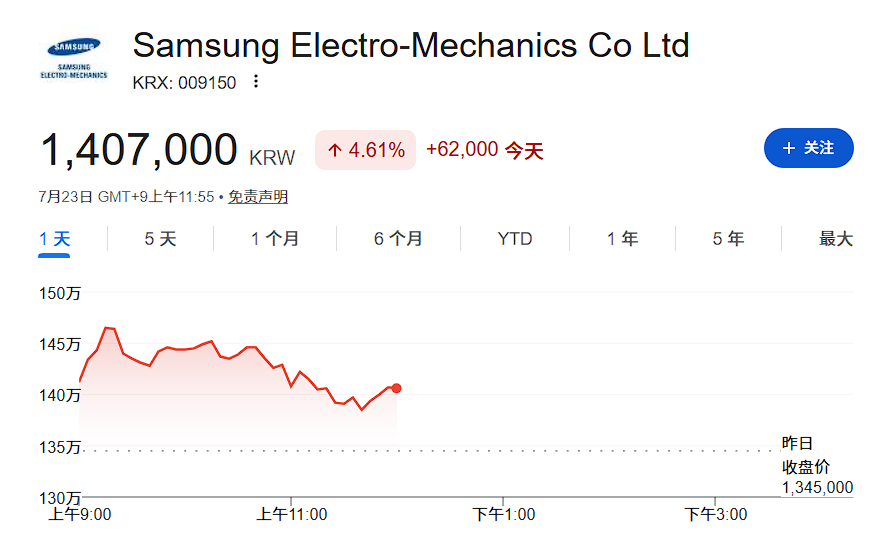
On the day of the announcement, Samsung Electro-Mechanics' stock price surged over 8% during trading, hitting 1.475 million KRW, outperforming heavyweight stocks like Samsung Electronics and SK Hynix among components of the Korea Composite Stock Price Index (KOSPI).
Consecutive Large Orders: Accelerated Accumulation of AI Server MLCC Orders
The value of this contract accounts for approximately 2.6% of Samsung Electro-Mechanics' consolidated revenue of 11.3145 trillion KRW last year. The supply includes high-volume, core high-performance MLCCs for the customer's AI servers and data center systems. A timeline of Samsung Electro-Mechanics' AI server component orders this year reveals a clear acceleration:
In May, the company signed a long-term silicon capacitor supply contract worth approximately 1.5 trillion KRW with a global customer. In June, it signed another AI server MLCC supply agreement worth about 450 billion KRW with a global tech giant. The contract disclosed in July further pushes the total value of publicly announced AI server MLCC contracts for the year to 750 billion KRW.
According to reports, industry observers noted that such a dense concentration of large-scale, long-term MLCC supply contracts is rare in the industry, signaling that MLCCs—a component category traditionally dominated by short-term orders—are accelerating their transition toward a long-term contract model driven by AI infrastructure demand.
Known as the "rice of the electronics industry," MLCCs serve the core function of providing stable current and controlling voltage fluctuations in electronic circuits. In the context of AI servers, the strategic value of this function is significantly amplified.
Compared to regular servers, AI servers require more than ten times the number of MLCCs—up to 600,000 MLCCs per server rack.
At the same time, the specifications required for MLCCs in AI servers are extremely stringent, demanding ultra-miniaturized, ultra-high-capacity designs, along with multiple reliability standards such as high-temperature resistance, high-voltage resistance, and resistance to board warpage. The technical barriers are very high, and the number of companies capable of large-scale mass supply is extremely limited.
As for silicon capacitors, these are installed inside AI chip packages (including GPUs and high-bandwidth memory HBM) to help stabilize the power supply. Their resistance is about one-hundredth that of traditional MLCCs, offering outstanding performance advantages.
Samsung Electro-Mechanics maintains a global leading position in the AI server MLCC market, with a market share exceeding 40%. This market share advantage is considered a key support for the company's continued favor with major customers and was a significant driver of the sharp stock price increase following the disclosure of the long-term silicon capacitor contract in May.
Samsung Electro-Mechanics stated that it is currently in further discussions with several global customers regarding mid- to long-term MLCC supply plans. By expanding these long-term supply contracts, the company aims to solidify a stable demand base for AI server MLCCs while accelerating its transformation toward a high value-added product portfolio centered on industrial, automotive electronics, and AI server applications.