




Google's earnings were impressive enough, but why isn't Wall Street buying it?


- Key Point: Alphabet, Google's parent company, reported Q2 2026 earnings with growth in both revenue and profit, and Google Cloud's performance surpassed expectations. However, the market reacted negatively due to concerns over the pressure on cash flow from massive AI infrastructure capital expenditures (Capex) and the competitiveness of its AI models. The stock fell in after-hours trading, with the core contradiction lying in the speed of value realization from AI investments.
- Key Elements:
- Alphabet's Q2 revenue was $119.8 billion, up 24% year-over-year, with operating profit of $40.8 billion, up 30%. However, EPS was below expectations when excluding gains from the equity valuation of Anthropic.
- Google Cloud revenue reached $24.77 billion, a significant 82% year-over-year increase, making it the fastest-growing business segment. However, Capex surged to $44.9 billion, with the full-year guidance raised to $195-205 billion.
- Free cash flow turned negative for the first time, reaching -$5.855 billion. To support AI infrastructure, the company has issued approximately $49.6 billion in convertible preferred stock and $20.3 billion in bonds, increasing its leverage.
- The growth driver for Google Cloud has shifted to AI infrastructure and solutions, with remaining performance obligations reaching $514 billion. However, its annualized revenue (approximately $100 billion) still needs to cover the full-year Capex of $200 billion.
- The Gemini App reached 950 million monthly active users, with nearly 90% of Fortune 100 companies using Gemini Enterprise. However, concerns about model capabilities are prominent. The release of Gemini 3.5 Pro has been delayed, facing competitive pressure from Anthropic, OpenAI, and others.
- Market focus has shifted from profitability to Capex efficiency, demanding that AI investments convert into commercial value more quickly. Otherwise, the traditional search portal advantage could be eroded by the AI assistant ecosystem.
Original by Odaily Planet Daily (@OdailyChina)
Author: Azuma (@azuma_eth)
On the morning of July 22, Beijing time, Google parent company Alphabet released its Q2 2026 earnings report after the U.S. stock market closed.
Looking purely at the financial figures, this is a nearly flawless report card. In Q2, Alphabet achieved revenue of $119.8 billion, a 24% year-over-year increase, and operating profit of $40.8 billion, up 30% year-over-year — the company has maintained double-digit revenue growth for 12 consecutive quarters, with its core business continuing to demonstrate strong growth resilience.
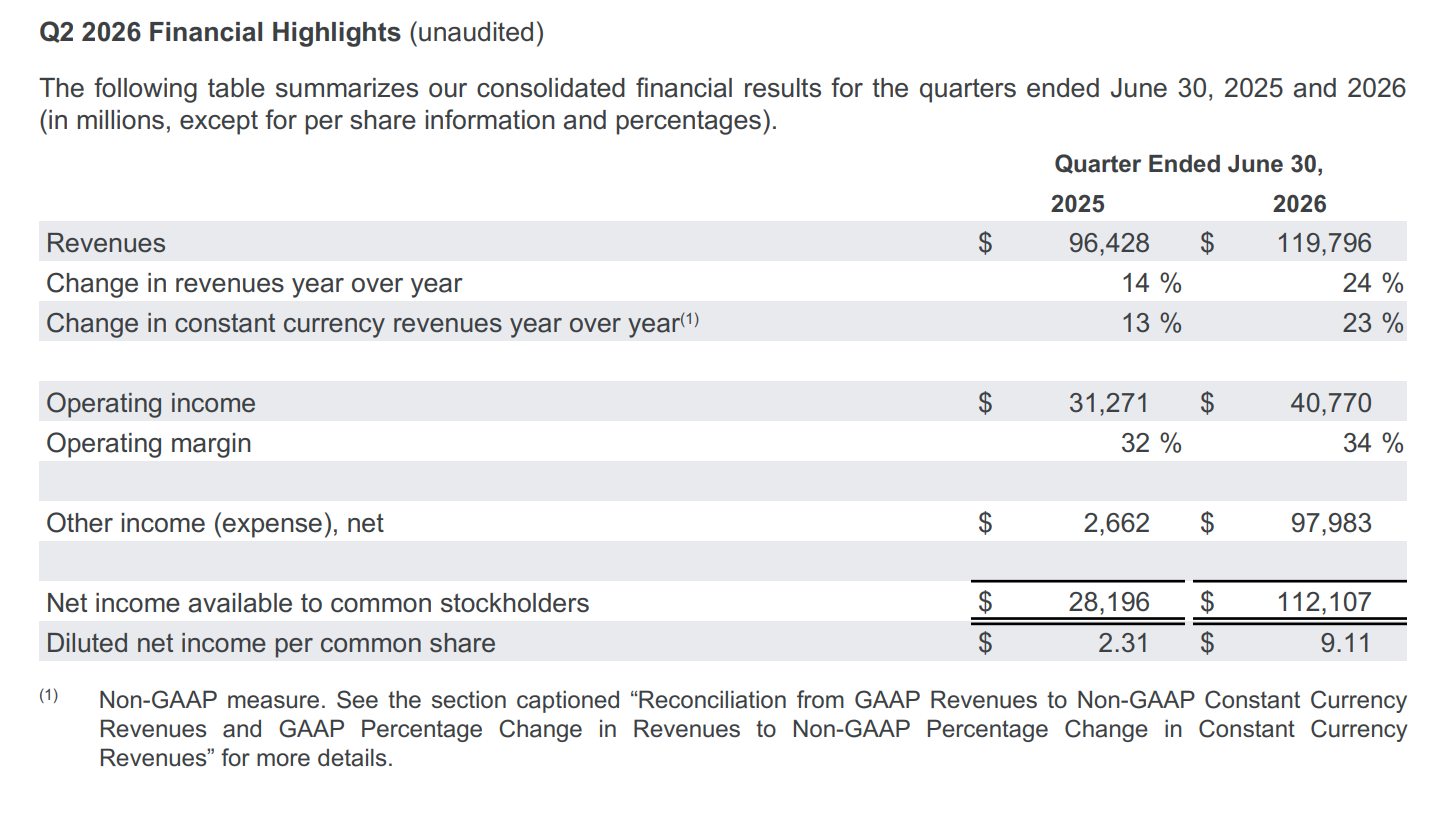
- Odaily Note: As shown in the table above, many investors noticed Google's explosive EPS of $9.11 for this quarter, emphasizing that this figure is significantly higher than the $2.31 in the same period last year. However, this is mainly due to the valuation increase from its 14% stake in Anthropic; excluding related gains, EPS would be only $2.85, below market expectations of $2.95.
Among them, Google Cloud, which has garnered the most market attention, delivered results that far exceeded expectations. In the last quarter, Google Cloud revenue reached $24.77 billion, a year-over-year increase of 82%, making it Alphabet's fastest-growing business segment.
At the same time, Google's traditional core business remains robust. Google Services revenue was $94.54 billion, up 15% year-over-year, with Search and other revenue at $63.27 billion (up 17%) and YouTube ad revenue at $11.06 billion (up 13%).
From revenue and profit to AI business progress, Google delivered almost exactly what all investors hoped to see. Interestingly, however, Alphabet's stock price did not rise after the earnings release; instead, it fell nearly 3% in after-hours trading.
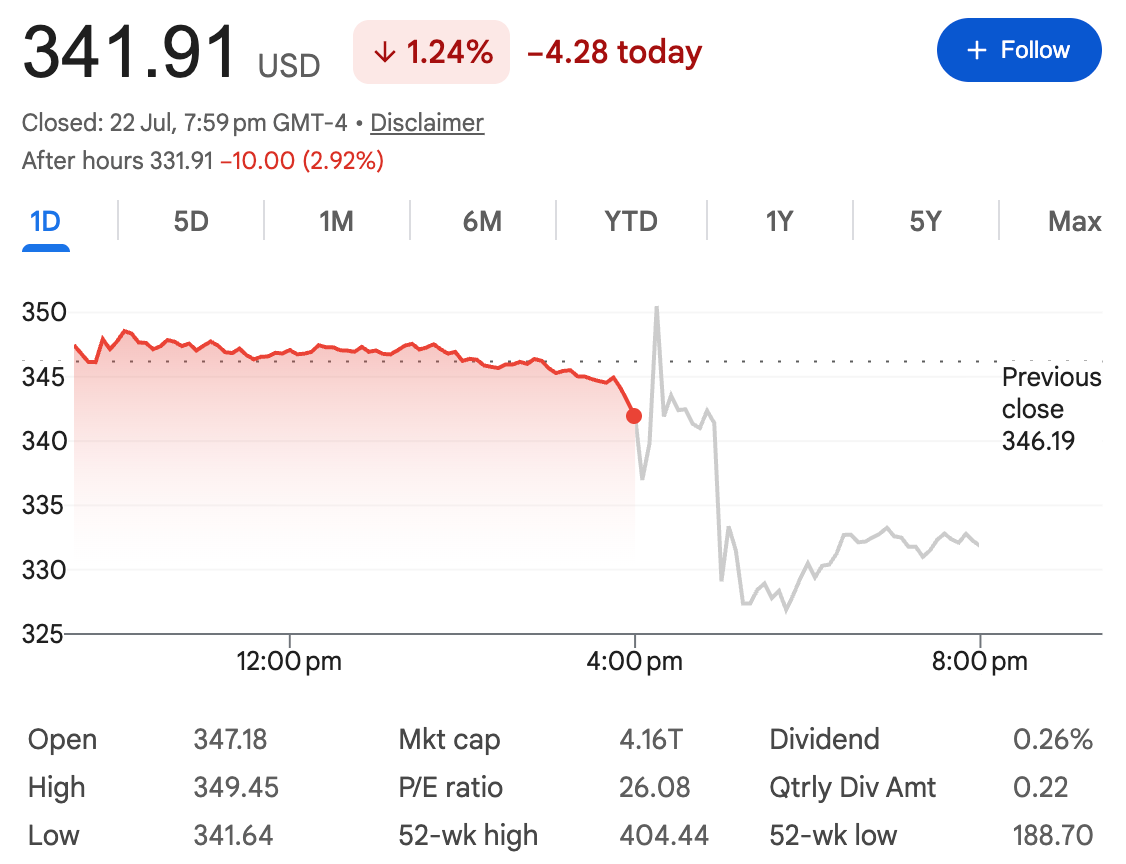
Why isn't the market buying it? The reason isn't hard to understand — compared to "how much money Google made," the market now places greater emphasis on "how much Google has to pay to win the AI era."
Capex Surges to $200 Billion, Free Cash Flow Turns Negative for the First Time
Over the past few years, thanks to continuous profit generation from businesses like Search and Advertising, Google has been one of the most cash-rich companies among global tech giants. However, as the AI competition enters a white-hot phase, this model is rapidly changing.
To secure a leading position in AI infrastructure, Alphabet is continuously ramping up investment. In Q2, Alphabet's capital expenditure reached $44.9 billion (exceeding market expectations of $44.2 billion) and raised its full-year 2026 capex guidance from $180-190 billion to $195-205 billion.
In terms of spending categories, most of the funds will go towards AI infrastructure such as servers, data centers, and network equipment. This means that in just this year alone, Google could invest nearly $200 billion betting on AI.
This massive investment has already put new pressure on Google. In Q2, due to the rapid growth in capital expenditure, Alphabet's free cash flow turned negative for the first time — the company generated $39.1 billion in operating cash flow, while capital expenditure reached $44.9 billion, resulting in free cash flow of -$5.855 billion.

During the investor conference call following the earnings release, Alphabet CFO Anat Ashkenazi acknowledged the cash flow issue, stating: "The investment in AI infrastructure will continue to pressure both the income statement and cash flow."
Additionally, it's worth noting that to support the ongoing expansion of AI infrastructure, Google has begun large-scale borrowing. In June this year, Alphabet completed an issuance of stock and convertible preferred shares, netting approximately $49.6 billion. The company also issued $20.3 billion in senior unsecured bonds to supplement capital needs.
For a company that has long relied on strong cash flow to win investor favor, this is undoubtedly a significant change. Of course, the market isn't opposing Google's continued investment in AI; the real question is: "How long will it take for these investments to translate into a new growth curve?"
Google Cloud Performs Well, But It's Not Enough
Fortunately, the Google Cloud revenue performance in the Q2 earnings report can somewhat ease some investor anxiety.
Enterprises training models and deploying AI applications require vast amounts of computing power, and cloud services are the key entry point connecting AI capabilities with commercial clients. In Q2, Google Cloud revenue reached $24.77 billion, up 82% year-over-year, not only far exceeding market expectations but also marking the fastest growth rate in recent years.
More importantly, the core driver of cloud business growth has gradually shifted from traditional cloud computing demand to AI infrastructure and enterprise-level AI solutions. Alphabet stated in its earnings report that Google Cloud's growth this quarter was primarily driven by enterprise AI infrastructure demand, Google Cloud Platform (GCP) AI solutions, and core cloud service growth.
Meanwhile, Google Cloud's order backlog continues to expand. As of the end of Q2, Google Cloud's remaining performance obligations (RPO) reached $514 billion, growing further from the previous quarter. Over half of this is expected to be recognized as revenue within the next 24 months — at least for now, Google's investment in AI infrastructure isn't just about chasing a technology race; it's starting to translate into actual business growth.
Compared to other major AI players, Google's biggest advantage has always been its more complete industry chain. From the Gemini model to self-developed TPU chips to the Google Cloud platform, Google can cover multiple layers of AI infrastructure.
Google Cloud's current rapid growth trend somewhat serves as a preliminary validation of the return on AI investment... but it's still far from enough. After all, while Google Cloud's annualized revenue has reached approximately $100 billion, Alphabet's full-year capital expenditure has surged to $200 billion.
As AI infrastructure investment continues to expand, can future revenue growth maintain sufficient pace to ultimately cover this capital expenditure? The market still has no answer for now. Judging by the after-hours decline, the market may be adopting a more cautious stance on this.
Gemini's Capability: The Biggest Concern?
If Google Cloud proves Google's ability to generate commercial returns from the AI wave, then Gemini determines whether Google can maintain its lead in this long-term competition.
Over the past few years, Google has consistently emphasized its "full-stack AI" strategy. From underlying TPU chips and data centers to the Gemini model and the Google Cloud platform, Google aims to build a complete system covering AI infrastructure and application ecosystem.
According to data disclosed in the earnings report, Gemini's user base is also growing rapidly. Currently, the Gemini App has 950 million monthly active users; the Gemini model API processes approximately 22 billion tokens per minute; and nearly 90% of Fortune 100 companies are using Gemini Enterprise.
These figures prove that Google hasn't missed the wave of AI commercialization. However, market concerns about Gemini persist.
The reason is that the core of AI competition isn't just about user numbers and infrastructure scale; model capability also determines ecosystem appeal. Previously, Google's planned release of Gemini 3.5 Pro was delayed, sparking market concerns about its model competitiveness. Especially in high-value application scenarios like AI programming and intelligent agents (Agents), competitors like Anthropic and OpenAI are iterating rapidly, and Gemini appears to be noticeably falling behind.
For Google, the most critical issue right now is whether Gemini can prove it still belongs in the first tier.
In the past, Google's biggest advantages were its world-leading search portal, strong engineering capabilities, and vast data resources. But the rules of competition in the AI era are changing. User habits may shift from traditional search to AI assistants, and developers may prioritize more powerful model ecosystems. If Gemini fails to prove itself, even with the most comprehensive infrastructure, Google could face the risk of its application value being intercepted by other models.
The AI Race Shifts Focus to "Value Realization"
Looking back, Alphabet's earnings report presents a very clear dual nature.
On one hand, Google is proving that AI investment isn't just a capital market fantasy. The rapid growth of Google Cloud, the increasing demand for AI infrastructure, and the expansion of Gemini's user base all indicate that AI is gradually transitioning from a technological wave to genuine commercial demand. On the other hand, the market's caution isn't unfounded. Nearly $200 billion in annual capital expenditure, the first negative free cash flow, and intense competitive pressure on model performance all mean Google needs to prove to investors that this high-stakes AI bet can ultimately deliver long-term returns exceeding the cost of investment.
And the challenges Google faces are actually the same issues the entire AI industry is dealing with. Over the past few years, tech giants like Microsoft, Amazon, and Meta have also continuously expanded their AI infrastructure investments, with data centers, computing power, and chip procurement becoming the main battlegrounds for these giants.
Going forward, the market's focus may no longer be on who invests the most, but on who can convert capital expenditure into commercial value faster. For Google and other tech giants, the AI race may have just entered a critical phase.