




Dialogue with Bitget CEO: rToken's AUM Surpasses $100 Million in First Month – What's Next?


- Core Insight: Bitget's US stock token rToken quickly surpassed $100 million in AUM, validating crypto users' demand for traditional financial assets. However, the next phase of competition will shift from the sheer number of assets to the efficiency of cross-asset unified accounts and capital utilization.
- Key Elements:
- rToken's AUM reached $114 million, with cumulative trading volume of $670 million. Trading volume surged during weekend market volatility, highlighting the value of 24/7 trading.
- Users fall into three categories: crypto-native users prioritize trading experience; cross-asset traders focus on execution quality and market connectivity; institutional users are more concerned with APIs, unified margin, and risk controls.
- The product differentiates itself by directly connecting to Nasdaq and NYSE liquidity (order book depth is 50-100x better than peers) and adopting a dividend distribution approach similar to traditional brokerages, reducing the learning curve for users.
- The next phase focuses on building a "cross-asset unified account," enabling advanced features such as using rToken as margin and for collateralized lending, thereby improving capital efficiency.
- The company is cautious about listing non-US stocks (e.g., A-shares, Hong Kong stocks) in the future, primarily due to unclear local regulations and product viability risks.
- rToken maintains a strict 100% reserve ratio, with a third-party auditor providing daily Proof of Reserves (POR) reports to ensure asset transparency.
- Strategically, rToken serves as a key validation for Bitget's "Universal Exchange (UEX)" vision, aiming to bridge the gap between crypto and traditional asset management.
U.S. Stock Token rToken's AUM Exceeds $100 Million – What's Next?
Gracy: The U.S. stock token rToken launched in early June and surpassed $100 million in AUM within about a month. As of July 6, AUM reached $114 million, with cumulative trading volume hitting $670 million. This growth rate exceeded our expectations and also confirmed that crypto users have a genuine demand for traditional financial assets like U.S. stocks.
This demand is reflected not only in holding size but also in trading activity. During a weekend of shifts in Middle East tensions and a U.S. market holiday, rToken's weekend trading volume surged to 10 times that of the previous week, an increase of about 2.2 times compared to the average June weekend level. We are seeing more and more users beginning to use rToken as a tool for allocating global assets during market volatility, rather than just for long-term holding. Although the absolute volume of weekend U.S. stock token trading is still in its early stages, market volatility has already highlighted the importance of 24/7 trading.
However, surpassing $100 million in AUM at least verifies that users are indeed willing to trade these types of assets. But for us, this is just the first step. What's more important next is the practical utility that can be provided to users after the assets are listed. Since we proposed the concept of the Universal Exchange (UEX) last September, we have successively covered U.S. stocks, forex, commodities, and Pre-IPO products. Now that most core asset classes are in place, we believe that simply increasing the number of assets in the future will make it difficult to form a long-term competitive advantage.
The focus of the next phase is to truly integrate different assets into a unified account to improve capital efficiency. For example, using rToken as unified margin, allowing different assets to share capital, and supporting cross-asset strategies, lending, APIs, and quantitative trading. In terms of unified accounts and institutional products, Bitget is indeed one to two years behind some leading platforms. What needs to be caught up on now is not just a single account feature, but the complete product capability built around professional traders and institutional users. Institutions care more about whether they can manage stocks and crypto assets within the same account, share margin, and efficiently allocate capital between different markets. What users need in the next phase is not just a "unified account," but a "cross-asset unified account." This is the direction we are focusing on building. Looking ahead, the metrics we focus on will not be limited to AUM and trading volume, but will also include transaction friction, capital utilization rates, and cross-product experience.
Will you consider listing Korean, Japanese, Hong Kong, and A-shares in the future?
Gracy: User demand does exist, but for stock markets outside the U.S., we will be more cautious at this stage. The core reasons are regulatory feasibility and product viability. Currently, the platform already covers 10 Hong Kong stock-related underlying assets through perpetual contracts, including AI concept stocks like Zhipu AI. However, this is not equivalent to having a complete Hong Kong stock spot or tokenized stock product.
Outside of the U.S., most regions do not yet have sufficiently clear and mature regulatory frameworks for RWA and stock tokenization. At the same time, global stock market capitalization and liquidity remain highly concentrated in the U.S. market, making it a more suitable priority for asset supply, institutional participation, and liquidity. The regulatory sensitivity for A-shares and Hong Kong stocks is particularly high. Regulators typically do not want local stocks to be repackaged and traded on overseas or crypto platforms outside their original exchanges and securities regulatory systems. This involves investor protection, market supervision, and cross-border capital flows.
Therefore, whether to list stocks from other countries and regions depends not only on user demand but also on whether the local regulations are clear and whether the platform can find a compliant product structure. For example, many users leave comments on my Twitter feed asking the platform to list a specific stock. But users "ordering from the menu" doesn't mean the "chef" can immediately serve the dish. We will certainly take these demands into consideration, but ultimately, a decision must be based on a comprehensive evaluation of regulations, product feasibility, and market maturity.
The Three Main User Types for the U.S. Stock Token rToken and What They Trade
Mao Di: rToken's AUM has already exceeded $100 million. What types of users are primarily using it now? How do the needs of different users vary?
Gracy: Currently, they can be broadly categorized into three types: crypto-native users, cross-asset traders, and institutions/professional traders.
The first type is crypto-native users. They already hold stablecoins like USDT and USDC, are accustomed to using crypto platforms, and hope to gain direct exposure to U.S. stock prices without having to open new accounts, perform fiat on-ramp/off-ramp, or transfer across platforms. What these users care about most is trading hours, liquidity, slippage, and whether corporate actions can be accurately handled. Whether the asset is "on-chain" is not the most important factor; what matters is whether it is genuinely tradable.
The second type is cross-asset traders. They simultaneously hold Bitcoin, Ethereum, U.S. stocks, and ETFs, and want to reduce account switching and manage multiple assets within the same fund system. This group is more concerned with the stability of the connection between the tokenized asset and the real securities market, including whether quotations closely track the underlying stocks, whether order execution is close to that of traditional brokerages, and whether prices will deviate significantly during extreme market conditions.
The third type is institutions and professional traders. What they care about is not manually buying or selling individual stocks, but whether rToken can integrate into their existing API, quantitative trading, and risk management systems, and be used for unified margin, lending, and cross-asset hedging. For example, an institution may want to hold both rToken and crypto contracts simultaneously, allowing different positions to share margin. In this case, interface stability, transaction latency, liquidation rules, and liquidity management are more important than the number of assets covered.
All three user types care about price, liquidity, and trading experience, but their focus differs: Crypto-native users value the convenience of stablecoins and crypto accounts; cross-asset traders value execution quality close to traditional brokerages; institutions focus more on APIs, margin, lending, and risk control.
How Should Regular Users Understand the U.S. Stock Token rToken? How Is It Different from Other Stock Tokenization Products?
Gracy: rToken is a tokenized asset issued by Reality, a licensed RWA protocol launched by Bitget. It currently supports over 500 major U.S. stocks and ETFs and may expand to other asset types in the future. Compared to other stock tokenization products on the market, we have made improvements primarily in three areas: liquidity, dividend distribution, and capital efficiency.
Bitget started supporting U.S. stock tokens from other RWA issuers as early as late last year. We found that the most common user feedback in the past was about liquidity. Orders of a few hundred dollars usually had manageable slippage, but larger orders might fail to execute or incur excessive slippage. Therefore, rToken planned from the beginning to tap into the liquidity of the Nasdaq and NYSE. As far as we know, very few platforms can achieve this currently. We have conducted some internal comparisons, and in terms of order book depth for major U.S. stock tokens, rToken leads similar products by 50-100 times. After all, it's hard to find a market with deeper liquidity than the Nasdaq and NYSE.
Another frequently mentioned issue by users involves corporate actions like dividends, stock splits, and reverse stock splits. In this regard, rToken's presentation is closer to that of traditional brokerages. If the underlying stock pays a cash dividend, users will receive the net dividend settled in USDT. If it's a stock dividend or stock split, the quantity and cost basis of the rTokens held by users will be adjusted accordingly.
Some other tokenized stock products may keep the cash dividends within the underlying asset pool, reflecting them in the token's net asset value (NAV) through reinvestment or share buybacks. This model may not necessarily reduce the user's economic returns, but it can cause the token price to gradually diverge from the stock price shown on traditional market data platforms. For example, if a stock price is $200 and generates a $2 per share cash dividend, rToken would handle the stock position and cash proceeds separately. The user continues to hold the corresponding asset and receives USDT equivalent to $2. Other types of products might add that $2 to the asset pool, increasing the token's NAV.
The economic outcomes of different models might be similar, but the user experience differs. rToken emphasizes keeping the price, holdings, and yield structure as consistent as possible with traditional securities accounts, reducing the cognitive burden for average users. Therefore, we want to maintain consistency with traditional brokerages. The difference between rToken and other products lies not just in whether there is underlying real asset backing, but also in how corporate actions like dividends, stock splits, and reverse stock splits are presented.
Furthermore, because Reality has a deep partnership with the Bitget platform, we can integrate rToken into various aspects of the Bitget exchange ecosystem. For example, within the cross-asset unified account, rToken can be used as margin. This means after buying NVIDIA stock, users don't have to sell it; they can use it as margin to open a BTC contract. We've also seen some interesting use cases, such as using Bitget's lending feature to borrow Apple stock tokens. If the dividends can cover the borrowing cost, there is potential for an arbitrage opportunity. Giving stock tokens the flexibility and utility of crypto assets will unlock more possibilities for users' operations, significantly improving capital efficiency. These are things that many other U.S. stock tokens find difficult to achieve currently.
Is rToken Used Primarily by Institutions and Professional Traders When Used as Margin for Contracts?
Gracy: To answer this, we need to first discuss our cross-asset unified account. Simply put, it allows one unit of rToken to do three jobs simultaneously: earn yield while holding, act as margin, and serve as collateral for loans.
For most regular users, the simplest is the first one: earning yield while holding. By buying and holding rToken, they gain price exposure to the corresponding U.S. stock and related rights, an experience akin to buying the stock itself.
The latter two uses – acting as margin and serving as collateral for loans – are more advanced features, better suited for institutions and professional users with risk management capabilities.
For example, suppose you use rNVDA as margin to open a BTC contract. Ideally, if NVIDIA's price remains stable and the BTC trade goes in your favor, you've effectively increased capital efficiency without selling the stock, generating additional returns. However, if NVIDIA declines simultaneously with a loss on the contract, both the collateral shrinkage and position loss occur together, leading to a faster approach to the liquidation threshold.
Regarding using rToken as collateral for loans, users can pledge rToken to obtain stablecoin liquidity. Different assets will have different borrowing limits and risk control requirements. For a large-cap stock like Apple, the per-user borrowing limit might be around $1.2 million, while for a small-cap stock like SanDisk (SNDK), it might be only $80,000. For assets that are more niche, more volatile, or have weaker liquidity, the limits are typically more conservative.
How Do U.S. Stock Orders Ultimately Enter the Real Market?
Gracy: To achieve direct liquidity connection between rToken and the Nasdaq and NYSE, we have built the technical link between the following three parties:
- Trading Platform: Bitget
- Issuer: Reality
- Partner Broker: Alpaca
For example, after a user submits a buy order for rToken, the order is sent to Alpaca, which then connects to the U.S. securities market for execution. Subsequently, the underlying broker and clearing system complete the securities settlement, and the stock is held by the custodian. Simultaneously, the system generates the corresponding quantity of rToken and credits it to the user's account. Therefore, theoretically, each newly minted rToken corresponds to the equivalent quantity or value of underlying securities. The user sees a token, but behind the scenes, it still relies on brokerages, exchanges, clearing houses, and custodian systems to complete the real securities transaction.
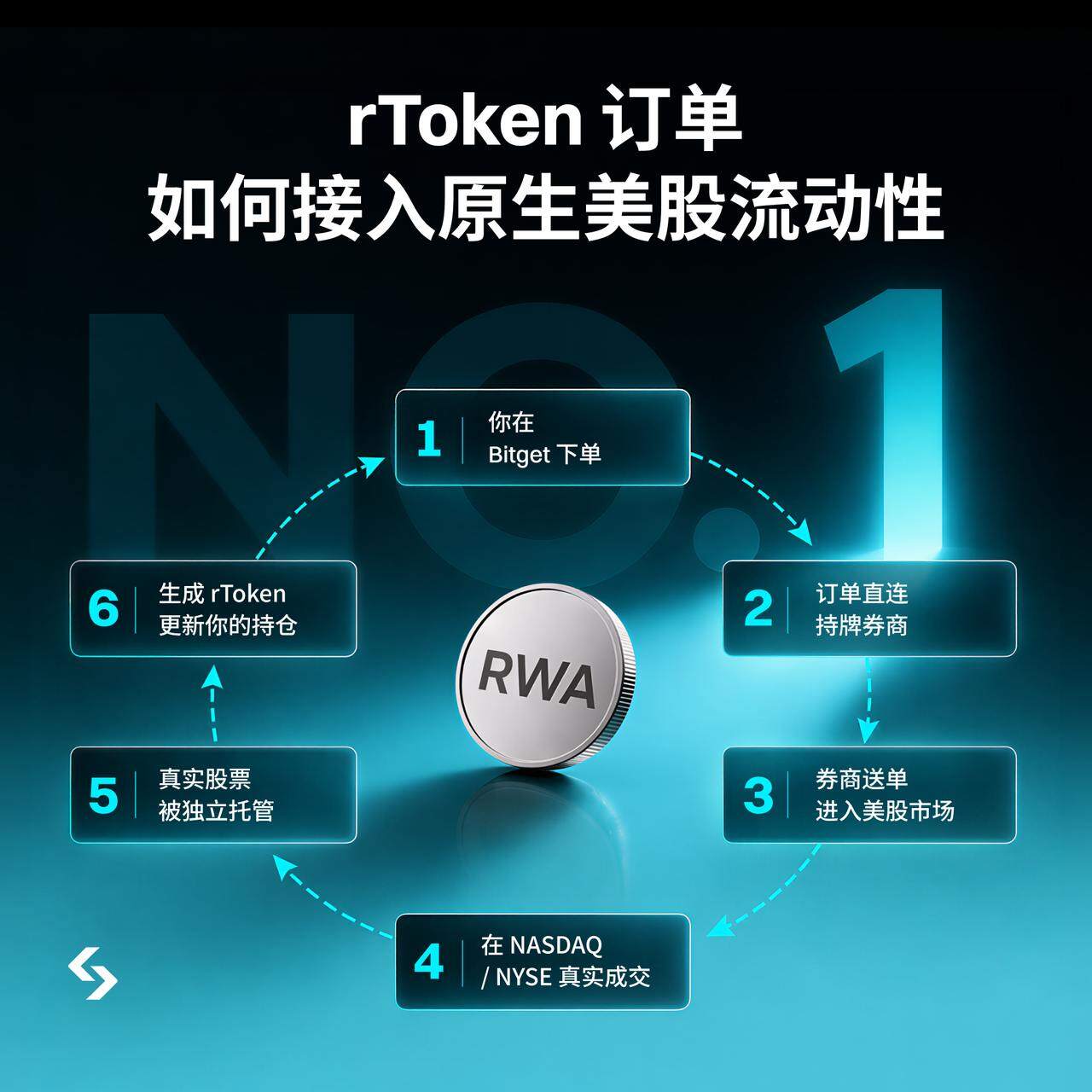
The sell process is essentially the reverse. After a user sells rToken, the corresponding token is burned. The underlying service provider sells the corresponding stock, and after settlement, the proceeds return to the user's account in stablecoins or settlement assets supported by the platform. Therefore, rToken does not operate independently of the traditional financial system. Instead, it connects the front-end crypto account and token format to the back-end traditional securities market. The user experience can be similar to trading crypto spot, but the foundation still relies on real securities trading, clearing, and custody systems.
How Does rToken Maintain Trading When the U.S. Stock Market Is Closed?
Mao Di: rToken aims to provide extended trading hours, but U.S. stocks themselves do not trade 24/7. How does the platform maintain liquidity and price stability when the underlying market is closed?
Gracy: Extended trading hours mean users are not entirely bound by the U.S. stock market's opening hours, and the market can react to unexpected events sooner. However, when the U.S. market closes, rToken's primary liquidity source temporarily disappears. At this stage, trading during closed hours is mainly facilitated by market makers. Partnering market makers will stockpile inventory of the underlying stocks before the U.S. market closes. User buy and sell orders for rToken over the weekend are primarily matched against this inventory.
However, this does not mean that the market depth during closed hours matches that of regular trading sessions. During major events, market makers need to assess risk without primary market prices, so they typically reduce their order book quotes and widen bid-ask spreads. Although some hedging can be done by referencing overnight market quotes like Blue Ocean, the liquidity in these markets is far lower than during regular hours and cannot fully replace the NYSE and Nasdaq.
Therefore, prices during market closures more accurately reflect the quotes formed by market makers based on their inventory and risk tolerance, rather than market prices established through full trading. Users need to accept risks such as reduced liquidity, wider slippage, and the possibility that the executed price may deviate significantly from the opening price of the next regular trading session. Longer trading hours solve the problem of "whether you can trade," not "whether you can always trade with normal market depth."
How Does rToken Handle Valuation and Liquidation During Trading Halts, Circuit Breakers, or Major Events?
Gracy: First, we need to distinguish between two issues: first, how the stock token is valued, and second, whether the unified account will trigger liquidation. If a user uses rToken as margin during a U.S. market holiday or closure, the platform will use the index price from the end of the most recent regular trading session or extended hours session for valuation. This is done to prevent fragmented transaction prices from distorting the margin value when the underlying market lacks continuous quotes. However, this is merely a temporary freeze of the valuation benchmark; it does not mean the risk has disappeared. If a major event occurs over the weekend, the stock could still gap significantly on the next trading day.
Simultaneously, other assets within the unified account will continue to fluctuate normally. For example, if a user holds a crypto contract using rToken as margin, even if rToken is temporarily valued at the previous session's price, a forced liquidation can still be triggered if other positions cause the overall account risk rate to hit the liquidation threshold. The unified account always performs risk control based on the entire account's collateral, liabilities, and unrealized P&L, rather than assessing a single item of margin in isolation.
If the underlying stock is halted, experiences a circuit breaker, or a major event prevents obtaining a reliable price quotation, the platform will take temporary risk control measures based on the nature of the event, the duration of the halt, and market liquidity. This could include adjusting collateral ratios, restricting new margin, limiting trading, or suspending the relevant product. The platform would not apply a fixed rule. For example, during a prolonged halt with clearly increased risk, the platform might proactively reduce the collateral value. If it's just a brief circuit breaker, the platform would typically wait for the underlying market to resume trading before updating the price. Therefore, a trading halt or market closure does not mean the risk is paused. So, when using rToken as margin, in addition to price volatility, one also needs to be mindful of risks related to price gaps, trading halts, reduced liquidity, and potential adjustments to the platform's risk control parameters.
Why Is the Reserve Ratio for Stock Assets Exactly 100%? Can rToken Be Redeemed for the Underlying Stock?
Mao Di: The reserve ratio for stock assets published by Reality is basically maintained at 100%. Why isn't there an excess reserve ratio like in some crypto products?
Gracy: For stock assets, we use a one-to-one matching structure. For every rToken Reality issues, Alpaca holds the corresponding quantity or value of the underlying stock. Currently, there is no excess stock inventory purchased beyond what is needed to back the issued tokens.
Therefore, as long as the token supply perfectly corresponds to the underlying holdings, the reserve ratio is naturally 100%. To make this ratio higher than 100%, Bitget, Reality, or another participating party would need to invest additional funds to buy a batch of stocks that do not correspond to any existing user holdings. In our view, this is not highly necessary at this stage.
Additionally, rToken is currently the only RWA asset on the market that provides a daily Proof of Reserves (PoR) audit from a third party. Other RWA issuers also disclose their reserves, but often in a self-reported format, which carries the risk of the