



Wolves of Wall Street, stop blindly rushing into 2x, 3x levered SK Hynix positions


- Core Thesis: Single-stock leveraged ETFs amplify the daily price movements of individual stocks through derivatives. They have grown rapidly amid the AI boom, but their risk profile means that under extreme market conditions, the fund can be directly liquidated and delisted. Investors cannot wait for a subsequent rebound, sparking regulatory concerns about systemic risk.
- Key Elements:
- Single-stock leveraged ETFs use derivatives like swaps and futures to magnify the daily price movement of a single stock by 2 to 3 times. If a stock rises 10%, the corresponding 2x leveraged ETF can rise approximately 20%; conversely, the same applies for declines.
- Shares of US electric vehicle company Lucid Group plunged 57% intraday before rebounding. However, its 2x leveraged long ETF (ticker: LCDL) was liquidated as its net asset value fell into negative territory. It was forcibly closed and initiated the delisting process, preventing investors from participating in the subsequent recovery.
- South Korea’s four major financial authorities have held a meeting to discuss regulating single-stock leveraged ETFs. Potential measures include raising margin requirements, limiting daily price fluctuations, and reducing leverage multiples to prevent systemic risk.
- Retail investors in South Korea have flooded into leveraged ETFs focused on popular AI stocks (e.g., Samsung, SK Hynix), exacerbating market volatility. Recent incidents, including rumors of suicide and violent attacks linked to failed investments, suggest that risks could spill over into social issues.
- Amid the AI storage boom, the scale of these products has expanded rapidly, but investors often overlook the risk of their "triggering a death mechanism." In extreme one-sided market moves, they face the potential for permanent loss of principal.
Original by Odaily Planet Daily (@OdailyChina)
Author: Azuma (@azuma_eth)

If we were to ask what the most talked-about concept in the global capital markets is this year, the answer would undoubtedly be storage.
As AI infrastructure construction continues to advance, HBM (High Bandwidth Memory) is in short supply. The three major memory manufacturers—SK Hynix, Samsung, and Micron—have become the focus of market attention. The influx of capital has driven their stock prices to soar rapidly. Even after experiencing a significant correction recently, their year-to-date gains remain quite astonishing.
When a stock keeps rising, there are always those in the market who feel it "isn't rising fast enough." Consequently, a once relatively niche product has quickly entered investors' sightlines: Single Stock Leveraged ETFs. Unlike traditional ETFs that track a basket of stocks or an index, these products track a single stock and use financial derivatives like swaps and futures to amplify the stock's daily price movement by 2x or even 3x. In other words, if the underlying stock rises 10% in a day, the corresponding 2x leveraged ETF would theoretically rise about 20%; conversely, if the stock falls 10%, the product would also lose about 20%.
For this reason, Single Stock Leveraged ETFs are becoming a new tool for increasingly aggressive investors betting on hot AI stocks. This year, as hot money seeking to amplify gains from the AI and storage market trends continues to pour in, the scale of Single Stock Leveraged ETFs launched around popular AI concept companies like SK Hynix has been expanding.
However, what many investors overlook is that on the flip side of amplified gains, risks are magnified by the same factor. In extreme market conditions, the underlying stock might still have a chance to rebound, but a Single Stock Leveraged ETF might not even get that opportunity.
A Vivid Case: The Delisting Path of a 2x Leveraged ETF
This is not alarmist. A case that occurred during US stock market trading the night before last sufficiently reveals how dangerous Single Stock Leveraged ETFs can be.
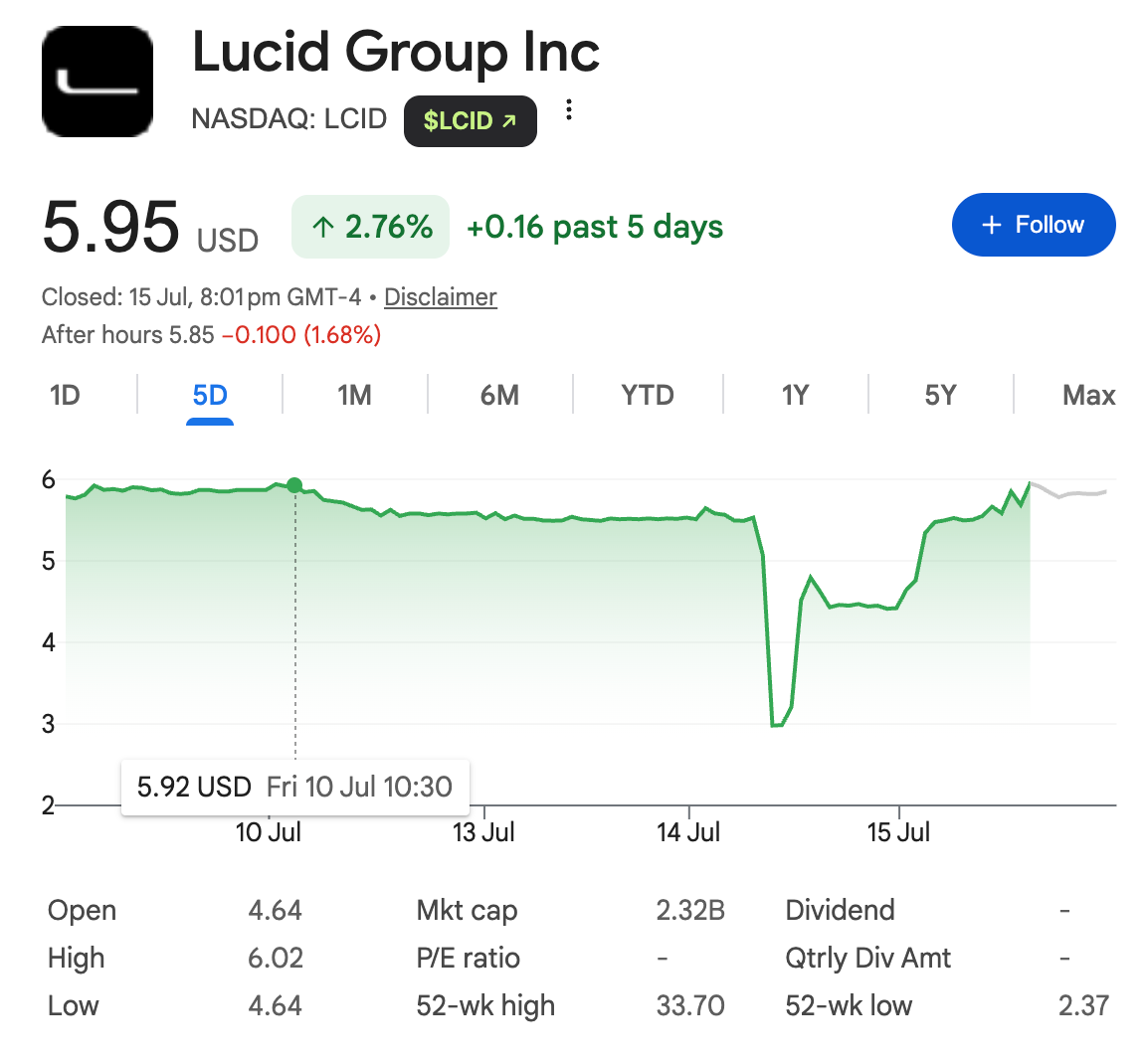
The image above shows the recent stock price trend of US electric vehicle maker Lucid (LCID). On July 14th, local time, rumors suddenly circulated during US trading hours that Lucid was considering filing for bankruptcy protection. Affected by this negative news, LCID's stock price plummeted as much as 57% intraday, triggering multiple circuit breakers, marking its largest intraday drop since listing.
However, the plot quickly reversed. Lucid subsequently issued a statement confirming that it had indeed hired consulting firm AlixPartners to conduct a comprehensive operational review to optimize operations, cut costs, and advance new model development, but stated the rumor about filing for bankruptcy was "completely false." Lucid also emphasized it currently has sufficient liquidity to support operations into next year, and AlixPartners is solely responsible for operational optimization work, having made no bankruptcy recommendations to management or the board.
As Lucid's swift denial restored market sentiment, its stock price recovered from its intraday low, eventually closing with a narrowed loss of approximately 16%. For investors holding Lucid stock, this felt more like a heart-stopping "roller coaster ride."
However, for another group of investors, the story ended right at the moment of the crash.
During Lucid's plunge, the 2x Long ETF tracking its stock performance—GraniteShares 2x Long LCID Daily ETF (LCDL)—was liquidated outright. Fund manager GraniteShares subsequently issued a notice confirming that the fund had closed out all its LCID positions that day. With its net asset value falling into negative territory, it would formally initiate the delisting process.
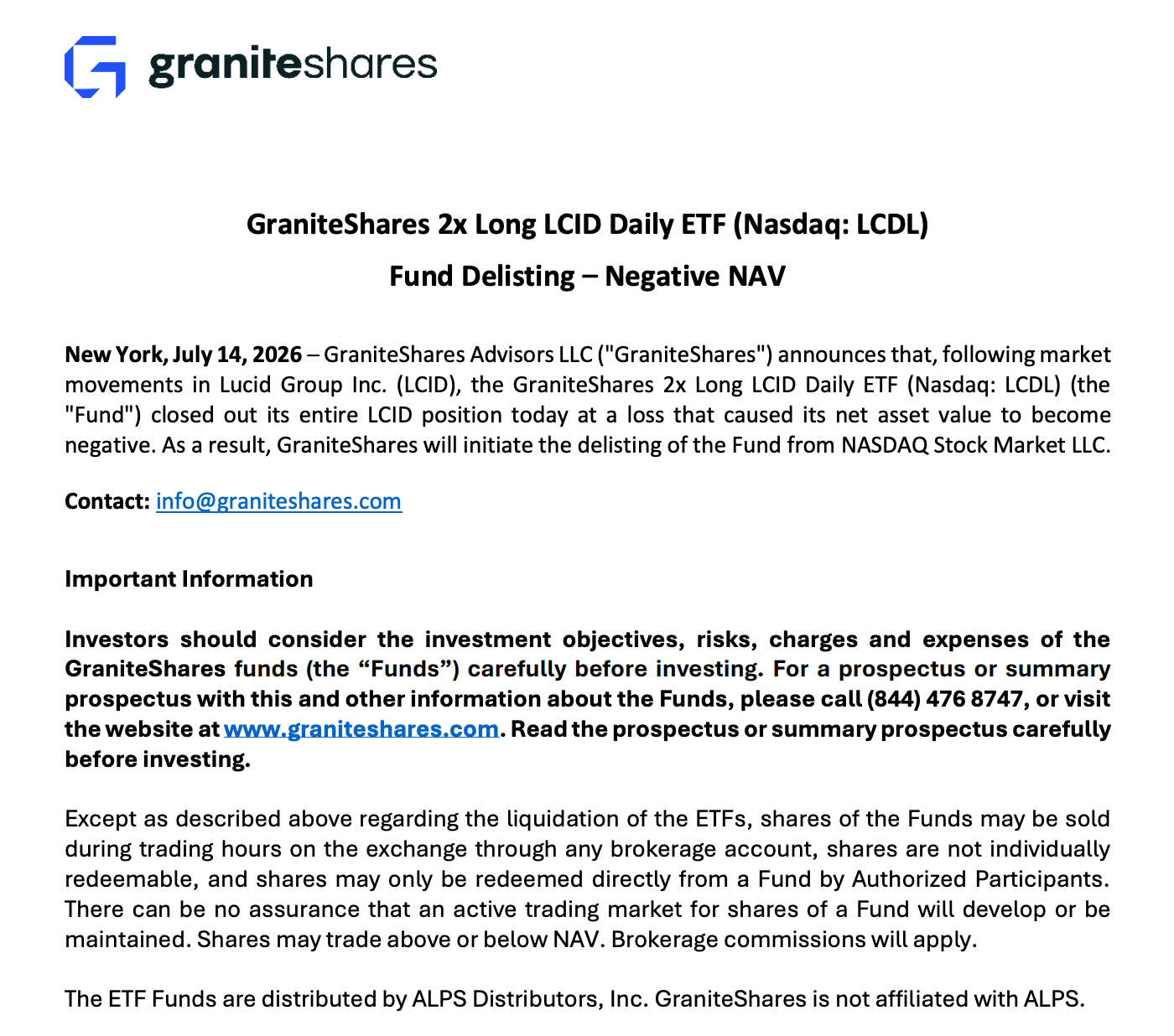
This means that when Lucid's stock price rapidly rebounded later, this ETF had no positions left to recover its net value. For all holders of LCDL, there was no longer any opportunity to participate in LCID's subsequent upward movement.
This is the biggest difference between Single Stock Leveraged ETFs and ordinary stocks. Even if a stock plummets, as long as the company still exists, investors have a chance to wait for a rebound. But once a Single Stock Leveraged ETF "triggers a death mechanism" amid extreme volatility, even if the underlying stock recovers its losses later, investors may never see that day.
Social Issues Emerge, South Korean Government Becomes Alarmed
The delisting of LCDL is by no means an isolated incident. In fact, with the rapid proliferation of Single Stock Leveraged ETFs in hot AI stocks, regulators have begun reassessing the potential systemic risks these products may introduce.
South Korea's stance is particularly representative.
In mid-July, reported by The Korea Times, South Korea's four major financial authorities—the Ministry of Economy and Finance, the Financial Services Commission, the Financial Supervisory Service, and the Bank of Korea—planned to hold a special meeting under the government's Macroeconomic and Financial Issues Coordination Mechanism (F4) to discuss the risks of Single Stock Leveraged ETFs and related regulatory measures. Discussed directions included raising margin requirements, limiting daily price fluctuation ranges, and lowering leverage multiples.
In recent years, as South Korean retail investors continue to flood into the stock market, the AI rally has almost evolved into a national investment frenzy. Heavyweight stocks like Samsung Electronics and SK Hynix have become the focus of capital, while leveraged ETFs launched around these individual stocks have further amplified market sentiment and stock volatility. Regulators are concerned that as more and more investors use high-leverage products to chase popular stocks, the impact of a sharp fluctuation is no longer just about changes in account numbers but could potentially escalate into a social issue.
As the storage concept faced pressure and corrected, South Korea's capital market has witnessed several extreme incidents in succession. On one hand, there have been unconfirmed reports on social media of suicides caused by failed stock investments. Additionally, The Chosun Ilbo reported yesterday that a YouTuber operating a stock investment channel in Busan was repeatedly stabbed on the street by a man in his 20s. Police preliminary investigations suggest the suspect is a subscriber to the channel who, believing the blogger's stock recommendations, suffered significant losses and harbored resentment leading to the attack.
Although these incidents are not directly caused by Single Stock Leveraged ETFs, for regulators, they send a highly consistent signal: When high-risk investment tools continuously lower the barrier to entry and overlap with communication channels like social media and live-streamed stock recommendations, financial risks may ultimately spill over into social risks.
For the South Korean government, this is the most frightening prospect.