






Conversation with Bitwise: Institutions See Current Market as an Entry Opportunity, Bitcoin Could Surge to $95,000 by Year-End


- Core View: Bitwise experts believe that despite the pessimistic market sentiment, key catalysts such as institutional demand, regulatory clarity, and improving macro conditions could drive Bitcoin to hit the $95,000 mark by 2026.
- Key Factors:
- Strong Institutional Demand: Despite market uncertainty, Bitcoin ETFs still recorded over $1 billion in inflows last month, indicating institutions are quietly accumulating.
- Regulatory Environment Expected to Clarify: The Clarity Act is expected to pass before 2026, providing a clearer regulatory framework for crypto assets, which is a long-term positive.
- Macro Geopolitical Shocks May Ease: Current geopolitical conflicts are seen as short-term shocks that could subside in the coming months, with interest rate environments stabilizing or even cutting rates, which is favorable for risk assets.
- Quantum Computing Threat Requires a Roadmap: Community focus on the quantum threat is increasing, and a clear solution roadmap could help restore confidence among early investors.
- Market Structure is Evolving: Institutional participation has significantly increased (e.g., changes in conference attire), and there is strong interest in new financial primitives like "Vaults" and tokenization, indicating deeper application of underlying technologies.
- Synergy Between AI and Crypto is Viewed Positively: AI developers are highly interested in the potential of crypto technology in areas like identity verification, privacy, and payments (stablecoins), and are optimistic about the prospects of their combination.
- Value of Prediction Markets is Recognized: Prediction markets have demonstrated unique value in providing high-quality, real-time economic data and serving as portfolio hedging tools, with their information aggregation accuracy even surpassing that of traditional experts.
Source: "The Milk Road" Podcast
Compiled by: Felix, PANews
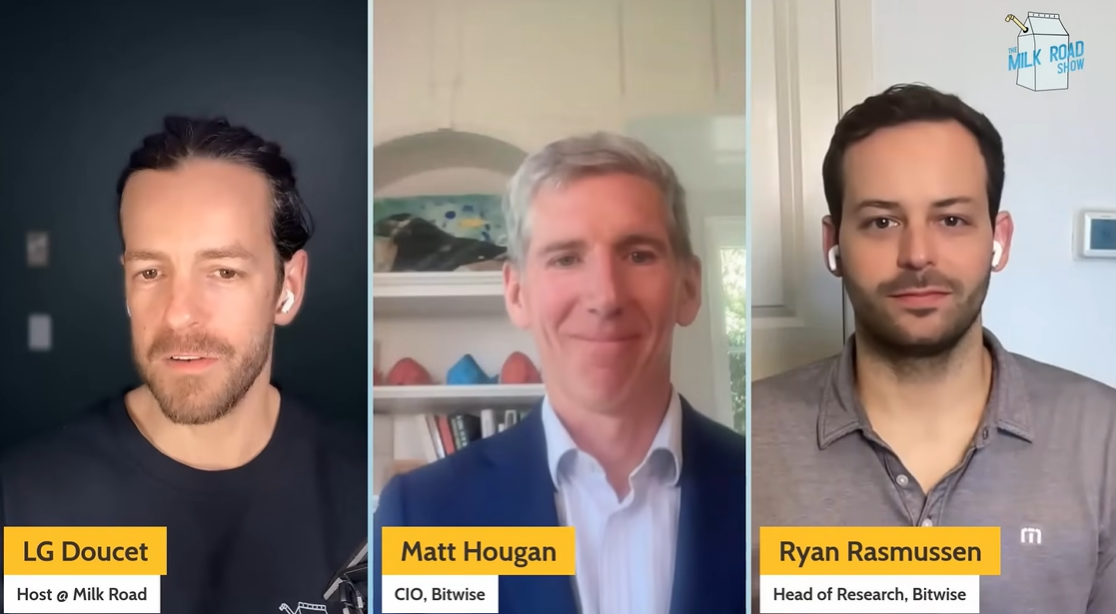
Matt Hougan, Chief Investment Officer at Bitwise, and Ryan Rasmussen, Head of Research, were guests on the "Milk Road Show" (recorded on April 6th), delving into the true drivers of the current crypto market and why institutional demand could be key to Bitcoin's next move.
They pointed out that despite overall pessimistic sentiment in the crypto market, institutional investors are quietly accumulating. From ETF inflows to regulatory dynamics and macroeconomic shifts, there are several key signals that could propel Bitcoin to challenge the $95,000 mark by 2026. PANews has compiled the highlights of the conversation.
Host: Ryan, I saw an article where you predicted Bitcoin would reach the $95,000 range by the end of the year. Is that true?
Ryan: That was an interesting conversation because we were talking about a lot of long-term positive factors that could drive the market higher. One example I gave was that heading into 2026, we see specific catalysts that could bring the market back to the $95,000 level, which is precisely where we need to be to break the four-year cycle. I think it's very likely to happen, and we might even close the year above $95,000. There are several very specific catalysts that will push us towards that target, of course, contingent on certain conditions being met. I did say that, and I believe it will happen.
Host: What are these catalysts?
Ryan: Three specific environmental factors need to shift in Bitcoin's favor to drive the price higher. The first is the macro and geopolitical situation. I strongly believe it will calm down in a relatively short period. Many worry that this prolonged conflict could drag on for many, many months, with ripple effects on inflation, interest rates, and the US and global economies. I don't believe that will be the case. I think this is just a relatively short-term shock that will fade, and six months from now, we'll talk about it the same way we talk about the tariff drama or other short-term market shocks triggered by Trump. So, I think the macro-geopolitical environment needs to shift from a state of uncertainty, instability, and persistent chaos to a more normalized environment. I believe this will happen in the coming months. We'll have Kevin Wars taking office, and I think we'll see interest rates stabilize or be cut. I don't foresee rate hikes, and that's positive for Bitcoin's price returns.
Next is regulatory clarity. Bitcoin's regulatory environment has been very uncertain, with the Clarity Act pending, but I believe the Clarity Act will pass before the 2026 window closes. I think that's positive news for Bitcoin and other crypto assets.
And the biggest catalyst (not just for 2026, but a long-term one) is very strong institutional demand for Bitcoin. Last month, despite all this geopolitical macro uncertainty and the regulatory uncertainty I just mentioned, we still saw over $1 billion in inflows into Bitcoin ETFs. So, you can imagine what could happen from an institutional demand perspective if these issues subside and become tailwinds for crypto. I think these factors will push Bitcoin back above $95,000 by year-end.
Host: Is there a possibility that these positive developments do occur, but the conflict also persists, and they cancel each other out?
Ryan: It's possible they could offset each other. If we see rate hikes and the conflict lasts for 6 months or even longer, it would be difficult for any financial asset to have relatively strong performance. However, interestingly, the market's reaction to these threats or announcements is starting to become less sensitive. For example, Trump issues an ultimatum, Iran responds saying it won't comply, Trump changes the deadline—each time this happens, the market's reaction diminishes. So, I think it's just the market gradually becoming desensitized, after which other forces will take over.
Ultimately, Bitcoin's price is based on supply and demand, so institutional demand will be the strongest driver. From our conversations with investors, they see the current price as a good entry point and are making many long-term allocations within their portfolios. I don't think this long-term demand will be offset; the question is whether it arrives next month, in six months, or in nine months.
Host: Matt, do you sense momentum towards $95,000 by year-end?
Matt: I do think it's conditional on the things Ryan mentioned. I would add another catalyst: We need some kind of resolution or clear roadmap to address growing concerns about the threat of quantum computing to Bitcoin. The only point where I might slightly disagree with Ryan is that if all our cards turn positive, I think the price could be well above $95,000; if it's a mixed bag, we might consolidate; if all factors worsen, we could close at lower levels. My view has a wider dispersion. But if we get regulatory clarity, the Iran issue is resolved, and we address the quantum computing problem, I think year-end could be fantastic. But it requires a series of events to go favorably.
Host: Is the quantum computing issue really that easy to solve? I recently interviewed some guests, and it sounds a bit complex—you need to rebuild consensus among everyone in the Bitcoin space. And the Ethereum Foundation seems more proactive lately, and the system is quite different. Is this a problem that can be quickly solved or mitigated in Bitcoin?
Matt: My view is that the things you'd want to see happening to address the quantum threat are actually happening. That is, high-credibility individuals are raising concerns, and there are more of them, so the community is paying more serious attention and is willing to weigh the trade-offs. In terms of preparedness, we are in a much better place today than 12 months ago. I don't think we need to solve everything; we need a credible roadmap to unlock the demand from those "OG" Bitcoin investors, leading us out of winter and into the spring of the four-year cycle. It's not that Ethereum has completely solved the problem; they just have a credible roadmap. If we also have a credible roadmap and commitment, it would be enough to bring the early OG investors back to the market. I think institutional investors will come regardless because they realize their under-allocation to Bitcoin, and holding zero position is no longer a tenable stance. My point is, to break through to the upside that Ryan mentioned at $95,000, we need those OG crypto players, the retail crypto players, to participate, and I think they would want a clear roadmap.
Host: You mean these OGs need to feel that after Google's and last week's warnings from various parties, the situation is being handled or will soon be under control. So Matt, for those OGs who started selling off their holdings heavily last year, was this concern initially the reason for the loss of demand?
Matt: Yes. I generally think single-cause explanations are wrong, but was it a contributing factor? Yes. Was it as important as the four-year cycle and avoiding a historic 75% drawdown? No. But it was certainly an excuse for people to make emotional adjustments to their risk exposure before the four-year cycle arrived. So it's a bit complex, but it was definitely a factor, and the level of attention has increased dramatically. And I think that's good; it shows the system is self-correcting. But I do think that if well-organized, it could become a catalyst at this point.
Host: Ryan, was the quantum issue discussed at the Digital Asset Summit? If not, what were people talking about?
Ryan: Quantum computing was indeed mentioned at the Digital Asset Summit, but not with as much focus as you might think. And Google's article about the accelerated timeline for quantum risk was actually published after the conference, so it only gained more attention last week. I'd say most of the attention at the summit was on institutional adoption, regulatory clarity, and things like tokenization, stablecoins, and vaults, with less focus on quantum risk, although it is certainly a concern for investors. Over the past month, many investors have asked about quantum risk for Bitcoin and Ethereum. They see communication about efforts to address these risks, which gives them some comfort, but we really need to see substantive action taken to truly alleviate long-term concerns.
Host: Ryan, you said institutional investors are "curious." Does that mean there's still an information gap, they don't understand these assets, or are they trying to get internal buy-in? What do you mean by "curious"?
Ryan: When you talk to different institutional and professional investors about how much attention they pay to the crypto industry and specific developments within it, you find it's a wide spectrum. Many professional investors spend very little time thinking about Bitcoin or crypto more broadly. Their information about the space usually comes from Wall Street Journal or CNBC headlines, or hearing someone on CNBC talk about potential market risks. So when they hear about quantum computing, or Google publishing a significant paper that catches their attention, they come to us and ask: How big is this risk really? You, as professional asset managers focused on this space 24/7, who talk to Bitcoin core developers and donate to support them, what's your take? So the information gap is that they rely on us to understand what's real and what's noise.
Host: Matt, at the summit, what else was top of mind for the institutional crowd regarding risks or opportunities? Or what did you learn that you previously underestimated?
Matt: One big takeaway for me is how the attire at the summit has changed over the past five years. Five years ago, maybe two or three people wore suits; this year, 80% to 85% wore suits, which is remarkable. It shows an unstoppable institutional bull market in crypto, reflected in stablecoins, tokenization, and vaults; the very nature of cryptocurrency is undergoing a real evolution. You just have to compare photos of the summit audience from 2020 to now to see a massive shift. Another hot topic was "Vaults." There was tremendous interest in vaults, which I'd describe as the next ETF. I think institutional interest in vaults even exceeds the current actual assets and growth level of that market.
Host: What exactly is the difference between an ETF and a vault?
Matt: Historically, asset management solved the problem of individuals wanting to invest in markets but not having access to the diversified allocations and management they needed (because it wasn't their full-time job), so they gave money to asset managers to deploy. 300 years ago (17th century), asset management started as very clunky and expensive. By the 1920s, we had open-ended funds; in the 1990s, we had ETFs, making it more efficient. The difference with a vault is that it takes this efficiency a step further. In the traditional world, an asset management firm handles custody, auditing, tax reporting, etc., and combines that with the intellectual property (IP) of where to invest. A vault strips away all that "real-world plumbing" and leaves just the IP. Investors put funds into a smart contract, which allocates according to the asset manager's operations. Therefore, it's a more streamlined, efficient, perfect version of asset management, leaving the other cumbersome parts for individuals to manage themselves.
Host: Ryan, I have a question. Are vaults an area where AI will have a huge impact? Because as Matt described, it sounds like it will involve very sophisticated strategies. I'm asking you because last week you shared a tweet saying that people working on AI are even more excited about crypto than crypto people.
Ryan: Absolutely. That was a very intriguing tweet. Over the past 6 to 9 months, crypto sentiment has been near historic lows, close to the lows of the FTX collapse in 2022, with prices down significantly and liquidity drying up. But when you talk to institutional investors, they don't see a price bear market; they see the positive factors that will drive the market higher long-term: vaults, tokenization, stablecoins, etc. And when you talk to people building AI products, they see many benefits of the underlying technology: AI needs to solve identity proof, which crypto/blockchain does very well; it needs to solve privacy, which crypto does well; it needs a way for AI agents to transact without accessing bank accounts, which stablecoins and blockchain are also very good at. So, AI developers see the synergies and are extremely bullish; institutional investors see the synergies between traditional finance and crypto tech and are increasingly bullish. Meanwhile, crypto-native investors only see prices falling, liquidity drying up, constant liquidations, meme coins collapsing, and they think it's all over. It's a huge disconnect. It's like crypto is holding an umbrella in the rain while it's sunny elsewhere.
Host: Why is the crypto space so emotional? Is it because it's more volatile? Can it break free from this emotional rollercoaster?
Ryan: I think part of it is the difference in investment time horizons. Many crypto investors entered the space because they wanted to gain significant wealth in a relatively short time to get ahead of institutions. As the market goes through boom and bust cycles, people become disillusioned and are hit hard. The professional investors we engage with at wealth management firms and platforms are typically long-term oriented. They plan for clients' retirements over 5 or even 45 years, they see the big trends and get excited. Crypto investors, due to over-concentration, exhibit highly emotional behavior when the market swings, which is extremely dangerous in investing. Professional investors are better at systematically investing for long-term returns; they are positioning now because they foresee this technology paying off in 10 years.
Matt: I think that's right. I'd also add that certain areas of the crypto market (like meme coins, alt L1s, vaporware apps) are indeed in "winter." Many people hold these assets, and the outlook is indeed bleak. That's a completely different mindset from making your first allocation from zero. If you're entering now and see stablecoins and tokenization poised to boom, and these assets are down 50%, you see an opportunity. But if you hold assets that are down 90% and might fall another 99%, the perspective is, of course, completely different.
Host: Matt, you published a great memo today answering the five biggest questions about prediction markets. As a professional "Degen," I love betting on all sorts of weird things, but prediction markets are indeed facing a lot of controversy and issues right now. In your article, you hinted that prediction markets are one of the most important tools in finance. Why is that?
Matt: Because they provide the world with new, critical information and are also useful portfolio tools. First, information quality. We're all frustrated that the Fed is always looking at lagging data, employment figures are often heavily revised, which has a huge impact on the economy and investor decisions. If we can improve the quality of economic data, the world would function better.
I mentioned a Fed paper in my article that showed prediction markets like Kalshi (even though still small) are already more accurate than Bloomberg's top economists and the Fed's own Survey of Expectations in predicting Fed rate cuts, GDP, CPI, etc., and they are real-time. From a portfolio perspective, the real world is affected by political and economic events. If you think Elizabeth Warren will become SEC Chair after a few years of elections, that would impact crypto, but you currently have no clean way to hedge that probability. It's not just crypto; defense stocks, AI stocks would be affected, and our current portfolios can't express that. Packaging these risks through prediction markets would be a very valuable hedging tool. Are they perfect? No. Do some markets need cleaning up? Absolutely. But overall, I think they are very positive things.
Host: The biggest skepticism about prediction markets is: this is just another form of gambling, especially when linked to crypto, like meme coins. How do you respond to that?
Matt: Some of it is indeed gambling. If you're betting on a football game on a prediction market, it's no different from going to a sportsbook, and that's fine. But if you're making predictions on Fed rate outcomes, that's equivalent to the CME's Fed Funds Futures market, where the world's largest financial institutions trade $5 to $15 trillion daily—we call that investing. Prediction markets can encompass both. We can separate complex financial investment/hedging from sports or pop culture events. They are very powerful tools.
Host: Will these prediction markets fragment in the future? For example, going to Polymarket now, you see thousands of topics, which is overwhelming. Will there be prediction markets dedicated solely to financial categories?
Matt: I think that's absolutely possible. When we consider applying to launch a prediction market ETF, we would certainly focus on financial market indicators, not Taylor Swift's concert revenue. Just like the existing ETF market, there are the simplest S&P 500 ETFs and 3x leveraged single-stock ETFs. Search tools clearly distinguish between regular and special ETFs. So as more financial users adopt these markets, I think they will differentiate, and I wouldn't be surprised to see sports betting separate out, especially since that area has additional legal and litigation risks.
Ryan: For investors, I think prediction markets give investors the ability to express their view on a binary outcome, which is very important. In the past, it was difficult to translate an expectation of someone winning an election into a complex cross-asset class portfolio involving commodities, tech, gold, bonds, etc. Prediction markets greatly simplify an investor's ability to hedge their portfolio or plan. Wrapping financial products like ETFs around specific prediction market events would make operations very straightforward and easy. Also, as Matt mentioned, the accuracy of prediction markets on macro or economic events (like Kalshi) even surpasses traditional polls and expert


