




Blockchain Quantum Security 10,000-Word Research Report: Panoramic Analysis of Quantum Computing Threat Theory, Quantum Security Status, Preparation Recommendations, and Timeline Projection


- Core Viewpoint: Quantum computing poses an imminent threat to blockchain cryptography. The industry is shifting from theoretical discussion to engineering deployment. Mainstream ecosystems like Ethereum and Bitcoin have initiated quantum-resistant upgrade plans to address the potential risk window predicted by institutions like Google for 2029.
- Key Elements:
- Threat Escalation: A Google paper from March 2026 pointed out that using fewer than 500,000 qubits could complete an attack within minutes, significantly advancing the post-quantum migration timeline to 2029.
- Core Risk: Shor's algorithm can efficiently crack the Elliptic Curve Digital Signature Algorithm (ECDSA) relied upon by blockchains, while Grover's algorithm threatens hash functions, potentially leading to "Harvest Now, Decrypt Later" (HNDL) attacks.
- Industry Response: Coinbase established a Quantum Advisory Committee; the Ethereum Foundation has listed quantum safety as its highest priority, planning to support quantum-resistant signatures via the EIP-8141 upgrade.
- Technical Path: Post-Quantum Cryptography (PQC) has become the mainstream solution, based on NIST standards (e.g., ML-KEM, ML-DSA). Technical approaches include lattice-based cryptography, hash-based cryptography, and code-based cryptography.
- Ecosystem Progress: The Bitcoin community is discussing proposals like BIP-360 to reduce public key exposure risk; Ethereum Layer 2 network Optimism has released a quantum-resistant roadmap extending to 2036.
- Timeline Projection: The industry needs to enter the planning and experimentation phase in 2026-2027, initiate large-scale migration in 2028-2029, with the goal of achieving quantum safety by 2030-2035.
Original Author:Bob, Researcher at Web3Caff Research
At the beginning of 2026, the largest publicly listed blockchain company in the US, Coinbase announced the establishment of a Quantum Advisory Board. The Ethereum Foundation elevated quantum security to its top strategic priority and formed a quantum security team. Furthermore, the US NIST (National Institute of Standards and Technology) also provided a timeline for quantum-safe migration. All signs indicate that the blockchain industry is about to face a significant security challenge.
Moving closer to March 30, 2026, a paper published by Ryan Babbush, head of Google's Quantum AI division, along with researchers from the Ethereum Foundation, Stanford University, and other related institutions, sounded the alarm for a quantum apocalypse. This latest paper, "Protecting Elliptic Curve Cryptocurrencies from Quantum Vulnerabilities: Resource Estimates and Mitigation Measures", states that under the latest quantum resource estimates, a quantum attack could be completed within minutes using fewer than 500,000 qubits, a 20-fold reduction compared to previous industry estimates. Compared to before, Google officially moved its post-quantum migration timeline forward to 2029 and publicly issued a "final" warning to the entire industry.
We know that the core foundation of blockchain is public-key cryptography. In recent years, the computing power of quantum computers has shown exponential growth trends, increasingly threatening traditional public-key cryptography. The media often presents a very urgent quantum threat timeline, making it seem as if quantum computers could instantly destroy the old digital world, but that is not the case. Facing the potential challenges of quantum computing, the blockchain industry is also actively researching quantum-safe solutions—for example, the Bitcoin community's newly proposed BIP-360 (Pay to Merkle Root) anti-quantum proposal; Ethereum's upcoming anti-quantum upgrade EIP-8141; and the 10-year anti-quantum roadmap proposed by the Ethereum Layer 2 network Optimism. Compared to the complexity of blockchain network upgrades, developer communities are also building more "simplified" anti-quantum infrastructure, such as developing "anti-quantum" tools (YellowPages) for Bitcoin users, aiming to ensure the quantum security of their private keys.
Of course, as the scale of qubits (Qubits) that can be stored increases, the risk of quantum computers breaking traditional blockchain cryptography is indeed intensifying. So, how severe is this threat? How is the Web3 industry responding? How far in the future is the realization of quantum resistance? Without "obscure" physics concepts, this research report will extend from the most basic concepts of "quantum," analyze the current state of blockchain quantum security, and provide a timeline projection for this "quantum doomsday clock," comprehensively dissecting the systemic risks it poses to the blockchain industry and the current response plans.
Table of Contents
- Introduction to Quantum Computing Theory
- Principles of Quantum Computing (Superposition, Entanglement, Interference)
- History of Quantum Computer Development
- Applications of Quantum Computing
- Threats of Quantum Computing
- Quantum Algorithm: SHOR
- Quantum Algorithm: Grover
- Analysis of Quantum Computing's Impact on Blockchain
- Impact of Quantum Computing on Digital Finance
- Current State of Quantum Security
- Development of Post-Quantum Cryptography
- Anti-Quantum Progress in the Blockchain Industry
- Preparation Recommendations and Timeline Projection for Blockchain Industry's Quantum Resistance
- National-Level Migration Planning
- Enterprise-Level Substantive Deployment
- Quantum Security Preparation Timeline for the Blockchain Industry
- Conclusion
- Key Structure Diagram
- References
Introduction to Quantum Computing Theory
Quantum mechanics (Quantum mechanics) is the theoretical foundation of quantum computing. This academic theory began in the early 20th century and is a very important part of modern physics. The term "quantum mechanics" originally came from the German "Quantenmechanik," created by a group of German and Austrian physicists at the University of Göttingen in Germany. The emergence of quantum mechanics was to explain systems that "classical physics" could not. "Classical physics" refers to the early understanding of the fundamental laws of nature, such as mechanics, electromagnetism, and thermodynamics. However, in the microscopic world, the theories of classical physics encountered limitations, and modern physical theories like quantum mechanics emerged. Unlike classical mechanics, quantum mechanics describes the behavior of matter in a "probabilistic" manner, providing a new theoretical framework for the microscopic world.
Using the metaphor of whether God plays dice is very appropriate to describe traditional physics and quantum physics. Over a hundred years ago, mainstream scientists of that era believed that the universe governed by God had "determinism." The legendary physicist Albert Einstein (hereafter referred to as Einstein) once used the phrase "God does not play dice" to question the randomness of quantum mechanics. The quantum school, however, argued that God not only plays dice but sometimes throws the dice where we cannot see them. Einstein, as a supporter of the incompleteness of quantum mechanics at the time, believed the universe existed objectively and subscribed to "physical determinism," meaning all phenomena are essentially necessarily controlled and there is no "true randomness." In contrast, Danish physicist Niels Henrik David Bohr (hereafter referred to as Bohr), as a representative of the new "probabilistic" quantum school, believed the essence of the world was "probabilistic" and proposed the "complementarity principle" (complementarity of particle and wave nature, which cannot be precisely measured simultaneously, related to the uncertainty principle). This academic debate about quantum mechanics lasted for 10 years starting in 1925. In the following decades, various experiments gradually began to prove Bohr's viewpoint. Although Einstein was once a critic of the "probabilistic" aspect of quantum mechanics, he also indirectly promoted the development of quantum theory. Over a hundred years later, quantum physics has permeated every aspect of modern technology, from semiconductor electronic devices to medical imaging. The world has also belatedly accepted that the underlying foundation of reality is quantum.
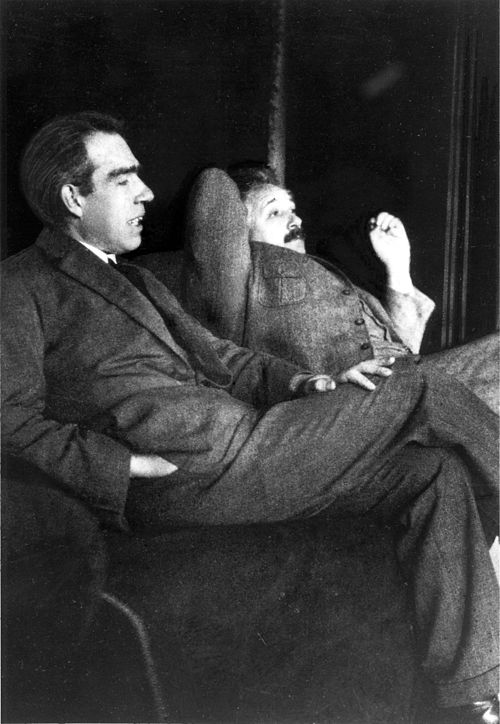
Bohr-Einstein Debate, Source: wikipedia
Quantum computing utilizes the unconventional rules of quantum mechanics to perform calculations. To distinguish between traditional computing and quantum computing in terms everyone can understand: traditional computing solves difficult problems like a detective following clues one by one in a step-by-step manner; whereas quantum computing is like sending out many detectives simultaneously to investigate clues in multiple dimensions, with all detectives' clues interconnected, thus finding the answer to the problem much faster.
We all know that traditional computers use binary 0 or 1. In quantum computing, a state that is simultaneously 0 and 1, known as "superposition," can exist until it is "measured" and determined. In plain terms, in a traditional computer, each bit of information can only be 0 or 1, like a light switch: off is 0, on is 1. You either see the light on or off; there is no third state. In quantum computing, this light can be simultaneously half-on and half-off (superposition), and it only "decides" to be on or off when you look at it. The superposition state in quantum mechanics stems from the nature of physics because that's how the natural world we observe operates. For example, electrons (one of the fundamental particles constituting matter) and photons (the basic unit of light and all electromagnetic radiation) indeed exist in multiple possible states before being measured.
Although the quantum world seems very different from the reality we perceive daily, classical experiments have verified its existence—this is the famous "Double-slit Experiment." In the experiment, scientists let electrons or photons pass through a screen with two slits and then record their positions on a detection screen behind it. They found that when electrons or photons pass through both slits simultaneously, interference fringes appear on the screen, as if the particles took both paths and "interfered" with each other. Even more奇妙的是, if you try to observe which slit they actually went through, the interference fringes disappear, leaving only two separate peaks on the screen, as if the particles could only take one path. This experiment shows that quantum particles, when unobserved, are truly in a superposition state—simultaneously existing in multiple possible states.
To make it easier to understand, it can be compared to flipping a coin: in the quantum world, while the coin is spinning in the air, it is not heads or tails but in a state where both heads and tails exist simultaneously. Only when you catch it and look does it "decide" to be heads or tails. The principle of quantum superposition is similar—before being observed, a particle can be in multiple possible states simultaneously. This is also a phenomenon that classical physics cannot explain, which is precisely why quantum mechanics is considered one of the most imaginative breakthrough directions for the future across disciplines and industries.
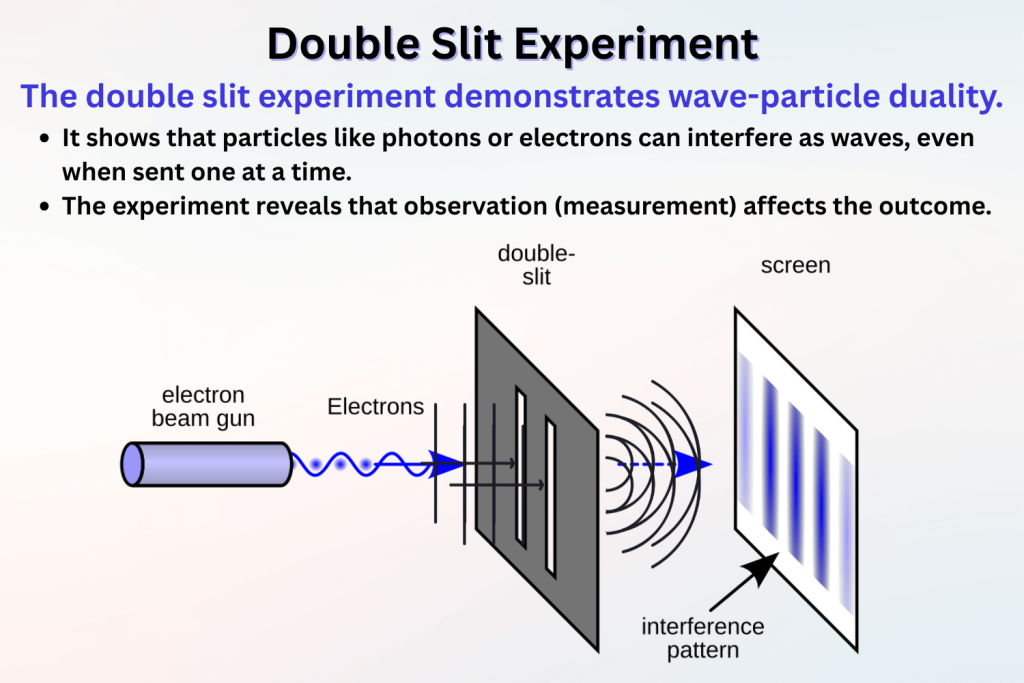
Double Slit Experiment, Source: Science Notes
Simply put, a quantum computer is a new type of computer that performs calculations based on the principles of quantum mechanics. Compared to traditional computers, which can only store and process bits (Bit: the smallest unit of information, representing only 0 and 1), quantum computers use "quantum bits or qubits (Qubit)" to store data. Because qubits can represent multiple states simultaneously, as described above as "superposition." Precisely because qubits can represent multiple states simultaneously, when multiple qubits are present, they can combine to produce an exponentially growing number of possibilities. Simply put, each additional qubit causes the computational space to expand exponentially. It is for this reason that quantum computers may have enormous potential advantages over traditional computers in certain specific fields, such as breaking complex cryptography, optimizing vast combinatorial problems, and simulating molecular structures.
Principles of Quantum Computing (Superposition, Entanglement, Interference)
To understand how quantum computing works, one first needs to understand a new set of terminology. This set of principles includes three important concepts: superposition (Superposition), entanglement (Entanglement), and decoherence (Decoherence).
As mentioned earlier, quantum computers use quantum bits or qubits (Qubit) to store and process information. A qubit is a special unit that can represent not just 0 or 1 but multiple states simultaneously. This property is called superposition.
In quantum mechanics, multiple quantum states can be added to form another valid quantum state, and conversely, a single quantum state can be represented as a combination of two or more other different states. The superposition property gives quantum computers parallel processing capabilities, enabling them to perform millions of computational operations simultaneously. A simple example: in a regular computing environment, 10 bits can only represent 1 state at a time (e.g., 0000011010), whereas 10 qubits in a quantum computer can simultaneously represent up to 1024 possible states (2 to the power of 10). Compared to a regular computer representing a single state at a time, a quantum computer can explore over 1000 states at once. The "superposition" of qubits is the most core characteristic in quantum computing.
The second important concept is quantum entanglement (Entanglement). Simply put, when two qubits become "entangled," no matter how far apart they are, modifying the state of one will cause an immediate corresponding change in the other. This is the most神奇 part of quantum mechanics, as if there is an invisible, mysterious connection between them. This phenomenon exists in tiny particles like photons and electrons. When several particles interact, they form an integrated system, like dance partners holding hands and spinning together. If you push one partner, the others will move accordingly.
Another intuitive life example: imagine you and a friend in another city each hold a magic coin that are "entangled" together. If you flip your