






Interview with Bitget AI Lead Bill: In the Era of AI Trading, How Far Are We from 'Passive Income'?


- Core Viewpoint: Dr. Bill, Head of AI at Bitget, believes that the current core value of AI trading lies in significantly lowering the barrier to trading operations through natural language interaction, achieving "trading democratization." However, its role is more akin to a high-level auxiliary tool for efficiently executing "manual labor" tasks; it is not yet capable of replacing humans in making core decisions or guaranteeing profits.
- Key Elements:
- Bitget has constructed a three-tier AI product architecture, ranging from a chat assistant (GetAgent) and developer tools (Agent Hub) to out-of-the-box products (GetClaw), aiming to cover the full spectrum of needs from geeks to ordinary users.
- The core transformation of AI trading is enabling users to implement complex conditional trades and market monitoring using natural language, greatly simplifying processes that traditionally required programming or complex parameter configuration.
- To build user trust, Bitget has designed a four-layer security isolation system, including identity, memory, permission, and fund isolation, and strictly controls risk exposure through a sub-account sandbox mechanism.
- Dr. Bill uses the "Pareto Principle" (80/20 rule) to define the current boundaries of AI capabilities: AI can efficiently handle 80% of the tedious execution work, but the 20% of core decisions that determine profit or loss still require human judgment.
- Bitget's long-term vision is to create an "AI Account Operating System" based on a "Long-term Memory System," achieving personalized trading assistance and asset growth companionship across scenarios and all asset categories.
Original Author: Frank, PANews
A "little lobster" has stirred up the entire tech world. The emergence of OpenClaw has excited everyone, as it allows AI to be granted operational permissions on an ordinary personal computer to help you check emails, write code, and even operate trading accounts. The overwhelming number of online case studies describe it as almost magical: "You might not even need to work anymore." But when most people actually installed it, they found things weren't quite like that.
In the field of crypto trading, this temperature difference from frenzy to calm is particularly pronounced. Over the past two years, almost every exchange has launched its own "AI Agent," but most remain at the stage of chat assistance—you ask it a question, and it writes you a long analysis, and that's it. The appearance of OpenClaw seems to have opened Pandora's box, showing everyone the possibility of AI "doing things" rather than just "talking."
But this precisely triggers new challenges. As a leading figure guiding his team to explore the frontiers of AI trading, Dr. Bill, Head of Bitget AI, has profound insights into this. PANews conducted an in-depth interview with Bill on this topic. Before joining Bitget, Bill held senior positions at several leading internet and technology companies, spearheading the large-scale implementation of multiple core algorithms and AI platforms, and has published dozens of papers at top international conferences and holds numerous patents.
Now, fully responsible for Bitget's AI strategic planning and intelligent trading technology R&D, he is dedicated to promoting the deep integration of AI with crypto asset trading scenarios. Facing the current Agent craze, this leading expert's judgment is extremely sober: "Most ordinary people are not accustomed to being managers. Suddenly being given 10 AI subordinates—how to command, delegate, and evaluate them—is an art in itself."
Enthusiasm will eventually fade, but the capability has been seen. The real question becomes: Who can package this capability into a product that ordinary people can use?
In the conversation with Bill, PANews attempted to deconstruct the real path for AI trading from concept to implementation from a product designer's perspective. In Bill's view, Bitget's intensive launch of two AI products, Agent Hub and GetClaw, is not a case of "seeing others do it, so we do it too," but rather a natural spillover of an internal product process. "To sum it up, it's the right time, right place, and right people."
The right time is OpenClaw igniting market awareness; the right place is the deep accumulation from continuous iteration on the AI assistant GetAgent launched last year, coupled with ample internal technical precipitation and experimentation; the right people is the team having internally validated the product's value, thus opening it to the public at the right moment."
Bitget's AI Product Panorama: The Three-Tier Architecture from GetAgent to GetClaw
To understand Bitget's layout in AI trading, one must first clarify the relationship between its three products. Externally, names like GetAgent, Agent Hub, and GetClaw can be confusing, but in Bill's narrative, this is actually a clear evolutionary path.
In June 2025, Bitget launched GetAgent within its App, an AI trading assistant in the form of a chatbot. According to Bill, GetAgent underwent multiple iterations: from initial chat responses, gradually adding one-click order placement, news aggregation, and expanding to full-category trading including US stocks, gold, and silver. "Each iteration was driven by user demand, expanding more and more." However, no matter how it expanded, the essence of GetAgent remained "chat-driven"—it could answer questions and give suggestions but couldn't help users autonomously execute complex trading tasks.
The turning point came after OpenClaw emerged. Bill revealed that after OpenClaw's release, Bitget quickly built its own version internally. "After internal use, the feedback was excellent, naturally leading to an idea: Could we also give GetAgent a major upgrade?" Following this line of thought, Bitget packaged its internally refined MCP capabilities for external release, officially launching Agent Hub on February 13 this year.
Agent Hub targets "relatively more hands-on" professional players.
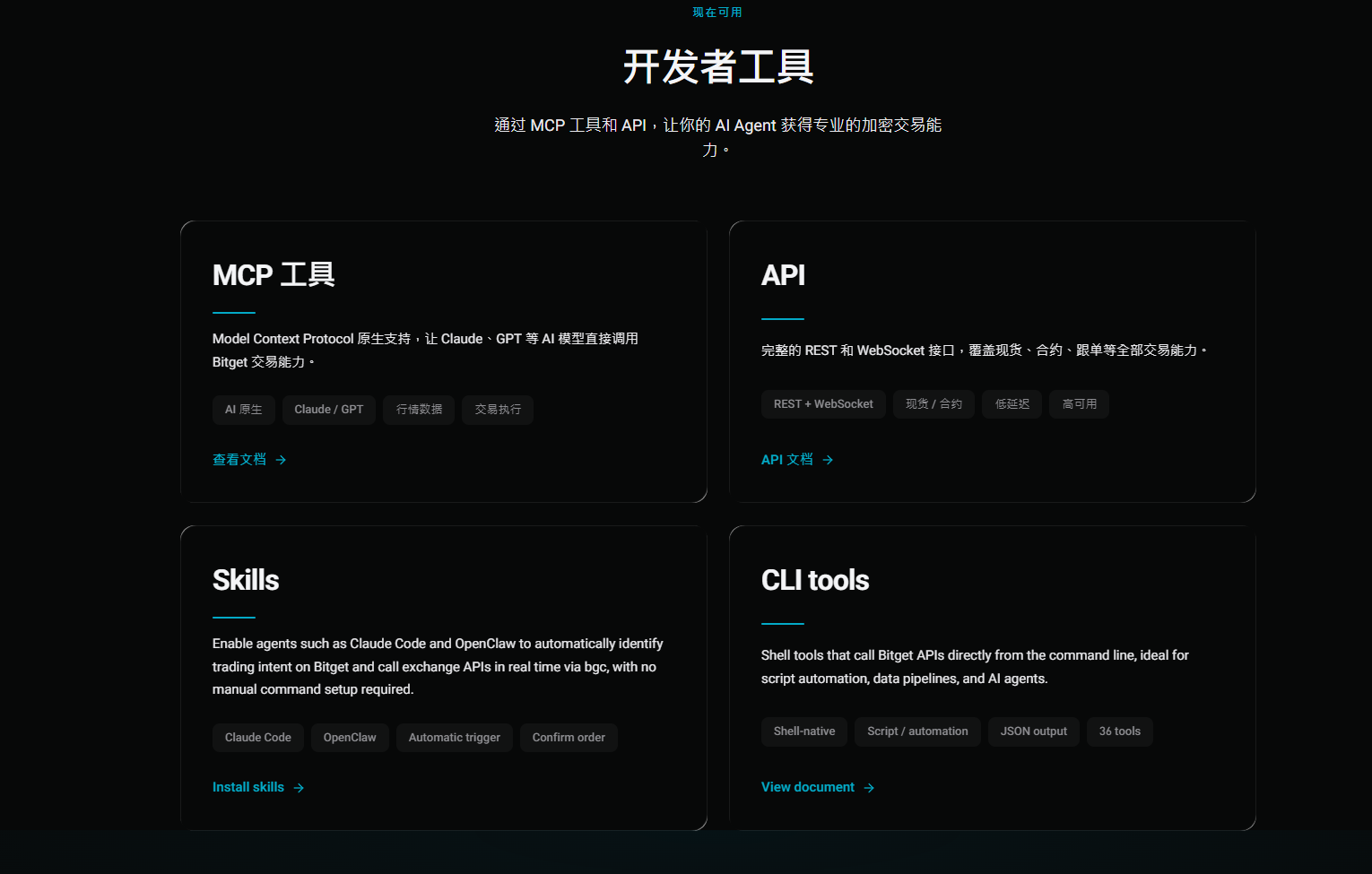
It provides four layers of capability interfaces from shallow to deep:
API is the atomic-level interface call, with the highest barrier to entry, requiring programming and key management;
MCP plays the role of a "universal interface," allowing external AI applications to directly read Bitget's data and execute operations;
CLI targets developers, supporting direct invocation of all APIs via terminal command line;
Skills are the core of this upgrade, equivalent to packaged "business modules." Through Skills, originally rigid API code is transformed into skills that AI can directly invoke (such as querying fees, analyzing K-lines, monitoring markets, placing orders), enabling AI to leap from "intent understanding" to "action execution."
Bill used a USB flash drive for a very intuitive analogy: "A USB drive itself has the storage skills of saving, reading, and writing, but to make it work, it needs a USB interface to connect to a device, which is equivalent to MCP. Having just the interface isn't enough; it also needs storage and various protocols to cooperate to complete the full interaction. This entire combination constitutes a Skill."
But Agent Hub still has a barrier for ordinary users.
Therefore, on March 14, Bitget launched GetClaw, an AI trading assistant based on Telegram, ready to use out of the box without installing anything. Users enter via a link, log into their account, and can start using it. The platform bears the cost of large model calls, completely transparent to the user. Bill summarized it in one sentence: "Ordinary users are recommended to use GetClaw, a fully assembled tool ready to play with immediately; professional players are recommended to use Agent Hub, choosing suitable Skills to build their own castle like assembling Lego."
These three products form a clear progression: GetAgent refined the underlying MCP capabilities, which were then deposited into Agent Hub for external release, and these capabilities were further embedded into GetClaw to lower the usage barrier to a minimum. From chatbot to developer tool to one-click product, Bitget's AI product line covers the entire user spectrum from geeks to novices.
"Say One Sentence to Monitor the Market": What Has AI Trading Truly Changed?
The product architecture is just the skeleton; what truly excites users is the experiential transformation AI brings to specific scenarios. In the exchange with Bill, a recurring keyword is "barrier."
The traditional trading process is a long chain: obtaining information, analyzing and making decisions, order execution, market monitoring, and post-trade review—each link relies on manual operation. If one wants to do conditional trading or quantitative strategies, users either write their own programs to call APIs or configure a bunch of complex parameters on the platform.
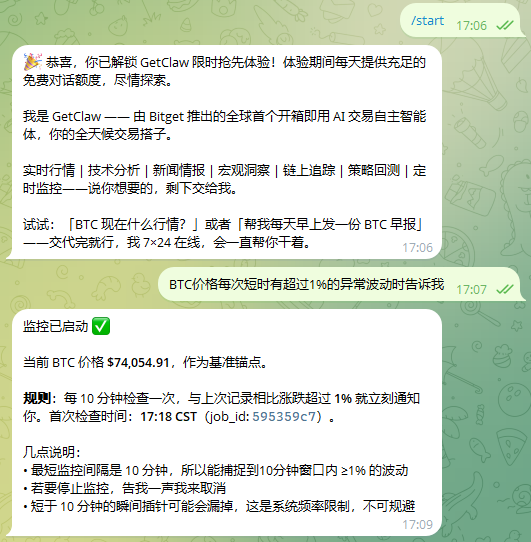
In Bill's view, this is precisely the most valuable entry point for AI: "These functions can also be achieved without Skills or GetClaw—just write a program. But the problem is, writing a program is simple for programmers, but the barrier is too high for ordinary users. What we are doing today is allowing users to achieve the same effect by saying one sentence."
He gave a specific example: A user says, "When Bitcoin drops 3% within one minute, help me increase my position by 50%." The backend system automatically converts this into a scheduled task, which actually needs to accomplish three things:
- Monitor Bitcoin price in real-time
- Calculate the price difference every minute
- Execute the position increase operation immediately once the condition is met
This logic, which previously only programmers could implement, can now be done by anyone with a single sentence.
Within less than 40 hours of GetClaw's launch, market monitoring alerts became the most explosive use case. This is not surprising. Configuring market monitoring alerts on traditional platforms requires users to understand various indicator parameters, "configuring for a long time without necessarily succeeding." Now, even for multi-indicator composite monitoring logic like MACD and CCI, users can describe their needs in natural language, and the system can implement it for them.
But Bill believes the real transformation of AI market monitoring is not just "being able to do it," but more importantly, "being able to optimize it." "On traditional platforms, if you can't configure it well, you give up. But now you can tell it, 'That's wrong, reflect on how to fix it,' and keep adjusting until satisfied." This interactive method of continuous iteration is a huge satisfaction for the vast long-tail user base.
In traditional stock markets, the proportion of quantitative trading is increasing, even exceeding 70% in relatively mature markets like the US. Ordinary retail investors entering the market face institutional opponents competing at the microsecond level, with almost no chance of winning. Bill summarized the significance of AI trading as a form of "equalization": "Bitget's vision in the AI field is to enable 100 million users to rival Wall Street," in other words, to let them achieve the operational logic and execution capabilities of top traders. "In the past, you could think of it but couldn't do it; today, as long as you can think of it, you can do it."
Four Locks of Trust: The Security Boundaries When AI Operates Real Money
When AI moves from "giving advice" to "executing for you," the power of the function is not the biggest challenge; trust is. In Bill's view, this cannot be overemphasized: "The thing ordinary users worry about most is 'Is it safe to use?' This level of trust must be established well. Once one or two security issues occur, no one will use it."
Centered around this core concern, Bitget has designed a four-layer isolation system.
- The first layer is identity isolation, accurately identifying the user's identity in each conversation.
- The second layer is memory isolation, completely isolating and preventing confusion between conversation memories of different users, ensuring personal privacy is not leaked.
- The third layer is permission control, determining what data and tools can be called, controlled by roles.
- The fourth layer is credential and fund isolation, where API Keys are limited to triggering use, and trades are executed within sub-account sandboxes.
The sub-account sandbox mechanism is a very pragmatic design. Bill gave an example: "For instance, if the main account has $1,000, the user can transfer only $50 to a sub-account for AI operation, making the risk much more controllable." This means even if the AI makes a judgment error, the risk exposure is strictly controlled within the user's preset range.
This safety-first approach is also reflected in Bitget's attitude towards the Skills market. Currently, all Skills are developed and maintained officially, not opened to third parties. Bill's explanation for this is straightforward: "If we open a Skill Market to allow more people to participate in building, security issues will inevitably arise. For example, if a hacker says, 'I'll also put one in there,' and a user uses it and suffers fund losses, that wouldn't be appropriate. We'd rather have none than have something that causes users to lose all their money. After all, in the asset market, earning fast is not as important as surviving long."
The lesson from OpenClaw proves the rationality of this caution. Running on personal computers with almost no restrictions, while exciting, also spawned an absurd new industry—"helping you cleanly uninstall the lobster" itself became a money-making business.
At the large model invocation level, Bitget initially chose to have the platform bear the cost rather than letting users configure tokens themselves. This is partly for security reasons and partly technical: "Our Skills and MCP are deeply adapted and optimized with multiple built-in large models. If users arbitrarily switch to other models, the effectiveness would be greatly reduced." Currently, the platform provides each user with a daily free call quota of $10, with subsequent adjustments to the pricing model based on market feedback.
80% of Tasks Can Be Done, 20% of Decisions Still Rely on Humans
Discussing the realistic capability boundaries of AI trading, Bill frankly stated the reality is not optimistic: "Now, some people online give AI $100 to try to make it into $1,000, only to find that such crude operations have a very high probability of losing everything."
AI trading capability today cannot guarantee helping users make money. Bill used the "80/20 principle" to summarize the current real state: In a complete trading process (which may involve 100 tasks), AI can efficiently complete 80 of the繁杂 (complex) tasks, such as information organization, real-time monitoring, conditional execution, and data review. However, the 20 core decisions that truly determine profit or loss, AI still cannot do.
Last year, Bitget held a playful AI trader competition to test AI's capability boundaries, providing a vivid footnote: many AI strategies ended in losses. The reason is not complicated. AI has no emotions, which sounds like an advantage but also means it cannot respond to black swan extreme events like "sudden outbreak of war." Bill mentioned that when AI was heavily used for execution in the US stock market before, abnormal phenomena like flash crashes and surges also occurred.
"Today, it's more of an advanced assistant role, just like the transition from L1 to L5 in autonomous driving." Bill used this analogy to position the current development stage of AI trading. Trend-wise, AI's capabilities are indeed conquering the remaining hurdles one by one, but when it comes to long-term creativity and empathetic judgment in extreme situations, machines still have obvious bottlenecks.
However, Bill also gave a relatively optimistic judgment: "The technical closed loop around fully automated trading may be basically achievable by next year, but this does not mean it can guarantee continuous profitability." In other words, there is still a considerable distance between "being able to run" and "being able to earn."
From Trading Tool to "AI Account Operating System": Bitget's Endgame Vision
Since AI cannot completely replace human traders in the short term, where is the end point of Bitget's AI strategy? Bill provided answers from three dimensions.
The first dimension is "panoramic trading," which also echoes Bitget's previously proposed UEX (Universal Exchange) strategy. It's not just cryptocurrencies; with the advancement of asset tokenization, traditional financial categories like gold, silver, and US stocks are being integrated. Bitget hopes to use AI to help users complete full-category trading operations on one platform, "enabling users to possess the full-category coverage capability of Wall Street traders."
The second dimension is global ecosystem expansion. Leveraging Bitget Wallet's capabilities, introduce AI into Web3 payments and global business scenarios, lowering the operational barriers for cross-border transactions and payments.
The third dimension, and the one Bill described with the most vivid imagery, is building a "long-term account operating system" based on Bitget. The core of this concept is establishing a "high-trust fund execution layer." In the future, multiple Agents will collaborate to help users handle various aspects, and the foundation supporting all this is a cross-device, cross-scenario "long-term memory system."
In Bill's description, this memory system would analyze and integrate users' past trading habits, historical operations, and even their behavior within the App, forming a deep personal profile. "Ensuring users' trading logic maintains long-term consistency across different platforms and scenarios, rather than a fragmented experience." This capability for continuous learning and adaptation is fundamental to distinguishing it from one-time tools.
He used a very everyday analogy to explain this gradual trust-building process: "Just like initially buying a home service robot only to let it sweep the floor; after using it for a long time and trusting it, you are willing to let it take on more tasks." AI needs to prove itself reliable in small matters first, then gradually gain greater permissions and trust, with the ultimate goal of "growing with you, accompanying your asset appreciation."
From GetAgent to Agent Hub to GetClaw, Bitget's AI products have completed the leap from chatbot to task execution layer in less than a year. The intensive layouts by major exchanges also indicate that AI trading is no longer an optional direction but a basic capability for future competition.
However, from the current reality, AI is better at replacing the "manual labor" in trading rather than the "mental labor." 80% of the繁杂 work can be handed over to machines, but the 20% of core judgments that determine profit or loss will likely still require humans to make. Technology can lower the barrier to trading but cannot completely eliminate the risks of trading.
AI has given everyone a Wall Street toolbox, but what's inside the toolbox is both opportunity and a reason for caution.


