Global Payments Weekly 2026W43


1. This Week's Highlights
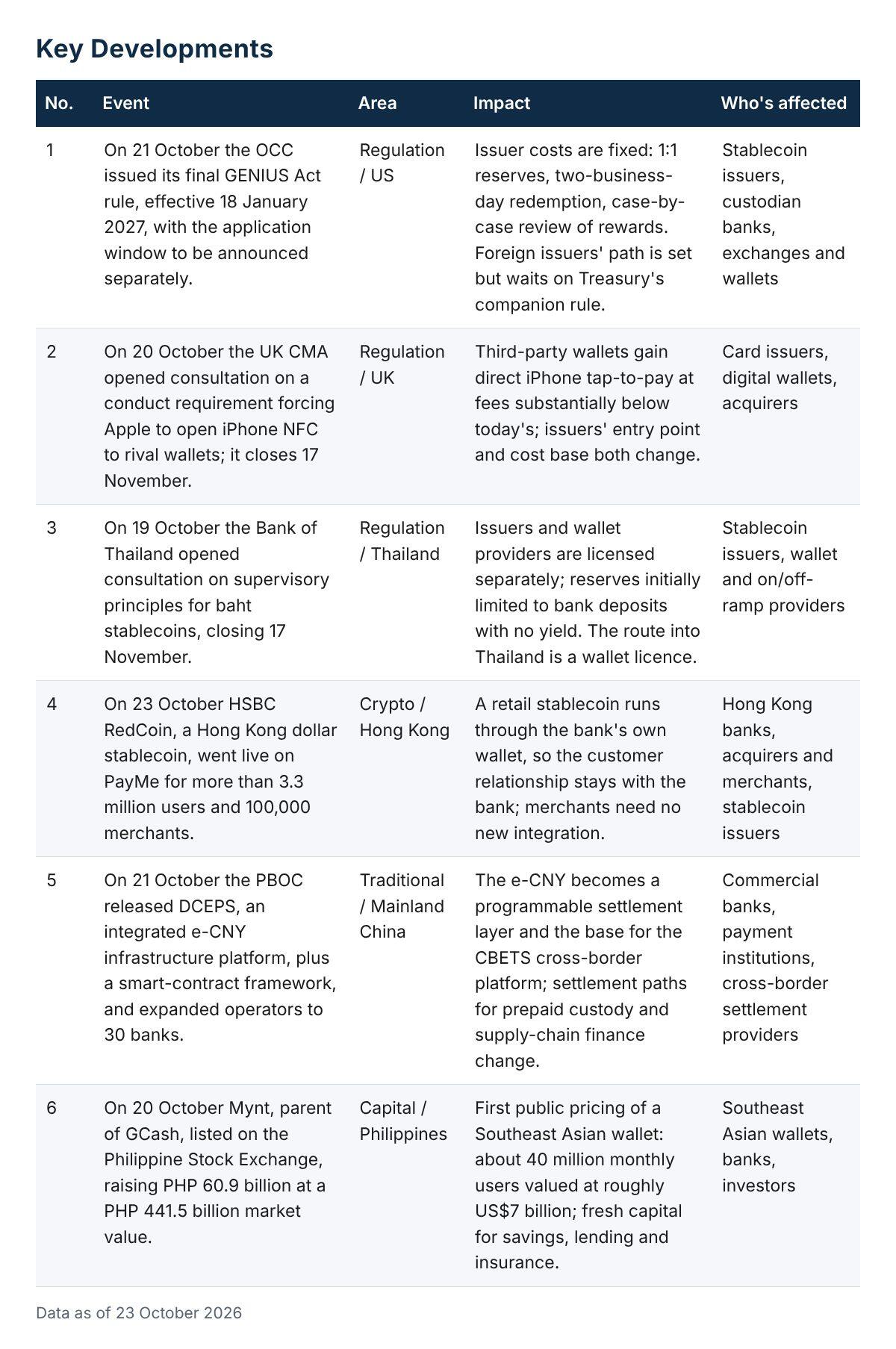
Official money on-chain moved from pilots to rules and products this week. The OCC issued its final GENIUS Act rule, HSBC put the first licensed retail Hong Kong dollar stablecoin live, the Bank of Thailand published a licensing architecture for baht stablecoins, and the People's Bank of China upgraded the e-CNY into an open smart-contract settlement layer. Issuance is consolidating with licensed banks and central banks; payment companies are being pushed toward distribution, acceptance and compliance.
The first signal is speed. The rule published on 21 October takes effect on 18 January 2027: one-to-one reserves, redemption within two business days, rewards judged case by case. The US issuer rulebook now exists; the application window does not yet.
The second signal is that banks are becoming the retail front door for stablecoins. HSBC RedCoin went live on PayMe on 23 October for more than 3.3 million users; J.P. Morgan put JPM Coin on Ethereum mainnet on 19 October for approved institutions only. Thailand's proposal caps issuers while licensing wallet providers in rounds. Issuance is a club; distribution needs a licence.
The third signal is that card networks and processors are moving onto the compliance and acceptance layers. Mastercard launched a stablecoin risk-intelligence product on 19 October, North America first; the same day Euronet and Fireblocks offered white-label stablecoin-funded card issuing. Issuers have more processors to choose from.
Key Figures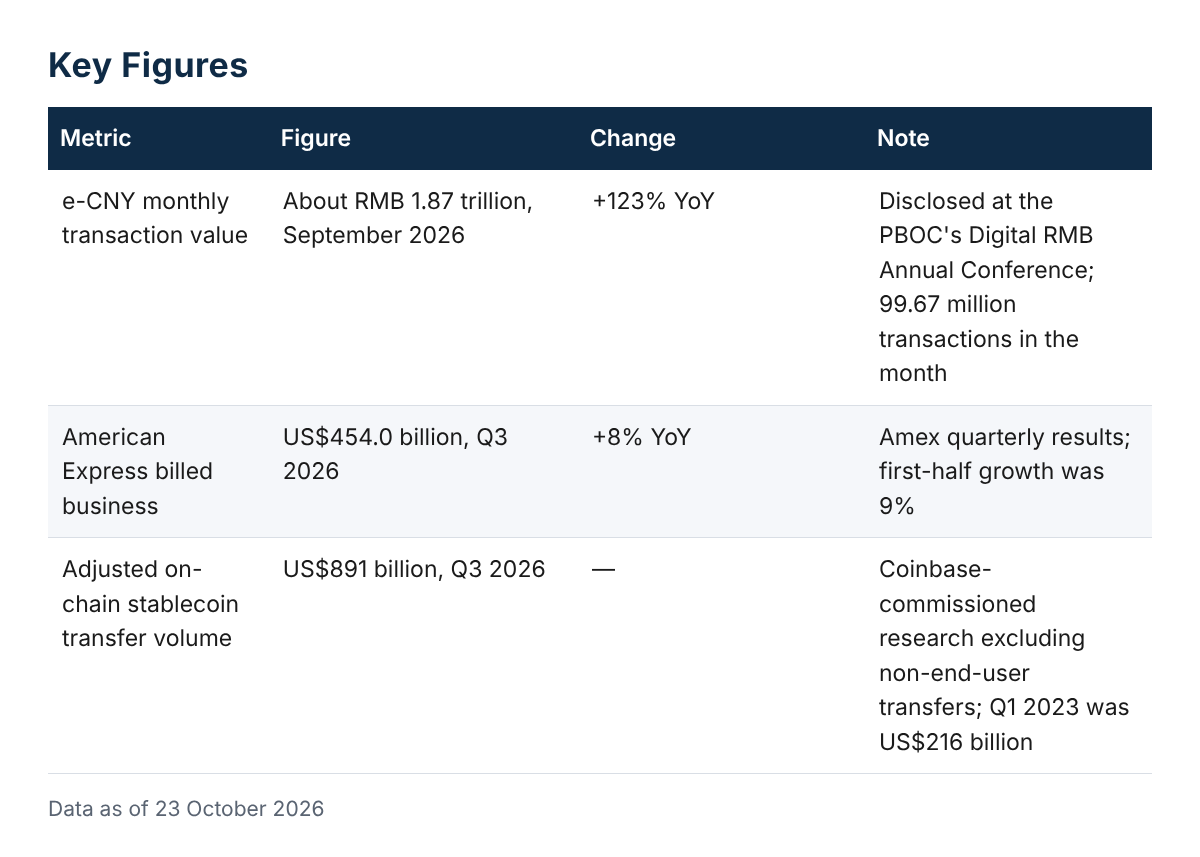
2. Key Developments
3. Analysis
Traditional payments
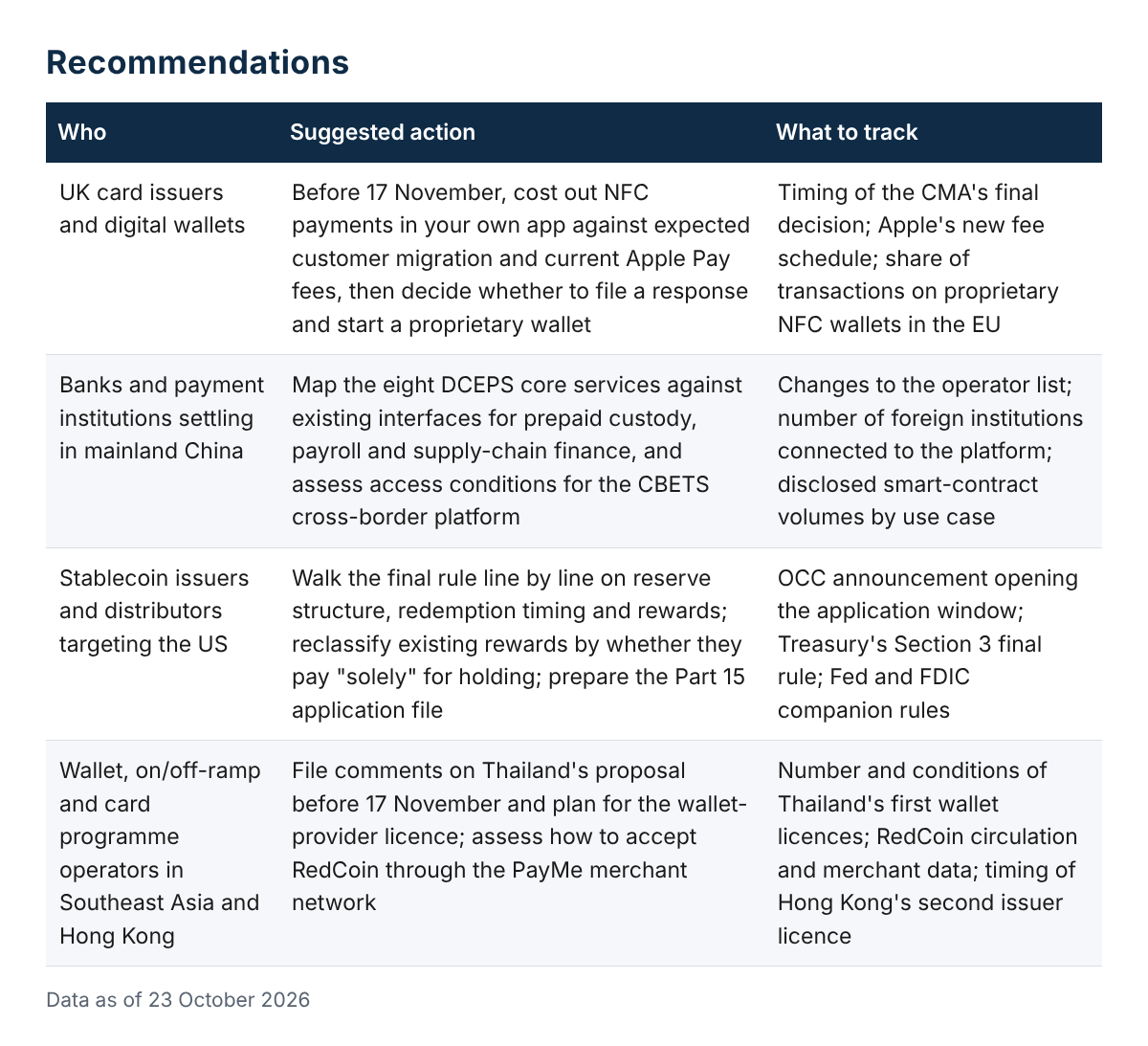
The UK wants Apple to open iPhone contactless and cut its fees sharply. Apple Pay charges issuers about 0.15% on credit transactions; once that falls, bargaining power between issuers and wallets shifts. In the EU, Vipps, PayPal and Klarna launched their own NFC wallets within six months of Apple's commitments, and the UK is likely to follow. Issuers must decide whether their own app becomes the default entry point.
The e-CNY upgrade changes who owns the settlement layer. With 30 operating banks and an open smart-contract framework, prepaid-fund custody, payroll and supply-chain finance can settle conditionally inside the central bank's system. Intermediary revenue for payment institutions in those use cases shrinks, but integration and scenario operation still need someone to do them.
Crypto payments
The OCC's final rule hard-codes three issuer costs: constrained 1:1 reserves, two-business-day redemption and case-by-case review of rewards. For licensed banks it is a checklist; for issuers and exchanges that rely on cashback-style rewards, existing programmes get no safe harbour. With the rule effective in January 2027, product and compliance budgets must be settled this quarter.
RedCoin and JPM Coin going live in the same week show two distribution routes for bank stablecoins: a proprietary retail wallet where customers and merchants never leave the bank, or a public chain open only to approved institutions. In both, the customer belongs to the bank. Third-party wallets and payment firms are left with acceptance, on/off-ramps and compliance, and Thailand's licensing design writes that division into law.
4. Recommendations
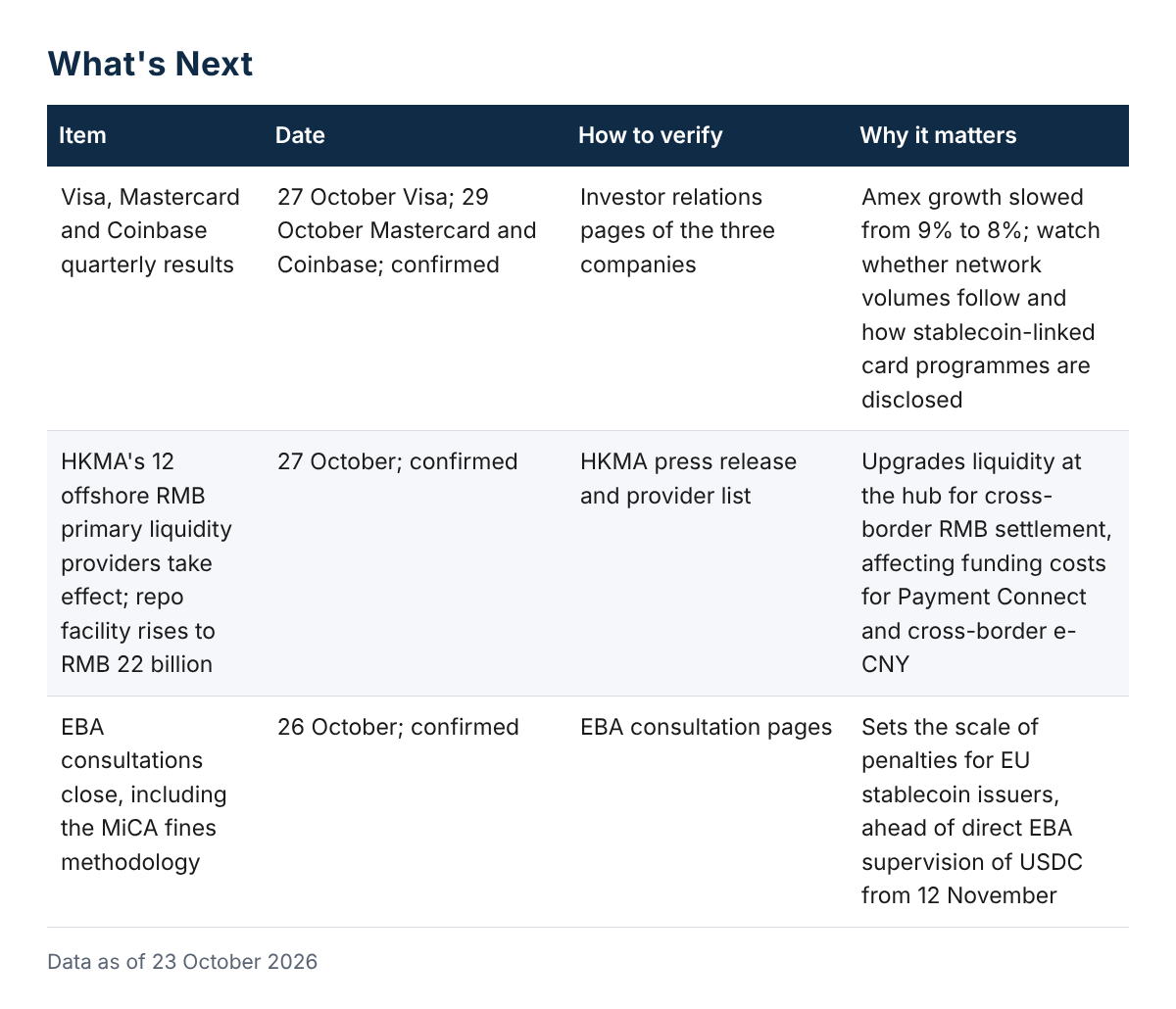
5. What's Next
Covering 24–30 October 2026.
6. Deep Dive | When banks issue their own stablecoins, what is left for payment companies?
This week's evidence
On 23 October HSBC RedCoin went live on PayMe. Issuance, wallet, merchant network and custody all sit inside HSBC; reserves are cash and disclosed daily; the coin is outside the deposit protection scheme, and 1:1 redemption rests on the issuer's promise. On 19 October J.P. Morgan put its JPMD deposit token on Ethereum mainnet, running on a public chain but open only to approved institutions; the Kinexys platform has processed more than US$4 trillion cumulatively, a platform-wide figure rather than a JPM Coin number. The same day the Bank of Thailand proposed two licence classes: a limited number of issuers, and wallet providers licensed in rounds with no cap.
How the money moves, and who charges
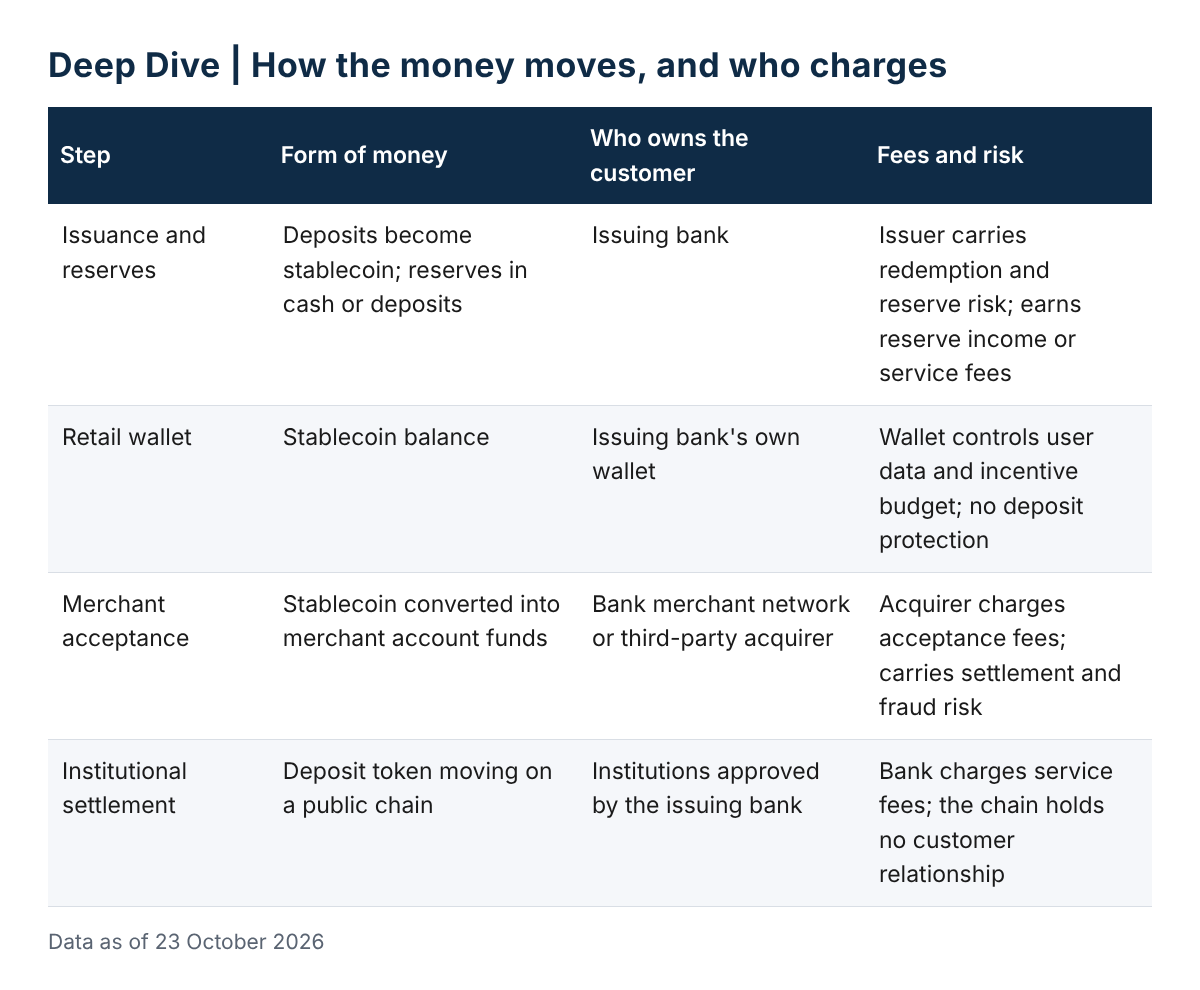
In the RedCoin flow, a user swaps Hong Kong dollar deposits for stablecoin; funds move from a deposit account into a reserve account, and wallet, acceptance and custody stay in one bank. The bank earns not a fee but the customer relationship and control of reserves. In the JPM Coin flow, an institution converts deposits into on-chain tokens, settles against tokenised assets on a public chain, and converts back; the bank charges an institutional service fee and the chain is merely the venue. In neither case does the customer leave the bank.
What it means for each side
For traditional payment firms, bank stablecoins leave the acceptance business intact: merchants still need acquiring, reconciliation and dispute handling, and RedCoin's use of the existing PayMe network shows that layer need not be rebuilt. But when a bank keeps wallet and acceptance in-house, third-party acquirers are left with merchant-side services only. For crypto payment firms, Thailand's design is the clearest message: issuer licences will not be open to most companies; what can be won is a wallet licence, on/off-ramp corridors and compliance services. Mastercard's new risk-intelligence product is a bid for that same position.
What evidence is missing
RedCoin's first-week merchant volume, activation rate and average balance are undisclosed, and phased wallet activation means early numbers will not reflect steady state. JPM Coin's stand-alone volume on Ethereum has not been published. The number and terms of Thailand's first wallet licences await the final rule, and the timing of Hong Kong's second issuer is unclear.
How to verify
Watch three data points: whether disclosed circulation keeps growing after launch incentives end; whether merchants report stablecoin settlement as a separate reconciliation line rather than folded into card statements; and whether any wallet or acquirer beyond the issuer connects to the same coin. HSBC has committed to daily disclosure; the third point can only be observed once Thailand issues its first wallet licences.
7. Around the World
Singapore: On 23 October the MAS announced that Bank Negara Malaysia and the Bank of Thailand joined BLOOM, its cross-border digital-money settlement initiative, alongside nine new industry members including Visa, Mastercard, Airwallex, Nium and Ripple.
South Korea: On 23 October the Bank of Korea said it would propose, with the government this year, amendments to the Foreign Exchange Transactions Act to regulate stablecoins as cross-border payment instruments.
Japan: On 21 October JPYC, SBJ Bank and LINE NEXT signed an MOU to test JPYC as the bridge for topping up digital wallets from bank accounts.
Europe: On 20 October Checkout.com launched in-person payments in the UK and EEA; the same day a Google Cloud outage in its London region knocked out card payments at Revolut, Lloyds and HSBC for several hours.
UAE: On 22 October Ziina obtained a Category III Retail Payment Services licence from the UAE central bank covering merchant acquiring and domestic transfers.
Compiled from public reports and official announcements; analysis and recommendations reflect the editorial team's views.