Gate Research: Meme Trading Terminals Are Moving Toward Alpha, Social, and Multi-Chain Convergence as Gate 打金狗 Builds an Account-Level On-Chain Trading Gateway


- Core Viewpoint: Competition among Meme trading terminals has shifted forward from execution speed to signal discovery and verification. The industry is evolving from Trading Terminal to Alpha Terminal, with social graphs, Agent trading, and multi-chain coverage becoming new barriers to entry. Gate 打金狗 has formed a differentiated path by leveraging the exchange account system.
- Key Elements:
- The core capabilities of terminals have been consolidated into four major modules: Alpha Discovery, On-chain Intelligence, Trading Execution, and Automation, forming a closed loop of discovery, verification, execution, and review.
- In June 2025, Meme-related applications accounted for 62% of Solana DApp revenue. Axiom, GMGN, Photon, and others formed the main tool camps, and the market has yet to see a single dominant player.
- KOL Tracking has upgraded from information monitoring to verifiable attribution, requiring disclosure of sample size, Callout price, associated wallet transactions, and actually realizable returns.
- The Meme attention-driven trading model is spilling over into stock tokens, RWA, and new public chain assets, but the risks, pricing, and settlement mechanisms of different assets need to be distinguished by layer.
- Gate 打金狗 offers fees as low as 0.5% and initially supports more than 15 networks including Robinhood, Solana, and Ethereum. Arc mainnet was integrated on the day of launch and supports 0 Gas transactions.
- Gate's user asset reserves reached $6.7 billion, ranking sixth globally. Direct access to account funds shortens the on-chain trading chain and lowers the barriers to wallet and cross-chain operations.
- The next stage of competition will focus on personalized Alpha Feed, Entity Graph and Social Graph, Strategy and Agent Trade, and the data flywheel.
Summary
• The core capabilities of Meme Terminal have gradually coalesced into four interconnected modules: Alpha Discovery, On-chain Intelligence, Trading Execution, and Automation. Opportunities are surfaced from new tokens, Trending, Smart Money, and KOL signals, then validated and executed through token distribution, wallet relationships, and trading data.
• The industry is continuing to evolve toward Alpha Terminal, Social Graph, Agent Trade, and Multi-chain. The discovery, validation, and rapid-trading model shaped by the Meme market is also beginning to extend to a broader range of on-chain assets, such as stock tokens, RWA, and assets on emerging public chains.
• Gate Trenches' differentiation stems primarily from its funding, multi-chain, distribution, and security capabilities under the exchange account system. Leveraging Gate's existing account funds, multi-chain coverage, in-platform traffic, and security system, users can complete on-chain asset discovery, analysis, and trading within a single account. This gives Trenches a product path distinct from standalone wallet terminals.
1. Market Status and Evolution of Meme Trading Terminals
Over the past few years, Meme trading terminals have undergone a competitive upgrade from "racing for speed" to "racing for the attention gateway." In the early days, users competed over who could copy a contract address and complete a swap faster; today, trading efficiency is determined further upstream—by who can spot hot trends earlier, identify Smart Money, assess token distribution structure, and convert signals directly into trades. As this chain continues to extend toward the front end, Meme terminals have gradually evolved from auxiliary trading tools into on-chain trading gateways that connect attention, data, and liquidity.
1.1 Development Stages of Meme Trading Terminals
The core contradiction in Meme trading is that information has an extremely short shelf life while risk validation is costly. A hot trend may first appear on X and, within minutes, spawn tokens with the same name, copycat tokens, bundled buys, and bot trading. Therefore, the core value of a trading terminal is not merely faster order placement, but completing trend capture, target discovery, risk validation, and trade execution before attention decays—while using on-chain data to reduce the probability of users being misled by false or manipulative signals.
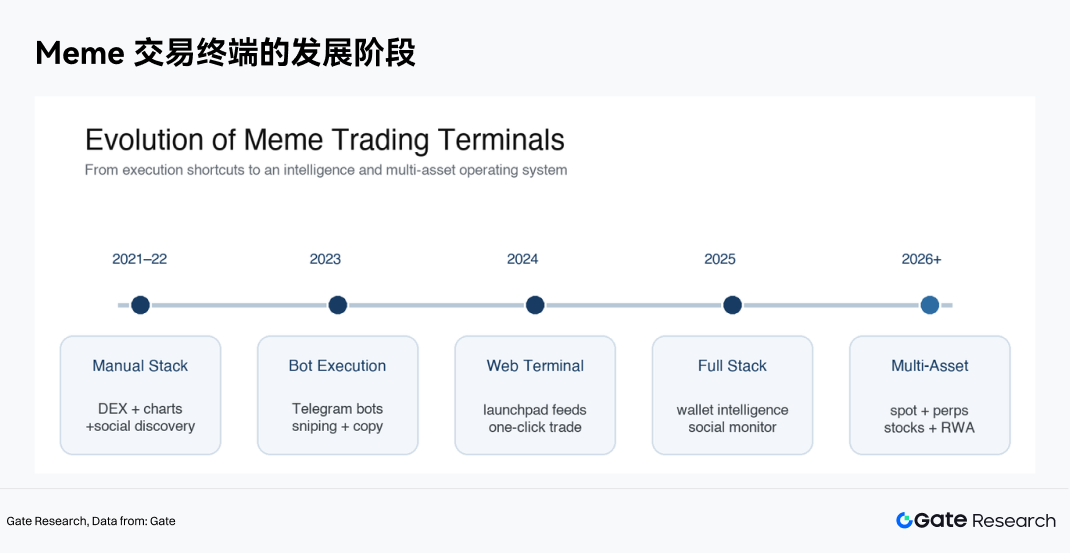
Looking back at the development of Meme trading terminals, their product forms have roughly gone through five stages. 2021–2022 remained in the "manual tool stack" period, when users had to switch frequently among DEXs, block explorers, candlestick charting sites, and social media. In 2023, Telegram Bots rose, packaging wallet, routing, sniping, limit orders, and copy trading into a chat interface, shifting the competitive focus to execution speed. In 2024, launchpads such as Pump.fun industrialized new token issuance, and web terminals such as Photon, BullX, and GMGN began integrating chain scanning, charts, positions, and one-click trading. In 2025, Axiom, GMGN, and others further brought Smart Money, wallet tracking, Twitter/X, Insider, Sniper, Bundle, and PnL into a unified workstation. Entering 2026, terminals began breaking through the boundaries of Meme, evolving into multi-asset on-chain trading platforms covering perpetuals, stock tokens, and other assets.
There are three main drivers behind this shift. First, the industrialization of new token supply. As launchpads expand across Solana, Base, BNB Chain, and other networks, issuance has shifted from manual deployment to Bonding Curves, automatic graduation, and DEX liquidity, requiring terminals to cover the full lifecycle of "creation—graduation—migration." Second, traffic and revenue are concentrating into integrated platforms. Syndica data shows that in June 2025, Meme-related applications accounted for 62% of Solana DApp revenue; Axiom, Photon, BullX, GMGN, Trojan, and others gradually formed the main camp of trading tools. Once discovery, data, and execution are integrated, trading frequency can be converted more directly into platform revenue. Third, pure execution speed is losing its differentiation advantage. As routing, priority fees, and automated trading capabilities converge, competition is shifting toward label quality, wallet profiling, address relationship graphs, and complete workflows from signal discovery to trading, take-profit/stop-loss, and review.
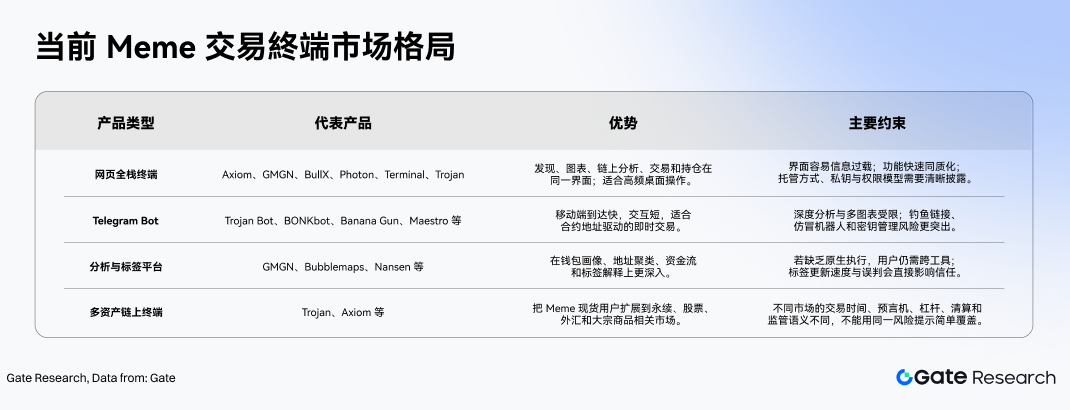
As a result, the current market has gradually formed four product categories: full-stack web terminals, Telegram Bots, analytics and labeling platforms, and multi-asset on-chain terminals. The core of industry competition has also shifted from "who trades faster" to who can discover valid signals earlier, understand on-chain capital more accurately, and form a closed loop of discovery, analysis, execution, and risk control.
1.2 New Competitive Trends in Trading Terminals: From Execution Speed to Attention Pricing
The competitive focus of crypto trading terminals is shifting from "who executes faster" upstream to who can discover opportunities earlier, validate signals, and convert attention into tradable assets. The two most noteworthy trends today are, first, KOL Tracking upgrading from information monitoring to trade attribution, and second, the attention-trading model formed by Meme beginning to spread to stocks, RWA, and other assets.
1.2.1 KOL Tracking: From Information Monitoring to Verifiable Attribution
The basic features of KOL Tracking have gradually become widespread. For example, Axiom offers Twitter Monitor and custom account monitoring, Trojan X Tracker can identify Cashtags and contract addresses and connect to trading entry points, and GMGN further combines KOL, Smart Money, and wallet activity. As a result, the competitive focus is no longer "whether a post can be seen immediately," but whether it can be proven that a KOL's signal has sustained, replicable trading value.
This requires terminals to further track the time a KOL first mentions a token, the price, market cap, and liquidity at the time of the callout, whether related wallets traded before or after the post, and to calculate subsequent gains, drawdowns, and actually realizable returns. Product forms are also expected to upgrade from simple monitoring and leaderboards to "auditable KOL performance cards": disclosing sample size, statistical period, liquidity, fees, and slippage assumptions, and distinguishing theoretical maximum returns, actually executable returns, and realized returns of related wallets. Only when the calculation methodology and attribution process are sufficiently transparent can KOL Tracking truly upgrade from a traffic tool to a trading decision tool.
1.2.2 Meme Paradigm Spillover: From Token Trading to Stocks and RWA
Meme is essentially the assetization and trading of attention, and its trading model features event-driven behavior, social-first dynamics, short holding periods, and rapid exposure building. When stocks, precious metals, forex, and RWA enter the same terminal through on-chain perpetuals, synthetic assets, or tokenized certificates, this model can migrate naturally: first capture events and social catalysts, then validate price, liquidity, and capital behavior, and finally establish trading exposure quickly. Trojan's advancement of multi-asset integration already reflects this development direction.
But trading experience can be unified; asset risks cannot. Stock perpetuals, tokenized stock certificates, and real stocks represent different financial exposures, involving different underlying assets, price sources, trading hours, redemption mechanisms, leverage, and liquidation rules, which terminals must clearly distinguish. From a business perspective, multi-asset expansion can reduce a platform's dependence on a single Meme cycle and extend existing users and trading workflows to a larger market; from a product perspective, it requires establishing a unified asset framework that maintains a consistent discovery, analysis, and order-placement experience on the front end while building tiered pricing, risk control, and settlement systems for different assets.
1.3 Core Trading Journey of Meme Users
The Meme user journey is not a one-off funnel but a continuous learning loop. Users repeatedly scan chains, filter, validate, execute, and review every day, gradually building their own address libraries, KOL lists, filters, and position rules. Terminal retention comes from these personalized assets, not just the trading entry point.
The most underappreciated parts of this journey are "cross-confirmation" and "review." If a platform only optimizes discovery and order placement, users will chase noise faster; if a platform binds each trade to the original signal, it can answer which types of sources, wallets, and token distribution structures actually contributed to returns. In the long run, this personalized decision data is more likely to drive retention than generic Trending rankings.
2. Core Product Capabilities of Meme Trading Terminals
The core capabilities of Meme trading terminals can be summarized as four interconnected systems: Alpha Discovery, On-chain Intelligence, Trading Execution, and Automation. Alpha Discovery is responsible for discovering opportunities, On-chain Intelligence for validating signals and identifying risks, Trading Execution for converting trading judgments into actual fills, and Automation for further reducing the cost of continuous monitoring and strategy execution. Together they form a complete trading chain from discovery and validation to execution and management.
2.1 Alpha Discovery
Alpha Discovery is not a simple information feed but a ranking system that screens trading opportunities from a massive volume of real-time information. On-chain new token creation, launchpad status, wallet transactions, social media, and market heat are all inputs, and the ultimate goal is to push more noteworthy tokens to users before attention is fully priced in.
2.1.1 New Token and New Pair
New Token and New Pair are the frontmost entry points of the discovery system, responsible for capturing newly minted tokens, new trading pairs, and assets with first-time liquidity. The real challenge is not "discovering a lot," but quickly determining which is a genuine and tradable asset. The same token may appear simultaneously on multiple DEXs and liquidity pools, and the same ticker may have numerous copycats, so terminals need to combine contract address, creation time, deployer, initial liquidity, launchpad source, and social information to complete deduplication and risk identification. On this basis, ranking is then performed by combining independent buyers, real trades, liquidity, and social heat, while identifying risks such as abnormal taxes, minting permissions, low liquidity, and wash trading.
2.1.2 Trending and Hot Token
The value of Trending is not to tell users "who gained the most," but to determine whether attention is genuine and whether heat is still accelerating. Compared with a single volume or gain metric, terminals need to simultaneously observe changes in independent buyers, net buying, trading activity, and social mentions within short periods, and determine whether the heat comes from organic spread, KOLs, Smart Money, or launchpads. For abnormal behaviors such as circular trading, batch wallet buys, and low-liquidity pumps, signal weights should be reduced. A good Trending module is essentially distinguishing "hotspots where genuine consensus is forming" from "assets that look hot in the data."
2.1.3 Launchpad and Graduation
As platforms such as Pump.fun drive the industrialization of Meme issuance, the launchpad lifecycle has also become an important clue for discovering new assets. From creation to Bonding Curve to Graduation and migration to DEX, different stages correspond to different capital structures and risks. Especially near Graduation, in addition to progress, the number of buyers, Dev holdings, Bundle ratio, and liquidity quality may all determine post-graduation performance. Therefore, terminals need to continuously track the complete lifecycle of a token from creation to migration, rather than splitting new tokens, graduated assets, and DEX trading into separate pages.
2.1.4 Smart Money Buys
The value of Smart Money does not come from a simple wallet label, but from whether the wallet has consistently demonstrated verifiable trading advantages. Terminals need to combine historical PnL, win rate, drawdown, holding time, entry timing, and recent performance to assess wallet quality, while distinguishing initial position building, continuous accumulation, and small test orders. When multiple Smart Money wallets buy simultaneously, it is also necessary to determine whether these wallets belong to the same funding entity, avoiding mistaking multiple addresses controlled by one entity for market consensus. As a result, Smart Money is shifting from static labels to a dynamic evaluation system.
2.1.5 KOL and Twitter Callout
Meme price discovery is highly dependent on social spread, so KOL and X monitoring are becoming an important part of Alpha Discovery. Axiom, Trojan, GMGN, and others can already track specific accounts, identify Cashtags or contract addresses, and connect to token pages and trading entry points. The next stage focuses on upgrading "who mentioned the token" further to "whether this callout is actually effective": for example, whether related wallets bought before or after the KOL's post, what the market cap and liquidity were at the time, and the actually realizable returns of historical callouts. Only when social information and on-chain trading are mutually validated do KOL signals truly have trading value.
2.2 On-chain Intelligence
If Alpha Discovery is responsible for discovering hot trends, then On-chain Intelligence's task is to break down the capital structure behind those trends. The core question is not to display more metrics, but to determine who actually controls the token supply, which wallets may belong to the same entity, and whether the rise comes from organic buying or related accounts.
2.2.1 Holder Distribution
Traditional Top 10 or Top 20 holding percentages only show concentration at the address level, which may not represent actual control relationships. A more effective approach is to exclude LP, burn addresses, and protocol contracts, then identify related wallets based on common funding sources, transfers, and synchronized trading, and calculate entity-adjusted supply concentration. At the same time, changes in holdings are often more important than static percentages—for example, concentration appearing around graduation, after a KOL callout, or before large sells may provide more direct risk signals.
2.2.2 Dev, Insider, Sniper, and Bundle
Early risks in Meme often hide in related wallets. The Dev is not necessarily just the Deployer, but may form a complete control network through initial funding, fee addresses, pre-allocated wallets, and early transfers; Snipers and Bundles reflect whether there was concentrated sniping or coordinated trading at the token's launch. Therefore, terminals need to combine funding sources, trade timing, wallet relationships, and subsequent consolidation to determine the degree of association, rather than simply treating all "early buys" as Insider activity. A better approach is to provide different risk levels, evidence, and confidence so users can trace back specific on-chain behaviors.
2.2.3 Wallet PnL and Smart Money Labels
Wallet PnL is the foundation for judging Smart Money, but high returns do not equal high quality. Instant high prices on low-liquidity tokens, airdrops, wallet transfers, and single hundredfold gains can all significantly distort actual performance. Therefore, terminals need to simultaneously observe realized returns, win rate, drawdown, return distribution, holding time, and strategy capacity, and dynamically adjust Smart Money labels based on recent performance. Furthermore, wallets can be categorized by trading style such as Early Sniper, Momentum, and Swing, so users know what a wallet "is good at," not just that it "made money in the past."
2.2.4 Social Wallet Token Correlation Analysis
Social Wallet Token correlation analysis is the ultimate convergence point of the above capabilities. It places KOLs, social posts, Wallets, Tokens, Deployers, and funding sources into the same relationship network, and reconstructs information propagation and capital flows in chronological order. For example, whether related wallets had already built positions before a KOL's post, whether multiple Smart Money wallets come from the same funding source, and whether the Deployer and Insiders have fund flows between them. Ultimately, what users see is no longer a set of isolated labels, but a traceable "Social → Wallet → Token → Trade" evidence chain.
Overall, Meme trading terminals are shifting from "providing more data" to "providing better judgment." Alpha Discovery improves the efficiency of discovering opportunities, and On-chain Intelligence improves the credibility of validating them, with the two ultimately converging at the trading execution end. As speed gradually becomes a baseline capability, those who can identify valid signals earlier, more accurately reconstruct capital relationships, and help users make decisions at a lower information cost are more likely to build long-term product barriers.
2.3 Trading Execution
Meme Terminal's trading functions have expanded from quick order placement to conditional orders, multi-wallet support, dynamic Gas, MEV protection, and multi-route aggregation, with the execution layer entering a stage of competition over fill quality. Newly issued tokens typically feature high price volatility, limited liquidity depth, and concentrated trading congestion, making deviations between displayed prices and final fill prices common. This creates four main competitive variables: order confirmation latency, on-chain fill success rate, quote-to-fill price deviation, and all-in cost including platform fees and network fees. As terminal interfaces converge, these four metrics constitute the main differences in execution capability.
2.3.1 Quick Trading Has Become a Baseline Capability, with Competition Shifting to Parameter Decisions
Quick Buy / Sell, preset amounts, percentage sells, keyboard shortcuts, and chart-based ordering have become standard features of mainstream terminals, and the gap in front-end operation steps continues to narrow. Execution differences are gradually shifting to the parameter layer, mainly reflected in whether terminals can dynamically configure slippage, Priority Fee, and Jito Tip based on order size, pool depth, network congestion, and token risk.
Slippage, Priority Fee, and Jito Tip together determine execution cost and confirmation probability. Higher slippage and priority fees can improve the probability of on-chain inclusion during congestion, but also expand price impact, MEV exposure, and fee losses; parameters that are too low increase the probability of failed transactions and missed liquidity windows. Fixed parameters are difficult to adapt to significantly different on