SpaceX Revenue Surges 161%, AI Becomes Its Largest Business—So Why Does Profit Still Depend on Starlink?


- Key Takeaways: SpaceX's Q3 revenue reached $14.575 billion, up 161% year-over-year. The AI business became the largest revenue source, but the connectivity business remains the primary profit pillar. The core question is whether growth can translate into sustained cash returns amid massive capital expenditures.
- Key Elements:
- SI business revenue reached $7.560 billion, up 830% year-over-year, surpassing connectivity to become the largest revenue segment—but its operating margin is only about 5.7%.
- Connectivity business revenue reached $5.248 billion, up 69% year-over-year, contributing $2.367 billion in operating profit at a margin of approximately 45.1%—still the profit pillar.
- SI business growth is partly acquisition-driven, with the Cursor acquisition contributing approximately $608 million in revenue—not entirely organic growth.
- Quarterly capital expenditures of $19.593 billion exceeded revenue, with the SI business accounting for $16.444 billion (about 84%). The capital recovery timeline remains to be seen.
- Musk has proposed a trillion-dollar revenue vision and discussed a potential merger with Tesla, but no definitive agreement has been reached and it should not be priced in prematurely.
- The stock rose 7% in after-hours trading following the earnings release. The market reaction represents only initial pricing; sustained revenue and cash conversion capability still need to be validated.
In SpaceX's earnings report, what deserves the most attention is not just the 161% revenue growth, but also the different roles that the AI business and the Starlink-related connectivity business play in revenue and profit.
On October 20, SpaceX released its financial results for the third quarter of 2026. The company's revenue for the quarter reached $14.575 billion, up 161% year-over-year; revenue from the Superintelligence (SI) business reached $7.560 billion, up 830% year-over-year, making it the company's largest source of revenue. At the same time, the connectivity business contributed $2.367 billion in operating profit, remaining the company's most important profit support.
Even more noteworthy is Musk's outlook on the company's future scale. He said it is possible for SpaceX to reach trillions of dollars in annual revenue in the future. This judgment paints a picture of the company's imagination regarding future growth space, but achieving this scale still depends on the expansion of the AI business, growth in connectivity services, and whether massive capital expenditures can be converted into sustained returns.
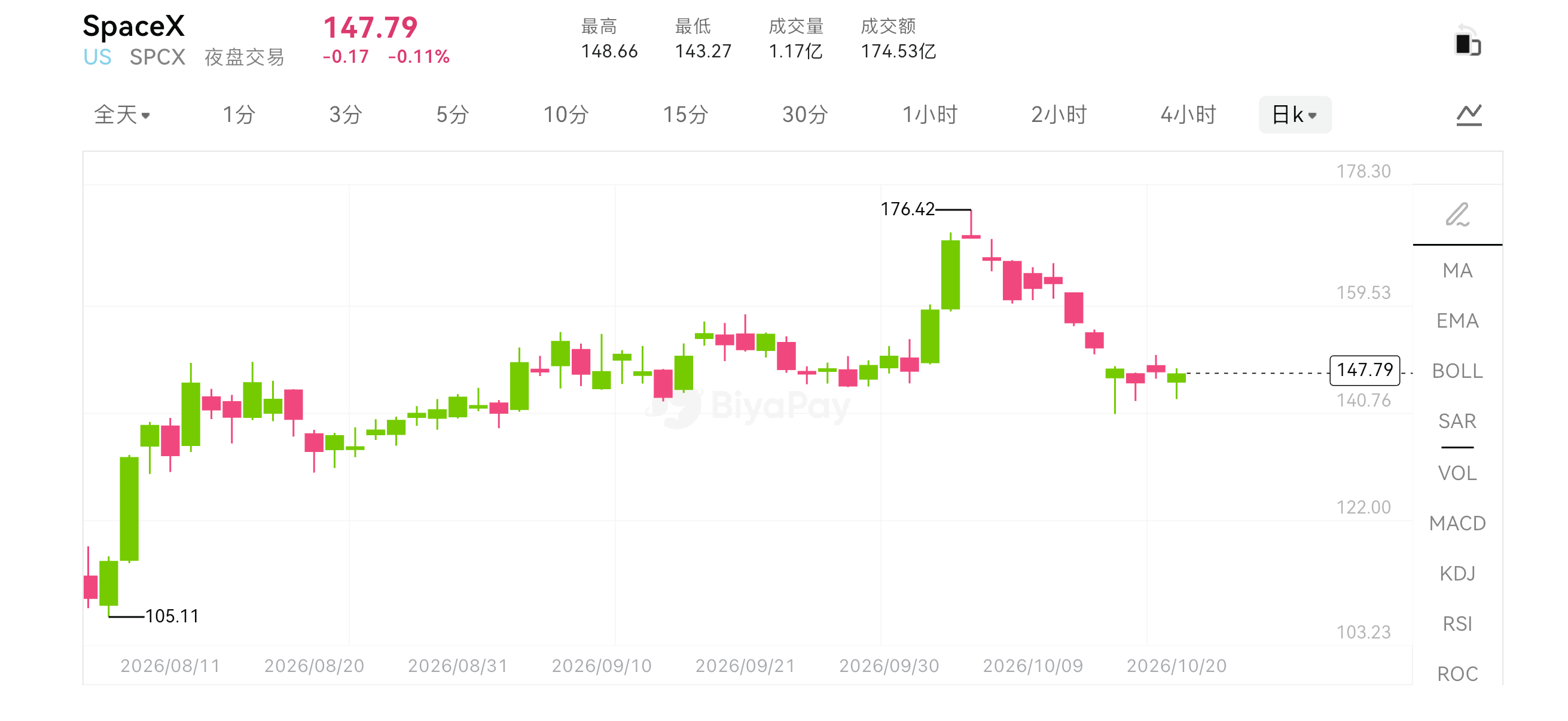
BiyaPay market data shows that after the earnings release, SpaceX's stock price rose in after-hours trading, surging 7%. For investors watching U.S. stocks, this earnings report raises a question worth analyzing: is the market pricing in the growth potential of the AI business, or is it pricing in profits that have already been delivered?
From a market observation perspective, the stock price reaction is only the starting point for analysis. Whether the AI business can continue to grow, whether the connectivity business can maintain profitability, and when massive capital expenditures will translate into cash returns are the key factors in judging the quality of this round of growth.
Strong results, but being No. 1 in revenue does not mean being No. 1 in profit
First, look at the overall data. SpaceX's third-quarter revenue was $14.575 billion, operating profit was $2.791 billion, and net profit was $4.404 billion. Compared with the same period last year, the company turned from a net loss of $1.1 billion to profitability, a clear improvement in performance.
What is more worth breaking down is the business structure. The Superintelligence business generated $7.560 billion in revenue for the quarter, surpassing the connectivity business's $5.248 billion and becoming the business segment with the largest revenue scale. But in terms of operating profit, the connectivity business contributed $2.367 billion, the SI business contributed $431 million, and the space business recorded an operating loss of about $7 million.
This means SpaceX has already formed two different growth supports: the AI business is rapidly expanding revenue scale, while the connectivity business provides more mature operating profit.
Based on disclosed data, the SI business's operating margin for the quarter was about 5.7%, while the connectivity business was about 45.1%. However, these two figures can only reflect the financial performance of the current quarter and cannot directly determine the long-term value of the two businesses. The SI business also included about $1.2 billion in share-based payment expenses related to the Cursor acquisition in the quarter, which also affected its operating profit performance.
Therefore, one cannot simply conclude that "the AI business is not profitable." A more accurate statement is that the SI business has already achieved operating profitability, but the connectivity business currently contributes more operating profit and has more mature profitability.
AI revenue surges 830% — where does the growth come from?
The revenue growth of the Superintelligence business cannot be entirely attributed to existing AI products suddenly becoming more popular.
According to company disclosures, SI business revenue growth was mainly driven by new cloud service agreements, the acquisition of Cursor, and increased use of Grok among enterprise and individual users. The business models behind different revenue sources are not the same.
Cloud service revenue is related to the delivery of computing infrastructure, equipment utilization, and customer contracts; software application revenue requires observing the depth of user usage and subsequent renewals; revenue from acquisitions consolidated into the financial statements will expand the business scale in the financial statements, but it is not equivalent to organic growth of the original business.
Among them, Cursor completed its acquisition in August 2026 and contributed about $608 million in revenue to SpaceX from the closing date to the end of September. This means that the rapid growth of the SI business includes both expansion of the original business and the boost from acquisitions.
To understand this earnings report, one needs to ask further: can the newly added revenue be sustained? Will customers continue to purchase computing power services? After new equipment is invested, can utilization remain at a reasonable level? These questions are more important than looking only at the 830% year-over-year increase.
For U.S. stock investors observing the AI industry chain, even if different companies are all categorized under the AI concept, their revenue quality, capital requirements, and profit margins may differ greatly. When analyzing stock prices, one cannot look only at growth rates; revenue sources, cost structures, and subsequent investment should also be judged together.
Why is the Starlink-related connectivity business still the profit pillar?
There are obvious differences between the revenue models of the rocket launch business and connectivity services.
The launch business needs to continuously secure orders, arrange missions, and complete deliveries, and quarterly revenue is easily affected by mission cadence. The connectivity business, by contrast, revolves around an already deployed network and continuously provides services to individual, enterprise, and government customers. As the scale of users and customers expands, network service revenue can continue to accumulate and, under certain conditions, dilute some fixed costs.
SpaceX's third-quarter connectivity business revenue was $5.248 billion, up 69% year-over-year; operating profit reached $2.367 billion, up 99% year-over-year. The company said that increased adoption by enterprise and government customers, as well as growth in Starlink consumer users, supported business performance.
It should be noted that the "connectivity business" disclosed in the earnings report is not entirely equivalent to the single Starlink product, so it is not appropriate to directly classify all segment data as Starlink's standalone performance. But Starlink-related connectivity services are indeed an important part of this business and an important clue for understanding SpaceX's profitability.
The connectivity business's large profit contribution does not mean it does not need continued investment. Satellites need to be updated, and ground equipment and service capabilities also need to be built to match. The key in the future is whether the operating income generated by continuous service can cover the investment needed to maintain network competitiveness and leave enough funds to support the development of other businesses.
In other words, the value of Starlink lies not only in user scale, but also in whether these users and enterprise customers can bring stable and sustainable revenue, and how much of that revenue can ultimately be converted into operating profit and cash.
Capital expenditures approach $19.6 billion, and the cost of AI expansion cannot be ignored
SpaceX's third-quarter capital expenditures reached $19.593 billion, higher than its operating revenue of $14.575 billion in the same period. Among this, SI business capital expenditures were $16.444 billion, accounting for about 84% of total capital expenditures.
This set of data reveals the change taking place in the company's growth model: the AI business is not only expanding revenue, but also consuming large amounts of capital to build computing infrastructure.
However, capital expenditures exceeding revenue does not mean the company incurred a loss in the quarter. Capital expenditures fall under investing activities, while operating revenue and net profit fall under income statement measures, and the two cannot be directly subtracted to judge profitability. Evaluating whether funds are truly being used effectively also requires considering operating cash flow, investing cash flow, equipment depreciation, changes in working capital, and future collections.
For the asset-heavy AI infrastructure business, it takes time for equipment to go from procurement and installation to being put into use, and then to actual customer use and payment completion. Only when new revenue can gradually cover equipment operating costs and related investment is a company's expansion more likely to translate into sustained economic returns.
That SpaceX's SI business operating profit was positive in the quarter is a positive signal; but the scale of capital expenditures also shows that the market still needs to keep watching its capital recovery cycle. Growth in AI demand can provide opportunities for expansion, but it cannot automatically guarantee that every investment will achieve ideal returns.
In addition, operating profit, net profit, and adjusted EBITDA cannot be conflated. SpaceX's adjusted EBITDA for the quarter was $8.809 billion, but this metric excludes some cost items and is not equivalent to free cash flow. For companies with high capital expenditures, one cannot judge that their cash generation capacity has improved in tandem based solely on EBITDA growth.
Stock price rises after earnings release — what else should be watched?
After the earnings release, SPCX's after-hours stock price rose, indicating that the market is reassessing the company's future growth space. But short-term price reactions do not mean the subsequent trend is already determined. Whether the AI business can continue to grow, whether the connectivity business can maintain its profit contribution, and when capital expenditures will translate into cash returns still need to be verified by subsequent performance.
For investors watching this type of U.S. stock company, analyzing the earnings report is only the first step. To further track a stock, one usually also needs to pay attention to its real-time price, trading sessions, subsequent company disclosures, and whether one's own trading account supports the corresponding market and trading instruments. Especially around earnings releases, pre-market, regular-session, and after-hours prices may differ, and one cannot judge the company's long-term value based only on gains or losses at a single point in time.
If, after understanding the company's fundamentals, you want to further study U.S. stock trading channels, you can also learn about BiyaPay, which offers multi-asset trading. For users who already hold USDT and also want to watch U.S. stock opportunities, it provides a business path from converting digital assets into U.S. dollars to participating in U.S. stock trading, reducing the steps of switching between different services.
Therefore, SpaceX's stock price rise is only the market's first round of reaction. For investors, what matters more is to continue tracking subsequent earnings reports and valuation changes, and then decide whether to participate based on their own risk tolerance, rather than hastily chasing highs just because of after-hours gains.
A potential merger with Tesla cannot be counted as profit in advance
On this earnings call, Musk also mentioned that SpaceX and Tesla are discussing a potential merger. The two sides have established an independent special committee of directors to study related matters, but there is currently no definitive final agreement. Musk also cautioned that the merger should not be regarded as an event certain to happen.
From an industry logic perspective, there is indeed room for synergy among AI models, computing infrastructure, automobiles, robots, and satellite connectivity. But industrial synergy does not equal a completed transaction, still less does it mean shareholders will necessarily benefit.
If a merger is actually pursued in the future, it would still be necessary to evaluate transaction terms, equity arrangements, changes in control, and integration costs. So-called synergies should ultimately manifest as increased external revenue, reduced duplicate investment, or improved operating efficiency, rather than simply adding the two companies' revenues together.
For the market, news of a potential merger may affect short-term expectations, but before formal agreements, transaction terms, and integration plans are disclosed, the related impact remains uncertain. When analyzing the earnings report, realized performance should be viewed separately from the imagination of transactions that have not yet been determined.
The next report card: whether growth can leave cash behind
SpaceX's third-quarter earnings report shows a new business landscape: the AI business has become the largest source of revenue, the connectivity business still contributes the main operating profit, and large-scale capital expenditures make future capital recovery efficiency more important.
Three directions are worth continuing to watch: first, how much of the AI business's revenue growth comes from sustained customer demand and how much from acquisitions and new contracts; second, whether the connectivity business can continue to maintain profitability; third, whether investment in AI infrastructure can gradually translate into higher utilization, sustained customer revenue, and cash returns.
If revenue continues to grow, profit improves in tandem, and the funds invested can also be gradually recovered, then SpaceX's expansion will be more convincing. Conversely, if revenue growth relies heavily on continuous additional investment while the pace of cash recovery consistently lags, the market may also reassess the cost of growth.
For investors watching U.S. stocks, the short-term stock price reaction brought by the earnings report is worth observing, but what matters more than a single day's gain or loss is whether subsequent data can validate market expectations. SpaceX has demonstrated the speed of scale expansion this time; next, whether growth can translate into sustainable profit and cash is the question worth continuing to track.